CHANGAN AUTOMOBILE-B(000625)

Search documents
行业周报:首批L3级自动驾驶车型获准入许可,全球首条具身智能机器人电池产线在宁德时代规模化落地-20251221
KAIYUAN SECURITIES· 2025-12-21 14:00
Investment Rating - The investment rating for the automotive industry is "Positive" (maintained) [1] Core Insights - The automotive sector is experiencing a significant shift with the approval of the first batch of L3 autonomous driving models in China, marking a transition from testing to commercial application [5][13] - Changan Automobile has achieved over 1 million annual sales of new energy vehicles, aiming for 5 million by 2030, indicating strong growth potential in the electric vehicle market [5][14] - The collaboration between Lantu Motors and CATL aims to enhance battery technology, which is crucial for the competitiveness of electric vehicles [5][15] - The automotive industry is witnessing a competitive landscape with various companies launching new models and technologies, including Tesla's advancements in autonomous driving and the introduction of new electric models by other manufacturers [5][18][21] Industry News Highlights - The first L3 autonomous driving models, Deep Blue SL03 and Arcfox Alpha S, have received approval for pilot testing in Beijing and Chongqing [5][13] - Changan Automobile's new energy vehicle sales have surpassed 1 million units, with a target of 5 million by 2030 [5][14] - Lantu Motors and CATL have signed a ten-year cooperation agreement to prioritize advanced battery technology [5][15] - Ford has terminated a significant battery supply agreement with LG Energy Solution, reflecting a strategic shift in its electric vehicle business [5][17] - The domestic Tesla Model Y L has received EU certification and is expected to enter the international market in 2026 [5][18] - SAIC MG is projected to exceed 300,000 units in European sales by 2025, maintaining its position as the top-selling Chinese brand in Europe [5][19] - Xiaomi is investing over 100 million yuan to subsidize dealers, accelerating its nationwide channel layout [5][20] Market Performance - The automotive sector's performance this week shows a slight increase of 0.13%, ranking 19th among A-share industries [6][28] - The passenger vehicle index has seen a decline of 1.64%, while the commercial vehicle index decreased by 0.43% [6] - The automotive parts index increased by 1.12%, indicating a positive trend in this segment [6] Investment Recommendations - For passenger vehicles, the demand for domestic high-end luxury cars is exceeding expectations, with recommended stocks including JAC Motors and Seres, while Geely is identified as a beneficiary [7] - In the automotive parts sector, profitability is expected to improve, with recommended stocks including Desay SV, Zhejiang Xiantong, and Meili Technology [7]




晓数点|一周个股动向:最牛股周涨超60% 中国平安获杠杆资金青睐
Di Yi Cai Jing· 2025-12-21 13:40
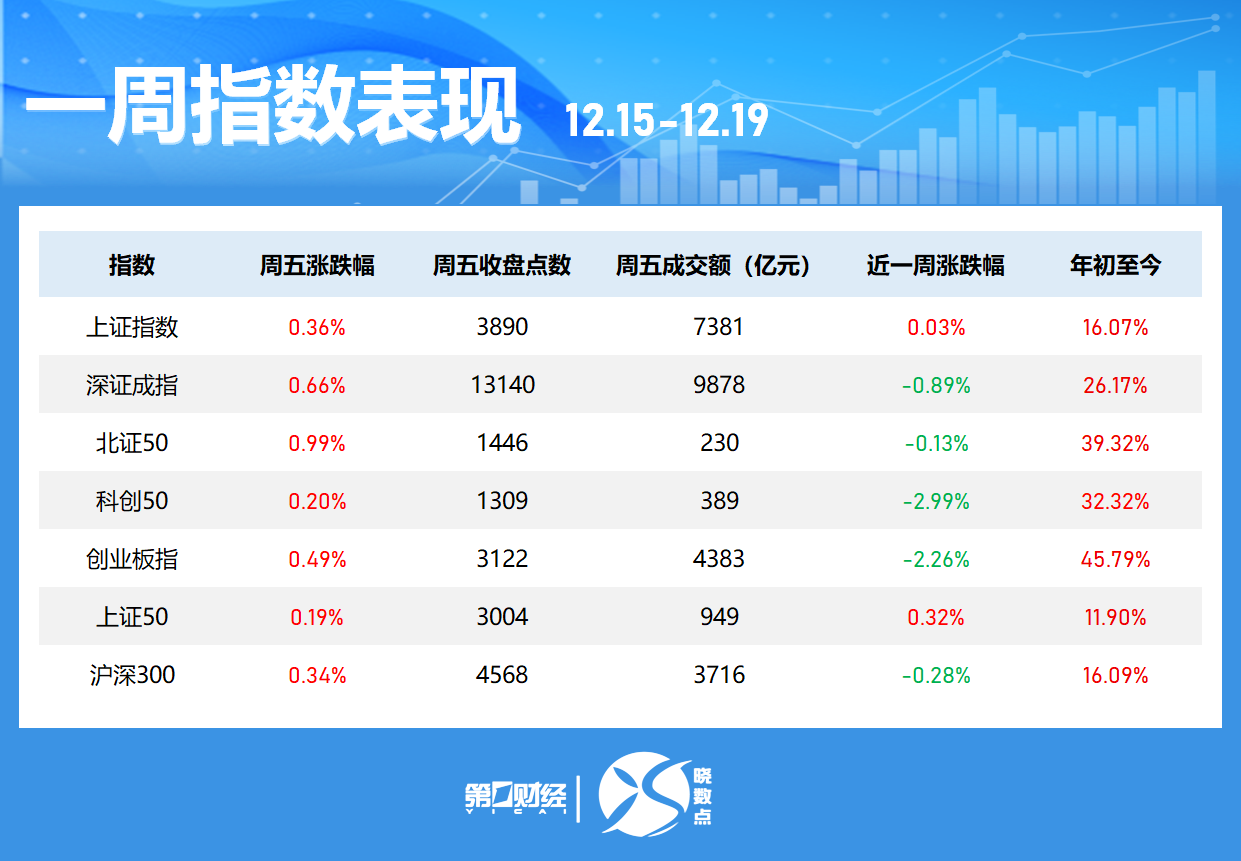
Market Performance - The A-share market indices showed mixed performance from December 15 to 19, with the Shanghai Composite Index rising by 0.03%, while the Shenzhen Component Index and the ChiNext Index fell by 0.89% and 2.26%, respectively [1] - On December 15, the Shanghai Composite Index closed at 3890 points with a trading volume of 738.1 billion yuan, while the Shenzhen Component Index closed at 13140 points with a trading volume of 987.8 billion yuan [2] Stock Performance - A total of 24 stocks increased by over 30% during the week, with 8 stocks rising by more than 40%. The top performer was Victory Energy, which surged by 61.06% [3][4] - The largest decline was seen in Guangdao Tui, which dropped by 41.47%, followed by Zhongyuan Home and *ST Lifang, which fell by 25.71% and 25.17%, respectively [3][4] Trading Activity - 67 stocks had a turnover rate exceeding 100%, with Dapeng Industrial leading at 259.83%, followed by Sanyangma at 224.61% and Xue Ren Group at 209.64% [5] - The majority of stocks with high turnover rates were from the machinery, computer, and power equipment sectors [5] Capital Flow - The electronics sector faced a net outflow of over 26 billion yuan, while the retail, textile, and beauty care sectors attracted significant capital inflow [8] - The top stock for net inflow was Shanzikou Technology, with 929 million yuan, followed by ShenNan Circuit and C Youxun with 754 million yuan and 748 million yuan, respectively [9] Margin Trading - China Ping An topped the list for margin trading with a net buy of 2.573 billion yuan, reflecting a weekly increase of 7.57% [10][11] - Other notable stocks for net buy included Shenghong Technology and Aerospace Electronics, while Dongshan Precision and Kweichow Moutai faced significant net sell-offs [10][11] Institutional Research - A total of 165 companies were researched by institutions, with Changan Automobile receiving the most attention from 214 institutions [12][13] - Other companies like Yipin Hong and Boin Special Welding also attracted significant institutional interest, with over 100 institutions participating in their research [12] New Institutional Interests - Institutions showed first-time interest in 59 stocks, with Tiancheng Technology receiving a "strong buy" rating and a target price of 95.31 yuan [14][15] - Other stocks like Huace Navigation and Shen Sanda A also received buy ratings from various institutions [14][15]


事关A股,重大调整!
Zheng Quan Shi Bao· 2025-12-21 12:57
Group 1: Regulatory Changes - The State Council of China held a meeting to implement decisions from the Central Economic Work Conference, emphasizing the need for departments to detail and accelerate the implementation of economic policies for the upcoming year [3] - The National People's Congress is set to review drafts related to state-owned asset management, which includes regulations on the management, reporting, and supervision of state-owned assets [4][5] Group 2: Market Regulation - The National Internet Information Office and the China Securities Regulatory Commission have cracked down on accounts spreading rumors and illegal stock recommendations, highlighting the impact of misinformation on investor decisions [6] - The Financial Regulatory Bureau is seeking public opinion on the draft of the Asset-Liability Management Measures for insurance companies, which aims to enhance asset-liability management frameworks [7] Group 3: Industry Developments - The "Internet Platform Pricing Behavior Rules" have been released to regulate pricing practices on online platforms, ensuring fair competition and protecting consumer rights [9] - The first L3-level autonomous driving license was issued to Changan Automobile, marking a significant milestone in the domestic autonomous driving sector [10] - Moore Threads unveiled a new GPU architecture, "Huagang," which boasts a 50% increase in computing density and a tenfold improvement in energy efficiency [11] Group 4: Index Adjustments - The FTSE China A50 Index has added companies such as China Molybdenum and Sungrow Power, while removing others like Jiangsu Bank and SF Holding [12] - The FTSE China A150 and A200 indices have also undergone adjustments, reflecting changes in the composition of included stocks [12] Group 5: Major Corporate Transactions - China Shenhua announced a significant acquisition involving the purchase of 100% stakes in multiple energy and coal companies, with a total transaction value of 133.598 billion yuan, making it the largest acquisition in A-share market history [13] Group 6: Upcoming Market Events - Three new stocks are set for subscription this week, with specific details on their issuance prices and codes provided [15] - A total of 53 companies will have their restricted shares released this week, amounting to 210.32 billion shares with a total market value of approximately 1,879.88 billion yuan [16][17] Group 7: Investment Strategies - Various securities firms are signaling a potential "cross-year-spring" market rally, with expectations for increased investment activity and a focus on blue-chip indices [19] - The ongoing demand for AI computing power is highlighted, with recommendations to focus on domestic AI infrastructure as it develops [19] - The appreciation of the RMB is noted as a factor for investment strategies, with certain industries expected to benefit from this trend [20]



汽车行业周报:首批L3车型获得准入许可,高阶智驾迎密集催化-20251221
CMS· 2025-12-21 12:34
汽车行业周报 首批 L3 车型获得准入许可,高阶智驾迎密集催化 中游制造/汽车 12 月 14 日至 12 月 20 日,汽车行业整体上涨 0.1%。本周,工业和信息化部正 式公布我国首批 L3 级有条件自动驾驶车型准入许可,两款分别适配城市拥堵、 高速路段的车型将在北京、重庆指定区域开展上路试点,标志着我国 L3 级自动 驾驶从测试阶段迈入商业化应用的关键一步。另外,小鹏获 L3 级自动驾驶道路 测试牌照;比亚迪展开 L3 量产内测,已完成 15 万公里道路验证;广州基本实 现自动驾驶全域开放;深圳启动 L3 自动驾驶内测。 ❑ 市场板块行情回顾 本周 CS 汽车+0.1%。本周(12 月 14 日至 12 月 20 日,下同)上证 A 指周 度持平,深证 A 指涨跌幅为-0.3%,创业板涨跌幅为-2.3%。本周各行业板块 多数下跌,涨幅较大的行业板块为 CS 商贸零售(+6.6%)、CS 消费者服务 (+4.4%)和 CS 非银行金融(+3.0%),下跌的行业板块为 CS 电新(-3.1%)、 CS 电子(-3.0%)和 CS 机械(-1.7%)。 汽车产业链各板块行情:本周,汽车行业二级板块多数上涨,其 ...


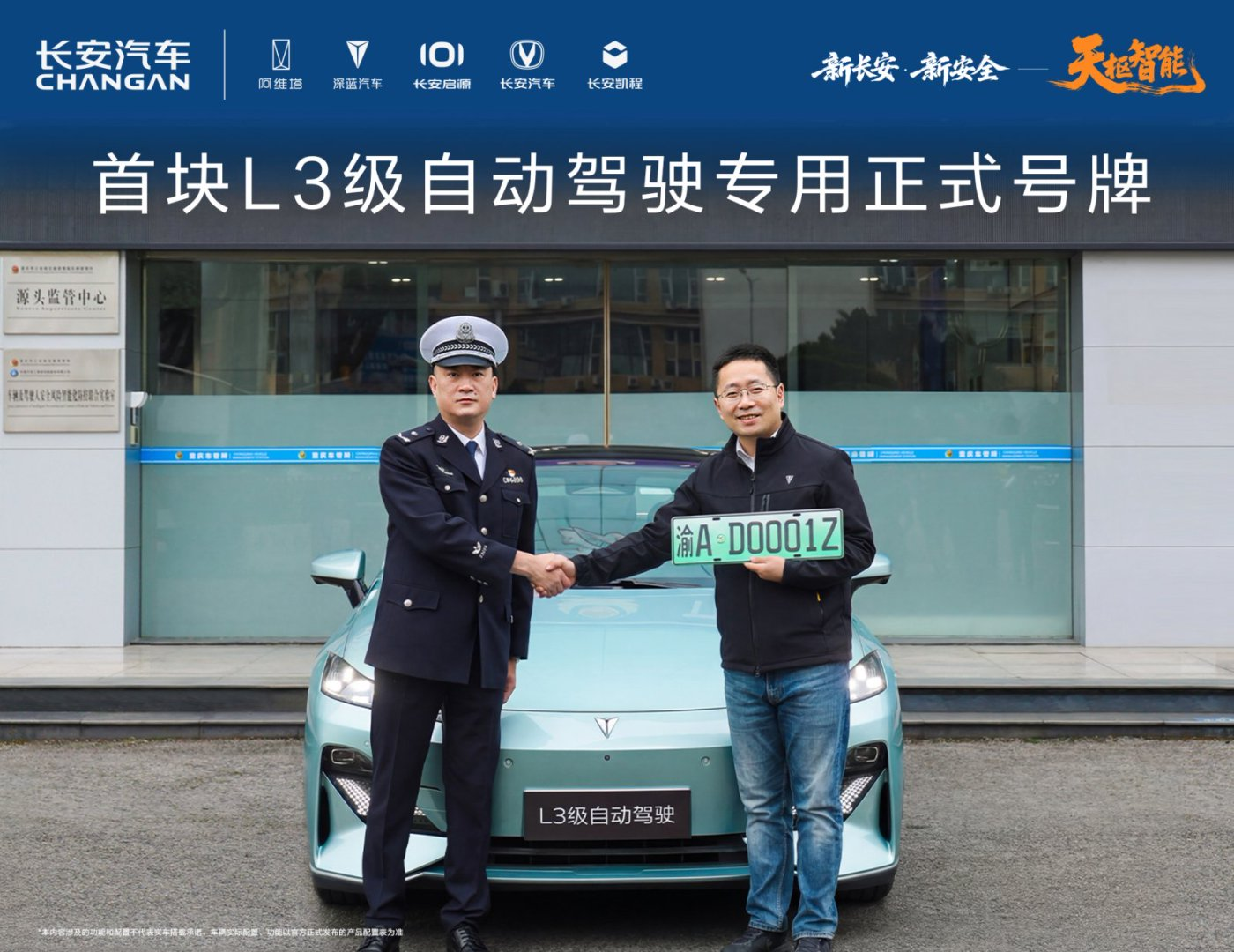
首块L3级自动驾驶专用正式号牌在长安汽车启用
Zheng Quan Shi Bao Wang· 2025-12-21 11:10
据介绍,编号"渝AD0001Z"的L3级自动驾驶专用号牌将率先安装于深蓝汽车旗下车型,由重庆长安车联科技有限公司作为运营主体,在重庆市内环快速 路、新内环快速路(高滩岩立交—赖家桥立交)及渝都大道(人和立交—机场立交)等核心路段开展上路通行试点。这些路段为重庆市民主要出行道路,其典型 的车辆密集拥堵、车流频繁汇入汇出、事故高发、道路施工等复杂路况,将成为长安L3级自动驾驶系统实战训练、迭代升级的最佳"考场"。 在真实城市道路拥堵环境进行试点,不仅检验系统对极端动态环境(如加塞、急刹)的预判与响应能力,接管机制的安全冗余与无缝衔接水平,更可积累长周 期、高密度的真实驾驶数据,为长安汽车L3级自动驾驶系统的可靠性与实用性提供无可替代的实践支撑。在智能汽车产业发展的关键节点,长安汽车以四 十余年造车底蕴与全维体系实力,获得首块L3级自动驾驶专用正式号牌,迈出了中国汽车品牌智能化、安全化的坚实一步。 面向未来,长安汽车表示,将始终以安全为基石、以创新为引擎,与用户、行业、社会携手共进,共同打通L3级自动驾驶系统从技术研发到规模商用的完 整链路,为汽车产业高质量发展注入强劲引擎。(郑渝川) 长安汽车的智能驾驶之路,始于 ...
L3 级自动驾驶首次获批;公共道路有限开放运营;利好芯片、CIS、DCU、软件及自动驾驶出租车-GC Tech_ L3 autonomous driving first approved; limited operation in public road; positive to chip, CIS, DCU, software and robotaxis
2025-12-21 11:01
Summary of Key Points from the Conference Call Industry Overview - The conference call discusses the approval of the first two L3 autonomous driving models in China, specifically from Changan and BAIC ARCFOX, marking a significant milestone in the autonomous driving industry in China [1][2]. Core Insights and Arguments - **Approval Details**: The L3 autonomous driving models are approved for limited operation on specific public roads in Beijing and Chongqing, with speed limits of 80 km/h and 50 km/h respectively, and restricted to single-lane driving [1][2]. - **Pilot Operations**: The approval is not yet available for private users; instead, the two car manufacturers will initiate pilot operations through affiliated fleet operation entities [2]. - **Technological Readiness**: The Changan model features 200MP front view cameras and 100MP surround view cameras, while the BAIC ARCFOX model includes three lidars and thirteen cameras, indicating a strong hardware readiness for L3 deployment [3]. - **Supply Chain Impact**: The approval is expected to positively impact the local smart driving supply chain, benefiting companies involved in ADAS chips, CMOS image sensors, domain controllers, and software [3]. Investment Recommendations - **Buy Recommendations**: Horizon Robotics, Pony AI, and OmniVision are highlighted as key beneficiaries of the L3 approval, with specific mentions of their products and market positions [3]. - **Market Forecast**: Shipments of automotive cameras in China are projected to reach 126 million by 2025 and increase to 343 million by 2030, indicating a growing market for automotive technology [8]. Additional Important Information - **Regulatory Context**: The Chinese government is actively promoting the adoption of autonomous technologies, as evidenced by the recent policies aimed at stabilizing and growing the automotive industry [2]. - **Future Outlook**: The limited approval for L3 functions is seen as a stepping stone towards broader acceptance and regulation preparation for future L4 robotaxi mass adoption [3]. This summary encapsulates the key points discussed in the conference call, focusing on the implications for the autonomous driving industry and the associated investment opportunities.
本周新闻资讯直通车
Sou Hu Cai Jing· 2025-12-21 10:01
本周看点 1、人民币国际化加速前进的"三重驱动" 跨境使用规模稳步增长,债券投融资受到青睐,离岸人民币市场不断升温……今年以来,人民币国际化不断取得积极进展,受到海外广泛关注和积极评 价。 国际航空运输协会11月初宣布将人民币纳入其清算系统的可结算货币名单,允许全球航空公司与航空供应商以人民币进行结算。今年年中,埃及宣布允许 中国企业使用人民币在埃及注册公司。 人民币在跨境贸易投资领域正获得更广泛使用。据中国人民银行最新发布的《人民币国际化报告(2025)》,2025年上半年,银行代客人民币跨境收付金 额合计为34.9万亿元,同比增长14.0%。人民币已成为全球第二大贸易融资货币;按全口径计算,人民币为全球第三大支付货币。 与此同时,人民币债券投融资受到国际市场青睐。今年4月,中国财政部在英国伦敦发行首笔60亿元人民币绿色主权债券,总申购金额是发行金额的6.9 倍。高认购倍数印证了国际投资者对中国主权债券的认可。10月,中国银行伦敦分行发行全球首笔以英镑和离岸人民币双币种计价的绿色债券。 2、我国海上最大油田年产油气突破4000万吨 中国海油21日宣布,我国海上最大油田——渤海油田2025年累计生产油气当量突 ...

汽车行业周报(20251215-20251221):板块触底有望提前,建议提前布局明年机会-20251221
Huachuang Securities· 2025-12-21 09:32
Investment Rating - The report maintains a "Buy" recommendation for the automotive sector, suggesting that the sector is expected to bottom out and presents a good opportunity for early investment in the upcoming year [3]. Core Insights - Traditional vehicle stocks continue to show weak performance, which is anticipated as the market awaits clarity on 1Q policies and retail trends. The report suggests that the current moment is a favorable time for positioning [3]. - The report highlights significant interest in the intelligent driving sector, particularly with L3 level autonomous driving vehicles, which are expected to gain traction in 2026 due to potential policy and standard implementations [3]. - The report emphasizes the importance of monitoring the automotive sector's recovery, particularly focusing on companies like Geely and JAC, which are expected to benefit from high-end product strategies and international expansion [5]. Data Tracking - In early December, the discount rate for vehicles decreased slightly, with an average discount amount of 22,156 yuan, down 1,238 yuan from the previous month. The discount rate was reported at 9.7%, a decrease of 0.4 percentage points month-on-month [5]. - In October, wholesale vehicle sales reached 2.96 million units, a year-on-year increase of 7.5% and a month-on-month increase of 3.6%. However, retail sales fell to 2.09 million units, down 9.2% year-on-year and 6.4% month-on-month [5]. - In November, BYD's delivery volume was 480,186 units, showing a significant month-on-month increase of 8.7%, while traditional automaker Geely's sales reached 310,000 units, up 24.0% year-on-year [6][26]. Industry News - On December 15, the Ministry of Industry and Information Technology approved two L3 level autonomous driving vehicle models from Changan Automobile and BAIC Blue Valley [9][32]. - The report notes that the automotive sector's performance index increased by 0.09% this week, ranking 9th out of 29 sectors [10]. - The report mentions that the retail market for narrow passenger vehicles is expected to reach approximately 2.3 million units in December, reflecting a month-on-month growth of 3.4% but a year-on-year decline of 12.7% [34].


A股,重磅来袭!芯片,大消息!证监会出手!摩尔线程,最新发布!影响一周市场的十大消息
券商中国· 2025-12-21 09:31
Group 1: Government Initiatives - The State Council, led by Premier Li Qiang, emphasized the need for all departments to align their actions with the central government's economic strategies for the upcoming year, enhancing responsibility and urgency in task execution [2] - Departments are encouraged to collaborate closely and develop specific implementation plans to ensure effective execution of economic policies [2] Group 2: Market Regulation - The National Internet Information Office and the China Securities Regulatory Commission have cracked down on accounts spreading rumors and illegal stock recommendations, highlighting the importance of maintaining market stability [3] - The authorities have urged the public to adopt correct investment philosophies and enhance their ability to discern financial information [3] Group 3: Major Corporate Transactions - China Shenhua announced a significant acquisition involving the purchase of 100% equity in multiple companies, with a total transaction value of 133.598 billion yuan, marking it as the largest acquisition in A-share market history [4][5] - The acquisition will enhance China Shenhua's coal reserves and production capacity significantly, with coal reserves increasing by 64.72% to 6.849 billion tons and production capacity rising by 56.57% to 512 million tons [5] Group 4: Technological Advancements - Researchers at Shanghai Jiao Tong University have achieved a breakthrough in optical computing, developing a chip that supports large-scale semantic media generation, which is crucial for AI and data processing [6] - Moore Threads unveiled a new GPU architecture that improves computing density by 50% and energy efficiency by ten times, indicating advancements in AI computing capabilities [7] Group 5: Regulatory Developments - The National Development and Reform Commission has released the "Internet Platform Pricing Behavior Rules" to regulate pricing practices on online platforms, ensuring fair competition and consumer protection [9] - The rules prohibit platforms from imposing unreasonable restrictions on sellers' pricing autonomy, promoting a healthier e-commerce environment [9] Group 6: Market Movements - Major U.S. stock indices saw gains, with significant increases in tech stocks, indicating a positive market sentiment [11] - The Chinese stock market is set to experience a substantial unlock of restricted shares, with a total of 210.32 billion shares worth approximately 1879.88 billion yuan becoming tradable [14][15]


渝AD0001Z,全国首张L3专用车牌诞生
第一财经· 2025-12-21 08:30
Core Viewpoint - The issuance of the first L3-level autonomous driving license plate "渝AD0001Z" in Chongqing marks a significant step towards compliant commercial use of autonomous driving in China [3]. Group 1: Autonomous Driving License and Testing - The L3-level autonomous driving license plate will be installed on the Deep Blue SL03 from Changan Automobile, with operations permitted on specific busy roads in Chongqing [3]. - The testing environment includes complex traffic conditions, which will provide practical training for the L3 autonomous driving system, having already accumulated over 5 million kilometers of real-world testing [3]. Group 2: Traffic Jam Pilot System - The Deep Blue SL03 has received approval for its L3-level autonomous driving capabilities, allowing for automatic driving in congested traffic conditions at speeds up to 50 km/h [4]. - The Traffic Jam Pilot (TJP) system is designed for speeds ranging from 0 to 60 km/h, with a safety margin of 10 km/h, focusing on user needs and urban congestion [5]. Group 3: Future Plans and Market Strategy - The primary goal for the initial pilot is to complete safety validation and promote industry standards rather than pushing technological limits [5]. - Following the implementation of relevant national regulations, Changan Automobile plans to introduce products to end consumers, with future models expected from brands like Avita and Deep Blue, potentially reaching lower price segments [5].