GREE(000651)

Search documents
2025年中国全屋智能行业财务指标分析 行业在发展过程中具备市场扩张的动力【组图】
Qian Zhan Wang· 2025-11-24 06:10
Core Insights - The Chinese whole-home smart industry is experiencing a growth trend in revenue, with a projected revenue of 211.85 billion in 2024, reflecting a growth rate of 10.6% [1] - The industry's sales gross margin shows a fluctuating trend, peaking at 34.8% in 2023 before declining to 33.5% in 2024 [2] - Inventory turnover rates are on a downward trend, decreasing from 5.14 times in 2020 to 4.64 times in 2024, attributed to changing consumer demands and rapid product updates [6] - Accounts receivable turnover rates have also shown a declining trend, from 17.53 times in 2020 to 15.23 times in 2024, indicating increasing management pressure [9] - The asset-liability ratio has fluctuated, decreasing to a low of 42.1% in 2022, then rising to 44.4% in the first half of 2025, reflecting dynamic adjustments in capital structure [11] Revenue Trends - The average revenue of representative companies in the Chinese whole-home smart industry is expected to grow significantly, reaching 211.85 billion in 2024, with a notable increase in the first half of 2025 at 116.69 billion [1] Profitability Analysis - The sales gross margin for the industry has shown volatility, starting at 33.9% in 2020, dropping to 32.2% in 2021, and then rising to 34.8% in 2023 before falling to 33.5% in 2024 [2] Inventory Management - The inventory turnover rate has decreased from 5.14 times in 2020 to 4.64 times in 2024, influenced by diverse consumer preferences and concerns over product depreciation [6] Accounts Receivable Management - The accounts receivable turnover rate has declined from 17.53 times in 2020 to 15.23 times in 2024, reflecting increased challenges in managing receivables [9] Capital Structure - The asset-liability ratio has shown a downward trend to 42.1% in 2022, followed by a rise to 44.4% in the first half of 2025, indicating changes in the industry's capital structure [11]







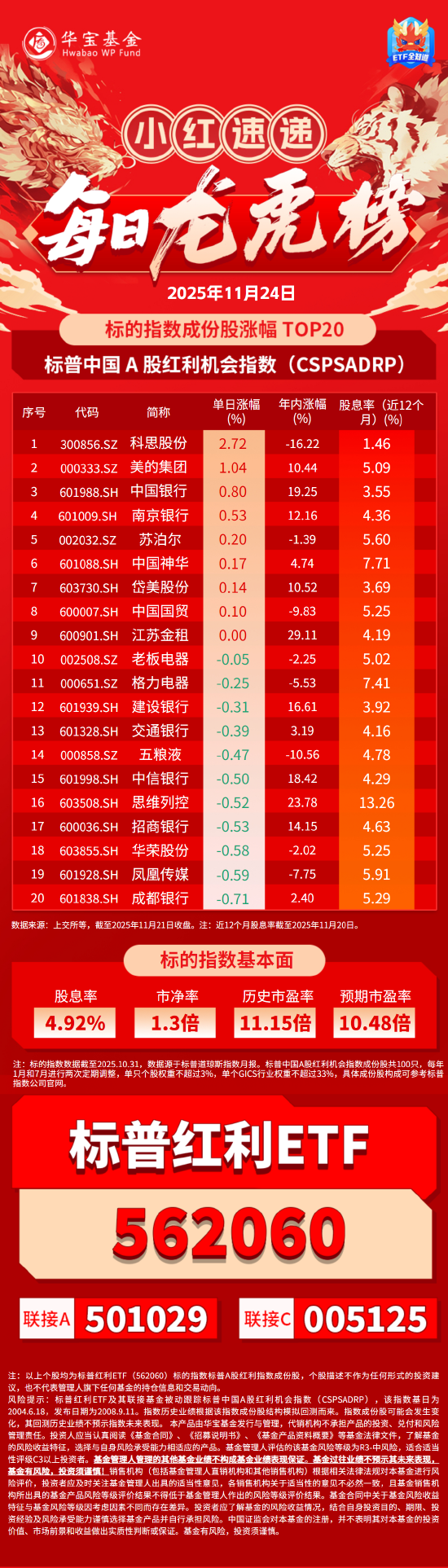
小红日报 | 标普红利ETF(562060)标的指数收跌-2.27%,资金逢跌积极布局
Xin Lang Ji Jin· 2025-11-24 01:11
Core Insights - The article presents the top 20 stocks in the S&P China A-Share Dividend Opportunity Index, highlighting their performance in terms of daily increase, year-to-date increase, and dividend yield [1] Group 1: Stock Performance - The top performer is Kesheng Co., Ltd. (300856.SZ) with a daily increase of 2.72% but a year-to-date decrease of 16.22% and a dividend yield of 1.46% [1] - Midea Group (000333.SZ) shows a daily increase of 1.04% and a year-to-date increase of 10.44%, with a dividend yield of 5.09% [1] - China Bank (601988.SH) has a daily increase of 0.80% and a year-to-date increase of 19.25%, with a dividend yield of 3.55% [1] Group 2: Dividend Yields - The highest dividend yield is from Siwei Liekong (603508.SH) at 13.26%, despite a daily decrease of 0.52% and a year-to-date increase of 23.78% [1] - Other notable dividend yields include China Shenhua (601088.SH) at 7.71% and Gree Electric Appliances (000651.SZ) at 7.41% [1] - Jiangsu Jinxiang (600901.SH) has a year-to-date increase of 29.11% with a dividend yield of 4.19% [1]




《2025/11/17-2025/11/21》家电周报:海尔机器人与 INDEMIND 达成战略合作,比依股份定增获批-20251122
Shenwan Hongyuan Securities· 2025-11-22 08:39
Investment Rating - The report indicates a positive investment outlook for the home appliance sector, highlighting that the sector outperformed the Shanghai and Shenzhen 300 Index during the week [3][4]. Core Insights - The home appliance sector is experiencing a shift with strategic partnerships, such as Haier Robotics collaborating with INDEMIND to advance embodied robots in home applications [8]. - The report emphasizes three main investment themes: the value and growth potential of leading white and black appliance companies, the technological advancements in core component manufacturers, and the increasing penetration of new consumer categories like cleaning appliances [26][30]. Summary by Sections Market Performance - The home appliance sector index fell by 2.3%, while the Shanghai and Shenzhen 300 Index dropped by 3.8%, indicating a relative outperformance of the sector [3]. - Key companies like Aupu Technology, Zhejiang Meida, and Supor showed positive growth, while Joyoung, Beilong, and Biyi experienced significant declines [4]. Industry Dynamics - Haier Robotics and INDEMIND signed a strategic cooperation agreement to enhance the application of embodied robots in home settings, leveraging Haier's data and supply chain capabilities alongside INDEMIND's AI technology [8]. - Biyi Electric received approval from the China Securities Regulatory Commission for a specific stock issuance, indicating potential capital expansion [9]. Sales Data - In October, sales of cleaning appliances like robotic vacuums and washing machines saw significant year-on-year increases, with robotic vacuum sales up 36.01% and washing machine sales up 60.11% [26]. - Personal care products also showed varied performance, with hairdryer sales slightly increasing while prices decreased, and electric shaver sales rising significantly [30]. Investment Themes - The report identifies three main investment lines: - **Dividend and Growth**: Leading white and black appliance companies are characterized by low valuations, high dividends, and stable growth, making them attractive investments [26]. - **Technology**: Core component manufacturers are diversifying into emerging tech fields like robotics and data center cooling, presenting new growth opportunities [26]. - **International Expansion**: The report highlights the growing demand for cleaning appliances in international markets, particularly in Southeast Asia and South America [26]. Macro Economic Environment - As of November 21, 2025, the USD to RMB exchange rate has decreased by 1.40% since the beginning of the year, which may impact import costs for the home appliance sector [36].


家电周报:海尔机器人与INDEMIND达成战略合作,比依股份定增获批-20251122
Shenwan Hongyuan Securities· 2025-11-22 07:49
Investment Rating - The report maintains a positive outlook on the home appliance sector, highlighting that the sector outperformed the CSI 300 index during the week [2][3]. Core Insights - The home appliance sector index fell by 2.3%, while the CSI 300 index dropped by 3.8%, indicating a relative strength in the sector [2][3]. - Key companies such as Aopu Technology, Zhejiang Meida, and Supor showed gains, while companies like Joyoung, Beiqi, and Biyi experienced significant declines [4]. - Haier Robotics and INDEMIND signed a strategic cooperation agreement to advance the application of embodied robots in home settings [8]. - Biyi Electric received approval from the China Securities Regulatory Commission for a specific stock issuance [9]. Sales Data - In October, sales of cleaning appliances increased year-on-year, with robotic vacuum sales rising by 36.01% to 500,900 units and sales revenue increasing by 35.34% to 1.025 billion yuan [29]. - Sales of washing machines also saw a significant increase, with units sold rising by 60.11% to 429,300 and revenue increasing by 60.34% to 756 million yuan [29]. - Personal care products showed mixed results, with hairdryer sales slightly up by 0.31% but revenue down by 18.17%, while electric shaver sales rose by 29.12% with revenue up by 38.05% [34]. Industry Dynamics - The report identifies three main investment themes: 1. The potential of leading white and black appliance companies characterized by low valuations, high dividends, and stable growth [2]. 2. Upstream core component manufacturers are diversifying into emerging tech fields such as robotics and data center cooling [2]. 3. The increasing penetration of new consumer categories like cleaning appliances presents significant growth opportunities [2]. Macro Economic Environment - As of November 21, 2025, the USD to CNY exchange rate was reported at 7.0875, reflecting a year-to-date decrease of 1.40% [40]. - In October 2025, the total retail sales of consumer goods reached 46,291 billion yuan, showing a year-on-year increase of 2.90% [42].
雷军特别助理徐洁云,再次兼任公关部总经理,王化调任武汉;名创优品回应千万年薪招募“IP天才”;吉利推进智驾整合丨邦早报
创业邦· 2025-11-22 01:09
Group 1 - Xiaomi Group has made personnel adjustments in its public relations department, with Xu Jieyun taking over as the new head while Wang Hua is reassigned to the Wuhan regional headquarters [4] - Miniso has launched the "IP Genius Youth Plan," offering annual salaries between 1 million to 10 million to attract top IP creators globally, aiming to enhance its original IP incubation [5] - Geely is integrating its intelligent driving teams, with the Zeekr team transitioning to a newly established joint venture focused on intelligent driving solutions [8] Group 2 - Xiaomi's intelligent driving team has grown to over 1,800 members, with significant investment in AI research, exceeding 7 billion in 2025 [8][9] - NIO's CEO Li Bin commented on the competitive landscape of the automotive industry, stating that the competition in smart electric vehicles is entering a critical phase [15] - Genspark has completed a $275 million Series B funding round, achieving a post-money valuation of $1.25 billion [21] Group 3 - The global market for OLED tablet panels is expected to grow by 39% year-on-year by 2026, reaching 15 million units, driven by strong demand [33] - The China Passenger Car Association forecasts that retail sales of narrow passenger vehicles in November will be around 2.25 million units, with new energy vehicles expected to reach 1.35 million units [33]


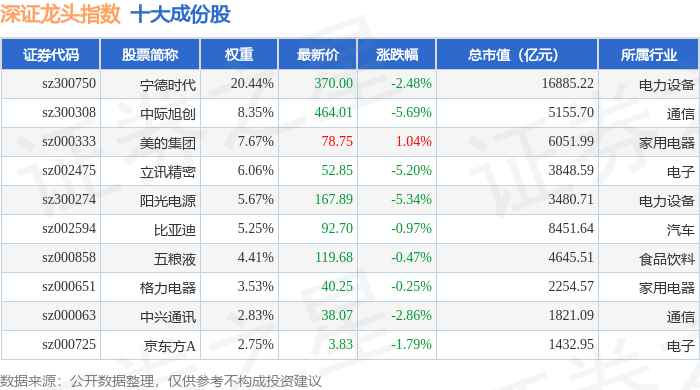
11月21日深证龙头(399653)指数跌2.13%,成份股瑞达期货(002961)领跌
Sou Hu Cai Jing· 2025-11-21 11:05
Market Overview - The Shenzhen Leading Index (399653) closed at 2908.89 points, down 2.13%, with a trading volume of 105.46 billion yuan and a turnover rate of 1.31% [1] Stock Performance - Among the index constituents, 5 stocks rose while 43 stocks fell, with Sanhua Intelligent Control leading the gainers at 1.77%, and Ruida Futures leading the decliners at 6.28% [1] - The top ten constituents of the Shenzhen Leading Index are as follows: - Contemporary Amperex Technology Co., Ltd. (Ningde Times) holds a weight of 20.44% with a latest price of 370.00 yuan, down 2.48%, and a total market value of 1688.52 billion yuan [1] - Zhongji Xuchuang has a weight of 8.35%, latest price of 464.01 yuan, down 5.69%, and a market value of 515.57 billion yuan [1] - Midea Group has a weight of 7.67%, latest price of 78.75 yuan, up 1.04%, and a market value of 661.51 billion yuan [1] - Luxshare Precision has a weight of 6.06%, latest price of 52.85 yuan, down 5.20%, and a market value of 384.86 billion yuan [1] - Sungrow Power Supply has a weight of 5.67%, latest price of 167.89 yuan, down 5.34%, and a market value of 348.07 billion yuan [1] - BYD has a weight of 5.25%, latest price of 92.70 yuan, down 0.97%, and a market value of 845.16 billion yuan [1] - Wrigley has a weight of 4.41%, latest price of 119.68 yuan, down 0.47%, and a market value of 464.55 billion yuan [1] - Gree Electric Appliances has a weight of 3.53%, latest price of 40.25 yuan, down 0.25%, and a market value of 225.46 billion yuan [1] - ZTE Corporation has a weight of 2.83%, latest price of 38.07 yuan, down 2.86%, and a market value of 182.11 billion yuan [1] - BOE Technology Group has a weight of 2.75%, latest price of 3.83 yuan, down 1.79%, and a market value of 143.30 billion yuan [1] Capital Flow - The net outflow of main funds from the Shenzhen Leading Index constituents totaled 7.45 billion yuan, while the net inflow from speculative funds was 2.39 billion yuan, and the net inflow from retail investors was 5.06 billion yuan [1]




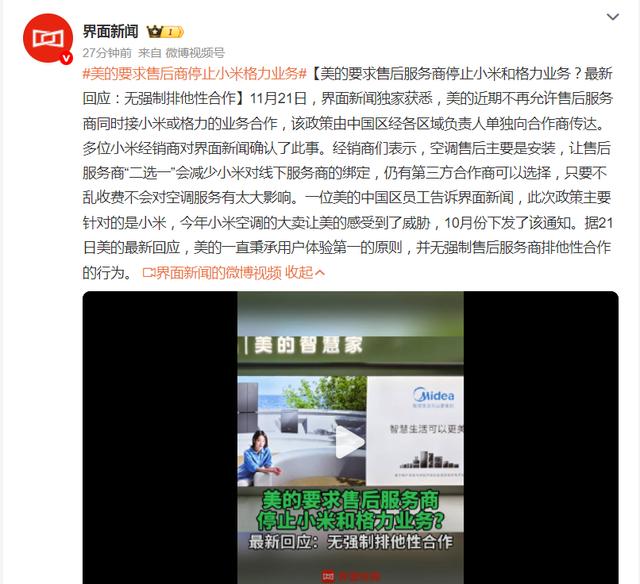
网传“美的要求所有售后服务商停止小米和格力业务”,到底是真是假?各方回应!
Sou Hu Cai Jing· 2025-11-21 11:05
(图片来源:网络) 出品|搜狐财经 作者|李保铭 律师则表示,若该消息为真,美的此举或触发《反垄断法》。不过,律师也表示,触犯该法并非仅凭行为本身,还需满 足两个关键前提。 网传该政策主要针对小米,接近小米的业内人士则告诉搜狐财经,小米内部没有太关注此事。业内人士也解读,此次事 件对小米的影响或有限。 今年以来,家电企业"混战"事件频发,背后既有市场进入存量因素,也与家电行业竞争加剧有关。 消息是真是假? 近日,网传"美的要求所有售后服务商停止小米和格力业务",一位业内人士告诉搜狐财经"是真的",对方还表示是"内部 传递,没有发文"。 不过,一位家电企业区域经理告诉搜狐财经"没有听说过",也引人思考此次事件是否只是区域性、而非全国性的动作。 他分析:"现在的家电市场不敢这么强势,终端销售特别差。"但他也表示,也有可能与相关政策刚出台有关,"估计刚 出,我们还不知道"。 近日,"美的要求所有售后服务商停止小米和格力业务"消息刷屏。 美的方面对此予以否认,但外界传言并未停息。 搜狐财经向多位家电行业人士求证,对于此消息,众说纷纭。有业内人士称传言为真,也有人表示仍未收到相关消息。 但业内人士对此政策合理性提出疑问 ...
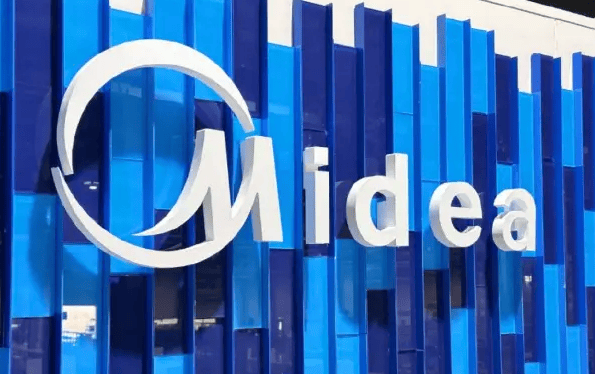
突发,美的“停服”小米、格力?
3 6 Ke· 2025-11-21 10:58
Core Viewpoint - Midea has implemented a policy prohibiting its after-sales service providers from simultaneously collaborating with Xiaomi or Gree, primarily targeting Xiaomi due to its significant sales growth in air conditioning this year, which has posed a competitive threat to Midea [1][5] Group 1: Industry Competition - The competition among major home appliance brands is intensifying, with Midea's policy change quickly becoming a trending topic on social media [1] - Midea has denied any forced collaboration restrictions, indicating a potential discrepancy in reports from various media outlets [1][4] - The relationship dynamics between Xiaomi and Gree are complex, with historical factors influencing public perception of their rivalry [5] Group 2: Market Position and Performance - In July, the top five air conditioning brands in China were Midea, Gree, Haier, Xiaomi, and Aux, with Midea experiencing a 1% decline and Xiaomi emerging as a notable competitor [6] - During the recent Double Eleven shopping festival, the sales rankings for air conditioning brands were Gree, Midea, Xiaomi, Hualing, and Haier, indicating Xiaomi's strong market presence [7] - Price competition is escalating, with average prices for air conditioning units dropping significantly, reflecting the aggressive strategies of leading brands [8] Group 3: Financial Insights - Xiaomi's air conditioning segment has a net profit margin of approximately 2%, while Midea's and Haier's margins are significantly higher, indicating a challenging financial landscape for Xiaomi [8] - Despite a 5.6% year-on-year revenue growth in Xiaomi's IoT and lifestyle products segment, there was a noticeable decline compared to the previous quarter, highlighting the competitive pressures in the home appliance sector [8] Group 4: International Expansion - Midea's overseas revenue reached 107.2 billion yuan in the first half of 2025, marking a 17.7% year-on-year increase, establishing it as a significant growth driver [9] - Haier's overseas revenue accounted for over 50% of its total revenue, showcasing its strong international presence [9] - Gree's overseas revenue reached 16.78% of its total, indicating room for growth in international markets [9] Group 5: Technological Advancements - The leading home appliance brands are heavily investing in technology and innovation, with Haier holding the highest number of smart home invention patents globally [10] - Xiaomi is pursuing a comprehensive ecosystem strategy, integrating its products with smart home technology, which may provide a competitive edge [10][11] - The smart home market in China is projected to reach 1.36 trillion yuan by 2030, indicating significant growth potential for all major players [11]
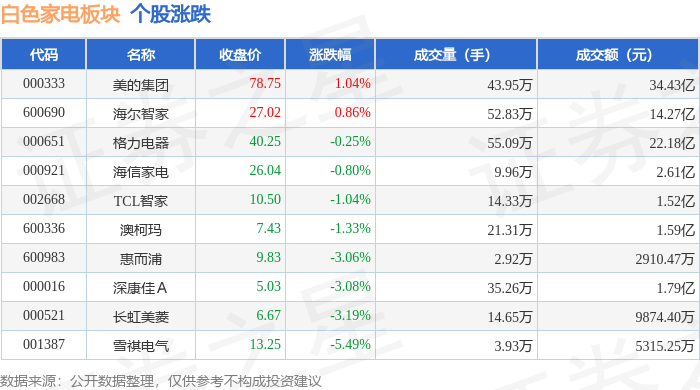
白色家电板块11月21日涨0.54%,美的集团领涨,主力资金净流出1.49亿元
Zheng Xing Xing Ye Ri Bao· 2025-11-21 09:33
Market Overview - The white goods sector increased by 0.54% on November 21, with Midea Group leading the gains [1] - The Shanghai Composite Index closed at 3834.89, down 2.45%, while the Shenzhen Component Index closed at 12538.07, down 3.41% [1] Stock Performance - Midea Group closed at 78.75, up 1.04% with a trading volume of 439,500 shares and a transaction value of 3.443 billion yuan [1] - Haier Smart Home closed at 27.02, up 0.86% with a trading volume of 528,300 shares and a transaction value of 1.427 billion yuan [1] - Gree Electric Appliances closed at 40.25, down 0.25% with a trading volume of 550,900 shares and a transaction value of 2.218 billion yuan [1] - Hisense Home Appliances closed at 26.04, down 0.80% with a trading volume of 99,600 shares and a transaction value of 261 million yuan [1] - TCL Smart Home closed at 10.50, down 1.04% with a trading volume of 143,300 shares and a transaction value of 152 million yuan [1] - Aucma closed at 7.43, down 1.33% with a trading volume of 213,100 shares and a transaction value of 159 million yuan [1] - Whirlpool closed at 9.83, down 3.06% with a trading volume of 29,200 shares and a transaction value of 29.104 million yuan [1] - Deep Kangjia A closed at 5.03, down 3.08% with a trading volume of 352,600 shares and a transaction value of 179 million yuan [1] - Changhong Meiling closed at 6.67, down 3.19% with a trading volume of 146,500 shares and a transaction value of 98.744 million yuan [1] - Snowman Electric closed at 13.25, down 5.49% with a trading volume of 39,300 shares and a transaction value of 53.1525 million yuan [1] Capital Flow - The white goods sector experienced a net outflow of 149 million yuan from institutional investors, while retail investors saw a net inflow of 4.7305 million yuan [1] - Haier Smart Home had a net inflow of 64.2082 million yuan from institutional investors, while it faced a net outflow of 92.977 million yuan from speculative funds [2] - Whirlpool had a net inflow of 578,200 yuan from institutional investors, with a net outflow of 1.4406 million yuan from retail investors [2] - Aucma experienced a net outflow of 179,900 yuan from institutional investors, while it had a net inflow of 6.4482 million yuan from speculative funds [2] - Gree Electric Appliances faced a net outflow of 1.36 million yuan from institutional investors, while retail investors had a net inflow of 7.08976 million yuan [2]


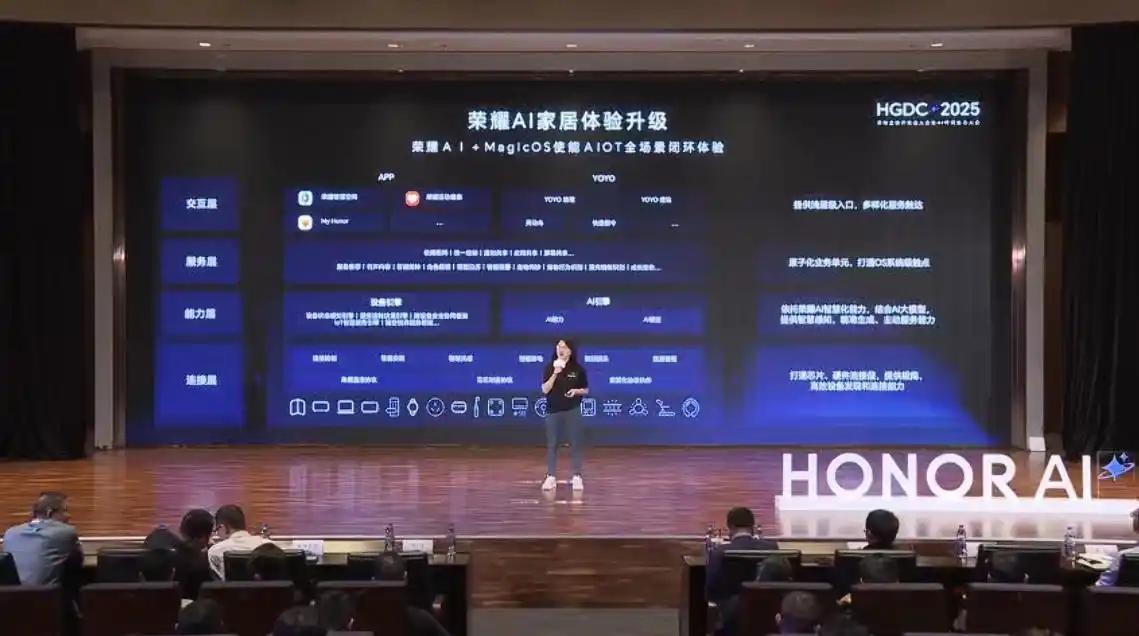
荣耀小米加码,全屋智能大乱战升级:家电巨头才是终极话事人?
3 6 Ke· 2025-11-21 07:52
Core Insights - The smart home sector is witnessing an influx of players, with companies like Honor officially entering the market by adapting to Home Assistant and supporting the Matter protocol, while Xiaomi's AIoT platform has connected over 1 billion IoT devices for the first time, marking a year-on-year growth of over 20% [1][3][8]. Group 1: Company Strategies - Xiaomi has evolved from a mobile phone manufacturer to a comprehensive consumer electronics brand with a complete ecosystem of home appliances and IoT products, including smart speakers, air conditioners, and more, all integrated under the Mi Home app [5][8]. - Huawei's strategy focuses on creating a unified operating system, HarmonyOS, which integrates various devices into a distributed system, aiming to transform homes into "super devices" [9][11]. - Apple maintains a strong user experience with its HomeKit but is limited by its ecosystem, relying on third-party manufacturers for device compatibility, which restricts its market reach compared to competitors [12][15]. - Honor aims to be a coordinator of smart devices rather than a manufacturer of home appliances, focusing on interoperability through industry-standard protocols like Home Assistant and Matter [16][18]. Group 2: Competitive Landscape - Traditional home appliance giants like Midea, Haier, and Gree are shifting their focus to whole-home smart solutions, leveraging their hardware expertise and understanding of user needs to maintain a competitive edge [19][21]. - The competition is evolving from single smart products to system collaboration, allowing mobile manufacturers to re-enter the market, but traditional appliance manufacturers still hold significant advantages in hardware performance and user experience [22][25]. - New entrants in the smart home market, such as Euribot and Green米, are focusing on foundational smart home components, while emerging players like Chasing are rapidly expanding their product offerings across various categories [23][24]. Group 3: Future Outlook - The future of the smart home market is expected to be characterized by coexistence among various players, with mobile manufacturers offering flexible product choices and traditional appliance manufacturers providing reliable performance and integrated solutions [25][27].