
Yanjing Brewery(000729)

Search documents
食品饮料周报:政治局会议定调积极,看好饮料旺季催化-20250429
Tianfeng Securities· 2025-04-29 08:46
Investment Rating - The industry rating is "Outperform" (maintained rating) [5] Core Viewpoints - The report highlights a positive outlook for the beverage sector, driven by the upcoming peak season and supportive macroeconomic policies from the central government [2][12] - The report emphasizes the potential for valuation recovery in the liquor sector, particularly in light of the recent political bureau meeting that indicated a more proactive fiscal and monetary policy [2][12] Summary by Sections Market Performance Review - For the week of April 21 to April 25, the food and beverage sector declined by 1.36%, while the Shanghai Composite Index rose by 0.38%. Notable performances included snacks (+4.50%) and soft drinks (+2.21%), while categories like beer (-0.72%) and health products (-1.28%) saw declines [1][19] Weekly Perspective Updates - **Liquor Sector**: The liquor sector saw a decline of 1.75%, attributed to the off-peak consumption period and inventory adjustments. However, the upcoming May Day holiday is expected to boost demand for banquet scenarios, aiding in inventory reduction [2][12] - **Beer and Beverage Sector**: The beer sector decreased by 0.72%, but companies like Zhujiang Brewery saw a 5.7% increase in stock price due to better-than-expected Q1 performance. The report anticipates improved demand as the weather warms and consumption policies are implemented [3][13] - **Consumer Goods Sector**: The report identifies opportunities in the snack sector, with a focus on companies that have shown resilience and potential for growth. The upcoming sales season for soft drinks is also highlighted as a catalyst for growth [3][14] Investment Recommendations - **Liquor Sector**: Recommended stocks include strong alpha leaders like Moutai and Shanxi Fenjiu, as well as cyclical stocks like Luzhou Laojiao and Jiugui Liquor [4][18] - **Consumer Goods**: The report recommends focusing on snacks and dairy products, with specific mentions of companies like Ganyuan Foods and Yuyuan Foods, which are expected to benefit from low base effects in Q2 [4][18] Sector and Individual Stock Performance - The report provides detailed performance metrics for various sectors, indicating that the snack and soft drink sectors are currently outperforming others, while the liquor sector is under pressure [19][22]





燕京啤酒(000729):净利率不断突破 2025年自信启航
Xin Lang Cai Jing· 2025-04-29 02:38
Core Insights - The company achieved a total revenue of 14.667 billion yuan in 2024, representing a year-on-year increase of 3.2%, while the net profit attributable to shareholders was 1.056 billion yuan, up 63.74% year-on-year, and the net profit excluding non-recurring items was 1.041 billion yuan, an increase of 108.03% year-on-year [1] Group 1: Revenue and Profitability - In Q4 2024, the company reported total revenue of 1.821 billion yuan, a year-on-year increase of 1.32%, but a net loss of 232 million yuan was recorded [1] - The company's sales volume for 2024 was 4 million kiloliters, a year-on-year increase of 1.6%, with U8 sales reaching 696,000 kiloliters, up 31.4% year-on-year [2] - The company’s revenue per ton increased by 1.6% year-on-year, while the ton price decreased by 0.6% year-on-year [2] Group 2: Cost Management and Efficiency - The company experienced a 6.6% decrease in ton cost year-on-year, leading to an overall gross margin increase of 3.1 percentage points to 40.7% [3] - The total number of employees decreased by 1,440 year-on-year, contributing to a reduction in overall expenses, with the expense ratio declining by 1.26 percentage points to 21.76% [3] - The net profit margin improved by 2.7 percentage points to 7.2% year-on-year, with the subsidiary Liqueur achieving a net profit increase of 11.9% and a net profit margin rise of 2.1 percentage points to 19% [3] Group 3: Future Outlook - The company is optimistic about achieving new highs in performance as it approaches the end of the 14th Five-Year Plan, with expectations for continued revenue and profit growth [4] - The company anticipates EPS of 0.51, 0.58, and 0.65 yuan for 2025, 2026, and 2027, respectively, with corresponding PE ratios of 25X, 22X, and 19X [4]

燕京啤酒(000729):Q1利润高增态势延续 燕京U8引领增长
Xin Lang Cai Jing· 2025-04-29 02:38
Core Viewpoint - Yanjing Beer reported strong financial performance in Q1 2025, with significant profit growth driven by revenue increase and effective cost control [2][4]. Financial Performance - Total revenue and net profit for Q1 2025 were CNY 3.827 billion and CNY 165 million, respectively, representing year-on-year growth of 7% and 61% [2]. - The non-recurring net profit was CNY 153 million, up 49% year-on-year [2]. - Gross margin and net margin improved to 43% and 6%, reflecting increases of 5.6 and 2.3 percentage points year-on-year [2]. - Operating cash flow and sales collection showed robust growth, with operating cash flow at CNY 1.333 billion (up 49%) and sales collection at CNY 4.713 billion (up 10%) [2]. Product Strategy - Beer sales reached 995,000 tons in Q1 2025, with the flagship product Yanjing U8 maintaining over 30% growth [3]. - The company is focusing on high-end products, with brands like "Jiuhao" targeting the raw beer market and "Lion King" aimed at premium craft beer consumers [3]. - The introduction of Beiste soda in March 2025 marks a strategic move into the non-alcoholic segment, enhancing market coverage for dining scenarios like hot pot and barbecue [3]. - The appointment of a brand ambassador has significantly increased market exposure, with discussion volume reaching 330 million across major platforms [3]. Profit Forecast - The company is expected to maintain high profit growth driven by the continued expansion of mid-to-high-end products, particularly U8, and ongoing operational improvements [4]. - EPS forecasts for 2025-2027 are CNY 0.51, CNY 0.62, and CNY 0.75, with corresponding PE ratios of 25, 21, and 17 times at the current stock price [4].
白酒板块持续调整,“问题”酒企股价大幅下跌 | 酒市周报
Mei Ri Jing Ji Xin Wen· 2025-04-28 08:13
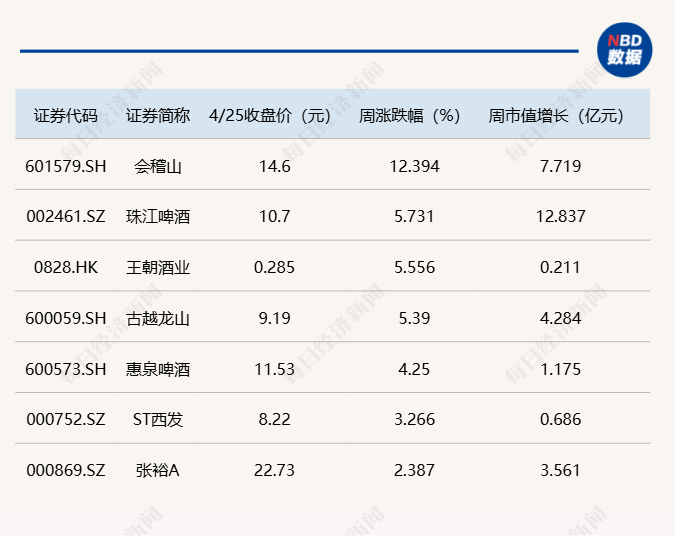
Group 1 - The overall performance of liquor companies was weak, with stock prices declining, particularly for major liquor brands, as their 2024 annual reports and 2025 Q1 reports were released, which were generally in line with or slightly below market expectations [1] - Public funds have significantly reduced their holdings in Yanghe and Yingjia Gongjiu, indicating concerns about the competitive strength of these companies in their respective regions [1][5] - The liquor sector saw a notable divergence in stock performance, with yellow wine companies like Kuaijishan and Guyue Longshan showing significant weekly gains of 12.39% and 5.39%, respectively, while the white liquor sector continued to decline [2][3] Group 2 - The white liquor index experienced a weekly decline of 1.61%, marking three consecutive weeks of losses, with major brands like Luzhou Laojiao and Shanxi Fenjiu seeing declines exceeding 3% [3] - Companies facing operational difficulties, such as ST Yanshi, saw substantial weekly declines, with ST Yanshi down 14.95% and Mogao Co. and Hainan Yedao down 7.65% and 8.11%, respectively [4] - As of March 31, 2025, public funds held a total market value of 257.1 billion yuan in the white liquor sector, a decrease of 0.23 percentage points from the previous quarter, continuing a downward trend since 2022 [5]



食品饮料行业深度报告:政策预期强化,关注景气细分
Dongguan Securities· 2025-04-28 07:39
Investment Rating - The report maintains an "Overweight" rating for the food and beverage industry [1] Core Insights - The food and beverage industry is gaining attention due to increased external uncertainties and positive domestic policy signals, with a focus on boosting domestic demand as a key driver for economic growth [12][16] - The liquor sector is expected to show a "front low, back high" performance trend for the year, with a focus on inventory digestion in the first half and gradual demand recovery in the second half [17][32] - The consumer goods sector, particularly those related to the catering supply chain and benefiting from fertility policy catalysts, is highlighted for potential investment opportunities [39] Summary by Sections 1. Policy Expectations and Industry Focus - Increased external uncertainties have led to a heightened focus on domestic demand as a crucial element for economic growth [12] - Recent government policies aimed at boosting consumption have positively influenced market confidence, with a comprehensive action plan to enhance consumer spending [13][16] 2. Liquor Sector - Liquor sales during the Spring Festival saw a year-on-year decline of approximately 10%, with a focus on inventory management during the off-peak season [17] - High-end liquor demand remains stable, while mid-range and regional brands are experiencing varied performance based on market conditions [19] - Major liquor companies are engaging in share buybacks and increasing shareholdings to bolster market confidence [24][30] 3. Consumer Goods Sector - The report emphasizes the importance of sectors related to the catering supply chain, with specific attention to the seasoning, beer, dairy, and snack segments [39] - The seasoning sector is expected to benefit from a recovery in restaurant consumption, while the beer sector is poised for growth due to the resurgence of dining scenarios [40] - Dairy demand is anticipated to rise following the introduction of fertility subsidies in various regions, which could positively impact dairy company performance [39]



燕京啤酒(000729):2024年年报点评:净利率不断突破,2025年自信启航
Changjiang Securities· 2025-04-28 05:12
Investment Rating - The investment rating for the company is "Buy" and is maintained [8]. Core Insights - The company reported a total revenue of 14.667 billion yuan in 2024, representing a year-on-year increase of 3.2%. The net profit attributable to the parent company was 1.056 billion yuan, up 63.74% year-on-year, while the net profit excluding non-recurring items reached 1.041 billion yuan, reflecting a 108.03% increase year-on-year [2][6]. - In Q4 2024, the company achieved a total revenue of 1.821 billion yuan, a year-on-year increase of 1.32%. However, the net profit attributable to the parent company was a loss of 0.232 billion yuan, with a net profit excluding non-recurring items also showing a loss of 0.221 billion yuan, indicating a reduction in losses [2][6]. - The company expects to continue its high-quality development trajectory, with confidence in achieving new highs in revenue and profit for 2025 [12]. Summary by Sections Financial Performance - In 2024, the company's total revenue was 14.667 billion yuan, with a gross profit margin of 41%. The operating profit was 1.609 billion yuan, accounting for 11% of total revenue [18]. - The company’s net profit margin improved to 7.2%, an increase of 2.7 percentage points year-on-year [12]. Sales and Market Dynamics - The company sold 4 million kiloliters in 2024, a year-on-year increase of 1.6%. The U8 product line saw a significant sales increase of 31.4% year-on-year [12]. - Revenue growth varied by region, with North China and East China showing increases of 5.4% and 9.8% respectively, while Northwest China experienced a decline of 12.5% [12]. Cost Management and Efficiency - The company successfully reduced its cost per ton by 6.6% year-on-year, leading to an overall improvement in gross profit margin by 3.1 percentage points to 40.7% [12]. - The company streamlined its workforce, reducing the number of employees by 1,440, which contributed to a decrease in overall expense ratios [12]. Future Outlook - The company is optimistic about its performance in 2025, projecting earnings per share (EPS) of 0.51 yuan, 0.58 yuan, and 0.65 yuan for 2025, 2026, and 2027 respectively, with corresponding price-to-earnings (PE) ratios of 25X, 22X, and 19X [12].
燕京啤酒:U8延续高增势头,改革红利仍在释放-20250428
HUAXI Securities· 2025-04-28 04:50
Investment Rating - The investment rating for the company is "Accumulate" [1] Core Views - The company has maintained a high growth momentum, with the U8 product continuing to perform well, particularly in the East China region [3][4] - The company has experienced significant profit growth due to ongoing reforms and cost advantages, with expectations for continued profit increases [5][7] - The company is expected to release more benefits from its reforms, which have already led to substantial revenue and profit growth [8] Financial Performance Summary - In FY 2024, the company achieved revenue of 14.667 billion yuan, a year-on-year increase of 3.20%, and a net profit attributable to shareholders of 1.056 billion yuan, up 63.74% year-on-year [2] - For Q1 2025, the company reported revenue of 3.827 billion yuan, a 6.69% increase year-on-year, and a net profit of 165 million yuan, up 61.10% year-on-year [2] - The company's sales volume for FY 2024 was 4.0044 million tons, a 1.57% increase year-on-year, with an average price of 3,304 yuan per ton, a slight decrease of 0.56% [3] Regional Performance - Revenue from different regions in FY 2024 showed growth in North China (+5.39%) and East China (+9.82%), while South China and Central China had minimal growth [4] Profitability Analysis - The gross margin for FY 2024 was 40.72%, an increase of 3.09 percentage points year-on-year, indicating improved profitability [5] - The net profit margin for FY 2024 was 7.20%, reflecting a year-on-year increase of 2.66 percentage points [6] Future Earnings Forecast - The revenue forecast for 2025 and 2026 has been adjusted to 15.441 billion yuan and 16.269 billion yuan, respectively, with EPS estimates increased to 0.51 yuan and 0.60 yuan [9]
观酒周报|五粮液老窖古井贡酒Q1保持增长;燕京珠啤Q1盈利大涨;ST春天预计将被披星戴帽
2 1 Shi Ji Jing Ji Bao Dao· 2025-04-28 01:44
Industry Overview - The performance of listed liquor companies has been disclosed, with nearly 20 companies reporting their 2024 annual reports and some also releasing Q1 reports as of April 27 [1] - The overall trend shows a slowdown in the liquor industry, particularly in the white liquor segment, while top brands continue to show growth [1] - Beer stocks have rebounded in Q1 after a decline last year, with companies like Yanjing Beer and Zhujiang Beer reporting high growth in profits [1] Company Performance - Wuliangye reported a revenue of 89.175 billion yuan for 2024, a year-on-year increase of 7.09%, with a net profit of 31.853 billion yuan, up 5.44% [1] - Gujing Gongjiu achieved a revenue of 23.578 billion yuan in 2024, growing 16.41% year-on-year, and a net profit of 5.517 billion yuan, up 20.22% [2] - Luzhou Laojiao's revenue for 2024 was 31.196 billion yuan, a 3.19% increase, with a net profit of 13.473 billion yuan, up 1.71% [3] - Yanjing Beer reported a revenue of 3.827 billion yuan in Q1 2025, a 6.69% increase, with a net profit of 165 million yuan, up 61.10% [4] - Zhujiang Beer achieved a revenue of 1.227 billion yuan in Q1 2025, a 10.69% increase, with a net profit of 157 million yuan, up 29.83% [4] - Laobai Gan Jiu reported a revenue of 5.358 billion yuan for 2024, a 1.9% increase, with a net profit of 787 million yuan, up 18% [5] - Tianyoude Jiu's revenue for 2024 was 1.255 billion yuan, a 3.7% increase, but net profit fell by 53% to 42.135 million yuan [7] - Zhangyu A reported a revenue of 811 million yuan in Q1 2025, a slight increase of 0.01%, with a net profit of 159 million yuan, up 0.21% [8] Market Dynamics - The liquor industry is experiencing a significant differentiation between leading brands and others, with some companies facing delisting risks due to poor performance [1] - The overall liquor market is still in a period of adjustment, with increased competition and declining production [7] - Guizhou province's liquor manufacturing sector saw a growth of 6.6% in Q1 2025, contributing to the overall economic growth of the region [16] - The import of wine has rebounded to become the top category, while the import value of spirits has decreased significantly [17]


中经酒业周报∣3月规模以上企业白酒产量同比下滑0.8%,五粮液、燕京啤酒、天佑德酒、上海贵酒等酒企披露年报
Xin Hua Cai Jing· 2025-04-27 09:17
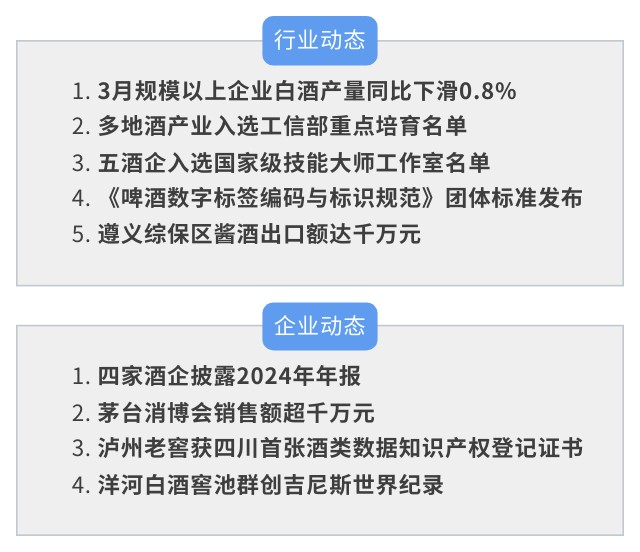
Industry Dynamics - In March, the production of liquor by large-scale enterprises in China decreased by 0.8% year-on-year, totaling 378,000 kiloliters, with a cumulative production of 1,032,000 kiloliters in the first three months, down 7.3% year-on-year [4] - Beer production increased by 1.9% year-on-year in March, reaching 3,128,000 kiloliters, but the cumulative production for the first three months fell by 2.2% [4] - Wine production saw a significant decline of 25% year-on-year in March, with a total of 9,000 kiloliters produced, and a cumulative production of 24,000 kiloliters in the first three months, also down 25% [4] - The Ministry of Industry and Information Technology announced a list of 40 key traditional food industries for cultivation, including liquor categories such as Baijiu, Huangjiu, and wine, aimed at boosting economic development and enhancing domestic demand [4] - Five liquor enterprises were recognized in the national-level skills master studio list, highlighting the industry's focus on skill development and training [7] Company Dynamics - Yanjing Beer reported a revenue of 14.667 billion yuan for 2024, a year-on-year increase of 3.2%, with a net profit of 1.056 billion yuan, up 63.74% [8] - Shanghai Gui Jiu (Rocky Co.) reported a revenue of 285 million yuan, a significant decline of 82.54%, with a net loss of 217 million yuan, down 349.63% [9] - Tianyoude Jiu reported a revenue of 1.255 billion yuan, a year-on-year increase of 3.69%, but a net profit decline of 52.96% to 42.135 million yuan [10] - Wuliangye reported a revenue of 89.175 billion yuan, a year-on-year increase of 7.09%, with a net profit of 31.853 billion yuan, up 5.44% [10] - Moutai achieved sales exceeding 10 million yuan during the China International Consumer Products Expo, showcasing strong consumer interest in its products [10] - Luzhou Laojiao received the first data intellectual property registration certificate in the liquor industry for real-time monitoring data of bottled liquor, indicating a focus on quality control [11] - Yanghe Baijiu's cellar group was certified by Guinness World Records as the largest scale of liquor cellars, emphasizing the company's production capacity [11]


燕京啤酒:Q1利润高增态势延续,燕京U8引领增长-20250427
Huaxin Securities· 2025-04-27 08:10
Investment Rating - The report maintains a "Buy" investment rating for Yanjing Beer (000729.SZ) [1] Core Views - The company continues to show strong profit growth, with Q1 2025 total revenue and net profit reaching 3.827 billion and 165 million yuan, respectively, representing year-on-year increases of 7% and 61% [5] - The gross margin and net margin for Q1 2025 improved to 43% and 6%, reflecting a year-on-year increase of 5.6 and 2.3 percentage points [5] - The company is focusing on high-end product development, with the flagship product Yanjing U8 maintaining over 30% growth in sales volume [6] - The company has launched a new soda product, Best Soda, to complement its beer offerings and enhance market presence [6] - The earnings per share (EPS) forecast for 2025-2027 is projected to be 0.51, 0.62, and 0.75 yuan, with corresponding price-to-earnings (PE) ratios of 25, 21, and 17 times [7] Summary by Sections Financial Performance - Q1 2025 total revenue was 3.827 billion yuan, with a net profit of 165 million yuan, showing a 7% and 61% year-on-year growth respectively [5] - The operating cash flow and sales collection improved significantly, with operating cash flow reaching 1.333 billion yuan, up 49% year-on-year [5] Product Strategy - The company sold 995,000 tons of beer in Q1 2025, with Yanjing U8 leading the growth [6] - The introduction of high-end products and the "beer + soda" strategy aims to capture a broader consumer base [6] Earnings Forecast - The report projects a steady increase in revenue and net profit, with a forecasted net profit of 1.436 billion yuan for 2025, representing a 36.1% growth [9] - The report emphasizes the ongoing optimization of the sales structure and cost control measures as key drivers for profitability [7]