
BNBMPLC(000786)

Search documents
招商研究一周回顾(0815-0822)




CMS· 2025-08-22 15:25
Macro Insights - The economic growth rate in August is expected to be supported by exports and consumption policies, despite a significant slowdown in the real estate sector, with a target of 5% annual growth remaining achievable [1][15][12] - The industrial added value in July grew by 5.7% year-on-year, with the manufacturing sector showing resilience, particularly in high-tech products and equipment manufacturing [12][13] - Fixed asset investment growth slowed to 1.6% year-on-year in the first seven months, primarily due to a decline in real estate investment, which fell by 12% [13][14] Strategy Insights - Current channels for resident capital entering the market include increasing financing balances and active personal investor accounts, leading to a positive feedback loop in the market [2] - The "anti-involution" market trend can be analyzed through policy expectations and real-world transmission, indicating a shift from theme-driven to profit-driven market dynamics [2] - The technology and small-cap sectors are expected to continue outperforming as more external funds enter the market [2] Industry Reports - The consumer electronics sector is anticipated to see significant opportunities with the upcoming release of new products, particularly in AI-related applications [8] - The coal mining industry is experiencing a continuous improvement in fundamentals, with the price of thermal coal expected to rise [8] - The healthcare sector, particularly innovative drugs, is projected to maintain a positive outlook due to improved profitability [8]
北新建材(000786) - 2025年8月22日投资者关系活动记录表
2025-08-22 14:02
Group 1: Business Performance and Strategy - In the first half of 2025, the domestic gypsum board industry experienced a decline in demand, leading to intensified competition. The company aims to enhance regional market competitiveness and increase market share through flexible strategies and new product development [2][3]. - The company plans to focus on high-value-added products and promote high-end, green, and digital transformation while leveraging brand, channel, and innovation advantages to explore new market opportunities [2][3]. Group 2: Two-Wing Business Development - The company’s "two-wing" business, which includes waterproofing and coatings, has room for market share improvement. The strategy involves enhancing product competitiveness and focusing on niche markets [3]. - The company is committed to a multi-faceted approach to improve its competitive position in the market, especially as the industry sees a concentration of market share among leading enterprises [3]. Group 3: International Expansion and M&A Plans - The company has entered markets in Tanzania, Uzbekistan, and Thailand, with plans for further expansion in Southeast Asia, Central Asia, Africa, Europe, and the Mediterranean through a point-to-area strategy [3]. - The M&A strategy is aligned with the "one body, two wings" approach, focusing on core business and seeking opportunities for international integration while ensuring compliance with disclosure obligations [3]. Group 4: Corporate Governance and Efficiency - The company is enhancing its governance structure to improve decision-making efficiency and effectiveness, addressing concerns about state-owned enterprises' competitiveness compared to private enterprises [3][5]. - Future initiatives include market-oriented reforms, performance-based assessments, and management personnel competition to boost organizational vitality and operational quality [5].

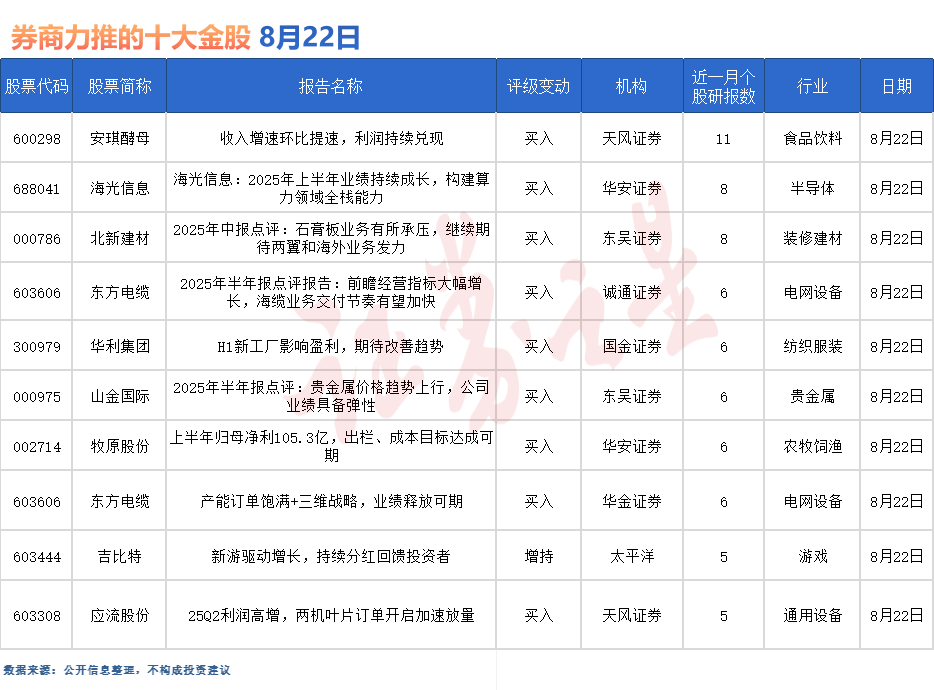
8月22日券商今日金股:11份研报力推一股(名单)
Zheng Quan Zhi Xing· 2025-08-22 08:26
Core Viewpoint - Securities firms have issued "buy" ratings for nearly 100 A-share listed companies on August 22, focusing on sectors such as food and beverage, semiconductors, construction materials, power grid equipment, textiles and apparel, precious metals, and agriculture [1] Group 1: Company Ratings and Performance - Anrui Xinyu received a "buy" rating from Tianfeng Securities, highlighting a sequential increase in revenue growth and sustained profit realization [2] - Haiguang Information was rated positively by Huazheng Securities, with expected revenues of 13.915 billion, 19.810 billion, and 25.770 billion yuan for 2025-2027, showing an increase from previous forecasts [3] - Beixin Building Materials was noted by Dongwu Securities, indicating that its gypsum board business is under pressure but expects growth from its global strategy [3] - Dongfang Cable received a "buy" rating from Chengtong Securities, with significant growth in forward-looking operational indicators and an expected acceleration in submarine cable business deliveries [2] - Muyuan Foods reported a net profit of 10.53 billion yuan in the first half of the year, meeting its output and cost targets, and was rated "buy" by Huazheng Securities [2] Group 2: Sector Focus and Trends - The focus of securities firms on various sectors indicates a trend towards recovery in demand and potential profit growth across industries such as food and beverage, semiconductors, and construction materials [1][4] - The report from Tianfeng Securities on Anrui Xinyu suggests that cost benefits from sugar molasses are contributing to profit elasticity, indicating a positive outlook for the food and beverage sector [3] - The overall attention from multiple securities firms on companies like Dongfang Cable, Huayi Group, and Jibite reflects a broader interest in sectors like power grid equipment and gaming, suggesting potential investment opportunities [4]


研报掘金丨东吴证券:维持北新建材“买入”评级,继续期待两翼和海外业务发力
Ge Long Hui A P P· 2025-08-22 08:02
Core Viewpoint - Dongwu Securities report indicates that Beixin Building Materials' net profit attributable to shareholders for the first half of 2025 is 1.93 billion yuan, a year-on-year decrease of 12.85% [1] Financial Performance - In Q2 2025, the net profit attributable to shareholders is 1.09 billion yuan, reflecting a year-on-year decline of 21.88% [1] - The gypsum board segment experienced a revenue decline of 8.57% year-on-year, while the keel business saw a revenue drop of 10.72% [1] Business Segments - The waterproof and coating businesses are expanding, with waterproof building materials revenue increasing by 5.99% year-on-year and coating business revenue reaching 2.16 billion yuan, a growth of 44.42% year-on-year [1] - The strategic focus on "one body and two wings, global layout" is expected to enhance the global market share of the gypsum board main business [1] Future Outlook - The potential for new business expansion and the competitive advantages of the gypsum board main business are anticipated to contribute to sustained growth [1] - The waterproof and coating businesses are expected to provide continuous rapid incremental contributions through both organic growth and external expansion [1]

西部证券晨会纪要-20250822
Western Securities· 2025-08-22 01:22
Group 1: Zhongtong Express (中通快递) - Profitability under pressure, adjusted net profit for Q2 2025 decreased by 26.8% YoY, with a single ticket net profit of 0.21 CNY, down 12 cents YoY [2][7][10] - Revenue for Q2 2025 reached 11.8 billion CNY, a 10.3% increase YoY, while H1 2025 revenue was 22.7 billion CNY, up 9.8% YoY [7][9] - Market share increased to 19.5% in Q2 2025, with a package volume of 9.85 billion pieces, up 16.5% YoY [9][10] - Capital expenditure for 2025 expected to remain flat or slightly decrease, with H1 2025 capital expenditure at 3.1 billion CNY [9][10] - Mid-term dividend of 0.3 USD per share, with a payout ratio of 40% [9][10] Group 2: Yuanda Pharmaceutical (远大医药) - Revenue for H1 2025 was 6.107 billion HKD, a 1.0% increase YoY, with net profit of 1.169 billion HKD, slightly down by 5.9% YoY [3][12] - The nuclear medicine segment saw a revenue increase of 105.5% YoY, contributing significantly to overall growth [12][13] - Revenue projections for 2025-2027 are 12.254 billion, 13.376 billion, and 14.779 billion HKD, with net profits of 2.185 billion, 2.462 billion, and 2.706 billion HKD respectively [14] Group 3: Yuandong Bio (苑东生物) - H1 2025 revenue was 654 million CNY, down 2.3% YoY, with net profit of 137 million CNY, down 6.8% YoY [4][16] - The company is focusing on self-research and strategic investments to accelerate innovation [16][17] - Revenue projections for 2025-2027 are 1.501 billion, 1.795 billion, and 2.202 billion CNY, with net profits of 282 million, 345 million, and 431 million CNY respectively [18] Group 4: Pop Mart (泡泡玛特) - H1 2025 revenue reached 13.876 billion CNY, a 204.4% increase YoY, with net profit of 4.574 billion CNY, up 396.5% YoY [19][20] - The company is expanding its global presence, with significant growth in the Americas and Asia-Pacific regions [19][20] - Revenue projections for 2025-2027 are 11.128 billion, 15.332 billion, and 20.295 billion CNY, with substantial YoY growth rates [21] Group 5: Nanjing Steel (南钢股份) - H1 2025 revenue was 28.944 billion CNY, down 14.06% YoY, while net profit increased by 18.63% to 1.463 billion CNY [23][24] - High-end products contributed significantly to profit, with advanced steel materials accounting for 29.77% of total sales [24] - The company is expanding its overseas operations, including a new coke production base in Indonesia [24] Group 6: Huayang Group (华阳集团) - H1 2025 revenue was 5.311 billion CNY, a 26.65% increase YoY, with net profit of 341 million CNY, up 18.98% YoY [26][27] - The automotive electronics and precision die-casting segments are driving growth, with significant new orders from major global clients [26][27] - Revenue projections for 2025-2027 are 12.71 billion, 15.89 billion, and 19.17 billion CNY, with net profits of 870 million, 1.15 billion, and 1.43 billion CNY respectively [27] Group 7: Shenhuo Co. (神火股份) - H1 2025 revenue was 20.428 billion CNY, up 12.12% YoY, while net profit decreased by 16.62% to 1.904 billion CNY [29][30] - The aluminum business is the main contributor to revenue, while coal business faced significant price declines [30][31] - Revenue projections for 2025-2027 are 2.41, 2.67, and 2.96 CNY per share, with corresponding PE ratios of 8, 7, and 7 [31] Group 8: Beixin Building Materials (北新建材) - H1 2025 revenue was 13.558 billion CNY, a slight decrease of 0.29% YoY, with net profit down 12.85% [33][34] - The gypsum board business is under pressure, while waterproof and paint businesses are showing growth [34][35] - Revenue projections for 2025-2027 are 3.935 billion, 4.464 billion, and 4.952 billion CNY, with corresponding EPS of 2.33, 2.64, and 2.93 CNY [35]




北新建材(000786):石膏板业务有所承压 继续期待两翼和海外业务发力
Xin Lang Cai Jing· 2025-08-22 00:33
Core Viewpoint - The company reported a decline in revenue and net profit for the first half of 2025, with a notable growth in its paint business and a focus on international expansion [1][2]. Financial Performance - In H1 2025, the company achieved revenue of 13.558 billion, a year-on-year decrease of 0.29%, and a net profit attributable to shareholders of 1.930 billion, down 12.85% [1]. - Q2 2025 revenue was 7.312 billion, reflecting a year-on-year decline of 4.46%, while net profit for the same period was 1.087 billion, down 21.88% [1]. - The gypsum board segment faced challenges, with revenue down 8.57%, and the keel business revenue decreased by 10.72% [1]. - The waterproof and paint businesses showed growth, with waterproof materials revenue increasing by 5.99% and paint revenue reaching 2.163 billion, up 44.42% [1]. Profitability and Cash Flow - The gross margin for H1 2025 was 30.35%, slightly lower than the previous year, with gypsum board gross margin at 38.68%, down 0.94 percentage points, and waterproof materials gross margin down 2.34 percentage points [2]. - The company experienced an increase in credit impairment losses, amounting to approximately 0.07 billion, up by about 0.06 billion from the previous year [2]. - Operating cash flow for H1 2025 was 0.962 billion, a significant decline of 52.86% year-on-year, primarily due to the impact of consolidating Jia Baoli and a decrease in cash received from sales [2]. Strategic Outlook - The company aims to enhance its global market share in the gypsum board sector and expects continued rapid growth in its waterproof and paint businesses through both organic and external expansion [3]. - The net profit forecasts for 2025-2027 have been adjusted to 3.997 billion, 4.523 billion, and 5.010 billion, respectively, with corresponding PE ratios of 11.1X, 9.8X, and 8.9X [3]. - The company maintains a "buy" rating, considering the potential of new business expansions and the competitive advantages in the gypsum board sector [3].
国信证券发布北新建材研报:收入整体稳健,海外同比高增
Mei Ri Jing Ji Xin Wen· 2025-08-21 13:37
国信证券8月21日发布研报称,给予北新建材(000786.SZ,最新价:26.5元)优于大市评级。评级理由 主要包括:1)收入整体稳健,盈利同比有所承压;2)石膏板承压、"两翼"均衡成长,海外业务同比高 增;3)Q2毛利率环比提升,经营现金流同比承压。风险提示:地产需求不及预期;原材料上涨超预 期;业务拓展整合不及预期。 (文章来源:每日经济新闻) ...
北新建材(000786):2025年中报点评:收入整体稳健,海外同比高增
Guoxin Securities· 2025-08-21 11:27
Investment Rating - The investment rating for the company is "Outperform the Market" [5][35]. Core Views - The company has shown stable revenue but faced pressure on profitability, with a slight decline in revenue of 0.29% year-on-year for H1 2025, resulting in a net profit decrease of 12.8% [1][8]. - The gypsum board segment is under pressure due to demand challenges and price competition, yet it maintains a relatively high gross margin, indicating the company's competitive advantage [2][11]. - The company is focusing on its core gypsum board business while actively promoting a "one body, two wings" strategy, which includes the integration of the industrial paint business and expansion of production capacity [3][35]. Summary by Sections Financial Performance - In H1 2025, the company achieved revenue of 135.6 billion yuan, with a net profit of 19.3 billion yuan and an EPS of 1.14 yuan per share [1][8]. - The Q2 revenue was 73.1 billion yuan, reflecting a year-on-year decline of 4.46%, with a net profit of 10.9 billion yuan, down 21.88% [1][8]. Product Segmentation - Gypsum board revenue was 66.8 billion yuan, down 8.57%, accounting for 49.2% of total revenue, with a gross margin of 38.7% [2][11]. - The waterproof and paint businesses saw revenue growth of 0.37% and 40.8%, respectively, contributing to balanced growth [2][11]. Regional Performance - Domestic revenue declined by 1%, while international revenue surged by 69%, indicating strong growth in overseas markets [2][11]. - The company is advancing projects in Thailand and Bosnia, which are expected to contribute to future revenue growth [2][11]. Cash Flow and Margins - The overall gross margin for H1 2025 was 30.4%, with a net margin of 15.3% in Q2, showing a sequential improvement [3][22]. - Operating cash flow for H1 2025 was 9.62 billion yuan, down 52.9% year-on-year, primarily due to previous acquisitions affecting cash inflow [3][22]. Future Outlook - The company has adjusted its earnings forecast for 2025-2027, expecting EPS of 2.26, 2.64, and 3.05 yuan per share, respectively [3][35]. - The company maintains a steady global expansion strategy, with ongoing projects expected to enhance revenue and profit contributions in the future [3][35].
北新建材(000786)2025年中报点评:收入整体稳健 海外同比高增
Xin Lang Cai Jing· 2025-08-21 10:29
Core Insights - The company reported a revenue of 13.56 billion yuan in H1 2025, a slight decrease of 0.29% year-on-year, with a net profit attributable to shareholders of 1.93 billion yuan, down 12.8% year-on-year [1] - The gypsum board segment faced pressure with a revenue of 6.68 billion yuan, a decline of 8.57% year-on-year, while the overseas business saw significant growth [2] Revenue and Profitability - In Q2 2025, the company achieved a revenue of 7.31 billion yuan, down 4.46% year-on-year, and a net profit of 1.09 billion yuan, down 21.88% year-on-year [1] - The overall gross margin for H1 2025 was 30.4%, a decrease of 0.6 percentage points year-on-year, with Q2 showing a gross margin of 31.6%, reflecting a sequential improvement [3] Product Performance - Gypsum board revenue accounted for 49.2% of total revenue, while the metal framework and waterproofing businesses contributed 8.4% and 14.2% respectively, with the latter showing growth [2] - The waterproofing segment reported a revenue of 1.92 billion yuan, up 0.37% year-on-year, while the coatings business grew by 40.8% to 2.51 billion yuan [2] Cash Flow and Financial Health - Operating cash flow for H1 2025 was 0.962 billion yuan, a decline of 52.9% year-on-year, primarily due to previous acquisitions affecting cash inflow [3] - As of H1 2025, total receivables and contract assets amounted to 6.92 billion yuan, an increase of 6% year-on-year [3] Strategic Developments - The company is focusing on its core gypsum board business while advancing its "one body, two wings" strategy, including the restructuring of a coatings subsidiary and plans for new production facilities [4] - The overseas business is expanding, with a new gypsum board production line in Thailand entering trial production and ongoing projects in Bosnia [2]
北新建材(000786):短期业绩承压,但长期逻辑不改
Hua Yuan Zheng Quan· 2025-08-21 10:29
Investment Rating - The investment rating for the company is "Accumulate" (maintained) [6] Core Views - Short-term performance is under pressure, but the long-term logic remains unchanged. The company is a leading player in the domestic gypsum board industry, leveraging its stable cash flow from gypsum board operations to accelerate its transformation into a comprehensive manufacturer and service provider in consumer building materials. The company is expected to benefit from domestic demand policies, enhancing its valuation center [8][6] Financial Performance Summary - For the first half of 2025, the company reported revenue of 13.558 billion yuan, a year-on-year decrease of 0.29%, and a net profit attributable to shareholders of 1.930 billion yuan, down 12.85% year-on-year. The second quarter revenue was 7.312 billion yuan, a decline of 4.46% year-on-year, with a net profit of 1.087 billion yuan, down 21.88% year-on-year [8] - The gypsum board business generated revenue of 6.677 billion yuan, down 8.57% year-on-year, while the paint business saw a significant increase in revenue by 40.82% year-on-year, attributed to the consolidation of Zhejiang Daqiao and the high-end positioning of Jiaboli [8] - The company’s operating cash flow for the first half of 2025 was 0.962 billion yuan, a decrease of 52.86% year-on-year, primarily due to the impact of consolidating Jiaboli and a reduction in cash received from sales [8] Earnings Forecast and Valuation - The company is projected to achieve net profits attributable to shareholders of 4.025 billion yuan, 4.362 billion yuan, and 4.805 billion yuan for the years 2025 to 2027, respectively. The corresponding price-to-earnings ratios (P/E) based on the stock price as of August 20 are 11 times, 10 times, and 9 times [8][9] - Revenue forecasts for 2023, 2024, 2025E, 2026E, and 2027E are 22.426 billion yuan, 25.821 billion yuan, 27.344 billion yuan, 28.961 billion yuan, and 31.137 billion yuan, respectively, with growth rates of 12.50%, 15.14%, 5.90%, 5.91%, and 7.51% [7][9]