ZGXT(000831)

Search documents
中国稀土新规暂停?美财长暗示美国关税威胁奏效,中方回应有玄机
Sou Hu Cai Jing· 2025-10-29 04:58
Core Points - The recent talks between the US and China in Kuala Lumpur resulted in some consensus, which is seen as a positive step towards easing trade tensions [1] - US Treasury Secretary Becerra's comments on China's rare earth export controls contradict China's stance, indicating a potential misunderstanding or miscommunication regarding the implementation of these measures [3] - Becerra's remarks suggest that the US may be leveraging threats of tariffs to influence China's actions, particularly in light of upcoming midterm elections [6][7] Group 1 - The US is concerned about China's rare earth export controls, with Becerra claiming that China has not effectively implemented these measures [3] - China's Foreign Ministry responded by stating that their export control measures are in line with international norms and aimed at maintaining global supply chain stability [3] - There is speculation that Becerra's comments may be an attempt to portray a diplomatic victory for the US in the context of the trade talks [4][6] Group 2 - The upcoming APEC summit presents an opportunity for the US to negotiate directly with Chinese leadership, which could lead to potential agreements to alleviate current diplomatic pressures [6][7] - The US may need to make concessions on issues important to China, such as Taiwan, to achieve favorable outcomes in the rare earth discussions [7][9] - The effectiveness of US diplomatic efforts may hinge on their willingness to address China's concerns, particularly regarding Taiwan's status [9]


稀土ETF嘉实(516150)涨近1%,成分股科力远10cm涨停,机构:关注“资源+成长”双主线投资机会
Sou Hu Cai Jing· 2025-10-29 03:12
Group 1 - The core viewpoint of the news highlights the performance and growth of the rare earth industry, particularly focusing on the rise of the China Rare Earth Industry Index and the significant gains of key stocks within this sector [1][2]. - As of October 29, 2025, the China Rare Earth Industry Index increased by 0.64%, with notable stock performances including Keli Yuan reaching a daily limit increase of 10%, and other companies like Antai Technology and Xiamen Tungsten rising by 5.13% and 4.98% respectively [1]. - The rare earth ETF managed by Jiashi has seen a substantial increase in scale, with a growth of 92.05 million yuan over the past two weeks, making it the top performer among comparable funds [1]. Group 2 - The top ten weighted stocks in the China Rare Earth Industry Index account for 61.96% of the index, with North Rare Earth and Wolong Electric Drive being the largest contributors [2][4]. - Recent regulatory changes by the Chinese Ministry of Commerce regarding export controls on rare earth materials and technologies aim to strengthen compliance and address illegal export activities [2]. - Market conditions indicate a slowdown in demand, with major manufacturers primarily restocking based on immediate needs, while supply-side pressures are increasing due to sluggish shipments from rare earth mines [2].





2025年8月中国稀土及其制品出口数量和出口金额分别为1.31万吨和3.93亿美元
Chan Ye Xin Xi Wang· 2025-10-29 03:03
Core Insights - The report by Zhiyan Consulting forecasts the competitive strategy and market demand for China's rare earth industry from 2025 to 2031 [1] - In August 2025, China's export volume of rare earths and related products is projected to reach 13,100 tons, representing a year-on-year increase of 19.6% [1] - The export value for the same period is expected to be $393 million, reflecting a year-on-year growth of 25.3% [1] Industry Overview - Zhiyan Consulting is recognized as a leading industry consulting firm in China, specializing in in-depth industry research and providing comprehensive consulting services [2] - The firm has over a decade of experience in the industry research field, offering tailored solutions for investment decision-making [2]

中国稀土让西方节节败退,俄有了个大胆的想法,就看中国教不教了
Sou Hu Cai Jing· 2025-10-28 12:24
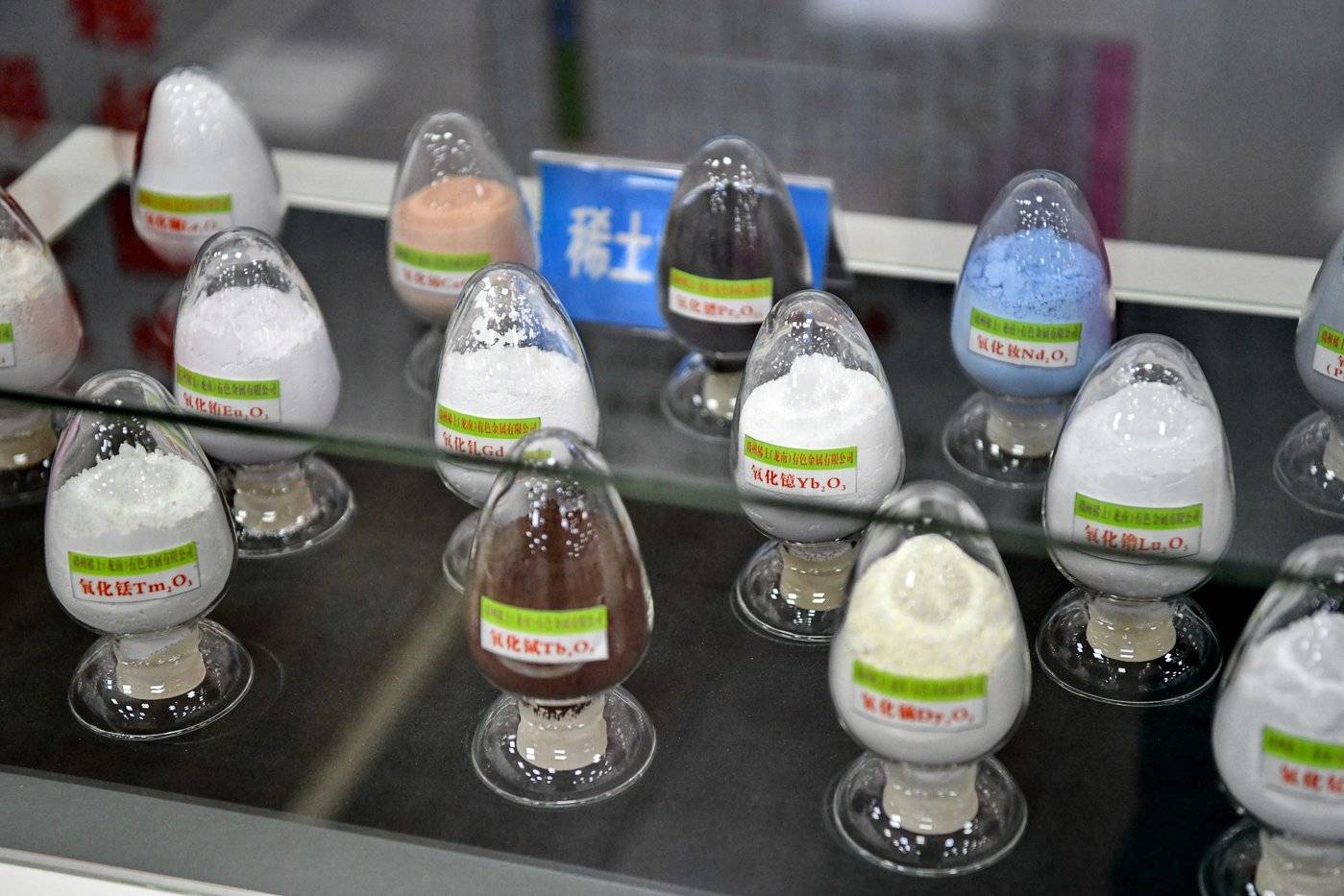
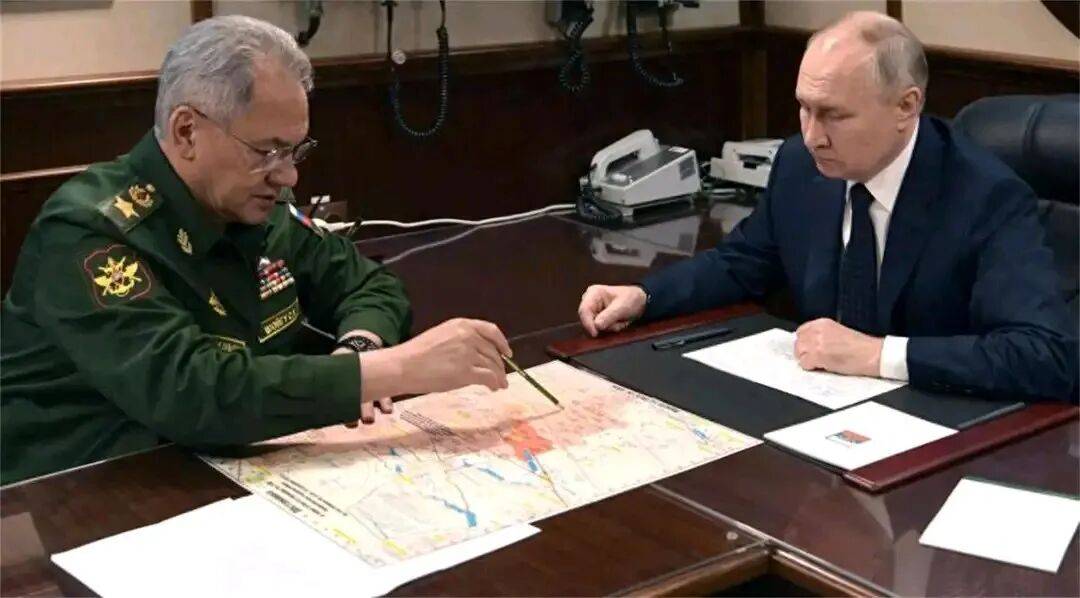
Core Viewpoint - Russia aims to establish a completely self-sufficient rare earth industry, independent of the US and China, from mining to finished products, as stated by Security Council Secretary Shoigu, reflecting the Kremlin's strategic intentions regarding this critical resource [1]. Group 1: Russia's Rare Earth Resources - Russia ranks among the top five countries globally in rare earth reserves, with approximately 28.5 million tons, primarily located in Tomsk, Yakutia, and Murmansk [3]. - Despite its rich reserves, Russia's annual rare earth production is only 2,600 tons, accounting for less than 1% of the global market, which is significantly lower compared to China's annual production of 270,000 tons [3][4]. Group 2: Strategic Importance of Rare Earth Industry - The development of the rare earth industry is crucial for Russia's national security, as reliance on Chinese rare earths poses risks despite the current strong Sino-Russian relations [4]. - The economic transformation driven by the rare earth industry is urgent, as it can create jobs and stimulate the development of downstream industries like semiconductors. Russia plans to invest over 700 billion rubles in Siberia to establish a processing cluster for critical rare and precious metals, potentially creating 3,500 jobs in the first phase [4]. Group 3: International Influence and Supply Chain Dynamics - Achieving self-sufficiency in the rare earth sector could alter the global supply landscape, providing Russia with leverage in its geopolitical dealings, particularly with the US [5]. Group 4: Challenges to Self-Sufficiency - Russia faces significant obstacles in developing its rare earth industry, including technological, financial, and infrastructural challenges. The technology for rare earth extraction is complex and pollution-intensive, with Russia's research capabilities having diminished since the Soviet era [7]. - Establishing a standard rare earth separation plant requires investments of several billion dollars, raising concerns about Russia's financial capacity amid ongoing conflicts and sanctions [7]. - The lack of infrastructure in Siberia complicates the establishment of a comprehensive production network for the rare earth industry, necessitating substantial investment in infrastructure [7]. Group 5: China's Technological Edge - China holds a dominant position in the rare earth sector, controlling 58% of global patents and achieving extraction costs that are only one-fourth of those in the US, with a high purity rate exceeding 99.99% [7]. - Chinese companies have a 30% higher yield in producing neodymium-iron-boron permanent magnets compared to US firms, while EU-developed alternatives fall short of high-end requirements [7]. - China has declined Russia's requests for technology transfer related to rare earth extraction, citing national security concerns and existing export control measures [9].
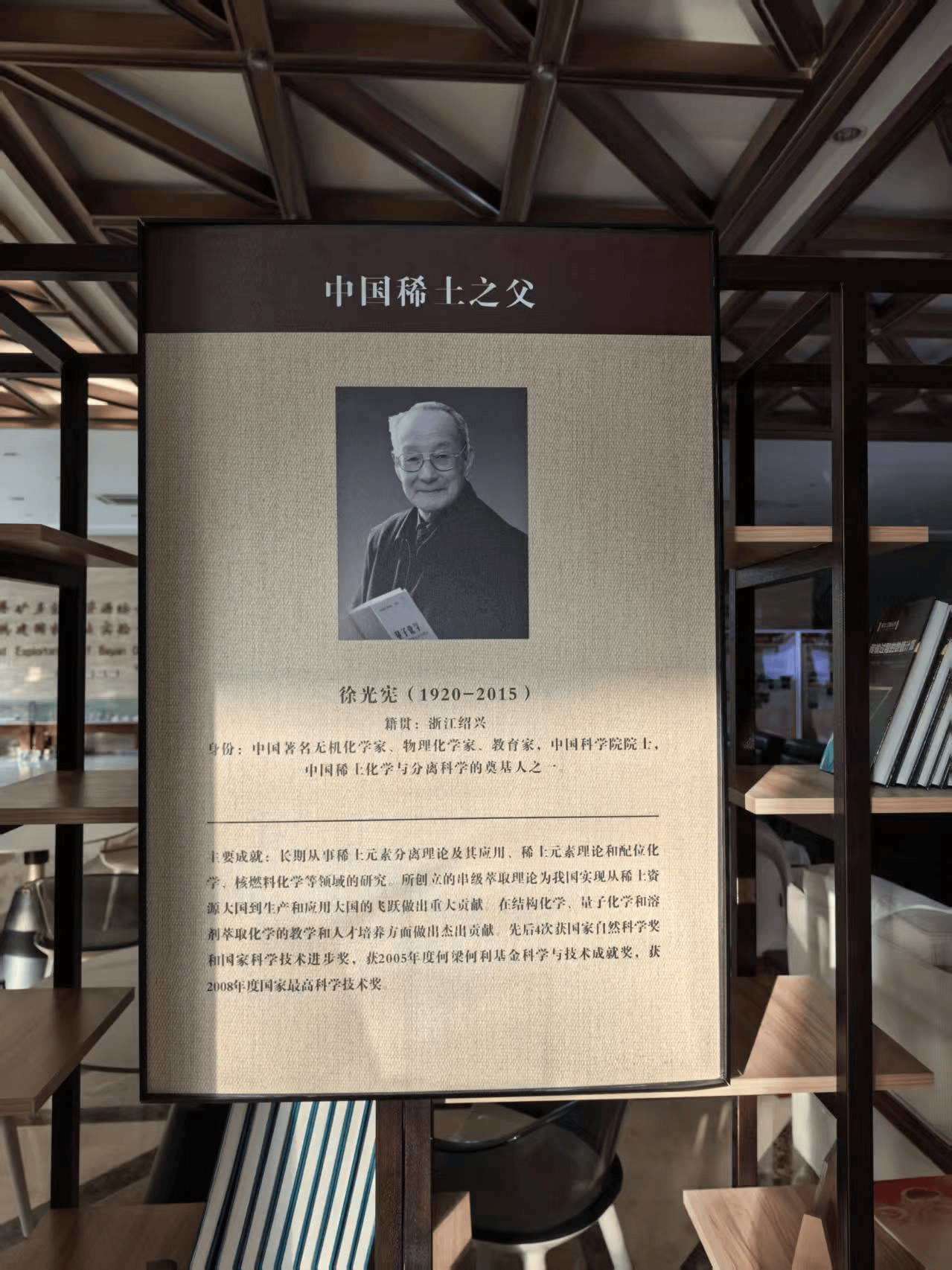
世界稀土之都与中国稀土之父 ——追星徐光宪院士包头之行随笔之九
Sou Hu Cai Jing· 2025-10-28 04:53
Core Viewpoint - The article highlights the significant contributions of Academician Xu Guangxian to the rare earth industry in Baotou, China, emphasizing his development of the staged extraction theory, which revolutionized rare earth separation and positioned Baotou as a global leader in rare earth production [1][3][10]. Group 1: Historical Context - The exploration of rare earth elements in China dates back to 1927, with significant advancements made by various scientists over the decades, culminating in Xu Guangxian's pivotal work in the 1970s and 1980s [5][10]. - Xu Guangxian's staged extraction theory was instrumental in overcoming the challenges of rare earth separation, which had previously hindered global progress in the field [3][5]. Group 2: Technological Advancements - The staged extraction theory developed by Xu Guangxian simplified the complex process of rare earth separation, significantly improving purity and efficiency, thus altering the global rare earth landscape [3][7]. - The application of this theory has led to high recovery rates of rare earth elements, with reported recovery rates of 86% for rare earths and 90% for iron from tailings at the Baiyun Obo mine [8][10]. Group 3: Industry Impact - Baotou has emerged as the "World Capital of Rare Earths," with its products being integral to various modern industries, including electric vehicles and aerospace [10][13]. - The legacy of Xu Guangxian continues to inspire new generations in the rare earth sector, with his contributions being celebrated in museums and educational institutions in Baotou [10][13].
从底层逻辑解析中国稀土-Australia Materials-Ground up China Rare Earths
2025-10-27 12:06
Summary of Key Points from the Conference Call Industry Overview - **Industry**: Rare Earths and NdFeB Magnet Markets - **Region**: China and Southeast Asia Core Insights and Arguments 1. **Policy Changes**: In August 2025, Beijing implemented new interim measures tightening controls on rare earth mining and processing, with production quotas no longer disclosed publicly. The first batch of 2025 quotas showed mining quotas up 2-5% YoY, with light rare earths comprising ~85% and medium/heavy rare earths ~15% [3][3][3] 2. **Feedstock Imports Decline**: China's rare earth feedstock imports fell by ~20% YoY from January to August 2025. Myanmar, a significant source, has mandated a halt to local rare earth mining from December 31, 2025, which could impact global NdPr supply [4][4][4] 3. **Price Trends**: NdPr prices are expected to soften into Q4 2025 from ~US$75/kg, influenced by eased export controls in Southeast Asia. However, there is potential upside risk for Dy and Tb prices due to thin spot markets and increasing European premiums [5][5][5] 4. **Export Recovery**: China's rare earth oxide exports rebounded significantly, with July exports at 6,422 tons (+69% YoY). Magnet exports also surged after a decline in May, indicating a recovery driven by backlogged orders and accelerated export license issuance [6][6][6] 5. **Capacity Utilization**: China's rare earth smelter operating rates decreased from ~40% in February to ~29% in July 2025, with leading enterprises maintaining higher rates due to scale and technology advantages [9][9][9] 6. **Magnet Price Stabilization**: N55 magnet blank prices rose sharply from ~US$23/kg in June to ~US$37–$38.50/kg in September 2025, with expectations for stabilization as order backlogs clear [10][10][10] 7. **Demand Drivers**: Strong demand is supported by electric vehicle sales, renewable energy, and automation/robotics. The introduction of humanoid robots is projected to add ~6,100 tons of NdFeB demand in 2025 [12][12][12] 8. **Supply Constraints**: Mined output remains stable under control quotas, but summer heat/power curbs and tighter governance are expected to lower mined supply in Q4 2025 [13][13][13] Additional Important Information - **Geopolitical Factors**: The geopolitical situation in Myanmar has led to a significant reduction in rare earth flows, which could have broader implications for global supply chains [4][4][4] - **Market Dynamics**: The interplay between domestic production and import reliance is critical, with a sourcing ratio of ~3:1 favoring domestic supply YTD [4][4][4] - **Future Projects**: Limited new mining projects are anticipated in the near term, although downstream expansions continue, such as a 10ktpa separation line under construction [11][11][11] This summary encapsulates the critical insights and trends affecting the rare earths and NdFeB magnet markets, highlighting both opportunities and risks for investors.
谁在偷卖中国稀土?3.5吨藏废铁运欧洲!还泄露军工稀土技术
Sou Hu Cai Jing· 2025-10-27 07:49
Core Viewpoint - Recent revelations indicate a significant increase in rare earth smuggling activities, posing a threat to national security and industrial integrity [1][7]. Group 1: Smuggling Incidents - A recent case involved the Xiamen Customs seizing a container labeled as "scrap metal," which contained 3.5 tons of rusty rare earth waste intended for Europe [3]. - Another incident at Guangzhou Baiyun Airport uncovered 2.3 tons of rare earth oxides hidden in a container marked as "cosmetic raw materials" [3][4]. - These incidents highlight a growing underground network for rare earth smuggling, with criminals employing increasingly sophisticated methods to evade detection [3][4]. Group 2: Importance of Rare Earth Elements - Rare earth elements are critical for advanced technologies, including missiles, aircraft carriers, satellites, and various high-tech products such as smartphones and electric vehicles [3][7]. - China holds a dominant position in global rare earth reserves, particularly in medium and heavy rare earths, accounting for 90% of the global supply [3]. Group 3: Smuggling Techniques - Smugglers have been found to mix rare earth materials with scrap to disguise them, using methods such as adding rust to neodymium-iron-boron waste [4]. - Advanced detection systems, including AI and density scanning technology, have been implemented by customs to combat these smuggling tactics [6]. Group 4: Government Response - In May 2024, a joint operation by the Ministry of Commerce, Public Security, National Security, and Customs was launched to combat rare earth smuggling, resulting in over 130 cases and more than 5 billion yuan involved in just three months [6]. - Legal measures are being discussed to enhance penalties for rare earth smuggling, with some experts suggesting that the severity of penalties should align with those for drug trafficking due to the potential national security implications [6][8]. Group 5: Broader Implications - The smuggling of rare earths not only threatens national resources but also undermines China's industrial foundation and aids foreign military technology development [7]. - The persistence of smuggling activities raises questions about the underlying networks supporting these operations and the need for comprehensive strategies to dismantle them [8].

中国稀土10月24日获融资买入2.18亿元,融资余额23.35亿元
Xin Lang Cai Jing· 2025-10-27 05:52
Core Insights - China's rare earth sector saw a price increase of 2.28% on October 24, with a trading volume of 2.167 billion yuan [1] - The financing buy-in for China's rare earth reached 218 million yuan, with a net buy of approximately 20.99 million yuan [1] - The total financing and securities lending balance for China's rare earth stood at 2.351 billion yuan as of October 24 [1] Financing Summary - On October 24, the financing buy-in for China's rare earth was 218 million yuan, with a financing balance of 2.335 billion yuan, accounting for 4.02% of the circulating market value [1] - The financing balance is above the 80th percentile level over the past year, indicating a high position [1] - The securities lending data showed a repayment of 23,700 shares and a sell-out of 5,300 shares, with a sell-out amount of 290,200 yuan [1] Company Performance - As of September 19, the number of shareholders for China's rare earth reached 230,000, an increase of 6.66% [2] - For the first half of 2025, China's rare earth reported a revenue of 1.875 billion yuan, a year-on-year growth of 62.38%, and a net profit of 162 million yuan, up 166.16% [2] - Cumulatively, the company has distributed 346 million yuan in dividends since its A-share listing, with 124 million yuan in the last three years [3] Shareholder Composition - As of June 30, 2025, Hong Kong Central Clearing Limited was the fourth-largest circulating shareholder, holding 19.6025 million shares, an increase of 3.8909 million shares [3] - The Southern CSI 500 ETF ranked fifth among circulating shareholders with 11.0663 million shares, an increase of 1.4870 million shares [3] - The Southern CSI Shenwan Nonferrous Metals ETF has exited the top ten circulating shareholders list [3]
A股,冲刺!
Zhong Guo Ji Jin Bao· 2025-10-27 05:07
Market Overview - The A-share market opened positively on October 27, with major indices closing higher: Shanghai Composite Index up 1.04%, Shenzhen Component Index up 1.26%, and ChiNext Index up 1.54%, approaching the 4000-point mark [1][3] - The total market turnover reached 1.58 trillion yuan, showing a significant increase compared to the previous day, with over 3700 stocks rising [3] Sector Performance - Key sectors that performed well included telecommunications, steel, non-ferrous metals, and electronics, with notable gains in controllable nuclear fusion, Fujian local stocks, and storage chips [3][7] - The non-ferrous metals sector was particularly active, with stocks like Antai Technology and Xiamen Tungsten hitting the daily limit, while other companies like Dongfang Tantalum and Zhongtung High-tech also saw significant increases [10][12] Notable Stocks - In the Hong Kong market, Baidu Group led the gains with a rise of over 5%, contributing to a 1.02% increase in the Hang Seng Index [3][4] - Fujian local stocks saw a collective surge, with Haixia Innovation hitting the daily limit and other stocks like Fujian Cement and Zhangzhou Development also performing strongly [7][8] Upcoming Events - The 2025 Financial Street Forum is set to open in the afternoon of October 27, with key financial leaders expected to deliver speeches, which has generated market anticipation for potential policy announcements [5][6] Strategic Insights - Recent signals of easing tensions in US-China relations and the release of the "14th Five-Year Plan" are expected to enhance market risk appetite and provide a clearer growth path for A-shares through technological breakthroughs and industrial upgrades [4][6]



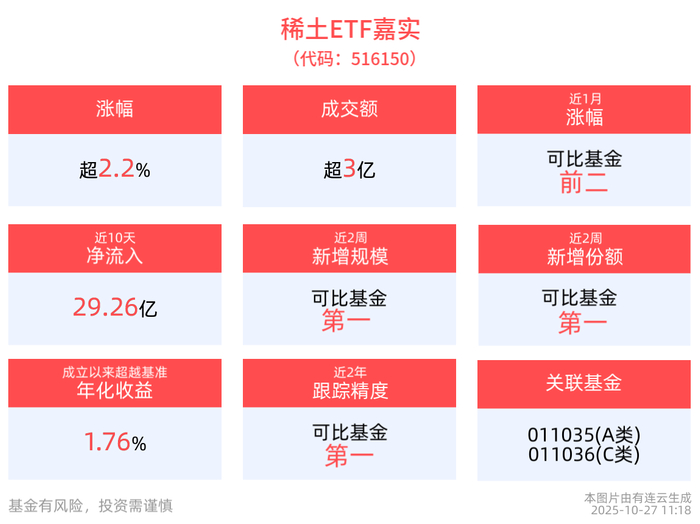
稀土板块长期估值中枢持续提升,稀土ETF嘉实(516150)上涨2.20%,成分股安泰科技、厦门钨业10cm涨停
Xin Lang Cai Jing· 2025-10-27 03:57
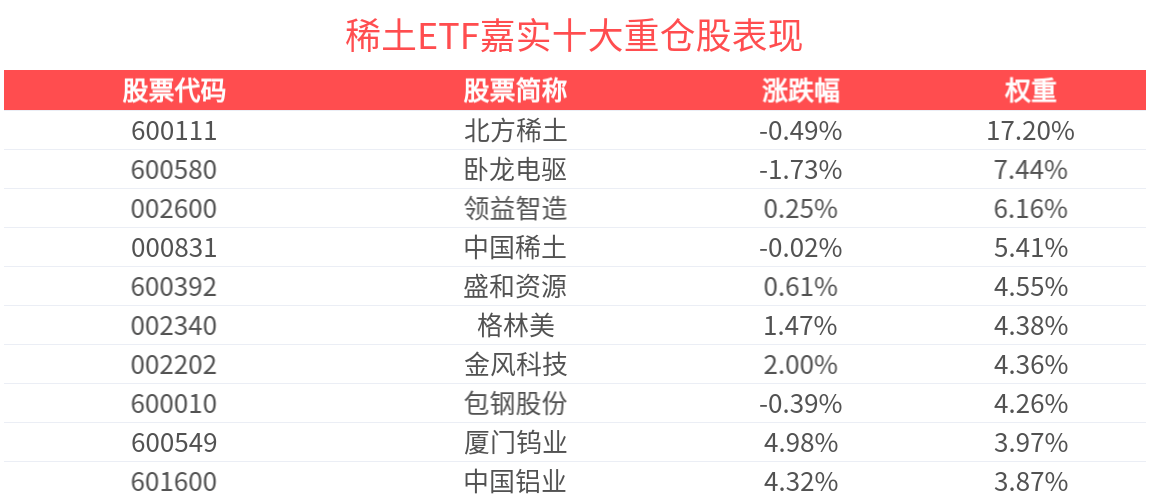
Core Insights - The rare earth industry index in China has seen a strong increase of 2.21%, with key stocks such as Antai Technology and Xiamen Tungsten hitting the daily limit up, indicating positive market sentiment and performance in the sector [1] - The recent export control measures by the Chinese government on rare earth materials and technologies have further solidified the strategic value of rare earths, leading to a reassessment of their long-term valuation in the international market [4][5] Market Performance - The rare earth ETF managed by Jiashi has experienced a turnover rate of 3.38% and a transaction volume of 365 million yuan, reflecting active trading [3] - Over the past two weeks, the Jiashi rare earth ETF has seen a significant growth in scale by 1.66 billion yuan, ranking first among comparable funds [3] - The ETF's net asset value has increased by 94.08% over the past two years, placing it in the top 4.31% of index equity funds [4] Stock Performance - The top ten weighted stocks in the China rare earth industry index account for 61.96% of the index, with North Rare Earth and Wolong Electric Drive being the most significant contributors [4] - Notable stock performances include North Rare Earth rising by 3.61% and Xiamen Tungsten by 10.00%, indicating strong investor interest [7] Supply and Demand Dynamics - The supply side is facing challenges with sluggish shipments from rare earth mines, increasing pressure on holders [4] - On the demand side, there is a weakening terminal demand and a cautious sentiment among large manufacturers, who are primarily restocking based on immediate needs [4] Investment Opportunities - The recent policy changes and market sentiment are positively impacting the rare earth sector, with expectations of continued global demand growth supporting the industry's outlook [5] - Investors can also consider the Jiashi rare earth ETF connection fund to capitalize on investment opportunities in the rare earth market [7]