WLY(000858)

Search documents
“大咖话川酒” 五粮液加快国际化进程
Zheng Quan Shi Bao Wang· 2025-09-19 15:08
Core Viewpoint - The event "Big Talks on Sichuan Liquor" highlighted the significance of multi-grain brewing in Chinese liquor culture and the global expansion of Chinese Baijiu, particularly focusing on Wuliangye's unique qualities and its role in promoting Chinese culture internationally [1][2]. Group 1: Wuliangye's Unique Qualities - Wuliangye is a distilled liquor made from five grains (sorghum, rice, glutinous rice, wheat, and corn), showcasing a "five characteristics" approach: innovative category, high-end quality, technological leadership, value scarcity, and unique branding [1]. - The ancient brewing techniques of Wuliangye have evolved through a process of "innovation while maintaining tradition," resulting in the most complex fermentation processes in the liquor industry [1]. Group 2: Cultural and Global Significance - Wuliangye is seen as a key player in the high-quality development of the Chinese Baijiu industry and is expected to lead the internationalization of Chinese Baijiu [2]. - The company actively embraces globalization, integrating into initiatives like the Belt and Road and promoting Chinese culture on the international stage [2]. Group 3: International Expansion Efforts - Wuliangye has established partnerships with Siemens for long-term collaboration in digitalization and low-carbon solutions, enhancing its operational capabilities [3]. - The opening of Wuliangye's international restaurant in Singapore marks a significant step in its global expansion, with previous establishments in Hong Kong and Tokyo, promoting a unique blend of Chinese liquor and cuisine [3].

五粮液携手大阪世博会:赓续百年情缘 再创时代经典
Xin Hua Cai Jing· 2025-09-19 12:59
Core Insights - Five Grain Liquid continues its century-long relationship with the World Expo, showcasing Chinese liquor at the 2025 Osaka World Expo [2][3] - The company has a rich history of participation in various World Expos, emphasizing cultural confidence and innovation [3][12] - The "Five Grain Liquid Theme Day" at the China Pavilion aims to provide an immersive cultural experience [3][5] Company Activities - The event features a 12.98-meter circular screen displaying a sand painting video that narrates the century-long connection between Five Grain Liquid and the World Expo [5] - A wall of honors showcases the brand's achievements, including multiple national awards and recognition as a national intangible cultural heritage [5][6] - Five Grain Liquid presented a commemorative gift box to the Osaka Expo China Pavilion, symbolizing the enduring friendship [6] International Strategy - The company is transitioning from "product export" to "value export," focusing on emotional connections with Japanese consumers [7] - The opening of the "New Longyin" restaurant in Osaka marks the second overseas authorized restaurant, enhancing local dining experiences [7][8] - Five Grain Liquid's marketing activities during the "Five Grain Liquid Theme Day" have received positive feedback from consumers, highlighting the fusion of Chinese and Japanese culinary aesthetics [8] Cultural Exchange and Global Presence - Five Grain Liquid has been actively promoting cultural exchange through its "Harmony Global Tour" in 17 countries, fostering mutual appreciation of different cultures [12] - The company has established restaurants in key international markets, collaborating with Michelin to create unique dining experiences [12] - Five Grain Liquid is committed to setting international standards for Chinese liquor and promoting sustainable development practices [13] Future Outlook - The company aims to leverage high-level global platforms to enhance cultural exchanges and create better experiences for consumers worldwide [13]

“五粮液日”闪耀大阪世博会 中国白酒香飘世界舞台
Zheng Quan Ri Bao Zhi Sheng· 2025-09-19 12:41
Core Insights - Wuliangye, a senior partner of the China Pavilion at the 2025 Osaka Expo, hosted a unique brand theme day event to showcase Chinese liquor culture and the value of Chinese national brands [1][3] - The event featured immersive cultural experiences and wine tasting, allowing international guests to appreciate the depth of Chinese Baijiu culture [1][3] Group 1: Event Highlights - The event included storytelling, classic product displays, and interactive activities to engage the audience [1] - Wuliangye presented a commemorative gift box to the China Pavilion, symbolizing the friendship and collaboration between the two parties [1] - The exhibition showcased various themes such as sustainable development and intangible cultural heritage through diverse formats like sand painting and videos [2] Group 2: Brand Representation - The exhibition highlighted Wuliangye's historical achievements since its debut at the 1915 Panama International Exposition, emphasizing its century-long legacy [2] - A central display featured a range of Wuliangye products, including special editions and traditional series, showcasing the brand's rich product matrix and cultural significance [2] - The event incorporated elements of Sichuan culture, such as bamboo and panda motifs, enhancing Wuliangye's image as a cultural ambassador for the region [2] Group 3: Future Commitment - Wuliangye aims to continue promoting the internationalization of Chinese Baijiu culture, using its products as a medium to foster global dialogue and cultural exchange [3] - The company is committed to creating a harmonious living experience for global consumers through the storytelling of Chinese Baijiu [3]
尼尔森IQ中国区出海业务负责人夏知秋:扬帆·破浪—中国企业出海之消费者及市场洞察 | 2025中国—东盟博览会品牌文化出海交流会
3 6 Ke· 2025-09-19 11:21
Core Viewpoint - The globalization narrative of Chinese companies is shifting from merely exporting products to offering culturally rich experiences and identities, as highlighted in the recent event "Breaking the Circle: Chinese Brand Culture Goes Global" hosted by 36Kr [1] Group 1: Market Trends and Opportunities - Southeast Asia is currently the fastest-growing export region for China, surpassing Europe and the US, driven by factors such as convenient transportation and favorable tariffs [5] - The consumer goods market in North America and Europe accounts for 72% of the global market, indicating that these regions are essential for any company aiming for true globalization [9] - The organic sales growth in Asia is relatively high, with consumers willing to spend more, suggesting potential for market entry and expansion [11][15] Group 2: Successful Case Studies - Wuliangye's export strategy involves collaboration with Michelin to reposition its brand in markets like Singapore and Thailand, successfully targeting younger consumers with new product offerings [6] - Anta's strategy focuses on acquiring mid-to-high-end brands to enhance its market presence, allowing it to operate globally while maintaining local brand identities [7] - Starry Innovation has found success in the niche market of pool cleaning machines in the US, demonstrating that innovative technology can thrive regardless of brand origin [8] Group 3: Consumer Behavior Insights - Southeast Asian consumers prioritize convenience, health, and value for money, with a cultural inclination towards a relaxed lifestyle, which influences their purchasing decisions [14][16] - The local consumer market shows a preference for affordable alternatives, indicating a strong presence of "value-for-money" products [16] - There is a notable difference in consumer concerns between Chinese and Southeast Asian markets, with the latter being more sensitive to food prices and public service costs [14] Group 4: Strategic Recommendations - Companies must adapt their strategies to local markets rather than simply exporting Chinese products, emphasizing the need for localized marketing approaches [20] - Embracing change and actively seeking out opportunities for globalization can help companies secure a competitive edge in the international market [21]



上半年8家上市白酒企直销营收超640亿元
Mei Ri Jing Ji Xin Wen· 2025-09-19 10:45
Core Insights - The direct sales channel is emerging as a new battleground for the liquor industry, with eight listed liquor companies reporting direct sales revenue exceeding 64.68 billion yuan in the first half of the year [1][2] - Moutai and Wuliangye are leading the direct sales segment, with both companies achieving over 40% of their revenue from direct sales [1][2] Group 1: Direct Sales Performance - In the first half of the year, Moutai's direct sales revenue reached 40.01 billion yuan, a year-on-year increase of 18.6%, while Wuliangye's direct sales revenue was 21.20 billion yuan, up 8.6% [2] - Other companies like Luzhou Laojiao and Gujing Gongji have shown significant growth in direct sales, with Gujing Gongji's direct sales revenue increasing by 40.19% to 0.0573 billion yuan [2][4] - However, companies such as Shanxi Fenjiu and Yanghe have experienced declines in direct sales revenue, with Shanxi Fenjiu's direct sales down 17.63% to 1.36 billion yuan [2][3] Group 2: Trends in Direct Sales - The overall trend for leading liquor companies shows a rising proportion of direct sales revenue, with Moutai's direct sales share increasing from 39.79% in 2022 to 43.79% in 2024 [4] - Wuliangye's direct sales share also grew from 36.6% to 38.56% during the same period [4] - Regional companies like Yingjia Gongji and Jianshiyuan have also seen their direct sales proportions increase, indicating a broader industry trend [4] Group 3: Future of Direct Sales - The rise of e-commerce and instant retail is reshaping the liquor sales landscape, with online sales in the liquor sector projected to reach 200 billion yuan by 2024 [6] - Moutai and Wuliangye are actively expanding their direct sales channels through e-commerce platforms and instant retail, positioning themselves for future growth [6][7] - The direct sales model is expected to enhance profit margins, with Moutai's direct sales gross margin at 95.33%, significantly higher than traditional wholesale margins [7]

白酒板块9月19日涨0.08%,*ST岩石领涨,主力资金净流出3.12亿元
Zheng Xing Xing Ye Ri Bao· 2025-09-19 08:47
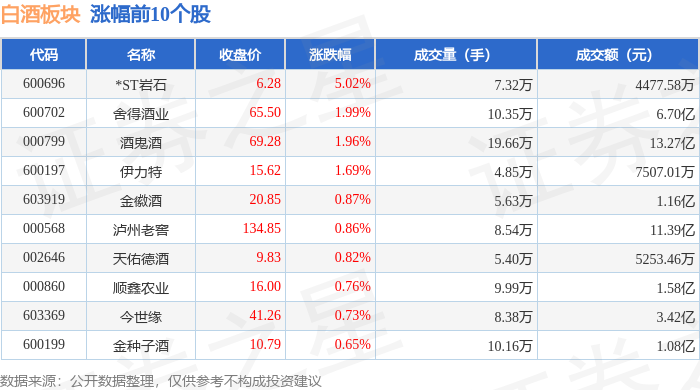
Market Overview - On September 19, the liquor sector rose by 0.08% compared to the previous trading day, with *ST Rock leading the gains [1] - The Shanghai Composite Index closed at 3820.09, down 0.3%, while the Shenzhen Component Index closed at 13070.86, down 0.04% [1] Individual Stock Performance - *ST Rock (600696) closed at 6.28, up 5.02% with a trading volume of 73,200 shares and a turnover of 44.78 million yuan [1] - Other notable performers include: - Shede Liquor (600702) at 65.50, up 1.99% with a turnover of 670 million yuan [1] - Si Gu Dian (000799) at 69.28, up 1.96% with a turnover of 1.327 billion yuan [1] - Yilite (600197) at 15.62, up 1.69% with a turnover of 7.51 million yuan [1] - Luzhou Laojiao (000568) at 134.85, up 0.86% with a turnover of 1.139 billion yuan [1] Capital Flow Analysis - The liquor sector experienced a net outflow of 312 million yuan from institutional investors, while retail investors saw a net inflow of 445 million yuan [2] - The capital flow for individual stocks shows: - Jiu Gu Dian (000799) had a net inflow of 25.85 million yuan from institutional investors [3] - Yanghe Distillery (002304) had a net inflow of 17.60 million yuan from institutional investors [3] - *ST Rock (600696) had a net inflow of 8.87 million yuan from institutional investors [3] Summary of Trading Activity - The trading activity indicates a mixed sentiment in the liquor sector, with some stocks gaining while others faced declines [2][3] - The overall market trend reflects cautious investor behavior, with significant capital movements between institutional and retail investors [2][3]


15只白酒股上涨 贵州茅台1467.97元/股收盘
Bei Jing Shang Bao· 2025-09-19 08:15
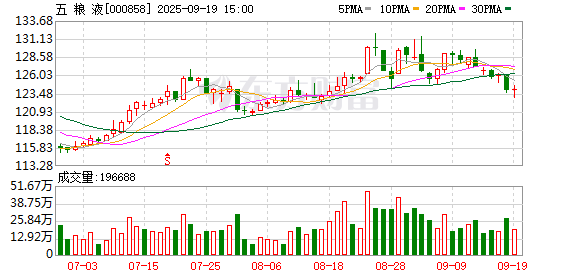
Group 1 - The three major indices collectively declined, with the Shanghai Composite Index closing at 3820.09 points, down 0.30% [1] - The liquor sector closed at 2317.98 points, up 0.11%, with 15 liquor stocks rising [1] - Individual stock performance included Kweichow Moutai closing at 1467.97 CNY per share, unchanged; Wuliangye at 124.08 CNY, up 0.11%; Shanxi Fenjiu at 200.00 CNY, down 0.50%; Luzhou Laojiao at 134.85 CNY, up 0.86%; and Yanghe Brewery at 70.45 CNY, up 0.46% [1] Group 2 - Guosen Securities believes that liquor companies will focus on destocking and promoting sales in the short term [1] - In the medium to long term, there should be an increased emphasis on consumer engagement and consumption scenario cultivation, along with active internationalization and targeting younger demographics [1]



五粮液持续闪耀2025大阪世博会,以“和美”对话全球
Zhong Guo Jing Ji Wang· 2025-09-19 06:49
Core Insights - The article highlights the successful hosting of the "Wuliangye Theme Day" at the 2025 Osaka World Expo, showcasing the brand's cultural heritage and confidence in Chinese liquor [1][2][4] Group 1: Event Overview - Wuliangye, a major Chinese liquor brand, held a series of activities at the China Pavilion during the Osaka Expo, emphasizing Sichuan culture and liquor traditions [1][2] - The "Wuliangye Theme Day" included interactive experiences and a licensing ceremony for the "Shinryugin" restaurant, marking it as Wuliangye's second authorized overseas restaurant [1][4] Group 2: Cultural Representation - The event featured artistic installations reflecting Sichuan culture, including bamboo weaving and giant panda elements, promoting the theme of "harmonious coexistence" [2][3] - A multimedia exhibition titled "Wuliangye Museum" showcased the brand's history, ecological advantages, and craftsmanship, enhancing visitor engagement through interactive elements [3][4] Group 3: Marketing Strategy - Wuliangye's marketing activities extended beyond the expo, with simultaneous events in Tokyo and Osaka, offering unique dining experiences and interactive promotions [4][5] - The opening of a new Wuliangye restaurant in Singapore further expands the brand's global presence, featuring a modern Chinese aesthetic and a focus on Cantonese cuisine [5][6] Group 4: Brand Philosophy - The brand's activities at the expo align with its long-standing cultural philosophy of "harmonious coexistence," aiming to promote Chinese liquor and culture on an international stage [5][6] - Wuliangye has a historical connection with world expos, having participated since 1915, and continues to leverage these platforms to enhance cultural exchange and brand visibility [6]
白酒板块午盘下跌贵州茅台微跌0.15%
Xin Lang Cai Jing· 2025-09-19 06:02
Core Viewpoint - The liquor sector, particularly the baijiu industry, is experiencing a downturn, with significant declines in stock prices for major companies, indicating a potential industry shift and the need for market restructuring [1] Industry Summary - On September 19, the Shanghai Composite Index fell by 0.03% to 3830.65 points, while the baijiu sector closed at 2299.94 points, down 0.67% [1] - Among 15 baijiu stocks, the majority experienced declines, with Shui Jing Fang leading the drop at 2.20% [1] - Major companies such as Kweichow Moutai, Wuliangye, Shanxi Fenjiu, and Luzhou Laojiao saw their stock prices decrease by 0.15%, 0.40%, 1.40%, and a slight decline respectively [1] Company Summary - According to招商证券, the second quarter has seen an accelerated clearing in the baijiu industry, particularly among second and third-tier companies, while leading firms show resilience [1] - The financial reports of leading liquor companies will serve as a critical signal for an industry turning point, which may lead to a restructuring of the industry and distribution channels [1]

沪深300ESGETF南方(560180)跌0.61%,半日成交额720.83万元
Xin Lang Cai Jing· 2025-09-19 05:23
Group 1 - The core point of the article highlights the performance of the HuShen 300 ESG ETF managed by Southern Fund Management, which has seen a return of 14.38% since its inception on April 13, 2023, and a monthly return of 6.09% [1] - As of the midday close on September 19, the HuShen 300 ESG ETF (560180) fell by 0.61%, trading at 1.142 yuan with a transaction volume of 7.2083 million yuan [1] - The major holdings of the ETF include stocks such as Kweichow Moutai, which decreased by 0.15%, and China Merchants Bank, which increased by 0.91% [1] Group 2 - The ETF's performance benchmark is the HuShen 300 ESG Index return rate, indicating its alignment with ESG investment principles [1] - The fund manager is Li Jialiang, responsible for overseeing the ETF's investment strategy and performance [1] - The article provides a snapshot of the performance of various heavy-weight stocks within the ETF, including increases in stocks like Midea Group (up 0.99%) and BYD (up 0.13%), while others like Industrial and Commercial Bank of China saw a decline of 0.96% [1]