EVE(300014)

Search documents
首批国家级零碳园区建设名单公布,AI储能价值凸显
起点锂电· 2025-12-31 07:30
Core Viewpoint - The establishment of the first batch of national-level zero-carbon parks in China, with 52 projects selected, highlights the significant role of renewable energy manufacturing in driving the development of zero-carbon industrial parks, accounting for at least 40% of the total projects [2][4]. Group 1: Zero-Carbon Parks Overview - The layout of zero-carbon industrial parks closely aligns with China's renewable energy industry map, indicating that leading enterprises' production bases are becoming models for deep decarbonization [4]. - The "Inner Mongolia Ordos Mengsu Economic Development Zone" features the world's first fully carbon-neutral battery factory, showcasing a complete industrial chain that includes lithium battery production and 100% zero-carbon energy supply [4][5]. - AI energy storage systems play a crucial role in ensuring stable power supply and reducing energy costs within zero-carbon parks, acting as a bridge between unstable green electricity and continuous industrial production [5]. Group 2: AI Energy Storage and Global Expansion - The AI energy storage system in the Yincheng Zero-Carbon Industrial Park allows for millisecond-level coordination between renewable energy generation and production loads, maximizing green electricity utilization and reducing electricity costs [5]. - The first batch of zero-carbon parks aims to provide replicable models for low-carbon and zero-carbon transformations globally, with the Yincheng model already being implemented in Europe, indicating international market recognition [5][6]. - Over ten zero-carbon parks in the national list are co-built with Yincheng, covering various challenging types within China's industrial system, demonstrating the potential for significant impact on global industrial decarbonization [6]. Group 3: Strategic Locations and Industry Implications - The national list of zero-carbon parks reveals strategic locations for the renewable energy industry, which has been a pioneer in responding to China's dual carbon goals since its inception [6]. - Key battery production bases associated with major companies like CATL, BYD, and others are included in the zero-carbon parks list, indicating a strong correlation between the renewable energy sector and zero-carbon initiatives [6][7]. - The zero-carbon park initiative not only showcases technological integration and operational capabilities but also offers a commercial pathway for global industrial decarbonization [6].





《关于26年实施大规模设备更新和消费品以旧换新政策的通知》点评:电动车补贴延续,26年电动车渗透率有望再提升
Shenwan Hongyuan Securities· 2025-12-31 07:12
Investment Rating - The industry investment rating is "Overweight" indicating a positive outlook for the sector compared to the overall market performance [2]. Core Insights - The report highlights the continuation of electric vehicle (EV) subsidies in 2026, which is expected to enhance the penetration rate of EVs and boost sales, particularly for mid to high-priced models [2]. - The implementation of a large-scale equipment renewal and consumer goods replacement policy reflects the government's commitment to supporting the consumption of new energy vehicles [2]. - The report anticipates a strong demand for lithium batteries in 2026, driven by the sustained growth in electric vehicle sales and the continuation of the old-for-new policy [2]. Summary by Sections Policy Impact - The 2026 policy includes subsidies for scrapping and replacing old vehicles, with personal consumers receiving up to 20,000 yuan for qualifying new energy vehicles [2]. - The policy aims to support the transition to low-emission vehicles, including electric trucks and city buses, thereby alleviating concerns about subsidy reductions for electric heavy trucks [2]. Market Performance - In 2025, the old-for-new policy significantly boosted the sales of new energy vehicles, with production and sales reaching 14.91 million and 14.78 million units respectively, marking a year-on-year growth of 31.4% and 31.2% [2]. - The report notes that the domestic power battery sales reached 1,044.3 GWh in 2025, reflecting a 50.3% year-on-year increase, indicating a robust market for battery manufacturers [2]. Investment Recommendations - The report suggests focusing on leading battery companies such as CATL, Zhongxin Innovation, and Yiwei Lithium Energy, as well as material suppliers like Hunan Youneng and Tianwei Technology, due to their strong market positions and growth potential [2]. - The anticipated increase in electric vehicle penetration and battery demand presents a favorable investment landscape for stakeholders in the new energy sector [2].


固态电池行业深度报告:材料和工艺设备体系革新,固态电池产业化加速
Shanghai Aijian Securities· 2025-12-31 06:24
证券研究报告 行业研究 / 行业深度 2025 年 12 月 31 日 行业及产业 电力设备 一年内行业指数与沪深 300 指数对比走势: 资料来源:聚源数据,爱建证券研究所 相关研究 《数据中心供配电设备行业跟踪:海外云厂商 资本开支高增长,电力设备需求高企》 2025-12-30 《光储行业跟踪:11 月国内光伏装机同比增 长,双玻组件价格小幅上涨》2025-12-30 《锂电行业跟踪:动力和储能电池需求旺盛, 储能电芯和系统均价上涨》2025-12-30 《2026 年电新行业策略报告:新能源基本业务 向上+国家战略安全资产赋能有望成为最强主 线》2025-12-30 盛,锂电材料价格回升》2025-12-23 朱攀 S0820525070001 021-32229888-25527 zhupan@ajzq.com 联系人 陆嘉怡 S0820124120008 021-32229888-25521 lujiayi@ajzq.com ——固态电池行业深度报告 材料和工艺设备体系革新,固态电池产 业化加速 强于大市 投资要点: 固态电池电解质固态化是核心,具有能量密度和安全性优势,体型的硫化物全固态电池是趋 ...


动力和储能电池需求旺盛,储能电芯和系统均价上涨
Zhong Guo Neng Yuan Wang· 2025-12-31 03:05
Core Viewpoint - The lithium battery industry is experiencing significant growth in production and demand, with notable increases in both battery and phosphoric iron lithium cathode material output in November 2025 compared to the same period in 2024 [1][2]. Production - In November 2025, domestic battery production reached 176.3 GWh, marking a year-on-year increase of 49.66% and a month-on-month increase of 3.34% [1][2]. - The production of phosphoric iron lithium cathode materials in November 2025 was 26.89 million tons, reflecting a year-on-year growth of 29.43% and a month-on-month growth of 0.75%, with a capacity utilization rate of 62.53% [1][2]. Pricing - As of December 26, 2025, the price of industrial-grade lithium carbonate rose to 116,000 yuan per ton, with a weekly increase of 14.85% [3]. - The price of phosphoric iron lithium (power type) reached 45,100 yuan per ton on December 26, up over 15% from December 19 [3]. - Prices for lithium hexafluorophosphate remained stable at 180,000 yuan per ton as of December 27 [3]. - The average price of square phosphoric iron lithium energy storage batteries remained stable, with slight increases in specific models [3]. Demand - In November 2025, the monthly loading volume of phosphoric iron lithium batteries was 75.3 GWh, a year-on-year increase of 43.62% and a month-on-month increase of 11.56%, achieving a new high for the year [4]. - The monthly loading volume of ternary power batteries was 18.2 GWh, reflecting a year-on-year increase of 33.82% and a month-on-month increase of 10.30% [4]. - The new bidding capacity for domestic new energy storage projects in January to October 2025 was higher than in the same period of 2024, with November slightly lower [4]. - In November 2025, China's battery exports reached 21.2 GWh, a year-on-year increase of 69.60% and a month-on-month increase of 9.28% [4]. Investment Recommendations - The production of domestic batteries and phosphoric iron lithium cathode materials in January to November 2025 exceeded that of 2024, with stable raw material and cell prices, and an increase in monthly loading volumes and new energy storage bidding capacities [5]. - The industry is advised to focus on core enterprises in battery cells that lead in the collaborative layout of power batteries and energy storage, as well as those related to lithium battery materials [5]. - Recommended companies include CATL (300750), EVE Energy (300014), Xinwangda (300207), Hunan Youneng (301358), Rongbai Technology (688005), Tianci Materials (002709), and Dofluor (002407) [5].


锂价翻倍、LFP 集中停产、电池厂加注钠电 锂电产业链博弈“三重门”
高工锂电· 2025-12-30 10:55
Core Viewpoint - The lithium battery industry is undergoing significant changes in pricing mechanisms, production adjustments, and technological advancements, with key players like Tianqi Lithium leading the way in redefining pricing structures and production strategies [3][8][41]. Pricing Restructuring - Lithium carbonate prices have surged, with the benchmark price exceeding 120,000 yuan/ton by December 30, marking a more than 30% increase from the beginning of the month and doubling from the year's low of under 60,000 yuan/ton [5][6]. - Tianqi Lithium announced a shift in its pricing model starting January 1, 2026, moving from a single pricing reference to a dual structure based on either the Mysteel index or the futures contract price, allowing customers to choose [9][10][12]. Production Adjustments - Major players in the lithium iron phosphate sector, including Hunan Youneng and Wanrun New Energy, have announced production cuts due to high operational loads and maintenance needs, with total reductions estimated between 30,000 to 70,000 tons, representing 7% to 17% of the domestic output in January [17][19][20]. - The industry is experiencing a shift from total price negotiations to discussions around processing fees, with leading companies seeking to raise processing fees by 2,000 to 3,000 yuan/ton to offset rising raw material costs [24][22]. Technological Developments - Sodium-ion batteries are gaining attention, with companies like CATL aiming for large-scale applications by 2026, focusing on energy storage and commercial vehicles [35][39]. - The economic viability of sodium-ion batteries is becoming more favorable as they do not require lithium carbonate or copper, providing a cost advantage in a high-price environment [38][39]. Market Dynamics - The lithium battery supply chain is attempting to redefine profit and risk boundaries in anticipation of a "tight balance" in 2026, with various strategies being employed across different segments of the industry [43][44]. - The overall net profit margin for lithium battery companies is around 9%, with upstream resources maintaining higher profitability while many midstream and downstream companies face tighter cash flows [42].



【新能源周报】新能源汽车行业信息周报(2025年12月22日-12月28日)
乘联分会· 2025-12-30 08:39
Industry Information - The 2025 Globalization and Sustainable Development Forum for the automotive industry released three key industry consensus points, emphasizing the integration of electric intelligence with ESG responsibilities, the importance of safety and user value in smart vehicles, and the necessity of sustainable development as a core requirement for the automotive industry [7] - Wuhan's 14th Five-Year Plan suggests accelerating the development of emerging industries such as embodied intelligence, high-end chips, quantum technology, and brain-computer interfaces [8] - As of November 2025, the total number of electric vehicle charging infrastructure in China reached 19.322 million, a year-on-year increase of 52.0%, with public charging facilities accounting for 4.625 million [9][10] - The total investment for the EVE Energy headquarters and Jin Yuan Robot AI Center project is approximately 1 billion yuan, focusing on sodium battery products and AI robotics [12] - Guangzhou aims to create a trillion-level smart connected new energy vehicle industry cluster as part of its 14th Five-Year Plan [13] - The "Shenzhen-Hong Kong Automotive Fast Pass Plan" has been officially implemented, streamlining the import process for electric vehicles [14] - The National Energy Administration is promoting the construction of charging piles in rural areas to support the growth of electric vehicles [15] - Huawei's ADS MAX 4.1 upgrade significantly enhances the experience in urban congestion scenarios [16] - The first batch of L3-level autonomous driving vehicle special license plates has been issued in Beijing, marking a milestone in the commercialization of autonomous vehicles [16] - By 2026, over 10,000 charging guns will be built in highway service areas across the country [16] - The National Energy Administration reported a 60.2% year-on-year increase in electricity consumption for charging and swapping services in November 2025 [18] - The first automotive intelligent chassis testing report was released, with BYD's Yangwang U7, NIO ES8, and Zhijie R7 recognized as benchmark models [20] - Hunan's electric vehicle exports exceeded 10 billion yuan for the first time, with a year-on-year growth of 105.3% [22] - Guangzhou's new energy vehicle production increased by 22.6% in the first 11 months of 2025 [22] - A total investment of 7.47 billion yuan was signed at the Ningde lithium battery new energy industry promotion conference, with an expected annual output value of 12.14 billion yuan [27] - The annual export of new energy vehicles from the Xiangyang Comprehensive Bonded Zone exceeded 10,000 units for the first time, marking a 350% year-on-year increase [27] - Inner Mongolia's Chifeng City has built 3,453 charging piles during the 14th Five-Year Plan period [29] Policy Information - The Guizhou Qiannan Prefecture government issued a plan for high-quality energy industry development from 2025 to 2027, focusing on expanding charging infrastructure [30] - The Henan Sanmenxia government released a plan for the construction of charging facilities in residential areas [31] - The Jiangsu province is adjusting its electric vehicle charging fee subsidy policy for 2026 [32] - The National Development and Reform Commission emphasized the need to regulate competition in the new energy vehicle, lithium battery, and photovoltaic industries to avoid "involution" [23][24]



锚定双碳目标 亿纬锂能全链条创新激活产业新动能
Zheng Quan Shi Bao Wang· 2025-12-30 08:29
Core Viewpoint - The article highlights the ongoing efforts of EVE Energy Co., Ltd. to enhance its capabilities in the energy storage and intelligent manufacturing sectors, emphasizing its dual focus on "hydrogen-lithium-sodium electrochemical energy storage solutions" and "comprehensive intelligent factory services" [1][6]. Group 1: Company Development and Strategy - EVE Energy has been a key player in the lithium battery industry for over 20 years, transitioning from a leading lithium battery supplier to a provider of comprehensive energy storage solutions and intelligent manufacturing services [1][6]. - The company has established a multi-dimensional financing system, raising over 10 billion yuan through various capital market tools to support its production line construction and R&D upgrades [2]. - In 2024, EVE Energy's R&D investment reached 3.06 billion yuan, a year-on-year increase of 6.58%, accounting for over 6% of its revenue [2]. Group 2: Innovation and R&D - EVE Energy has developed a comprehensive R&D system with over 6,000 researchers across various disciplines, enabling rapid transformation from theory to practice in emerging application scenarios [4]. - The company has applied for over 10,000 domestic and international patents and has been involved in 25 national-level projects, showcasing its commitment to innovation [2][4]. Group 3: Product Development and Market Position - In the consumer battery sector, EVE Energy's lithium batteries have become core components in industrial automation and automotive electronics, filling gaps in the domestic market [5]. - The company has achieved significant breakthroughs in the power battery sector, becoming the first in China to mass-produce large cylindrical batteries, with over 70 GWh of capacity and more than 60,000 units delivered [5]. - EVE Energy leads the industry in energy storage battery technology, being the first to mass-produce 600Ah+ large square lithium iron phosphate batteries, with a strong global market presence [5]. Group 4: Future Outlook and Goals - EVE Energy aims to create an industrial closed loop through its new "EVE Sodium Energy Headquarters and Jinyuan Robot AI Center," enhancing production efficiency and product precision [6]. - The company is committed to leveraging various capital market tools to strengthen its resilience and quality, while also improving governance and investor relations [6].
深走访·提质效丨锚定双碳目标 亿纬锂能全链条创新激活产业新动能
Zheng Quan Shi Bao Wang· 2025-12-30 08:28
Core Insights - The article highlights the ongoing efforts of EVE Energy Co., Ltd. to enhance its manufacturing capabilities and innovation in the energy storage sector, particularly through the establishment of the "EVE Sodium Energy Headquarters and Jinyuan Robot AI Center" project [1][6] - EVE Energy has transitioned from being a leading lithium battery supplier to a comprehensive solution provider for hydrogen, lithium, and sodium electrochemical energy storage, aiming to achieve a closed-loop system where "robots manufacture batteries for robots" [1][6] Group 1: Company Development and Financial Performance - EVE Energy has utilized capital market tools effectively, raising over 10 billion yuan through various financing methods, which has significantly bolstered its production capacity and R&D efforts [2] - In 2024, the company's R&D investment reached 3.06 billion yuan, a year-on-year increase of 6.58%, accounting for over 6% of its revenue [2] - The company has applied for over 10,000 domestic and international patents and has received multiple awards for its innovations, demonstrating its commitment to technological advancement [2] Group 2: Innovation and R&D Capabilities - EVE Energy has established a comprehensive R&D system with over 6,000 researchers across various disciplines, enabling rapid transformation from theoretical concepts to practical applications [4] - The company has developed differentiated solutions to address emerging application scenarios, enhancing its competitive edge in the industry [4] Group 3: Product and Market Position - In the consumer battery sector, EVE Energy's lithium batteries have become essential components in industrial automation and automotive electronics, filling significant market gaps [5] - The company has achieved breakthroughs in the production of cylindrical batteries, with over 70 GWh of capacity and significant market share in commercial vehicles [5] - EVE Energy leads the industry in the storage battery sector with its innovative "large square + stacking" technology, becoming the first globally to mass-produce 600Ah+ large square lithium iron phosphate storage batteries [5] Group 4: Future Growth and Strategic Goals - EVE Energy is pursuing dual objectives of becoming a comprehensive solution provider for hydrogen, lithium, and sodium electrochemical energy storage, and an intelligent factory service provider [6] - The company aims to enhance production efficiency and product precision through the integration of robotics in its manufacturing processes [6] - EVE Energy plans to leverage regulatory support and various capital market tools to strengthen its resilience and quality of development [6]
锂电行业跟踪:动力和储能电池需求旺盛,储能电芯和系统均价上涨
Shanghai Aijian Securities· 2025-12-30 06:41
Investment Rating - The industry is rated as "Outperform" compared to the market [3]. Core Insights - The demand for power and energy storage batteries is strong, with an increase in average prices for storage cells and systems [3][4]. - In November 2025, domestic battery production reached 176.3 GWh, a year-on-year increase of 49.66% and a month-on-month increase of 3.34% [3]. - The production of lithium iron phosphate (LFP) cathode materials in November 2025 was 268,900 tons, up 29.43% year-on-year and 0.75% month-on-month, with a capacity utilization rate of 62.53% [3]. - The price of industrial-grade lithium carbonate rose to 116,000 CNY/ton as of December 26, 2025, with a weekly increase of 14.85% [3]. - The average price of LFP (power type) reached 45,100 CNY/ton, increasing over 15% since December 19, 2025 [3]. - The average price of square LFP energy storage cells remained stable, with slight increases noted in December 2025 [3]. - In November 2025, the monthly loading volume of LFP batteries was 75.3 GWh, a year-on-year increase of 43.62% and a month-on-month increase of 11.56% [3]. - The export volume of Chinese power batteries in November 2025 was 21.2 GWh, a year-on-year increase of 69.60% [3]. Summary by Sections Production - In November 2025, the production of LFP cathode materials and batteries showed significant growth compared to the same period in 2024 [3][4]. Prices - Prices for key materials such as lithium carbonate and LFP have seen substantial increases, indicating a tightening supply [3][4]. Domestic Demand - The domestic demand for batteries is robust, with record loading volumes and increased tender capacities for new energy storage projects [3][4]. Overseas Demand - The export market for Chinese power batteries is expanding, with notable year-on-year growth in November 2025 [3][4].
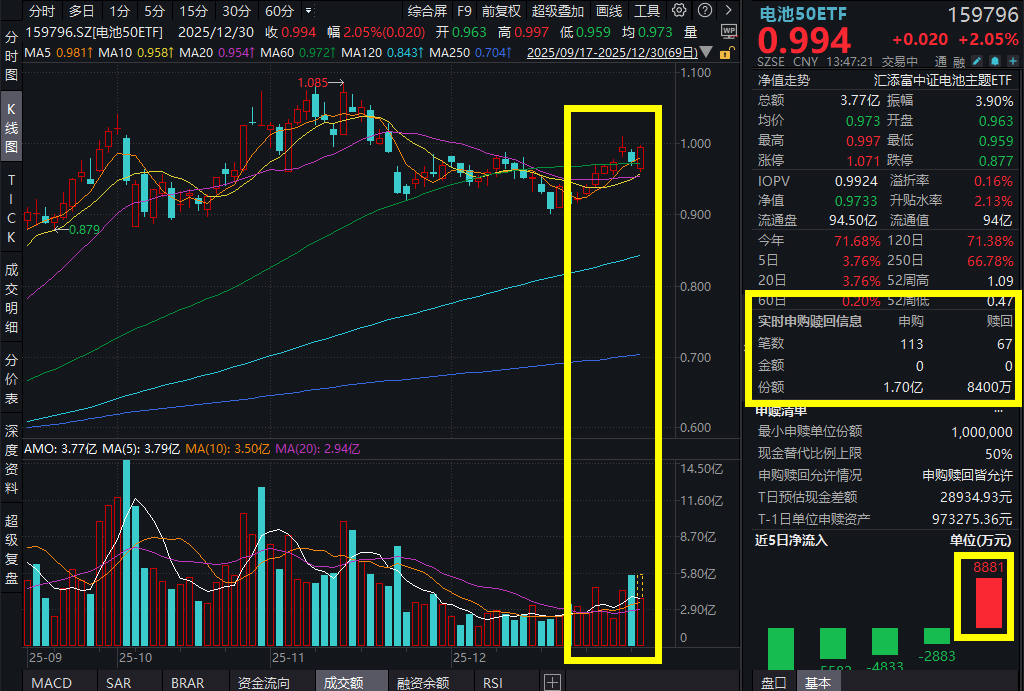
电池午后狂飙,三花智控涨停,电池50ETF(159796)大涨超2%,大举揽金8500万元!全球储能需求共振,电池后市怎么看?
Xin Lang Cai Jing· 2025-12-30 06:40
Core Viewpoint - The battery sector, particularly the battery 50 ETF (159796), has experienced a significant surge due to strong capital inflow and a rebound in component stocks, driven by the booming demand for energy storage solutions [1][3][5]. Group 1: Market Performance - As of December 30, the battery 50 ETF (159796) rose over 2%, recovering from previous declines with more than 85 million yuan in capital inflow [1]. - Key component stocks such as Sanhua Intelligent Control and Tianci Materials saw substantial gains, with Sanhua hitting the daily limit and Tianci rising over 3% [3][4]. Group 2: Industry Dynamics - The energy storage sector is experiencing a transformative shift, driven by the global energy transition and advancements in AI, leading to a significant increase in electricity demand [7]. - Domestic policies are evolving from mandatory energy storage to independent energy storage, enhancing the economic viability of storage projects [7]. - The demand for energy storage in China is projected to grow significantly, with a 118% year-on-year increase in project bidding data for the first ten months of 2025 [8]. Group 3: Future Projections - Global energy storage installations are expected to grow by over 60% next year, with a compound annual growth rate of 30-50% over the next three years [10]. - By 2025, the domestic energy storage installation capacity is anticipated to reach over 180 million kilowatts, nearly doubling within two and a half years [8]. Group 4: Investment Opportunities - The battery 50 ETF (159796) has a high concentration in the energy storage sector, with 27% of its index comprising energy storage components, positioning it well to benefit from the sector's growth [15]. - The ETF also includes a significant portion of solid-state battery technology, which is expected to see substantial advancements and market potential [15][17].