ZHONGJI INNOLIGHT(300308)

Search documents
偏振片与法拉第片:隔离器上游缺口
GOLDEN SUN SECURITIES· 2025-12-14 08:22
Investment Rating - The report maintains a "Buy" rating for key companies in the optical communication sector, including Zhongji Xuchuang, Xinyi Sheng, and Tianfu Communication [5][10]. Core Insights - The optical isolator is a critical passive device in optical communication systems, relying on the combination of polarizers and Faraday plates. There is a significant technological dependency and supply gap in the upstream manufacturing of these core components, particularly in high-end Faraday magnetic optical materials, which has become a bottleneck for industry development [1][19]. - The report highlights the low domestic production rate of core materials for polarizers, which are monopolized by Japanese and Korean suppliers, indicating a need for increased localization [3][21]. - The global shortage of Faraday plates is a critical issue, as their complex material growth and precision processing are dominated by a few companies in the US and Japan, leading to supply constraints that hinder the expansion of isolators and high-speed optical modules [4][22][23]. Summary by Sections Investment Strategy - The report suggests focusing on the upstream gaps in isolators, particularly polarizers and Faraday plates, and recommends companies like Zhongji Xuchuang, Xinyi Sheng, and Tianfu Communication for investment [8][24]. Market Review - The communication sector has seen an increase, with optical communication performing particularly well, as indicated by various indices showing significant growth [15][18]. Supply Chain Dynamics - In 2024, China's production capacity for polarizers is expected to account for approximately 73% of the global market, yet the localization rate of core materials remains below 10%, posing challenges to supply chain stability [6][7][24]. Key Companies to Watch - The report identifies several key companies to monitor within the optical communication and related sectors, including Zhongji Xuchuang, Xinyi Sheng, Tianfu Communication, and others involved in the supply chain [8][9][24].


CPO再度爆发,低费率创业板人工智能ETF华夏(159381)盘中涨超3%领涨市场,中际旭创市值再创新高
Mei Ri Jing Ji Xin Wen· 2025-12-13 02:22
Group 1 - The CPO concept has seen a resurgence, with companies like Zhongji Xuchuang rising over 5% and reaching new market highs, while others like Xinyi Sheng and Taicheng Guang also experienced gains [1] - The U.S. government has announced that it will allow NVIDIA to sell its H200 AI chips to China, which will charge a fee per chip, potentially expanding domestic computing power demand and driving investment in related industries [1] - The optical module industry chain is facing a supply gap due to rapidly increasing computing power demand, with structural shortages in upstream optical chips and slow capacity ramp-up becoming critical constraints on industry development [1] Group 2 - The Huaxia (159381) ETF tracking the ChiNext AI Index has a significant weight of 56.7% in optical modules CPO, covering domestic software and AI application companies, indicating high elasticity [2] - The top three weighted stocks in the ETF are Zhongji Xuchuang (26.62%), Xinyi Sheng (19.35%), and Tianfu Communication (5.05%) [2] - The ETF has a low overall fee rate of only 0.20%, making it the lowest among similar products [2]
电力设备掀涨停潮!A股下周怎么走?
Guo Ji Jin Rong Bao· 2025-12-12 14:49
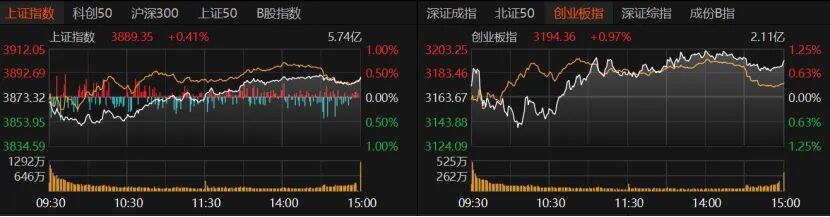
Core Viewpoint - The A-share market experienced a significant increase in trading volume, driven by positive signals from the Central Economic Work Conference, although there remains notable sector differentiation in performance [1][9]. Market Performance - The trading volume reached 2.12 trillion yuan, an increase of 233.7 billion yuan from the previous day, with the Shanghai Composite Index rising by 0.41% to 3889.35 points and the ChiNext Index increasing by 0.97% to 3194.36 points [2]. - A total of 2683 stocks rose, with 83 hitting the daily limit up, while 2612 stocks fell, with 26 hitting the daily limit down [6][7]. Sector Analysis - Technology stocks, particularly in power equipment, communication, and defense industries, saw strong performance, with 21 out of 31 sectors rising, including notable gains in non-ferrous metals, electronics, and power equipment [4][9]. - The power equipment sector experienced a surge, with 19 stocks hitting the daily limit up, indicating strong investor interest [7]. Investment Trends - The Central Economic Work Conference emphasized support for technology innovation and new energy sectors, which has led to increased investment in related stocks, particularly in power equipment and communication sectors [9][10]. - The market sentiment is expected to remain positive, with potential for a "slow bull" market trend, driven by continued policy support and sector performance [10][11]. Future Outlook - Analysts suggest that the market may continue to experience fluctuations, with a focus on sectors that align with policy support, particularly technology and cyclical industries [11][12]. - The upcoming spring market is anticipated to focus on sectors with significant growth potential, such as communication equipment benefiting from AI infrastructure and semiconductor industries supported by domestic substitution policies [12].



热点追踪周报:由创新高个股看市场投资热点(第223 期)-20251212
Guoxin Securities· 2025-12-12 13:05
Quantitative Models and Construction Methods 1. Model Name: 250-Day New High Distance Model - **Model Construction Idea**: The model tracks the distance of stock prices or indices from their 250-day high to identify market trends and hotspots. It is based on the momentum and trend-following strategy, which has been proven effective in various studies[11][18]. - **Model Construction Process**: The 250-day new high distance is calculated as follows: $ 250\text{-day new high distance} = 1 - \frac{Close_t}{\text{ts\_max}(Close, 250)} $ Where: - $ Close_t $ is the latest closing price - $ \text{ts\_max}(Close, 250) $ is the maximum closing price over the past 250 trading days If the latest closing price reaches a new high, the distance is 0. If the price has fallen from the high, the distance is a positive value, indicating the degree of decline[11]. - **Model Evaluation**: The model effectively identifies stocks and indices that are leading the market, providing insights into market trends and potential investment opportunities[11][18]. 2. Model Name: Stable New High Stock Selection Model - **Model Construction Idea**: This model focuses on selecting stocks that exhibit stable momentum characteristics, avoiding extreme price jumps. It incorporates factors such as analyst attention, price stability, and trend continuation to identify stocks with strong and consistent performance[26][28]. - **Model Construction Process**: The selection process involves the following steps: 1. **Analyst Attention**: Stocks must have at least five "Buy" or "Overweight" ratings in the past three months. 2. **Relative Strength**: Stocks must rank in the top 20% of the market in terms of 250-day price performance. 3. **Price Stability**: Stocks are scored based on: - **Price Path Smoothness**: Measured by the ratio of price displacement to the total price path. - **Momentum Continuity**: The average 250-day new high distance over the past 120 days. 4. **Trend Continuation**: The average 250-day new high distance over the past five days is calculated, and the top 50 stocks are selected based on these criteria[26][28]. - **Model Evaluation**: The model emphasizes stable momentum and avoids stocks with erratic price movements, making it suitable for identifying consistent performers[26][28]. --- Model Backtesting Results 1. 250-Day New High Distance Model - **Indices' 250-Day New High Distance**: - Shanghai Composite Index: 3.48% - Shenzhen Component Index: 3.40% - CSI 300: 3.52% - CSI 500: 5.02% - CSI 1000: 3.62% - CSI 2000: 2.46% - ChiNext Index: 3.91% - STAR 50 Index: 12.36%[12][13][33] 2. Stable New High Stock Selection Model - **Selected Stocks**: 44 stocks were identified as stable new high performers, including Zhongji Xuchuang, Guangku Technology, and Yuanjie Technology. - **Sector Distribution**: - Cyclical and technology sectors had the highest number of selected stocks, with 16 stocks each. - Within the cyclical sector, the non-ferrous metals industry had the most stocks. - Within the technology sector, the electronics industry had the most stocks[29][34]. --- Quantitative Factors and Construction Methods 1. Factor Name: 250-Day New High Distance - **Factor Construction Idea**: Measures the relative position of a stock's or index's price compared to its 250-day high, serving as a momentum indicator[11]. - **Factor Construction Process**: $ 250\text{-day new high distance} = 1 - \frac{Close_t}{\text{ts\_max}(Close, 250)} $ Where: - $ Close_t $ is the latest closing price - $ \text{ts\_max}(Close, 250) $ is the maximum closing price over the past 250 trading days[11]. - **Factor Evaluation**: The factor is effective in identifying leading stocks and indices, providing a clear signal of market momentum[11][18]. 2. Factor Name: Price Path Smoothness - **Factor Construction Idea**: Evaluates the stability of a stock's price movement over time, favoring stocks with smoother price paths[26]. - **Factor Construction Process**: - Calculate the ratio of price displacement to the total price path over a specified period. - Higher scores indicate smoother price paths, which are preferred for stable momentum strategies[26]. - **Factor Evaluation**: This factor helps avoid stocks with erratic price movements, improving the reliability of momentum-based strategies[26]. --- Factor Backtesting Results 1. 250-Day New High Distance Factor - **Indices' 250-Day New High Distance**: - Shanghai Composite Index: 3.48% - Shenzhen Component Index: 3.40% - CSI 300: 3.52% - CSI 500: 5.02% - CSI 1000: 3.62% - CSI 2000: 2.46% - ChiNext Index: 3.91% - STAR 50 Index: 12.36%[12][13][33] 2. Price Path Smoothness Factor - **Selected Stocks**: 44 stocks were identified as stable new high performers, including Zhongji Xuchuang, Guangku Technology, and Yuanjie Technology. - **Sector Distribution**: - Cyclical and technology sectors had the highest number of selected stocks, with 16 stocks each. - Within the cyclical sector, the non-ferrous metals industry had the most stocks. - Within the technology sector, the electronics industry had the most stocks[29][34].


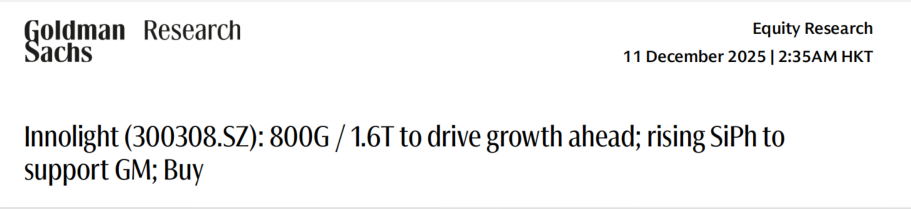
高盛乐观预测光模块巨头前景:还有30%上涨空间,维持买入评级,12个月内看到762元
Zhi Tong Cai Jing· 2025-12-12 12:53
Core Viewpoint - The stock price of Zhongji Xuchuang, a global leader in optical modules, has reached a historical high, with Goldman Sachs maintaining a positive outlook and projecting strong growth in the company's performance, setting a target price of 762 RMB, indicating a potential upside of over 30% from the current price of 582 RMB [1][2]. Group 1: Market Demand - Goldman Sachs expresses optimism regarding terminal market demand, driven by the growth in AI server shipments and the increasing proportion of ASIC AI servers, with a significant rise in rack-level AI servers expected by 2026 [4]. - The diversification of AI server chip platforms, particularly with more ASIC AI server models anticipated in the second half of 2026, will increase the demand for optical modules, further supporting industry growth [4]. - The transition from EML to silicon photonic optical modules is expected to enhance Zhongji Xuchuang's gross margin due to lower costs associated with silicon photonic technology [4]. Group 2: Supply Side Improvement - Goldman Sachs forecasts ongoing improvements in the supply side over the coming years, with silicon photonic chip foundries expanding capacity and the supply of indium phosphide (InP) substrates in mainland China returning to normal [6]. - Monthly revenues for InP epitaxial wafer and continuous wave laser suppliers, LandMark and VPEC, are gradually recovering, indicating a mitigation of the impacts from export controls [6]. - These companies are expanding their InP substrate supplier channels and increasing capacity for epitaxial wafers and continuous wave lasers to meet future growth demands, supporting the development of silicon photonic optical modules [6]. Group 3: New Opportunities in On-Board Optical Modules - Despite market concerns that the evolution of optical modules towards optical engines may reduce the added value of Zhongji Xuchuang in the on-board optical module (NPO) sector, Goldman Sachs believes that product pricing will still be linked to speed as high-speed interconnects continue to upgrade [8]. - The competition in the industry is becoming healthier, requiring suppliers to possess photonic integrated circuit (PIC) design capabilities, with the optical engines in NPOs being more integrated than pluggable optical modules [8]. - Zhongji Xuchuang's involvement in the NPO business demonstrates its strong research and development capabilities, keeping pace with the technological iterations of major cloud service providers in the U.S. [8].
2026-2027年最强王者!巴菲特背书,光模块概念将继续新高!
Xin Lang Cai Jing· 2025-12-12 10:31
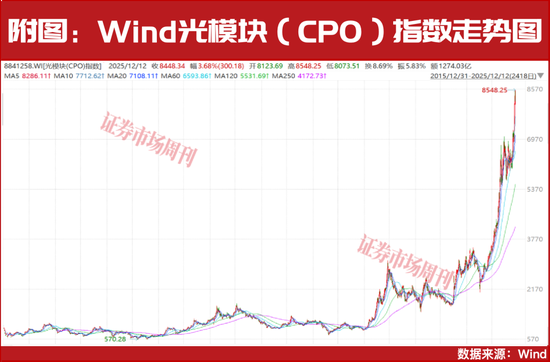
Core Viewpoint - The optical module sector is experiencing significant growth, with the Wind Optical Module (CPO) index reaching new highs and a strong demand forecast leading to a supply-demand imbalance that is expected to persist until 2027 [1][2][15]. Company Performance - Among 19 optical module stocks, 7 reached historical price highs in the past week, with 12 companies doubling their stock prices this year. Notably, Shijia Guangzi's stock surged over 500%, while Xinyi Sheng and Yuanjie Technology both exceeded 400% [4][18]. - In the third quarter of 2025, 16 companies in the optical module sector reported revenue and net profit growth, with Yuanjie Technology achieving a revenue of 383.25 million yuan, up 115.09%, and a net profit of 105.89 million yuan, up 19348.65% [8][9][10]. Industry Trends - The optical module industry is witnessing a "volume and price increase" scenario, with significant demand for 1.6T optical modules and stable pricing for 800G and lower products. This is driven by increased capital expenditures from global cloud providers and accelerated technological iterations among leading manufacturers [7][20]. - The AI industry is catalyzing growth in the optical module sector, with major companies like Google and Amazon enhancing their capabilities, which is expected to drive demand for optical modules significantly [6][20]. Financial Highlights - Zhongji Xuchuang, a leading player in the optical module market, reported a revenue of 250.05 billion yuan in Q3 2025, a 44.43% increase year-on-year, and a net profit of 71.32 billion yuan, up 90.05% [10][11]. - The company's overseas revenue has surged, with North American cloud providers projected to spend $330 billion in 2025, a 53% increase from the previous year, further boosting demand for high-speed optical modules [11].
数据看盘北向、游资“爆买”联特科技 量化资金激烈博弈摩尔线程
Sou Hu Cai Jing· 2025-12-12 09:59
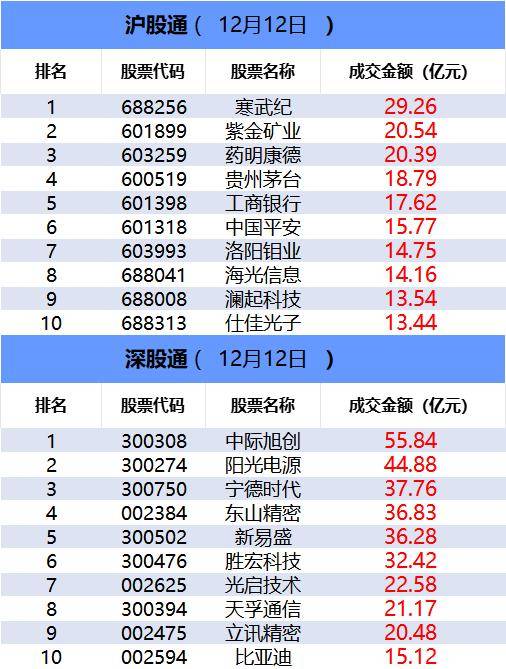
Core Viewpoint - The total trading volume of the Shanghai and Shenzhen Stock Connect reached 309.68 billion, with significant trading activity in specific stocks and sectors, indicating a dynamic market environment [1]. Trading Volume Summary - The total trading amount for the Shanghai Stock Connect was 149.88 billion, while the Shenzhen Stock Connect totaled 159.8 billion [2]. - The top traded stocks included Cambricon (29.26 billion) and Zhongji Xuchuang (55.84 billion) for Shanghai and Shenzhen respectively [3]. Sector Performance - The leading sectors in terms of net inflow of funds were power grid equipment (48.52 billion) and electric new industry (26.91 billion) [6]. - Sectors with the highest gains included controllable nuclear fusion, precious metals, and commercial aerospace, while retail and real estate sectors saw declines [5]. ETF Trading Activity - The top ETF by trading volume was A500ETF Huatai Baichuan with 105.91 billion, followed by Hong Kong Securities ETF at 99.49 billion [9]. - The China Securities 500 ETF (159922) experienced a remarkable trading volume increase of 258% compared to the previous trading day [10]. Stock Specific Activity - Notable stocks with significant net inflow included Dongshan Precision (11.51 billion) and BYD (8.28 billion) [7]. - Conversely, stocks with the highest net outflow included Sunshine Power (-21.87 billion) and Changying Precision (-14.64 billion) [7]. Institutional and Retail Activity - Institutional trading was active, with notable purchases in Guocera Materials (1.86 billion) and Zhongneng Electric (1.24 billion) [12]. - Retail investors showed high activity, particularly in stocks like Lian Te Technology, which saw significant net buying from various brokerage firms [14]. Quantitative Fund Activity - Quantitative funds were notably active, with significant trading in stocks like Moer Thread, which saw a net inflow of 2.07 billion from Morgan Stanley and outflows from multiple firms [15].



AI硬件市场大爆发:2025年冲在最前面的10家公司是谁?
和讯· 2025-12-12 09:36
Core Insights - The article emphasizes that AI hardware is not only the main market line for 2025 but also the core increment of the technology cycle for the coming years [2][3] - The Wind hardware equipment index has surged approximately 49% this year, with transaction volume increasing by 83.83% compared to the same period last year, reaching an average daily transaction volume of 271.9 billion yuan [2] Company Rankings - The article presents the top 10 hardware equipment companies based on a comprehensive evaluation of 589 A-share companies, focusing on "R&D innovation, financial health, growth potential, and market performance" [4] - The top 10 companies include: 1. Xinyi Technology (新易盛) - Optical module solutions provider 2. Hikvision (海康威视) - Intelligent IoT solutions provider 3. Zhongji Xuchuang (中际旭创) - High-speed optical module solutions provider 4. ZTE Corporation (中兴通讯) - Network equipment and telecommunications provider 5. Dahua Technology (大华股份) - Video-centric smart IoT solutions provider 6. Shenghong Technology (胜宏科技) - High-precision PCB manufacturer 7. Industrial Fulian (工业富联) - Industrial internet and smart manufacturing service provider 8. BOE Technology Group (京东方) - Display panel leader 9. Yingshi Innovation (影石创新) - Intelligent imaging equipment provider [5][6] Industry Trends - The industry is entering a new phase characterized by "AI/computing power first," with AI being the largest variable and certainty for hardware equipment in 2025 [10] - A "hard technology growth chain" centered around AI computing power is rapidly forming, with leading companies showing high innovation, financial stability, and strong market performance [10][19] - The first-tier companies exhibit a total score above 1600, indicating robust financial health and market competitiveness, while the second-tier companies, scoring between 1400-1600, include both large manufacturers and niche leaders [19][20] Financial Health and Market Performance - The article notes that top companies have a strong financial foundation and market competitiveness, while R&D innovation and growth potential scores are more dispersed, particularly in high-demand sectors like data centers and AI [9][12] - Companies with high R&D scores but poor financial health tend to have lower market performance, indicating a stricter market scrutiny of "stories" and "concepts" [12]





热点追踪周报:由创新高个股看市场投资热点(第223期)-20251212
Guoxin Securities· 2025-12-12 09:31
证券研究报告 | 2025年12月12日 **Acknowledgement** **The authors thank the anonymous referee for the help and comments on the manuscript.** 见微知著:利用创新高个股进行市场监测:截至 2025 年 12 月 12 日,共 746 只股票在过去 20 个交易日间创出 250 日新高。其中创新高个股数量最多的 是基础化工、机械、电子行业,创新高个股数量占比最高的是有色金属、纺 织服装、农林牧渔行业。按照板块分布来看,本周制造、周期板块创新高股 票数量最多;按照指数分布来看,中证 2000、中证 1000、中证 500、沪深 300、创业板指、科创 50 指数中创新高个股数量占指数成份股个数比例分别 为:14.45%、13.10%、10.20%、12.33%、10.00%、0.00%。 平稳创新高股票跟踪:我们根据分析师关注度、股价相对强弱、趋势延续性、 股价路径平稳性、创新高持续性等角度,本周从全市场创新高股票中筛选出 了包含中际旭创、光库科技、源杰科技等 44 只平稳创新高的股票。按照板 块来 ...
多股午后异动拉升!300308,300502,成交超200亿元!
Zheng Quan Shi Bao Wang· 2025-12-12 07:08
Group 1 - Multiple stocks experienced significant afternoon rallies, with ZTE Corporation seeing a rise of over 5% in Hong Kong and A-shares turning positive after an early drop of over 3% [1] - ZTE announced on December 12 that it plans to repurchase its A-shares using its own funds through centralized bidding, with a total repurchase amount not less than 1 billion yuan and not exceeding 1.2 billion yuan [1] - Several heavily held stocks by funds, including Yandong Micro and Tuojing Technology, surged over 10% [1] Group 2 - Zhongji Xuchuang (300308) and Xinyi Sheng (300502), both of which are heavily held by funds, saw their trading volumes exceed 20 billion yuan [1]