WENS FOODSTUFF GROUP CO.(300498)

Search documents
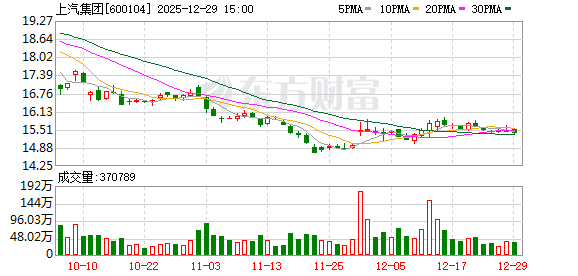
海外机构调研股名单 上汽集团最受关注
Zheng Quan Shi Bao Wang· 2025-12-29 09:27
Group 1 - In the past 10 days (from December 16 to December 29), 50 listed companies were surveyed by overseas institutions, with SAIC Motor being the most focused, receiving attention from 17 overseas institutions [2] - A total of 322 companies were surveyed by institutions in the last 10 days, with securities companies surveying 291 companies, accounting for the largest share, followed by fund companies with 210 companies [2] - The average stock price of companies surveyed by overseas institutions increased by 4.51% over the past 10 days, with notable performers including Pulite and Mailland, which saw increases of 24.76% and 21.88% respectively [2] Group 2 - The stock price performance of companies surveyed by overseas institutions shows that 12 companies experienced declines, with Huali Group having the largest drop at 12.42% [2] - The list of companies surveyed includes Pulite, Mailland, and SAIC Motor, among others, with varying degrees of interest from overseas institutions [3] - SAIC Motor's stock price decreased by 2.72% despite being the most surveyed company, indicating potential concerns among investors [3]



温氏股份大宗交易成交23.03万股 成交额308.14万元
Zheng Quan Shi Bao Wang· 2025-12-29 09:23
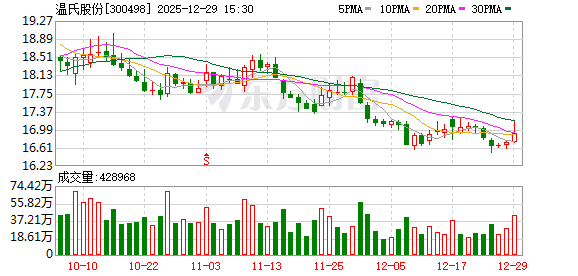
Group 1 - The core transaction on December 29 involved a block trade of 230,300 shares of Wens Foodstuff Group, with a transaction value of 3.0814 million yuan, at a price of 13.38 yuan, representing a discount of 20.92% compared to the closing price of the day [2][4] - In the last three months, Wens Foodstuff Group has recorded a total of 15 block trades, with a cumulative transaction value of 81.5304 million yuan [3] - The closing price of Wens Foodstuff Group on the day of the transaction was 16.92 yuan, reflecting an increase of 1.14%, with a daily turnover rate of 0.72% and a total trading volume of 728 million yuan [3] Group 2 - The latest margin financing balance for Wens Foodstuff Group is 920 million yuan, which has increased by 30.5036 million yuan over the past five days, representing a growth rate of 3.43% [4] - The company was established on July 26, 1993, with a registered capital of 66,539.27141 million yuan [4]
养殖业板块12月29日涨1.58%,京基智农领涨,主力资金净流入9041.58万元
Zheng Xing Xing Ye Ri Bao· 2025-12-29 08:55
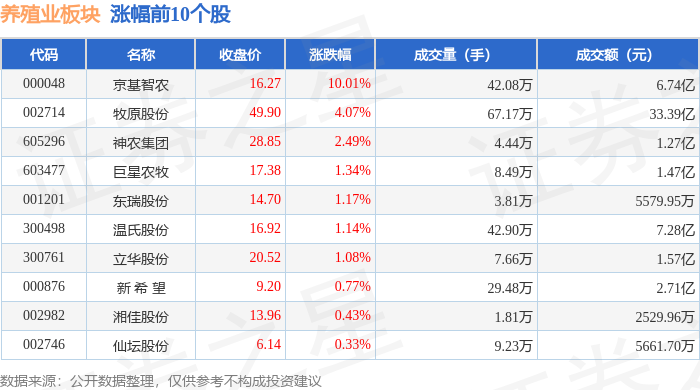
Group 1 - The aquaculture sector increased by 1.58% on December 29, with Jingji Zhino leading the gains [1] - The Shanghai Composite Index closed at 3965.28, up 0.04%, while the Shenzhen Component Index closed at 13537.1, down 0.49% [1] - Key stocks in the aquaculture sector showed varied performance, with Jingji Zhino rising by 10.01% to a closing price of 16.27 [1] Group 2 - The main funds in the aquaculture sector saw a net inflow of 90.42 million yuan, while retail funds had a net inflow of 10.91 million yuan [2] - Major stocks like Muyuan Foods and Wen's Foodstuffs experienced significant net outflows from retail investors [3] - Jingji Zhino had a net inflow of 67.42 million yuan from main funds, indicating strong institutional interest [3]


生猪:产能调整、节奏博弈与周期拐点
Dong Zheng Qi Huo· 2025-12-29 05:17
1. Report Industry Investment Rating - The investment rating for the hog industry is "Oscillating" [1] 2. Core Viewpoints of the Report - In 2025, the hog market evolved from "counter - cyclical inventory accumulation" to "policy - driven inventory reduction" under the backdrop of absolute over - capacity. Despite efficiency improvements and lower feed costs, the industry entered a phase of substantial capacity reduction due to continuous policy guidance and deep losses [2][13] - In 2026, the market will show a clear pattern of "near - term weakness and long - term strength". It is recommended to adopt a reverse spread strategy as the base allocation for the whole year to capture the price difference between reality and expectations [3] 3. Summary by Relevant Catalogs 3.1 2025: Waiting for the Bottom to Come - **Q1**: A "structural bottom" supported by expectations. The pre - Spring Festival concentrated slaughter led to a short - term supply shortage after the festival. The high fat - to - standard price spread strengthened the industry's reluctance to sell, delaying capacity clearance [14] - **Q2**: An "oscillating bottom - grinding" in sentiment games. After May Day, pig prices declined. The rebound after the Dragon Boat Festival lacked fundamental support, and the market returned to an oscillating pattern [15] - **Q3**: A "re - construction of far - month contracts" driven by policies. The industry symposium in July signaled "anti - involution" and "capacity and inventory reduction", shifting the trading logic to "strong expectations" and establishing a reverse spread structure [15] - **Q4**: A "cost breakdown" after returning to reality. After the National Day, pig prices fell sharply, breaking through the cash cost line. The market focused on the substantial reduction of sow inventory and potential winter epidemic risks [16] 3.2 Market Pattern Re - shaping and the Capacity Reduction Cycle 3.2.1 Vertical Intensification of the Industry - The hog industry has entered a new stage of structural differentiation and intensive upgrading. By October 2025, large - scale enterprises dominated the industry, with listed companies and large breeding groups controlling 43.1% of the sow inventory. The industry's overall ability has improved, but price and capacity adjustments have become more sensitive [20] - Regionally, different patterns have emerged: South China is highly intensive, Northeast China has a dual - structure, and Central China is more balanced. The inter - regional price difference has become more stable, and the futures delivery area has been expanded, strengthening the linkage between futures and spot markets [23][24] 3.2.2 Cycle Development Path: Policy and Market - Driven Capacity Reduction - **Downward inflection point delay**: Thanks to cost optimization, the downward inflection point of this cycle was postponed. The industry's profit was maintained until September 2025 when the industry entered a full - scale loss phase due to inventory pressure and spot price drops [30] - **Total over - supply**: The large inventory and high出栏 volume in 2025 were due to the increase in sow capacity last year. The supply pressure was significant, and many listed companies were close to or had exceeded their annual出栏 targets [43][47] - **Capacity loosening**: Since 2025, the sow inventory has gone through four stages. Multiple data sources confirm that the industry entered a new capacity adjustment phase in the third quarter, but the reduction is still mild, and the supply is expected to remain loose until the end of Q1 2026 [52][67] 3.3 Peak出栏, Speculation Support, and Consumption 3.3.1 Piglets: Leading Indicator for出栏 Forecast - Piglets are a key indicator for predicting hog出栏. In 2025, piglet supply increased steadily, and the industry's efficiency improvement contributed to the increase in piglet births. Based on the piglet - to - hog conversion cycle, the出栏 is expected to peak in Q1 2026 and may improve in Q2 [69][70] 3.3.2 Elasticity and Support from Speculation - **Breeding speculation**: The inventory adjustment through breeding speculation affects the存栏 structure. In 2025, the industry showed long - term optimization and short - term fluctuations in the weight distribution of hogs. In 2026, post - Spring Festival low - price pressure and secondary fattening may support prices [78][80] - **Frozen product inventory**: In 2025, the frozen product inventory rate first decreased and then increased. In 2026, if there is a price reversal expectation in the second half of the year, the slaughter end may increase inventory in the first half, supporting post - Spring Festival spot prices [93][94] 3.3.3 Limited Boost from Curing Demand - Although the slaughter volume increased year - on - year, the curing demand at the end of the year had limited impact on prices. The reasons include the long - term consumption structure optimization and the postponed Spring Festival in 2026 [98] 3.3.4 Feed Data Confirmation - Feed data can confirm the hog存栏 structure. As of November, the feed sales data from different institutions showed that the feed consumption related to capacity had decreased marginally, while the fattening feed was still increasing, indicating a significant存栏 pressure [100][101] 3.4 Outlook and Investment Suggestions 3.4.1 Summary of Views - The continuous increase in sow inventory in 2024 led to an expansion of hog出栏 in 2025 and a price decline. However, factors such as lower feed costs, speculative behavior, and improved production efficiency deviated from the early market expectations. The industry may see a new upward inflection point in pig prices around Q2 2026, but the cycle evolution is complex [110][111] 3.4.2 Strategies - **Short - term (end of the year to pre - Spring Festival)**: Seize the band - trading opportunities in the oscillating market. Use an interval - oscillating strategy, and consider short - term long positions when the market is pessimistic and short positions when prices reach key resistance levels. The support level for LH2603 is 11,000 yuan/ton, and the resistance level is 11,800 - 12,000 yuan/ton [112] - **Medium - term (post - Spring Festival to Q1 2026)**: Adopt a bearish strategy and focus on the release of supply pressure. Short positions can be added on price rebounds, but beware of potential rebounds. Pay attention to short - selling opportunities when LH2603 approaches 11,800 - 12,000 yuan/ton and LH2605 returns to 12,500 - 13,000 yuan/ton [113][114] - **Long - term (from Q2 2026)**: Observe on the left - hand side and prepare for the cycle reversal. Shift the strategy from "short - selling" to "finding the inflection point". When the fundamental signals are confirmed, gradually build long positions in far - month contracts at the support level of 12,500 - 13,000 yuan/ton. Use a flexible reverse spread strategy for arbitrage [115]


农林牧渔行业周报第44期:行业亏损持续,继续关注生猪养殖-20251229
HUAXI Securities· 2025-12-29 03:27
Investment Rating - Industry Rating: Recommended [4] Core Insights - The pork industry continues to face losses, with a focus on pig farming opportunities. The average price of live pigs is 11.59 CNY/kg, down 0.46% week-on-week. The total breeding sow inventory is 39.9 million heads, down 1.1% month-on-month and 2.1% year-on-year. The industry is experiencing ongoing losses, with self-bred and purchased pig farming losses at 130.11 CNY/head and 162.80 CNY/head respectively. The recent anti-dumping ruling may alleviate domestic pork supply pressure, leading to accelerated capacity reduction [2][12]. Summary by Sections Planting Industry Chain - The Ministry of Agriculture and Rural Affairs has initiated winter crop seed supervision checks to ensure seed safety for the upcoming spring and summer planting. The checks focus on key crops such as corn, rice, soybeans, cotton, and vegetables. The commercialization of genetically modified technology is expected to accelerate, enhancing self-sufficiency rates of key varieties. Recommended stocks include Beidahuang and Suqian Agricultural Development [1][11]. Pig Farming - The average price of live pigs is reported at 11.59 CNY/kg, with a slight decrease of 0.46% from the previous week. The average price for pig futures is 11,469 CNY/ton, reflecting a 1.07% increase. The average weight of pigs post-slaughter is 89.57 kg, with a month-on-month increase of 3.21% in slaughter volume [12][62][65]. Recommended Stocks - For pig farming, recommended stocks include: 1. Livestock sector: Lihua Stock, Muyuan Food, Shuanghui Development, Dekang Agriculture, Jingji Zhino, and Wens Foodstuff 2. Feed sector: Haida Group 3. Animal health sector: Jinhai Biological, Biological Shares, Placo, and Zhongmu Shares [2][12].


ETF盘中资讯|生猪养殖板块大涨,全市场“含猪量”最高农牧渔ETF(159275)继续上攻!“猪周期”反转在即?
Jin Rong Jie· 2025-12-29 03:01
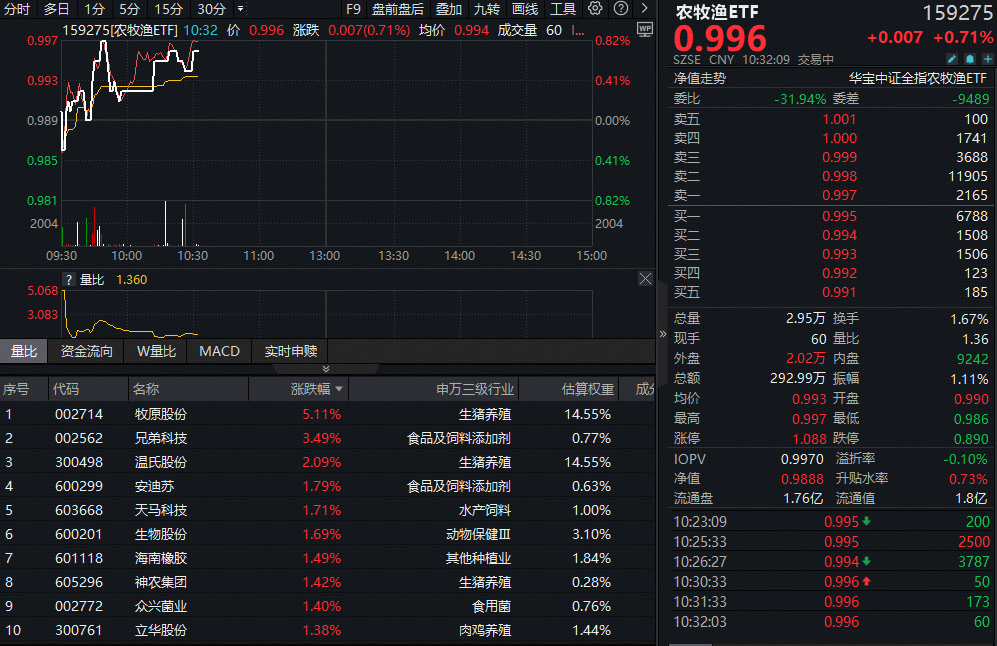
Core Viewpoint - The agricultural and livestock sector, particularly pig farming, continues to show upward momentum, with the highest "pig content" agricultural ETF (159275) experiencing a price increase of 0.71% as of the latest report [1]. Group 1: Market Performance - The agricultural ETF (159275) opened with a slight dip but then rose, showing a current increase of 0.71% [1]. - Key stocks in the sector, such as Muyuan Foods, rose over 5%, while other companies like Brother Technology and Wens Foodstuff increased by over 3% and 2%, respectively [1]. Group 2: Industry Trends - Data from the Guangdong Provincial Department of Agriculture indicates a 2.10% month-on-month decrease in the number of breeding sows, marking four consecutive months of decline [1]. - The pig farming industry is entering a regulatory phase, with authorities reducing production capacity to control pig prices, which are under downward pressure due to increased slaughter volumes and large pig inventories [3]. Group 3: Future Outlook - Analysts predict that the supply-demand dynamics in the pig farming industry will improve, with continued pressure on prices expected until mid-2026, followed by a gradual easing of supply pressures [3]. - The agricultural and livestock sector is currently at a relatively low valuation level, presenting a good opportunity for long-term investment [3]. - The pig farming industry is facing three main pressures: falling market prices, rising epidemic risks, and regulatory pressures, which may lead to continued rapid capacity reduction [5].
生猪养殖板块大涨,全市场“含猪量”最高农牧渔ETF(159275)继续上攻!“猪周期”反转在即?
Xin Lang Cai Jing· 2025-12-29 02:55
Core Viewpoint - The agricultural and livestock sector, represented by pig farming, continues to rise, with the highest "pig content" agricultural ETF (159275) showing a price increase of 0.71% as of December 29 [1][11]. Market Performance - The agricultural ETF (159275) opened with a slight dip but then rose, with a current price of 0.996, reflecting a gain of 0.007 [2][12]. - Key stocks in the sector include Muyuan Foods, which surged over 5%, and other companies like Brother Technology, Wens Foodstuff, and several others showing gains of over 1% [1][11]. Industry Trends - Data from the Guangdong Provincial Department of Agriculture indicates a 2.10% month-on-month decrease in the number of breeding sows as of November 2025, marking four consecutive months of decline [4][12]. - The pig farming industry is entering a regulatory phase, with authorities reducing production capacity to control pig prices, which are under downward pressure due to increased slaughter volumes and large pig inventories [3][13]. Future Outlook - Analysts predict that the supply-demand dynamics in the pig farming sector will improve, with ongoing supply pressures expected to ease by the second half of 2026 [3][14]. - The agricultural and livestock sector is currently valued at a relatively low level, presenting a good opportunity for long-term investment [3][15]. Investment Recommendations - The agricultural ETF (159275) is highlighted as a key investment vehicle, tracking the CSI Agricultural and Livestock Index, which includes leading companies in pig farming and related sectors [5][15]. - Investors are encouraged to focus on leading pig farming companies, which are expected to recover in valuation as the market stabilizes [5][15].
开源晨会-20251228
KAIYUAN SECURITIES· 2025-12-28 14:46
Core Insights - The report highlights a continued slowdown in corporate profits, with the cumulative profit of large-scale industrial enterprises in China showing a year-on-year increase of only 0.1% from January to November 2025, down from 1.9% in the previous period [3] - The report suggests that the current economic environment is characterized by a weak demand, necessitating further policy support to stimulate internal demand and address rising inventory levels [6][25] - The report emphasizes the importance of the upcoming spring market rally, suggesting a dual focus on technology and cyclical sectors for investment strategies [12] Macro Economic Analysis - The cumulative operating revenue of large-scale industrial enterprises from January to November 2025 increased by 1.6%, a slight decrease from the previous year's 1.8% [3] - November's profit margin saw a significant decline, with a year-on-year drop of 13.1%, indicating a challenging environment for industrial profitability [4] - The report notes that the inventory-to-sales ratio has risen significantly, indicating a need for policy intervention to stimulate demand [6] Industry Insights Chemical Industry - The report indicates an overall upward trend in the polyester industry chain, driven by rising prices of PX and PTA, with PX prices increasing by 6.97% and PTA by 8.95% as of December 26, 2025 [35] - The report highlights the importance of the "anti-involution" policy in supporting price stability and profitability within the chemical sector [36] Real Estate - The report notes a month-on-month increase in new and second-hand housing transaction areas, with Beijing further optimizing housing purchase restrictions [40] - The report indicates that various policies aimed at stabilizing the real estate market are beginning to take effect, contributing to a gradual recovery in housing prices [41] Electronics - The electronics sector is experiencing a high level of prosperity, with significant price increases expected in storage components, driven by strong demand and supply constraints [46][49] - The report highlights the positive performance of semiconductor stocks, with notable increases in stock prices for major players like SK Hynix and Micron [46] Biotechnology - The report discusses the upcoming IPO of Rebio Biotech, which focuses on innovative siRNA technology platforms for treating chronic diseases and cancers [52][54] - The company has established multiple clinical research pipelines and has secured significant partnerships with major pharmaceutical firms, indicating strong growth potential [55]



农林牧渔周观点(2025.12.22-2025.12.28):二育进场猪价反弹;宠物新国货大会召开-20251228
Shenwan Hongyuan Securities· 2025-12-28 13:22
Investment Rating - The report recommends a "left-side investment opportunity" in the pig farming sector, indicating a positive outlook despite current challenges [5][6]. Core Insights - The agricultural sector index increased by 0.3%, while the Shanghai and Shenzhen 300 index rose by 1.9%. Notable stock performances included Shen Nong Technology (up 35.7%) and Guotou Zhonglu (up 20.8%) [5][6]. - The pig price rebounded significantly due to the re-entry of the second batch of fattening pigs and increased retail demand as the year-end approaches. However, the report suggests that this price increase may not be sustainable in the coming quarters [5][6]. - The pet sector is experiencing a valuation shift as the year-end approaches, with a focus on companies like Muyuan Foods, Wens Foodstuff, and others [5][6]. Summary by Sections Pig Farming - The average selling price of the national external three yuan pigs was 12.21 yuan/kg, with a week-on-week increase of 7.0%. The price surge is attributed to the re-entry of fattening pigs and a decrease in supply [5][6]. - The report indicates that the industry remains below the breakeven line, with losses reported for small-scale and medium-scale operations. The outlook for the next 1-2 quarters suggests a bottoming out of prices, with ongoing capacity reduction [5][6]. Pet Industry - The seventh Pet New National Goods Conference was held, revealing that the Chinese pet market is expected to reach a size of 154.5 to 160 billion yuan in 2025. The market is characterized by channel differentiation and a focus on specific product categories [5][6]. - Ruipai Pet Hospital submitted an application for an IPO, aiming to become the first publicly listed pet hospital in China [5][6]. Meat Chicken Farming - The average selling price of white feather broiler chicks was 3.37 yuan/chick, with a slight decrease of 0.6% week-on-week. The price of white feather broiler meat reached a new high of 3.80 yuan/kg, reflecting a week-on-week increase of 4.7% [5][6]. Beef Industry - The prices of beef and cattle have slightly decreased, with the average price of fattened bulls at 25.47 yuan/kg, down 0.24% week-on-week [5][6].
农林牧渔周观点:二育进场猪价反弹,宠物新国货大会召开-20251228
Shenwan Hongyuan Securities· 2025-12-28 12:42
Investment Rating - The industry investment rating is "Overweight" indicating that the industry is expected to outperform the overall market [5][6]. Core Insights - The report highlights a significant rebound in pig prices due to the re-entry of the second batch of fattening pigs and a rise in consumer sentiment as the year-end approaches. However, it notes that this price increase may not be sustainable in the coming quarters due to an oversupply situation [5][6]. - The report emphasizes the need to focus on the ongoing capacity reduction in the pig farming sector and suggests left-side investment opportunities in this area. It also mentions a potential valuation shift in the pet sector as it undergoes adjustments [5][6]. - The report provides specific recommendations for companies to watch, including Muyuan Foods, Wens Foodstuff, Dekang Agriculture, Tiankang Biological, Noposion, Guai Bao Pet, Zhongchong Pet, and Petty [5][6]. Summary by Sections Agricultural Stock Market Performance - The Shenwan Agricultural, Forestry, Animal Husbandry, and Fishery Index rose by 0.3%, while the CSI 300 Index increased by 1.9%. The top five gainers included Shennong Technology (35.7%), Guotou Zhonglu (20.8%), and Jinliang Holdings (19.9%) [5][6]. Pig Farming - The average selling price of external three yuan pigs was 12.21 yuan/kg, with a week-on-week increase of 7.0%. The report indicates that the current price increase is driven by several factors, including the re-entry of fattening pigs and a decrease in available pig sources [5][6]. - The report forecasts that pig prices will continue to fluctuate at the bottom level, with a focus on the progress of capacity reduction in the industry [5][6]. Pet Sector - The report mentions the seventh Pet New National Goods Conference held in Wuhan, projecting the annual market size of China's pet industry to be between 154.5 billion and 160 billion yuan. It highlights the rapid growth in the pet market and the emergence of new customer segments [5][6]. - Ruipai Pet Hospital has submitted an application for listing on the Hong Kong Stock Exchange, indicating a positive outlook for the pet medical service sector [5][6]. Poultry Farming - The average selling price of white feather broiler chicks was 3.37 yuan/chick, with a week-on-week decrease of 0.6%. The report notes that the supply of white feather broilers remains abundant, which is expected to be a theme for 2025-2026 [5][6].