EOPTOLINK(300502)

Search documents
A股CPO概念股普跌,天通股份逼近跌停,剑桥科技跌超5%,新易盛、联特科技跌超4%,永鼎股份、光库科技跌超3%
Ge Long Hui· 2026-01-20 02:38
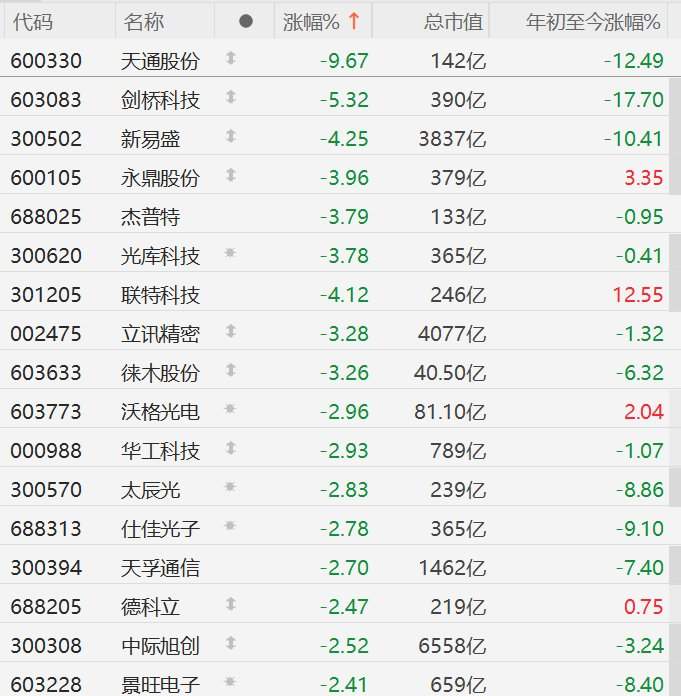
Group 1 - The CPO concept stocks in the A-share market experienced a widespread decline, with Tian Tong Co., Ltd. (600330) nearing the limit down, and Cambridge Technology (603083) dropping over 5% [1] - Other companies such as Xin Yi Sheng (300502) and Lian Te Technology fell more than 4%, while Yong Ding Co., Ltd. (600105), Jie Pu Te, and Guang Ku Technology (300620) saw declines exceeding 3% [1] Group 2 - Cambridge Technology (603083) recently released a performance forecast, expecting a net profit attributable to shareholders for the fiscal year 2025 to be between 252 million yuan and 278 million yuan, representing a year-on-year increase of 51.19% to 66.79% [2] - For the first three quarters of 2025, Cambridge Technology's net profit attributable to shareholders was reported at 259 million yuan, indicating that the estimated net profit for Q4 2025 is expected to be between -7 million yuan and 19 million yuan, which is below analysts' consensus forecast of 139 million yuan [2]




A股异动丨CPO概念股普跌,剑桥科技跌超5%,新易盛跌超4%
Ge Long Hui A P P· 2026-01-20 02:12
Group 1 - The CPO concept stocks in the A-share market experienced a widespread decline, with Tian Tong Co. nearing the limit down, Cambridge Technology dropping over 5%, and several other companies like Xin Yi Sheng and Lian Te Technology falling more than 4% [1] - Cambridge Technology recently released a performance forecast, expecting a net profit attributable to shareholders for the fiscal year 2025 to be between 252 million to 278 million yuan, representing a year-on-year increase of 51.19% to 66.79% [1] - Based on Cambridge Technology's net profit of 259 million yuan for the first three quarters of 2025, the estimated net profit for Q4 is projected to be between -7 million to 19 million yuan, which is below analysts' consensus forecast of 139 million yuan [1] Group 2 - Tian Tong Co. reported a decline of 9.67% with a total market capitalization of 14.2 billion yuan and a year-to-date decline of 12.49% [2] - Cambridge Technology saw a decrease of 5.32% with a market cap of 39 billion yuan and a year-to-date decline of 17.70% [2] - Other companies such as Xin Yi Sheng, Yong Ding Co., and Jie Pu Te also reported declines ranging from 3.78% to 4.25% [2]
CPO概念股普跌
Ge Long Hui· 2026-01-20 02:08
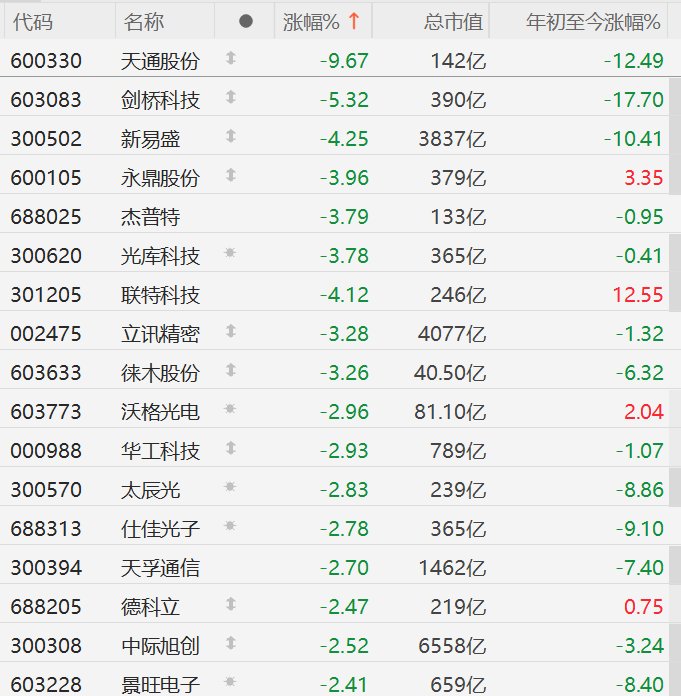
Group 1 - The A-share market saw a decline in CPO concept stocks, with Tian Tong Co. nearing the limit down, Cambridge Technology dropping over 5%, and several other companies experiencing declines of more than 3% [1] - Cambridge Technology recently released a performance forecast, expecting a net profit attributable to shareholders of 252 million to 278 million yuan for the fiscal year 2025, representing a year-on-year increase of 51.19% to 66.79% [1] - For the first three quarters of 2025, Cambridge Technology's net profit attributable to shareholders was 259 million yuan, indicating that the expected net profit for Q4 2025 is projected to be between -7 million to 19 million yuan, which is below analysts' consensus forecast of 139 million yuan [1] Group 2 - Tian Tong Co. experienced a decline of 9.67% with a total market value of 14.2 billion yuan and a year-to-date decline of 12.49% [2] - Cambridge Technology's stock fell by 5.32%, with a total market value of 39 billion yuan and a year-to-date decline of 17.70% [2] - New Yi Sheng's stock dropped by 4.25%, with a total market value of 383.7 billion yuan and a year-to-date decline of 10.41% [2]



主力资金 | 3股尾盘获资金大幅抢筹
Sou Hu Cai Jing· 2026-01-19 12:42
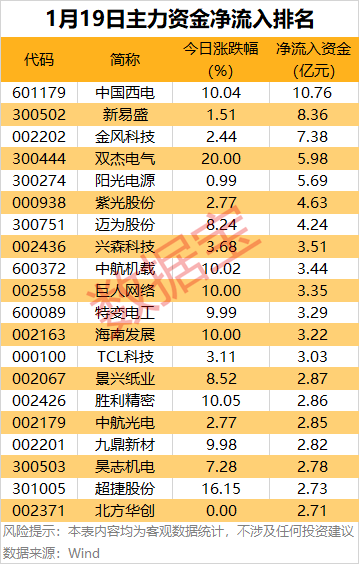
Group 1 - The A-share market showed mixed performance on January 19, with major indices fluctuating, while most industry sectors experienced gains, particularly in precious metals, electric power equipment, aerospace, and tourism [1] - The net outflow of main funds in the Shanghai and Shenzhen markets reached 39.798 billion yuan, with six industries seeing net inflows, including electric power equipment, building materials, and banking [1] - The electronic, computer, and communication sectors faced the largest net outflows, with amounts of 9.971 billion yuan, 8.997 billion yuan, and 6.184 billion yuan respectively [1] Group 2 - Seven stocks recorded net inflows exceeding 400 million yuan, with China West Electric leading at 1.076 billion yuan, supported by a government announcement projecting a significant increase in national electricity consumption [2][3] - New Yisheng and Goldwind Technology followed with net inflows of 836 million yuan and 738 million yuan respectively, with Goldwind announcing a supply agreement for wind turbines [2] - A total of 74 stocks experienced net outflows exceeding 200 million yuan, with Ningde Times, Shannon Chip, and Oriental Fortune among those with the highest outflows, each exceeding 1 billion yuan [4][5] Group 3 - At the end of the trading day, the main funds saw a net outflow of 5.829 billion yuan, with significant inflows in the electric power equipment sector [6] - Key individual stocks with notable net inflows at the close included TBEA, New Yisheng, and Kidswant, each exceeding 100 million yuan [6][7] - Conversely, stocks like Rock Mountain Technology and Shannon Chip experienced substantial net outflows, each exceeding 200 million yuan [8]




主力资金丨3股尾盘获资金大幅抢筹
Zheng Quan Shi Bao Wang· 2026-01-19 11:14
Group 1 - The A-share market showed mixed performance on January 19, with major indices fluctuating and most industry sectors closing higher, particularly in precious metals, electric power equipment, aerospace, and tourism [1] - The net outflow of main funds in the Shanghai and Shenzhen markets reached 39.798 billion yuan, with six industries experiencing net inflows, including electric power equipment, building materials, and banking [1] - The electronic, computer, and communication sectors saw the largest net outflows, with amounts of 9.971 billion yuan, 8.997 billion yuan, and 6.184 billion yuan respectively [1] Group 2 - Seven stocks recorded net inflows exceeding 400 million yuan, with China Western Power leading at 1.076 billion yuan, driven by a government announcement projecting a significant increase in national electricity consumption by 2025 [2] - New Yi Sheng and Goldwind Technology also saw substantial net inflows of 836 million yuan and 738 million yuan respectively, with Goldwind announcing a supply agreement for wind turbines in Vietnam [3] - A total of 74 stocks experienced net outflows exceeding 200 million yuan, with notable outflows from Ningde Times and other tech companies exceeding 1 billion yuan [3] Group 3 - At the end of the trading day, the electric power equipment sector saw a net inflow of over 369 million yuan, while other sectors like retail and non-bank financials also experienced significant inflows [4] - Individual stocks such as TBEA, New Yi Sheng, and Kidswant saw net inflows exceeding 1 billion yuan at the close [5] - Notable net outflows at the end of the day included companies like Rock Mountain Technology and others, with outflows exceeding 200 million yuan [6]
数据复盘丨90股获主力资金净流入超1亿元 龙虎榜机构抢筹16股
Zheng Quan Shi Bao Wang· 2026-01-19 09:57
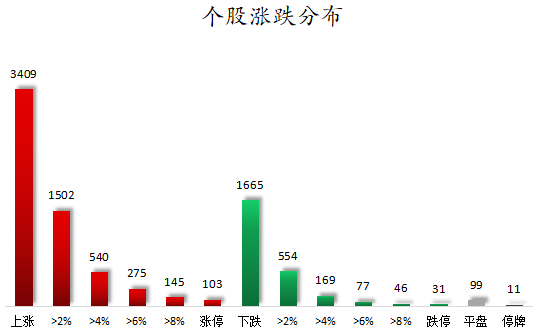
Market Overview - The Shanghai Composite Index closed at 4114.00 points, up 0.29%, with a trading volume of 11,901 billion yuan [1] - The Shenzhen Component Index closed at 14,294.05 points, up 0.09%, with a trading volume of 15,182.9 billion yuan [1] - The ChiNext Index closed at 3,337.61 points, down 0.7%, with a trading volume of 7,150.64 billion yuan [1] - The STAR Market 50 Index closed at 1,506.86 points, down 0.48%, with a trading volume of 933 billion yuan [1] - Total trading volume in both markets was 27,083.9 billion yuan, a decrease of 3,179.15 billion yuan from the previous trading day [1] Sector Performance - Strong sectors included chemicals, petroleum and petrochemicals, automotive, electric equipment, precious metals, construction materials, national defense and military, and light manufacturing [2] - Active concepts included ultra-high voltage, duty-free, geothermal energy, smart grid, glyphosate, general aviation, aircraft carriers, phosphorus chemicals, and ice and snow economy [2] - Weak sectors included computers, communications, banking, insurance, education, and biomedicine [2] Stock Performance - A total of 3,409 stocks rose, while 1,665 stocks fell, with 99 stocks remaining flat and 11 stocks suspended [2] - 103 stocks hit the daily limit up, while 31 stocks hit the daily limit down [2] Capital Flow - The net outflow of main funds in the Shanghai and Shenzhen markets was 39.798 billion yuan, with the ChiNext experiencing a net outflow of 19.422 billion yuan [6] - The electronic sector saw the largest net outflow of 99.71 billion yuan, followed by computers and communications [6] Individual Stock Highlights - China West Electric had the highest net inflow of main funds at 1.076 billion yuan, with a price increase of 10.04% [10] - 90 stocks received net inflows exceeding 1 billion yuan, including New Yisheng and Goldwind Technology [9] - Ningde Times experienced the largest net outflow of 1.441 billion yuan, with a price decrease of 0.97% [12] Institutional Activity - Institutions net bought 16 stocks, with Goldwind Technology leading at approximately 339 million yuan [15] - The net selling was highest for Hongxiang shares, amounting to approximately 130 million yuan [15]
75.11亿元主力资金今日撤离通信板块
Zheng Quan Shi Bao Wang· 2026-01-19 09:34
Market Overview - The Shanghai Composite Index rose by 0.29% on January 19, with 23 out of the 28 sectors experiencing gains, led by basic chemicals and petroleum & petrochemicals, which increased by 2.70% and 2.08% respectively [1] - The computer and communication sectors were the biggest losers, declining by 1.55% and 0.96% respectively [1] Capital Flow Analysis - The main capital outflow from the two markets totaled 35.714 billion yuan, with 13 sectors seeing net inflows [1] - The power equipment sector had the highest net inflow, with 7.597 billion yuan, followed by the basic chemicals sector with a net inflow of 1.331 billion yuan [1] Communication Sector Performance - The communication sector fell by 0.96%, with a total net capital outflow of 7.511 billion yuan [2] - Out of 124 stocks in the communication sector, 43 rose while 80 fell, with 4 hitting the daily limit down [2] - The top three stocks with the highest net inflow were NewEase, Changfei Optical Fiber, and Hengtong Optic-Electric, with net inflows of 830 million yuan, 349 million yuan, and 91 million yuan respectively [2] Communication Sector Capital Outflow - The top three stocks with the highest net capital outflow were Zhongji Xuchuang, Runze Technology, and Cambridge Technology, with outflows of 1.093 billion yuan, 910 million yuan, and 811 million yuan respectively [3] - Other notable stocks with significant outflows included Fenghuo Communication and Tianfu Communication, with outflows of 673 million yuan and 562 million yuan respectively [3]


2025年中国光模块细分产品分析 800G光模块在2025年成为主流【组图】
Qian Zhan Wang· 2026-01-19 09:10
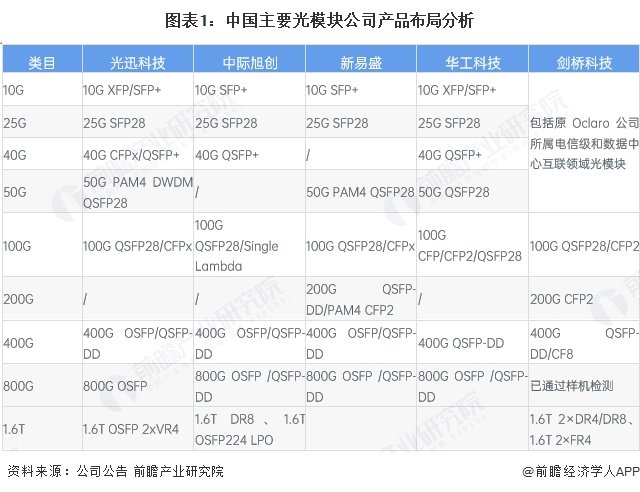
Core Insights - The report provides an analysis of the global and Chinese optical module industry, highlighting the product layout of representative companies and a comparative analysis of segmented products. Group 1: Product Layout of Representative Companies - Major Chinese optical module companies have product lines covering transmission rates up to 800G and below, including 10G, 25G, 40G, 50G, 100G, 200G, 400G, and 800G modules [1]. - The table outlines the specific products offered by companies such as Guangxun Technology, Zhongji Xuchuang, and others across various transmission rates, indicating a comprehensive coverage in the optical module market [1]. Group 2: 10G Optical Module Market - The 10G optical module market is mature, primarily featuring XFP and SFP+ modules, with SFP+ being favored for its lower cost, smaller size, and strong compatibility [3]. - 10G data center solutions typically involve 10G switches paired with SFP+ modules and LC fiber jumpers, emphasizing the importance of matching switch rates with corresponding optical modules [3]. Group 3: 40G Optical Module Demand - The 40G optical module, particularly the QSFP+ type, is widely used due to its compact design and ability to meet high-density, high-speed market demands [6]. - Transitioning from 10G to 40G is driven by the need for increased bandwidth and throughput in data centers, with 40G solutions often involving 40G switches and QSFP+ modules [6]. Group 4: 100G Optical Module Applications - The 100G optical module is primarily utilized in cloud data centers and high-speed networks, with QSFP28 emerging as the mainstream packaging method [7]. - Significant technological advancements in 100G modules include digital coherent receiver technology and advanced error correction coding, catering to evolving user demands [7]. Group 5: 400G Optical Module Commercialization - The 400G optical module is set to become commercially viable in 2023, driven by the increasing demand from AI model training and 5G network construction [10]. - Major Chinese telecom operators are expected to deploy 400G modules extensively, with significant market share anticipated by 2024-2025 [10]. Group 6: 800G Optical Module Projections - The 800G optical module is projected to become mainstream by 2025, primarily driven by the needs of AI data centers for large-scale GPU cluster interconnections [13]. - Different types of 800G modules are categorized based on transmission distance, catering to various applications from data center interconnections to long-distance transmission [15]. Group 7: 1.6T Optical Module Development - The 1.6T optical module is expected to see commercial rollout in 2025, with gradual scaling from initial small batch shipments to larger production volumes by year-end [16]. - Key players like Nvidia and Zhongji Xuchuang are leading the early adoption and certification processes for 1.6T modules [18].


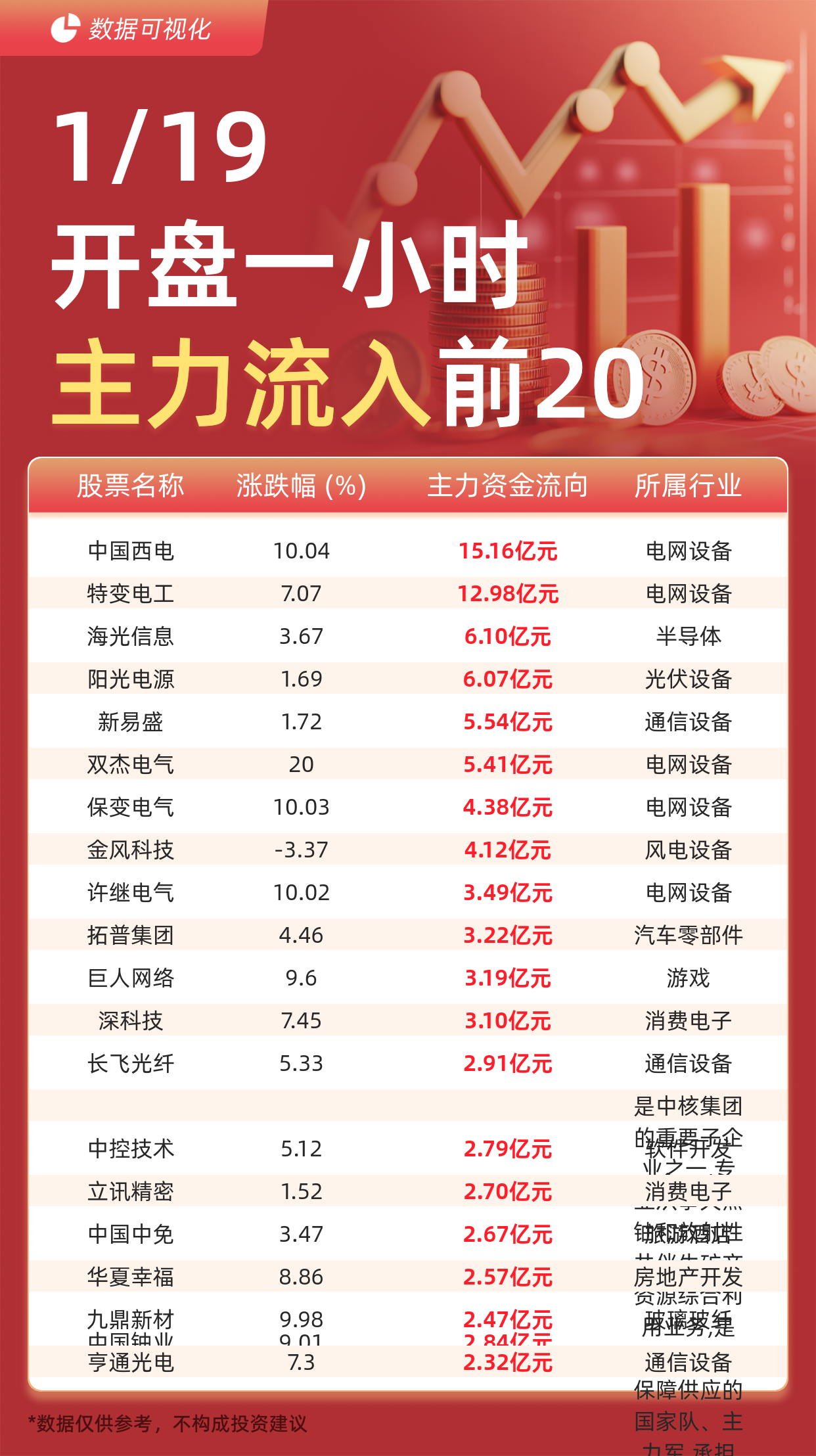
主力资金流入前20:中国西电流入15.16亿元、特变电工流入12.98亿元
Jin Rong Jie· 2026-01-19 02:38
Core Viewpoint - The data indicates significant capital inflows into various stocks, particularly in the electric grid equipment and renewable energy sectors, highlighting investor interest in these industries. Group 1: Stock Performance and Capital Inflows - China Xidian (中国西电) saw a capital inflow of 1.516 billion, with a price increase of 10.04% [1][2] - TBEA (特变电工) experienced a capital inflow of 1.298 billion, with a price increase of 7.07% [1][2] - Haiguang Information (海光信息) had a capital inflow of 610 million, with a price increase of 3.67% [1][2] - Sungrow Power (阳光电源) attracted 607 million in capital, with a price increase of 1.69% [1][2] - NewEase (新易盛) received 554 million, with a price increase of 1.72% [1][2] - Shuangjie Electric (双杰电气) had a notable price increase of 20% with a capital inflow of 541 million [1][2] - Baobian Electric (保变电气) saw a capital inflow of 438 million, with a price increase of 10.03% [1][2] - Goldwind Technology (金风科技) experienced a capital outflow of 4.12 billion, with a price decrease of 3.37% [1][2] - XJ Electric (许继电气) had a capital inflow of 349 million, with a price increase of 10.02% [1][2] - Top Group (拓普集团) attracted 322 million, with a price increase of 4.46% [1][2] - Giant Network (巨人网络) saw a capital inflow of 319 million, with a price increase of 9.6% [1][2] Group 2: Additional Stocks and Their Performance - Deep Technology (深科技) had a capital inflow of 310 million, with a price increase of 7.45% [3] - Changfei Fiber (长飞光纤) attracted 291 million, with a price increase of 5.33% [3] - Zhongkong Technology (中控技术) saw a capital inflow of 279 million, with a price increase of 5.12% [3] - Luxshare Precision (立讯精密) had a capital inflow of 270 million, with a price increase of 1.52% [3] - China Duty Free Group (中国中免) attracted 267 million, with a price increase of 3.47% [3] - Huaxia Happiness (华夏幸福) saw a capital inflow of 257 million, with a price increase of 8.86% [3] - Jiuding New Materials (九鼎新材) had a capital inflow of 247 million, with a price increase of 9.98% [3] - Hengtong Optic-Electric (亨通光电) attracted 232 million, with a price increase of 7.3% [3]


通信|未来三年景气确立-算力方向重点布局
2026-01-19 02:29
Summary of Conference Call Records Industry Overview - The telecommunications industry is expected to experience strong growth over the next three years, with leading companies like Zhongji Xuchuang and Xinyi Sheng showing impressive performance, indicating a positive outlook for 2025 [1][3] - The demand for the telecommunications sector is optimistic for 2026 and beyond, driven by overseas wafer factory expansions, GPU upgrades, VR glasses, and public demand [1][5] - The domestic computing power industry chain is set to initiate procurement and bidding for 2026 starting in the second half of 2025, with significant growth expected in the IDC sector [1][6] Key Insights and Arguments - The current GPU power consumption is high, with approximately 1.5GW for one million cards, leading to a total demand of around 5GW when including other devices [1][7] - Internet capital expenditure is expected to continue growing, which will drive demand in the IDC market, potentially leading to a supply-demand imbalance [1][8] - The SDN network is a significant growth area in the network equipment sector, with major internet companies like ByteDance, Alibaba, and Tencent launching their SKAP network frameworks [1][9] Investment Opportunities - Companies with strong performance, such as Xuchuang, Xinyi Sheng, Yuanjie, and Bochuang, are highlighted as key investment opportunities in the optical module sector [1][5] - The optical fiber industry is experiencing price increases, with G657A2 optical fibers in short supply, prompting operators to adjust bidding strategies [1][14] - New technology directions in optics, such as onboard optics, CPO, and NPO, present significant growth potential, with companies like Robertco and Zhichuang Technology being noteworthy [1][15] Market Dynamics - The IDC market is expected to see a significant increase in bidding activity, with a large-scale bidding market anticipated in early 2026 [1][6] - The optical communication sector is projected to be a critical allocation direction due to clear demand forecasts for 2026 and 2027 [1][13] - Second-tier module manufacturers may have opportunities to capture overflow orders, with the 800G and 1.6T market expected to reach 70-80 million units this year [1][17][18] Future Outlook - TSMC's capital expenditure plans for the next three years are significantly higher than expected, indicating a clear industry outlook [1][12] - The upcoming earnings forecasts are expected to alleviate concerns regarding fourth-quarter performance fluctuations and material impacts, leading to a focus on the first quarter and 2027 [1][19]