Yunnan Botanee Bio-Technology (300957)

Search documents
国货美妆龙头贝泰妮主动求变
2 1 Shi Ji Jing Ji Bao Dao· 2025-09-01 08:48
Core Viewpoint - The company, Betaini, reported a resilient performance in the sensitive skin segment despite short-term revenue and profit pressures, with a strategic focus on product optimization, channel refinement, and supply chain efficiency [1][3]. Financial Performance - In the first half of 2025, Betaini achieved revenue of 2.372 billion yuan and a net profit of 247 million yuan [1]. - The gross margin improved by 3.42 percentage points to 76.01%, indicating enhanced product profitability [1]. - Operating cash flow reached 347 million yuan, a year-on-year increase of 145.70%, providing ample cash reserves for future R&D and market expansion [1]. Brand Strategy - Betaini has developed a multi-brand matrix, including key brands such as Winona, Winona Baby, AOXMED, Beforteen, Za, PURE&MILD, and TriPollar [2]. - The core brand, Winona, generated revenue of 1.95 billion yuan in the first half of 2025, maintaining its leading position in the Chinese sensitive skin care market [3]. - Winona's strategic upgrade to focus on "researching sensitive skin" has expanded its product offerings to include anti-aging and whitening solutions [3]. Growth Drivers - The AOXMED brand recorded revenue of 51.47 million yuan, a year-on-year growth of 93.90%, indicating strong market demand [4]. - The company has also invested in the high-end body care brand "BATHFELL," acquiring a 20% stake to enhance its health ecosystem [5]. - Betaini's channel strategy includes a focus on both online and offline sales, with online revenue accounting for 73.93% of total sales [7]. Global Expansion - Betaini has established a Southeast Asia headquarters in Bangkok, focusing on local market adaptation and brand building [8]. - The company is leveraging social media platforms like Instagram and TikTok to enhance brand recognition in international markets [9]. - The participation in the China-South Asia Expo reflects the company's commitment to global expansion and enhancing international competitiveness [9]. Future Outlook - With the release of new products and growth in overseas markets, Betaini is expected to experience a performance recovery in the second half of the year [10].
华泰证券今日早参-20250901
HTSC· 2025-09-01 02:17
Macro Insights - The recent appreciation of the Renminbi against the US dollar and a basket of currencies has been notable, with a 0.4% increase observed on August 28-29 [2] - The manufacturing PMI for August showed a slight recovery to 49.4% from 49.3% in July, indicating marginal improvement in manufacturing activity [3] - The non-manufacturing business activity index rose to 50.3% from 50.1% in July, suggesting a stable outlook for the service sector [3] Investment Strategy - The technology sector is experiencing increased investor interest, with TMT transaction volume exceeding 40% of total market activity, indicating a shift towards fundamental-driven market behavior [5] - The report suggests focusing on sectors benefiting from Renminbi appreciation, such as consumption, non-bank financials, and electric new energy, which are currently at relatively low valuations [5] - The report emphasizes the importance of maintaining flexibility in investment strategies, particularly in the context of market volatility and sector rotation [8] Company Performance - Alibaba's Q1 FY26 revenue reached 247.7 billion yuan, a year-on-year increase of 1.8%, with adjusted EBITA declining by 13.7% [14] - Huichuan Technology reported a 26.73% increase in revenue for H1 2025, reaching 20.509 billion yuan, with a net profit of 2.968 billion yuan, up 40.15% [18] - Zhonggu Logistics experienced a 41.6% increase in net profit for H1 2025, despite a 7.0% decline in revenue, attributed to high demand in the foreign trade container leasing market [19] Sector Analysis - The beverage sector showed strong sales performance, with revenue growth of 22.8% in Q2 2025, while the snack food sector faced challenges with a 0.3% decline [12] - The insurance sector is seeing a shift towards high-yield stocks, with the average allocation to FVOCI stocks increasing by 1.3 percentage points to 4.2% [10] - The real estate sector is under pressure, with China Overseas Development reporting a 4% decline in revenue for H1 2025, but maintaining a strong project pipeline for future growth [22]


贝泰妮(300957):公司信息更新报告:2025H1业绩承压,期待业务调整后利润释放
KAIYUAN SECURITIES· 2025-08-31 09:41
Investment Rating - The investment rating for the company is "Buy" (maintained) [1][3] Core Views - The company reported a revenue of 2.372 billion yuan in H1 2025, a year-on-year decrease of 15.4%, with a net profit of 247 million yuan, down 49.0%. The Q2 2025 revenue was 1.423 billion yuan, down 16.7%, and net profit was 218 million yuan, down 28.9%. The company is a leader in sensitive skin care and expects growth after adjustments to its brand matrix [3][4] - The company maintains its profit forecast, expecting net profits of 672 million yuan, 803 million yuan, and 927 million yuan for 2025, 2026, and 2027 respectively, with corresponding EPS of 1.59, 1.90, and 2.19 yuan. The current stock price corresponds to P/E ratios of 29.8, 24.9, and 21.6 for the same years [3][4] Financial Performance Summary - In H1 2025, the company's revenue from various brands was as follows: Winona 1.950 billion yuan (-18.4%), Winona Baby 110 million yuan (+8.6%), Aikeman 51 million yuan (+93.9%), Jirei 212 million yuan (-11.5%), and Pomei 24 million yuan (-4.7%). Online, offline, and OMO channels generated revenues of 1.743 billion yuan (-5.9%), 424 million yuan (-41.7%), and 191 million yuan (-10.0%) respectively [4] - The overall gross margin for H1 2025 was 76.0%, an increase of 3.4 percentage points. The sales, management, and R&D expense ratios were 54.2%, 8.1%, and 4.9%, respectively, with sales expenses increasing due to enhanced marketing personnel, channel expansion, and advertising investments [4][6] Financial Forecasts - The company forecasts revenue growth from 5.522 billion yuan in 2023 to 7.962 billion yuan in 2027, with a CAGR of 13.4%. The net profit is expected to recover from 757 million yuan in 2023 to 927 million yuan in 2027, reflecting a significant turnaround [6][8] - The projected P/E ratios are expected to decline from 26.5 in 2023 to 21.6 in 2027, indicating an improving valuation as earnings recover [6][8]
【最全】2025年中国功能性护肤品行业上市公司全方位对比(附业务布局、业绩对比、业务规划等)
Qian Zhan Wang· 2025-08-31 02:10
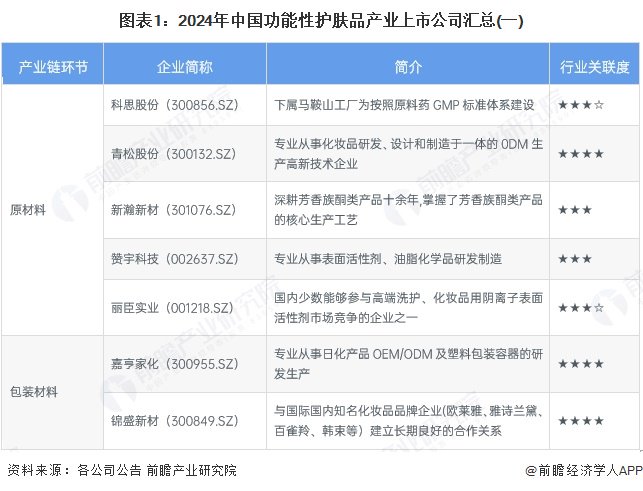
Core Viewpoint - The functional skincare industry in China is experiencing a rise of domestic brands, with various listed companies involved across the supply chain, including raw materials, packaging, and sales channels [1][2]. Group 1: Industry Overview - Functional skincare products are designed to address specific skin issues and possess certain pharmacological effects, indicating a growing market for targeted skincare solutions [1]. - The industry is characterized by a diverse range of companies, from raw material suppliers to online and offline sales channels [2]. Group 2: Company Distribution - Key companies in the raw materials segment include Kesheng Co., Qingsong Co., and Xinhang New Materials, while packaging material companies include Jiaheng Household and Jinsong New Materials [2][3]. - Major players in the functional skincare segment include Betaini, Huaxi Biological, Shanghai Jahwa, and Chuang'er Biological, with significant online sales channels represented by Alibaba, JD.com, and Pinduoduo [2][4]. Group 3: Financial Performance - Betaini leads the industry with a revenue of 57.36 billion yuan in 2024, followed by Huaxi Biological with 53.71 billion yuan and Shanghai Jahwa with 56.79 billion yuan [6][18]. - The gross profit margins for most companies in the functional skincare sector range from 70% to 85%, with Juzhi Biological achieving the highest margin at 82.09% [17][18]. Group 4: Business Strategies - Companies are focusing on R&D innovation, brand enhancement, and channel optimization to capture more market share and adapt to competitive pressures [19]. - Betaini plans to enhance its product offerings in the baby skincare segment and expand its online and offline presence, while Huaxi Biological is shifting towards anti-aging strategies and enhancing its technological capabilities [20][19]. Group 5: Market Positioning - Betaini has a dominant market position with 99.49% of its business in functional skincare, primarily targeting the Chinese market [16]. - Huaxi Biological and Shanghai Jahwa have also established strong brand identities with competitive product lines, while Chuang'er Biological focuses on collagen products [14][16].


贝泰妮直面敏感肌叙事挑战
Hua Er Jie Jian Wen· 2025-08-29 13:33
Core Viewpoint - Domestic beauty brands are collectively facing a slowdown after years of rapid growth, as evidenced by Beitaini's significant revenue and profit declines in the first half of 2025 [1] Financial Performance - Beitaini reported a revenue of 2.372 billion yuan and a net profit of 247 million yuan for the first half of 2025, representing year-on-year declines of 15.43% and 49.01% respectively [1] - The company's second-quarter revenue was 1.423 billion yuan, down 16.67% year-on-year, marking its first loss during the "618 shopping festival" in four years [2] Marketing Strategy Adjustments - Beitaini is controlling its promotional spending, with sales expenses for the first half of 2025 at 1.285 billion yuan, a modest increase of 0.6% year-on-year, but a slowdown of 15.81 percentage points compared to the same period in 2024 [2] - The company has shifted its focus from low-efficiency promotions to content marketing, user education, and precise conversion strategies, which has improved gross margins and operating cash flow [6] Product Category Performance - Beitaini has seen declines across various product categories, particularly in medical device products, which generated 116 million yuan in revenue for the first half of 2025, a drop of over 50% year-on-year [6] - The company has reduced resource allocation for medical device products and is concentrating more on core skincare categories and high-growth segments [8] Growth Potential - Beitaini's anti-aging skincare brand, Aikeman, has transitioned from beauty salons to e-commerce, achieving over 90% year-on-year growth with revenue of 51 million yuan in the first half of 2025 [8][9]
贝泰妮(300957):2025 年中报点评:主品牌增长承压,净利率逐季改善
GUOTAI HAITONG SECURITIES· 2025-08-29 09:46
Investment Rating - The investment rating for the company is "Accumulate" with a target price of 56.57 CNY [4][10]. Core Insights - The company focuses on big product lines and streamlining its main brand SKU strategy to drive continuous improvement in gross margin. However, the significant decline in offline channels in 1H25 has impacted main brand growth. There are expectations for new products to expand the consumer base and improve operational efficiency on platforms like Douyin [2][10]. - In 1H25, the company reported total revenue of 2.372 billion CNY, a year-on-year decline of 15.43%, and a net profit attributable to the parent company of 247 million CNY, down 49.0% year-on-year. The gross margin improved to 76.0%, up 3.42 percentage points, attributed to a focus on big products and reduced promotions [10][11]. - The company has adjusted its EPS forecasts for 2025 and 2026 to 1.12 CNY and 1.49 CNY, respectively, reflecting the impact of short-term offline channel adjustments and product line streamlining [10][11]. Financial Summary - For 2023A, the total revenue is projected at 5.522 billion CNY, with a year-on-year growth of 10.1%. The net profit attributable to the parent company is expected to be 757 million CNY, down 28.0% [3][11]. - The company’s gross margin is expected to improve to 75.3% in 2025E, with a net profit margin of 8.6% [11]. - The company’s total assets are projected to reach 8.456 billion CNY by 2025E, with total liabilities of 1.936 billion CNY [11]. Market Performance - The stock has a 52-week price range of 39.34 CNY to 70.30 CNY, with a total market capitalization of 19.871 billion CNY [5][10]. - The stock has shown an absolute increase of 14% over the past 12 months, although it has underperformed relative to the index by 41% [9][10].
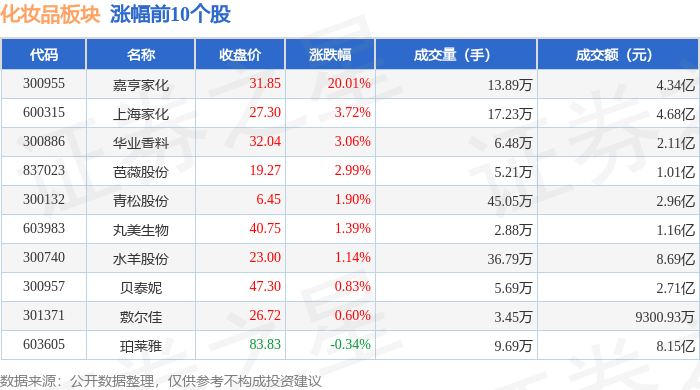
化妆品板块8月29日涨1.05%,嘉亨家化领涨,主力资金净流入1035.31万元
Zheng Xing Xing Ye Ri Bao· 2025-08-29 08:48
Group 1 - The cosmetics sector increased by 1.05% on August 29, with Jiaheng Jiahua leading the gains [1] - The Shanghai Composite Index closed at 3857.93, up 0.37%, while the Shenzhen Component Index closed at 12696.15, up 0.99% [1] - Jiaheng Jiahua's stock price rose by 20.01% to 31.85, with a trading volume of 138,900 shares and a transaction value of 434 million yuan [1] Group 2 - The cosmetics sector saw a net inflow of 10.35 million yuan from institutional investors, while retail investors contributed a net inflow of 88.15 million yuan [2] - Major stocks in the sector experienced varied capital flows, with Jiaheng Jiahua having a net inflow of 76.21 million yuan from institutional investors [3] - Shanghai Jiahua had a net inflow of 35.86 million yuan from institutional investors, but a net outflow of 51.01 million yuan from retail investors [3]


贝泰妮涨2.07%,成交额1.03亿元,主力资金净流出181.58万元
Xin Lang Cai Jing· 2025-08-29 03:17
Core Viewpoint - The company Betaini has experienced fluctuations in stock performance and financial metrics, with a notable decrease in revenue and net profit in the first half of 2025, while maintaining a focus on skincare products targeting sensitive skin [1][2]. Financial Performance - As of June 30, 2025, Betaini reported a revenue of 2.372 billion yuan, a year-on-year decrease of 15.43% [2]. - The net profit attributable to shareholders was 247 million yuan, reflecting a significant year-on-year decline of 49.01% [2]. - The company has distributed a total of 1.289 billion yuan in dividends since its A-share listing, with 844 million yuan distributed over the past three years [3]. Stock Performance - Betaini's stock price increased by 13.75% year-to-date, with a 1.46% rise over the last five trading days and a 6.45% increase over the last 20 days [1]. - The stock was trading at 47.88 yuan per share, with a market capitalization of 20.282 billion yuan as of August 29 [1]. Shareholder Information - The number of shareholders decreased by 2.86% to 37,500 as of June 30, 2025, while the average number of circulating shares per person increased by 2.94% to 11,297 shares [2]. - Notable institutional shareholders include Hong Kong Central Clearing Limited and E Fund's ChiNext ETF, with both increasing their holdings [3]. Business Overview - Betaini, established in May 2010 and listed in March 2021, focuses on skincare products under the "Winona" brand, emphasizing natural plant-based ingredients for sensitive skin [1]. - The company's revenue composition includes 84.36% from skincare products, 10.07% from makeup, 4.88% from medical devices, and 0.70% from services and others [1]. Industry Position - Betaini operates within the beauty and personal care sector, specifically in the branded cosmetics segment, and is associated with concepts such as cross-border e-commerce and high dividend yields [1].
申万宏源证券晨会报告-20250829
Shenwan Hongyuan Securities· 2025-08-29 00:44
Group 1: Snow Peak Technology (603227) - The company is positioned as a leader in the civil explosives and chemical industry in Xinjiang, with a dual business layout of "civil explosives + chemicals" [10][12] - Revenue forecasts for 2025-2027 are projected at 6.582 billion, 7.665 billion, and 8.613 billion yuan, with corresponding net profits of 545 million, 820 million, and 1.035 billion yuan, indicating growth rates of -19%, 51%, and 26% respectively [12] - The company benefits from a significant regional advantage in Xinjiang, where the scarcity of ammonium nitrate is highlighted, and the entry of Guangdong Hongda is expected to facilitate the scale-up of explosives production [12] Group 2: Meituan (03690) - The company maintains a "buy" rating despite a decrease in profits due to increased competition in the food delivery and instant retail sectors, with adjusted net profits for 2025-2027 revised to -4.5 billion, 38.5 billion, and 57.6 billion yuan [11][15] - The core local business revenue grew by 7.7% year-on-year to 65.3 billion yuan, but operating profit fell by 75.6% to 3.7 billion yuan, indicating significant pressure on profit margins [13][15] - The company is actively expanding its logistics network and enhancing service quality, with a peak daily order volume exceeding 150 million in July [13][15] Group 3: Banking Sector Insights - Industrial Bank (601166) reported a revenue of 110.5 billion yuan in 1H25, a decrease of 2.3%, but net profit increased by 0.2% to 43.1 billion yuan, indicating a recovery in profitability [17][19] - CITIC Bank (601998) achieved a revenue of 105.8 billion yuan in 1H25, down 3%, while net profit rose by 2.8% to 36.5 billion yuan, reflecting stable asset quality [21][23] - Su Nong Bank (603323) reported a slight revenue increase of 0.2% to 2.28 billion yuan in 1H25, with net profit growing by 5.2% to 1.18 billion yuan, showcasing a robust fundamental performance [25][26]



贝泰妮2025年中报简析:净利润同比下降49.01%,公司应收账款体量较大
Zheng Quan Zhi Xing· 2025-08-28 23:06
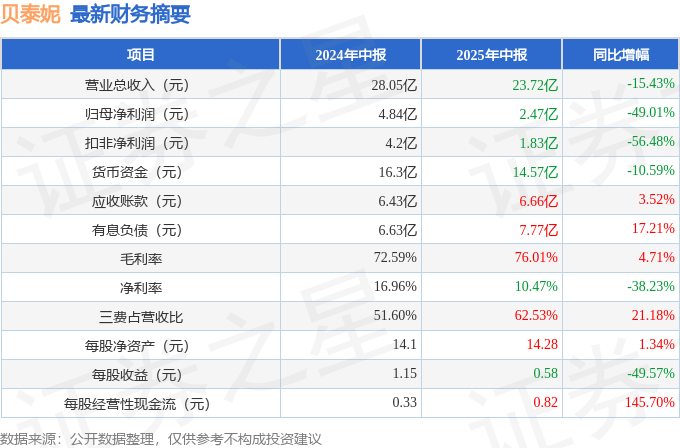
Core Viewpoint - Betaini (300957) reported a decline in revenue and net profit for the first half of 2025, indicating potential challenges in its financial performance and operational efficiency [1][2]. Financial Performance - Total revenue for the first half of 2025 was 2.372 billion yuan, a year-on-year decrease of 15.43% [1]. - Net profit attributable to shareholders was 247 million yuan, down 49.01% year-on-year [1]. - In Q2 2025, revenue was 1.423 billion yuan, a decline of 16.67% compared to the same quarter last year [1]. - Q2 net profit attributable to shareholders was 218 million yuan, a decrease of 28.87% year-on-year [1]. - Gross margin was 76.01%, an increase of 4.71% year-on-year, while net margin was 10.47%, down 38.23% [1]. - Total selling, administrative, and financial expenses amounted to 1.483 billion yuan, representing 62.53% of revenue, an increase of 21.18% year-on-year [1]. - Earnings per share were 0.58 yuan, a decrease of 49.57% year-on-year [1]. Accounts Receivable - The company has a significant accounts receivable issue, with accounts receivable amounting to 132.3% of the latest annual net profit [1][2]. Return on Investment - The company's return on invested capital (ROIC) for the previous year was 7.43%, indicating average capital returns [2]. - Historical median ROIC since the company went public is 41.16%, suggesting better investment returns in the past [2]. Business Model - The company's performance is primarily driven by marketing efforts, necessitating a deeper analysis of the underlying factors [2]. Fund Holdings - Major funds holding Betaini include CITIC Jiantou Value Growth A, Guofu China Income Mixed A, and others, indicating interest from institutional investors [3]. Brand Positioning - The Aikeman brand is positioned as a mid-to-high-end domestic product, initially benchmarking against international beauty brands, with strengths in R&D and supply chain management [4].