
BIDU(BIDU)

Search documents
AI早报 |京东正招募端侧AI芯片领域人才,中国联通人工智能产业创新大会在京举办
Xin Lang Cai Jing· 2025-12-13 00:18
Group 1 - JD is recruiting talent in the field of edge AI chips, focusing on integrated storage and computing AI chips for applications in robotics and smart home devices, offering salaries ranging from 40K to 100K times 20 [1] - OPPO is set to launch the "AI Miaot听" feature, which transforms articles into podcasts, enhancing user experience with a dual-person format and background music, catering to the growing preference for audio content consumption [1] - Baidu's founder, Li Yanhong, predicts that 2025 will be a pivotal year for AI application proliferation, emphasizing that the application layer will present the most opportunities for success [1] Group 2 - TCL's founder, Li Dongsheng, stated that AI, represented by large models and computing systems, is transitioning from concept to deep industrialization, becoming a key driver for future growth, with R&D expenses expected to reach 15 billion yuan by 2025 [2] - TCL aims to generate over 1 billion yuan in comprehensive benefits through the implementation of AI applications by 2025 [2] Group 3 - Beijing has launched its first online exhibition themed around AI science popularization, titled "Youth AI Adventure," providing resources for young people to understand and apply AI technology [3] - China Unicom held an AI industry innovation conference in Beijing, focusing on policy interpretation, capability release, case sharing, and ecosystem agreements to showcase its strategic layout and practical achievements in the AI field [4]


AIGC 行业专题报告:AI 技术演进视角下,智能内容生成的现在与未来
Sou Hu Cai Jing· 2025-12-12 23:09
Core Insights - The article discusses the transformative potential of Artificial Intelligence (AI) as the fourth industrial revolution, emphasizing its role in enhancing productivity and reducing costs across various sectors [1][5]. Group 1: AI Development Drivers - AI is driven by the need to improve efficiency and reduce costs, addressing pain points in consumer-related scenarios such as entertainment, travel, and health [3]. - The application of AI in consumer sectors includes labor replacement and productivity enhancement through technologies like voice recognition and intelligent customer service [3]. - In the business sector, AI is widely adopted in finance, public safety, and healthcare, reflecting a strong demand for efficiency improvements [3]. Group 2: Historical Context and Evolution - AI is positioned as the fourth productivity revolution, following the steam, electrical, and information technology revolutions, with significant historical milestones marking its development [5]. - The evolution of AI has seen three major waves of growth, each driven by breakthroughs in underlying algorithms, with the current wave characterized by deep learning advancements [8][12]. - The first wave of AI in the 1950s was limited by computational performance, while the second wave in the 1980s faced challenges due to the high costs of expert systems [9][11]. Group 3: AI Industry Structure - The AI industry can be segmented into three layers: foundational support (hardware and data), technology (algorithm development), and application (commercial solutions) [6][7]. - Major players in the foundational layer include international tech giants like Nvidia and Intel, while the technology layer features companies like Google and IBM focusing on specific AI applications [6][7]. - The application layer is where AI technologies are commercialized, with a relatively low entry barrier due to the global open-source community [6]. Group 4: Current AI Landscape - The current state of AI is classified as "weak AI," focusing on specific tasks such as speech and image recognition, with significant performance exceeding human capabilities in certain areas [30][33]. - AI's impact on global GDP is projected to be substantial, with estimates suggesting a 14% increase, translating to approximately $15.7 trillion in growth [37]. - The rapid advancement of deep learning algorithms and the availability of vast datasets are expected to drive widespread AI application across various industries [38][39]. Group 5: Future Opportunities - The article highlights the potential for AI to revolutionize content generation and distribution, particularly through platforms like TikTok and Douyin, which utilize AI-driven recommendation systems [46][52]. - The emergence of generative AI (AIGC) is seen as a significant opportunity, with advancements enabling the creation of diverse content types, including text, images, and videos [54][61]. - The integration of AI into various sectors is anticipated to accelerate, driven by technological advancements and supportive policies from governments [44][45].





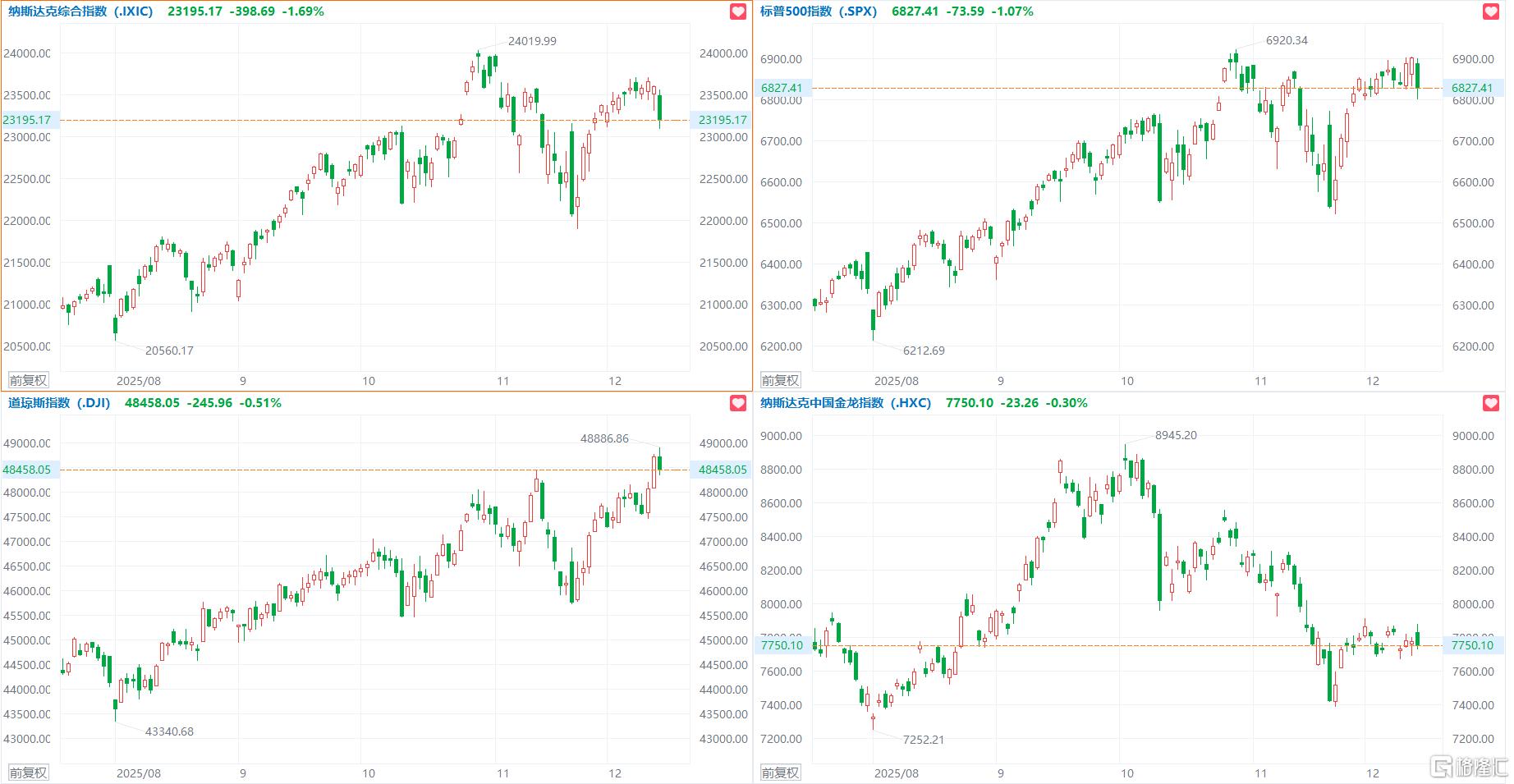
美股三大指数集体收跌,纳指、标普500指数跌逾1%,博通跌超11%
Ge Long Hui· 2025-12-12 22:26
Market Overview - The three major U.S. stock indices closed lower, with the Dow Jones down 0.51%, the Nasdaq down 1.69%, and the S&P 500 down 1.07% [1] - Popular tech stocks experienced declines, with Broadcom falling over 11%, Nvidia down over 3%, and Google, Microsoft, Meta, and Amazon all dropping over 1%. Tesla, however, saw an increase of over 2% [1] Sector Performance - The storage sector, cryptocurrency mining companies, and semiconductor stocks faced significant declines, with Corning down nearly 8%, Quantum down over 7%, and Micron Technology, Dell Technologies, and Logitech all dropping over 6%. AMD fell nearly 5%, Intel was down over 4%, and HP dropped over 2% [1] - The automotive manufacturing sector saw gains, with Polestar rising over 19%, Rivian up over 12%, and Toyota increasing by over 2% [1] Chinese Stocks - The Nasdaq Golden Dragon China Index fell by 0.30%. Among popular Chinese stocks, Pony.ai dropped 5.6%, WeRide fell 3.2%, and Baidu and NIO both declined over 2%. XPeng was down 1.1%, Alibaba fell 0.9%, and Pinduoduo remained flat. However, Li Auto rose 0.3%, Yum China increased by 1.8%, and New Oriental and NetEase both gained 2.1% [1]


Is Apollo Go's Global Push a Sign of More Upside for Baidu Stock?
ZACKS· 2025-12-12 17:25
Core Insights - Baidu's strategic expansion of Apollo Go internationally marks a significant development in the autonomous ride-hailing sector, aiming to establish it as a global mobility platform rather than just a domestic showcase [1] Group 1: International Expansion - Apollo Go has launched services in Switzerland with PostBus and secured complete driverless commercial permits in Abu Dhabi, while testing zones have expanded in Hong Kong [2] - By November 2025, Apollo Go is projected to surpass 17 million cumulative public rides and expand its service footprint to 22 cities, with weekly fully driverless rides exceeding 250,000 [2] Group 2: Economic Signals - Several cities are already profitable on a unit basis, with expectations for more profitability in 2026 as utilization improves and asset-light partnerships develop [3] - The Zacks Consensus Estimate for fourth-quarter 2025 revenues is $4.62 billion, reflecting a 1.09% year-over-year decline, indicating that Apollo Go has not yet fully mitigated broader revenue pressures [3] Group 3: Competitive Landscape - Competition in the autonomous mobility sector is intensifying, with Tesla and Alphabet scaling their platforms, which increasingly overlap with Baidu's objectives [4] - Tesla is enhancing its Full Self Driving capabilities, while Alphabet is expanding Waymo's robotaxi network, creating competitive pressure for Baidu as it enters global markets [4] Group 4: Financial Performance - Baidu's shares have increased by 49.2% over the past six months, underperforming the Zacks Internet - Services industry's growth of 76.1% but outperforming the Zacks Computer and Technology sector's increase of 28.4% [5] - The forward 12-month price/earnings ratio for Baidu is 20.09X, which is below the industry average of 29.44X [9] - The Zacks Consensus Estimate for Baidu's fourth-quarter 2025 earnings is $1.5 per share, indicating a 42.97% year-over-year decline [11]

阻止互联网广告下滑,全靠AI?
3 6 Ke· 2025-12-12 10:38
Core Insights - The article discusses how AI is becoming a crucial driver for advertising revenue in major internet companies, particularly Baidu and Kuaishou, as they seek to counteract declines in traditional advertising revenue [2][3][4][5]. Group 1: AI's Impact on Advertising Revenue - Baidu's AI native marketing service revenue reached 2.8 billion yuan, a year-on-year increase of 262%, contributing significantly to its core online marketing revenue [5]. - Kuaishou reported online marketing service revenue of 20.1 billion yuan, a 14% year-on-year growth, with AI-driven initiatives like OneRec contributing approximately 4%-5% to Q3 revenue [5][7]. - Meta also benefits from AI, with a 26% year-on-year increase in advertising revenue, highlighting the trend of AI enhancing advertising efficiency across platforms [8]. Group 2: AI as a Growth Engine - Baidu's core online marketing services account for 53% of total revenue, making AI a vital narrative for growth as traditional search advertising declines [3][4]. - Kuaishou's AI initiatives are seen as a means to generate new revenue streams, with a significant portion of its revenue coming from online marketing services [7]. - The integration of AI in advertising is viewed as a transformative force, allowing for dynamic content generation and improved targeting [10][12]. Group 3: Broader Industry Trends - AI is reshaping the marketing landscape, with companies like Meta and Kuaishou leveraging AI to enhance user engagement and advertising effectiveness [10][15]. - The global advertising market is experiencing a shift towards AI-driven solutions, with projections indicating substantial growth in AI advertising spending [18]. - Despite the promising outlook, challenges remain, including consumer skepticism towards AI-generated content and the need for a balance between investment and return [20][21].


红果大手笔买入AI漫剧,一分钟出价三万元
36氪未来消费· 2025-12-12 09:01
Core Viewpoint - The article discusses the emergence of "manhua drama" (漫剧) as a new trend in the entertainment industry, leveraging AI technology to reduce production costs and increase efficiency, marking 2025 as the "Year of Manhua Drama" [3][4][5]. Industry Overview - Manhua drama encompasses various forms, including meme-based comics, dynamic animations, and AI-generated 3D comics, with the definition still evolving [3]. - The industry is experiencing rapid growth, with a projected market size exceeding 20 billion yuan by 2025, driven by an 83% compound growth rate in supply during the first half of 2025 [7][9]. Financial Performance - Leading manhua drama brand Jiangyou Culture reports monthly revenues of 50 million yuan, while the company Lingju Animation has achieved a return on investment (ROI) of 1.15-1.2 [6]. - The average production cost for manhua dramas ranges from 50,000 to 150,000 yuan per episode, significantly lower than traditional short dramas, leading to higher profit margins [13][14]. Business Model - The business model for manhua dramas includes in-app advertising (IAA), in-app purchases (IAP), and hybrid monetization, with 80-90% of revenue still reliant on advertising spending [11][12]. - Companies are exploring new monetization strategies, such as brand collaborations and product placements, with successful examples already emerging [17]. Competitive Landscape - The competition in the manhua drama sector is primarily based on production volume, as the market is currently underserved [16][19]. - Major platforms like ByteDance, Tencent, and iQIYI are aggressively entering the manhua drama space, offering favorable revenue-sharing models to attract content creators [24]. Audience and Content Strategy - The primary audience for manhua dramas consists of males aged 20-30, contrasting with the female-dominated audience of traditional short dramas [23]. - The industry is awaiting a breakout hit to validate the manhua drama trend, similar to past successes in the short drama sector [25].



大摩预测了25家人形机器人公司将主导行业,没有宇树、智元
具身智能之心· 2025-12-12 07:59
Core Insights - Morgan Stanley predicts that 25 humanoid robot companies will dominate the industry, with 7 Chinese companies listed [2][3] - The Chinese companies include Baidu, Alibaba, Horizon Robotics, Junsheng Electronics, iFlytek, Desay SV, and Hesai Technology, focusing on various sectors such as AI, automotive, and electronic manufacturing [3][4] - The report emphasizes the importance of component and module suppliers over traditional humanoid robot manufacturers, highlighting the critical role of companies providing AI chips, visual sensors, precision actuators, and power management chips [3][4] Company and Industry Summary - The 7 Chinese companies identified are significant players in their respective fields, with a focus on AI, automotive intelligence, language recognition, and electronic manufacturing [3] - The absence of companies like Yushun and Zhiyuan in the report raised questions about its professionalism, but Morgan Stanley justified this by focusing on the foundational components essential for the humanoid robot industry [4] - The Chinese market has seen the emergence of nearly 150 humanoid robot startups, indicating a growing interest and investment in this sector, regardless of potential market bubbles [4]





昆仑芯势头强劲 华尔街看好百度:有望复制谷歌AI逆袭之路
Ge Long Hui A P P· 2025-12-12 05:17
Core Viewpoint - Baidu is regaining favor on Wall Street as expectations rise for the IPO of its chip subsidiary Kunlun, which is seen as a key step in unlocking the company's potential value and replicating Alphabet's success in the AI sector [1] Group 1 - The rise of Kunlun's semiconductor business is believed to help Baidu release its latent value [1] - Analysts from Goldman Sachs and Macquarie Securities have indicated that the potential IPO of Kunlun is crucial for Baidu to "unlock value" [1] - Baidu's chip strategy may allow it to follow a similar path to Alphabet in the artificial intelligence field [1]
《时代》周刊专访李彦宏:“AI应用层是机会最多的地方”
Xin Lang Cai Jing· 2025-12-12 04:10
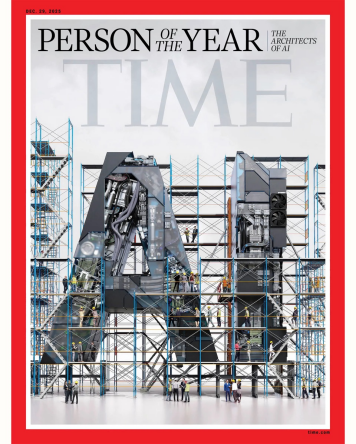
Core Insights - Time Magazine named "The Architects of AI" as the 2025 Person of the Year, highlighting the contributions of key figures in the tech industry, including Baidu's founder, Robin Li [1][3] Company Overview - Baidu, originally a search engine company, has transformed into a leading full-stack AI company in China, with a diverse portfolio that includes chips, cloud infrastructure, models, intelligent agents, applications, and consumer products [3] - The company showcased a series of advanced AI products at the Baidu World Conference on November 13, emphasizing its unique development path focused on application value [3] Industry Trends - The AI sector in China has rapidly evolved over the past year, positioning itself as a significant player on the international stage, with Baidu being a key representative of China's AI development [3] - Robin Li predicts that 2025 will be a pivotal year for AI application proliferation, suggesting that only a few foundational models will remain, while numerous successful participants will emerge in various application areas [3][6] Strategic Approach - Baidu adopts an "application-driven" strategy, focusing on specific application areas rather than creating a universal model [5] - Li emphasizes that the true value of AI lies in its applications, not in the foundational models or chips [5] Competitive Landscape - The global AI competition has intensified, with a notable difference in focus between the U.S. and China; while the U.S. invests heavily in AGI, China prioritizes practical applications [5] - Baidu's newly launched self-evolving intelligent agent, "Famu," aims to find optimal solutions in real industrial scenarios, showcasing its technological competitiveness [5] Future Outlook - Li anticipates that the most significant breakthroughs in the industry by 2025 will be in multimodal AI, with hopes for revolutionary changes in drug development through AI [6] - The challenges in drug development, particularly in verifying the effectiveness of solutions, are seen as a bottleneck that AI could potentially address in the next 10 to 20 years [6]
谁定义未来出行?高德、百度、腾讯的AI地图暗战
Tai Mei Ti A P P· 2025-12-12 00:49
Core Insights - The article highlights the competitive landscape of the map industry, emphasizing the shift towards AI-driven services and the challenges faced by major players like Baidu, Gaode, and Tencent in balancing technology implementation with user experience [1][13]. Gaode Map - Gaode Map has launched the world's first AI-native map application, leveraging AI technology to enhance its competitive edge in the industry [2][3]. - The integration with Alibaba's ecosystem allows Gaode to utilize advanced models and cloud computing, creating a robust "spatial intelligence" capability that enhances its service offerings [3]. - Despite its advancements, Gaode faces challenges in user experience due to potential over-commercialization, which may detract from the core navigation experience [4][5]. Baidu Map - Baidu Map is recognized for its strong technical capabilities, driven by its Wenxin model and extensive AI patent portfolio, positioning it as a key supplier for major smart car brands [6][7]. - The platform has achieved 96% AI automation in data production, boasting a vast database that supports high-precision navigation and intelligent decision-making [8]. - However, Baidu's lack of a cohesive service ecosystem limits its ability to fully capitalize on its technological advantages, resulting in challenges in commercializing its offerings [9]. Tencent Map - Tencent Map, while historically a follower in the market, is now pursuing a differentiated strategy with the launch of its GAIA platform and Smart Driving Map 9.0, aiming to enhance its service capabilities [10][11]. - The integration with social platforms like WeChat provides Tencent with a unique advantage, allowing seamless access to navigation services without requiring a standalone app [11][12]. - Nonetheless, this reliance on social platforms may hinder brand recognition and the establishment of a strong, independent identity for Tencent Map [12]. Industry Trends - The competition among Gaode, Baidu, and Tencent is intensifying, with a shift from traditional navigation tools to intelligent services capable of perception, understanding, and decision-making [13]. - The value proposition of map services is expanding beyond transportation to encompass broader lifestyle applications, necessitating a focus on ecosystem collaboration [13]. - The future of competition will hinge on the ability to deliver reliable, useful, and unobtrusive AI services on top of accurate navigation capabilities [13].