BMW(BMWYY)

Search documents
New England dealership group enters California with BMW acquisition
Yahoo Finance· 2025-12-18 08:00
Group 1 - Premier Companies has expanded its operations by acquiring a BMW dealership in Fairfield, California, marking its only venture into the West for this brand [1][4] - The dealership group now owns nine new-vehicle dealership rooftops, including two BMW stores, with the majority located in the Northeast [3] - Premier Companies has a strong relationship with BMW, citing the brand's manufacturing presence in the U.S. and the quality of its retail network as key reasons for their partnership [4] Group 2 - The acquisition of the California dealership was prompted by a referral from JP Morgan Chase, indicating a strategic move rather than an initial plan for expansion [4] - BMW sales in the U.S. increased by 8.5% in the first three quarters of 2025 compared to the same period in 2024, with a notable surge of 24% in the third quarter [5] - Despite Premier's enthusiasm for BMW, a survey indicated that dealers showed a stronger preference for owning Toyota or Lexus franchises, with BMW ranking ninth in desirability [5]
中国VS德国,一代工业强国走向衰落
Xin Lang Cai Jing· 2025-12-17 18:22
Core Viewpoint - The article discusses the progress and challenges of China's "Made in China 2025" initiative compared to Germany's "Industry 4.0" plan, highlighting the need for China to enhance its manufacturing capabilities and reduce reliance on foreign technology [4][18]. Group 1: Overview of "Made in China 2025" - "Made in China 2025" was launched to transform China's manufacturing sector from being large but weak to becoming competitive in ten key areas, including new information technology, high-end machine tools, aerospace equipment, and new energy vehicles [4][5][18]. - The initiative aims to achieve specific KPIs by 2020 and 2025, such as reaching an annual revenue of over 1 trillion yuan in the civil aircraft industry by 2020 and over 200 billion yuan by 2025 [23][27]. Group 2: Comparison with Germany's "Industry 4.0" - Germany's "Industry 4.0" emphasizes digital transformation in manufacturing through AI and IoT, aiming for customized mass production, while China's approach is more pragmatic and focused on specific sectors [6][9]. - The article notes that while Germany's manufacturing sector faces challenges such as energy shortages and labor shortages, Chinese companies are making significant investments in advanced manufacturing capabilities [13][16]. Group 3: Achievements and Shortcomings - China has made notable progress in areas like electric power equipment and new energy vehicles, exceeding initial targets, with 2023 sales of 9.495 million electric vehicles and a market share of 80.6% [32][35]. - However, challenges remain in high-end machine tools and commercial aircraft, with the domestic market share for high-end machine tools at only 6% and the C919 aircraft program still in development [38][40]. Group 4: Future Outlook - The article suggests that "Made in China 2025" is just the first step in a longer journey, with future initiatives like "Made in China 2035" and "Made in China 2049" planned to continue the evolution of China's manufacturing sector [40].



崔东树:11月B级豪华SUV市场同比下滑22.6% 环比增长14.6% 月度走势好于B级主流燃油SUV市场
智通财经网· 2025-12-17 09:08
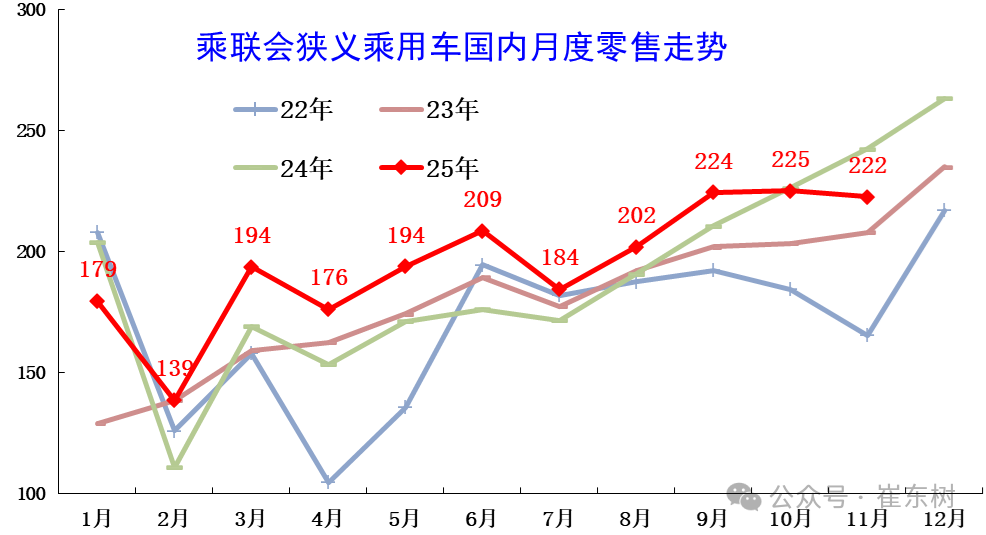
Core Insights - The B-class fuel SUV market experienced a year-on-year decline of 27% in November, with a month-on-month increase of 6% compared to October, indicating significant growth pressure [1][13] - The luxury B-class SUV segment saw a year-on-year decline of 22.6% in November, but a month-on-month increase of 14.6%, showing better monthly performance than the mainstream B-class fuel SUV market [1][13] - The traditional winter market is underperforming, with a severe drop in sales of homogeneous products, while differentiated products are performing well, reflecting a clear trend of high-end consumer upgrades [1] Market Trends - The retail growth rate of the domestic passenger car market fluctuated significantly in 2025, starting with a 1.2% increase in January-February, peaking at 15% from March to June, and then declining to -8% in November [1][4] - The market is currently in a transitional phase due to the adjustment of subsidy policies, which has led to a slowdown in sales [7][20] - The overall retail sales in the fourth quarter are expected to create a favorable growth space for the "15th Five-Year Plan" period, following strong performance during the "14th Five-Year Plan" [19][20] Sales Performance - In November, the retail sales of fuel passenger vehicles dropped by 22% year-on-year and 7% month-on-month, indicating a challenging market environment [10][11] - The luxury B-class SUV market saw significant declines, with major brands like Audi, Mercedes-Benz, and BMW experiencing year-on-year drops exceeding 20% [14][15] - The only model showing positive growth in this segment was the Cadillac XT5, which achieved a 7% year-on-year increase in sales, highlighting potential opportunities in a contracting market [14][15] Consumer Behavior - Consumers are increasingly rational, focusing on the practical value of products rather than just luxury branding, which is reshaping the luxury vehicle market [15] - Safety has become a critical concern in the automotive industry, with brands like Cadillac emphasizing safety features to enhance consumer value perception [15] Future Outlook - The automotive market is expected to continue facing challenges in 2026, with intensified competition and the need for brands to maintain distinctiveness and differentiation [19][20] - The continuation and optimization of the "old-for-new" subsidy policy is anticipated to significantly boost automotive consumption potential in the coming years [20]

车百会:年销不足10万辆的跨国车企,退出概率超80%
Di Yi Cai Jing· 2025-12-16 12:56
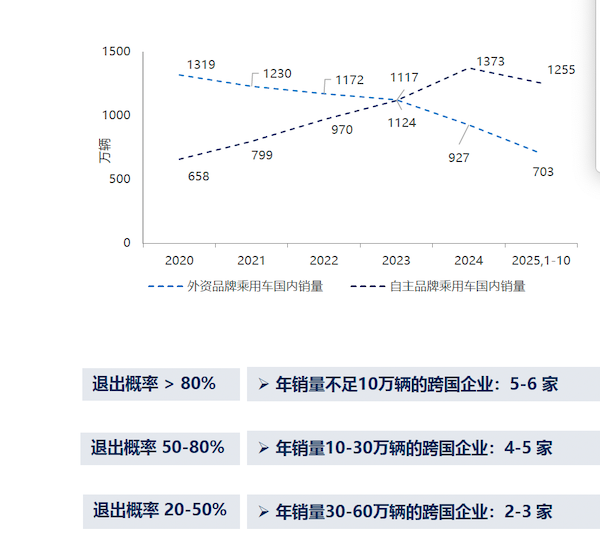
Core Viewpoint - Foreign brands in China are facing significant challenges, with a high probability of exit for multinational car companies with annual sales below 100,000 units, estimated at over 80% for 5 to 6 companies [1] Group 1: Market Share Dynamics - In 2020, domestic brands held a market share of 36%, while foreign brands had 64%. By January to October of this year, domestic brands increased their share to 65%, while foreign brands decreased to 35% [3] - In November, the retail market shares were reported as follows: German brands at 14%, Japanese at 11.7%, American at 5.7%, and Korean at 0.9% [4] Group 2: Exit Probability of Multinational Companies - The probability of exit for multinational companies is closely linked to their market scale. Companies with annual sales between 100,000 to 300,000 units have a 50% to 80% exit probability, with an expectation of 4 to 5 companies exiting; those with sales between 300,000 to 600,000 units have a lower exit probability of 20% to 50%, with an expectation of 2 to 3 companies [4] - Companies with annual sales below 100,000 units include Shenlong Automobile, Chery Jaguar Land Rover, smart, Changan Lincoln, Changan Mazda, and Jiangling Ford [4] Group 3: Strategic Adaptations of Multinational Companies - Leading multinational companies are accelerating their transformation towards a "made in China, for China" strategy. Volkswagen has established a China Technical Research Center (VCTC) for electric vehicle architecture; Toyota has set up an electric intelligent vehicle R&D center in China; Nissan has founded Nissan Technology Development (Shanghai) Co., Ltd. for smart driving and new energy research [4] - In joint ventures, the influence of Chinese teams on product definition is increasing. For instance, Toyota has adopted a local chief engineer management model; Volkswagen has upgraded its strategy from "headquarters directive, local execution" to "joint definition, co-development"; General Motors has shifted product definition authority to local teams, focusing entirely on Chinese customer needs [5] Group 4: Global Sharing of R&D Achievements - Some multinational companies are beginning to share their R&D achievements from China with global markets. For example, BMW has developed a voice interaction system based on Alibaba and DeepSeek's large model for global application; Tesla has integrated over 60 Chinese suppliers into its global procurement system; Stellantis has formed a joint venture with Leap Motor to fill the market gap for affordable electric vehicles [5]





合资品牌的2025:用品牌溢价换喘息的一年
Tai Mei Ti A P P· 2025-12-16 05:23
Core Insights - The Chinese automotive industry is undergoing a significant transformation, moving from a "market for technology" model to a "brand for survival" approach as foreign joint venture brands face declining market shares and increased competition from local manufacturers [2][20] - The year 2025 is characterized as a turning point for joint venture brands, which are now prioritizing survival over growth by leveraging their brand equity to maintain market presence [3][20] Market Performance - In 2025, the overall market for joint venture brands in China has seen a decline, with monthly retail shares for German brands dropping from 18.4% at the beginning of the year to around 14% by year-end, and Japanese brands hovering between 11% and 13% [6][20] - The market share of joint venture brands fell from nearly 28% at the start of the year to about 22% by the end, indicating a broader trend of decline across the sector [6][20] Pricing Strategies - Joint venture brands have adopted a "one-price" model to combat declining sales, which involves sacrificing brand premiums for market share, leading to significant price reductions across various models [10][12] - The average prices of several key brands have decreased significantly, with Volkswagen's average price dropping by 15.37% and Honda's by 18.54% [11] Localization Efforts - There is a notable shift towards localization in management and product development, with foreign brands increasingly empowering local teams to make decisions that cater to the Chinese market [17][20] - The transition to local management is evident, with several key appointments of Chinese executives in leadership roles across major automotive brands [18][19] Technological Adaptation - Joint venture brands are increasingly adopting local technologies and solutions, such as Huawei's smart solutions, to meet the demands of Chinese consumers for advanced features in electric vehicles [14][15] - The focus has shifted from traditional automotive engineering to integrating smart technology and user-friendly interfaces, reflecting changing consumer priorities [14][15] Long-term Implications - The current strategies employed by joint venture brands are seen as a survival tactic rather than a sustainable growth strategy, raising questions about their long-term competitiveness in the evolving market [13][20] - The shift in valuation from brand equity to survival costs indicates a fundamental change in how these brands will operate in the future, as they must adapt to new consumer expectations and market dynamics [20]

德国汽车制造商三季度利润创2009年以来新低
Zhong Guo Xin Wen Wang· 2025-12-16 02:19
加尔表示,随着财务层面整顿工作完成,成本削减措施有望逐步显现效果,并推动利润率回升。他指 出,裁员,尤其是在德国本土进行的裁员,虽将带来较高成本,但从中期来看,相关举措预计有助于提 升企业竞争力。(完) (文章来源:中国新闻网) 中新网柏林12月16日电(杨楚瑜马秀秀)国际会计师事务所安永15日发布的分析显示,尽管德国三大汽车 集团大众、宝马和梅赛德斯-奔驰在7月至9月期间的销量和营收整体保持稳定,但其息税前利润同比暴 跌近76%,共约17亿欧元,达到2009年第三季度以来最低水平。 安永汽车行业专家康斯坦丁·加尔表示,全球汽车行业正处于深度危机之中,而当前受冲击最严重的是 德国汽车企业。造成利润下滑的原因包括高端汽车市场整体疲软、美国关税政策、不利的汇率变动、电 动汽车领域的高额投资尚未带来回报,以及企业转型所产生的高昂成本。"所有这些因素叠加在一起, 正为德国汽车制造商带来一场'完美风暴'。" 在盈利承压背景下,德国汽车行业已有多家公司于近期宣布裁员计划,其中包括博世、采埃孚等大型汽 车零部件供应商,以及头部汽车制造商梅赛德斯-奔驰和旗下拥有多个品牌的大众集团。 ...
国家市场监管总局:11月共7家汽车生产企业宣布召回共计24.45万辆汽车
Xi Niu Cai Jing· 2025-12-15 06:38
Group 1 - BYD recalls 88,981 vehicles due to issues with battery pack consistency, which may limit power output and pose safety risks in pure electric mode [2] - A total of 244,500 vehicles are set to be recalled by seven automotive manufacturers by November 2025, as reported by the State Administration for Market Regulation [3] - BMW recalls 144,132 vehicles due to poor waterproofing of starter relay, which may lead to electrical short circuits and fire risks [4] Group 2 - BMW recalls an additional 7,740 vehicles due to insulation monitoring issues that may cause high-voltage systems to shut down unexpectedly, increasing collision risks [4] - Ford recalls 3,357 Lincoln Navigator vehicles due to insufficient welding in the seatbelt pre-tensioner, which may lead to safety hazards [4] - Other recalls include 187 vehicles from FAW-Volkswagen ID.7 VIZZION due to airbag generator filter size deviations, and 48 Subaru Solterra vehicles due to design flaws in the panoramic monitoring system [5]


宝马集团董事会成员尼古拉·马丁:依然坚持中国市场的核心地位
Xin Hua Cai Jing· 2025-12-15 01:05
Group 1 - BMW Group emphasizes that despite external challenges, the Chinese market and customer demand remain central to its global strategy, driven by the market's size and China's irreplaceable value in BMW's global supply chain [1] - The automotive industry has a complex global division of labor, with BMW sourcing over 36 million components daily from thousands of suppliers worldwide, highlighting the deep interconnection of its global supply chain [1] - BMW is optimizing logistics to mitigate the impact of tariffs and potential disruptions, including pausing some logistics during negotiations and flexibly reallocating resources within its global production network [1] Group 2 - In 2025, the global automotive industry is expected to enter a deep adjustment period, and while BMW maintains resilience in overall sales, it faces challenges in the competitive Chinese market [2] - BMW is committed to the Chinese market and plans to deepen localization efforts to counteract downward trends, recognizing China as not only its largest single market but also a source of global innovation [2] - The efficiency of Chinese partners in the new energy sector is aiding BMW in accelerating its global carbon reduction goals, with the supply chain carbon emissions of the iX3 model reduced by approximately 42% compared to its predecessor [2] Group 3 - BMW is actively promoting the construction of open data ecosystems like Catena-X, leveraging AI technology for quality and carbon footprint management across the entire industry chain [3] - Strategic partnerships with companies like Baidu, Tencent, and Huawei are enhancing BMW's global digital governance, capitalizing on China's advantages in digital infrastructure and AI application scenarios [3] - BMW aims to retain its "pure driving pleasure" by collaborating deeply with China in supply chain, green initiatives, and digitalization, while rejecting simple external vehicle architecture purchases for rebranding [3]
X @The Wall Street Journal
The Wall Street Journal· 2025-12-14 13:02
An enthusiast got his 1939 BMW 327/28 sports car ready for the prestigious competition by researching in the archives, sourcing handmade parts and taking much of the car apart. https://t.co/R5QyMXE4Gi ...
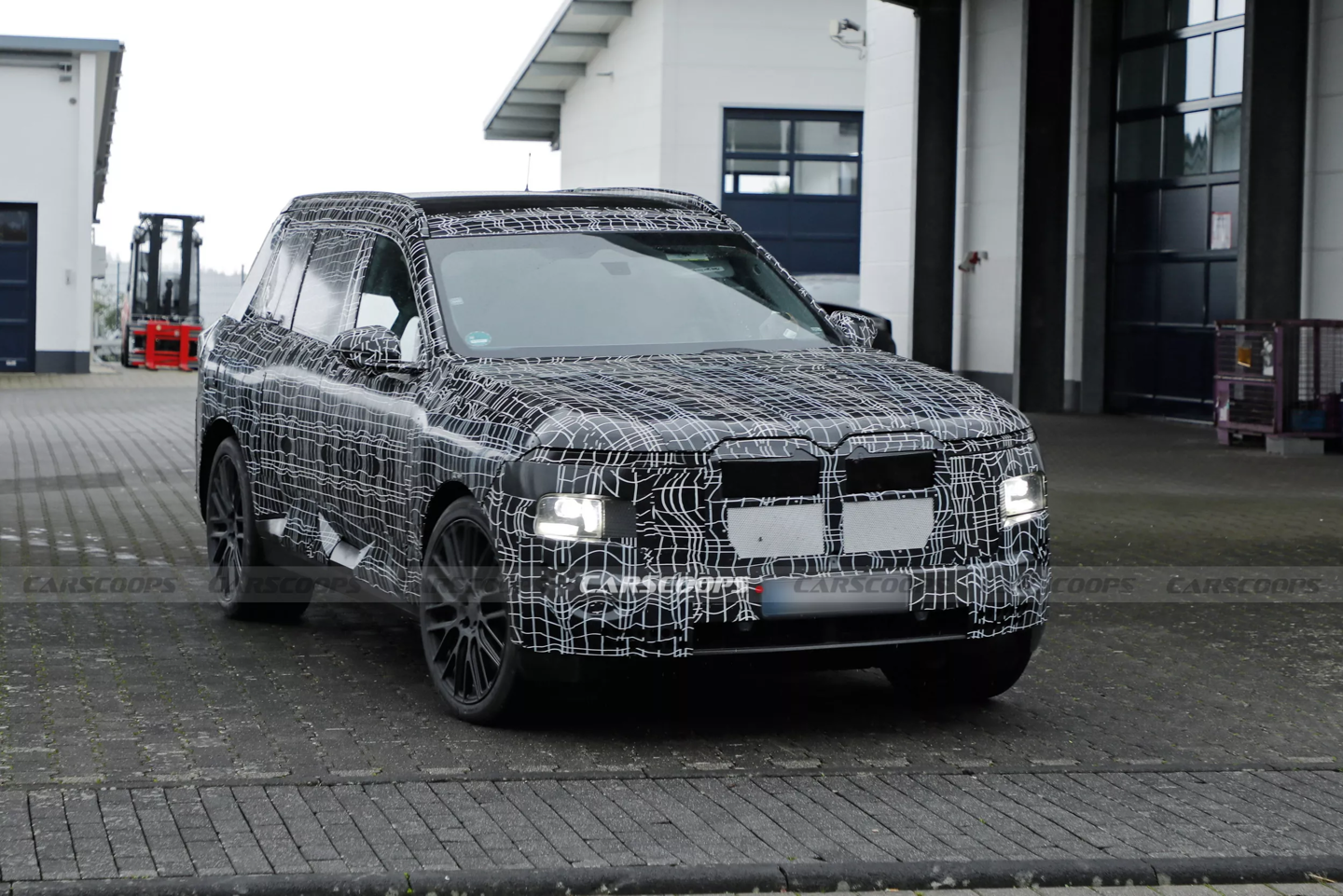
宝马全新一代 X7 最新谍照曝光:线条更硬朗,配备新形态门把手
Xin Lang Cai Jing· 2025-12-13 23:27
IT之家 12 月 13 日消息,宝马正在密集筹备"Neue Klasse"产品线,计划在 2027 年底前集中推出 40 款新车或改款车型。北京时间今晚,外媒 Carscoops 带来 了下一代 X7 近期在德国道路测试的最新谍照。 该媒体分析称,新车的实际设计变化已明显超出中期改款范畴。考虑到现款 X7 在 2022 年完成更新,此次换代本就在既定节奏之内。 Y 高元元 CARSCOOPS in St 5 1 300 ■ t 27 - 33 55 25 277 7 n CHLY REFL 21 p (C)H 2 / IIIT CARSCOOPS CARSCOOPS - H 新车的车尾仍处于高度保密状态,测试车使用临时尾灯。量产版本预计采用贯穿式尾灯设计。 据悉,新车内饰预计将使用 Panoramic Vision"全景视觉"显示系统,贯穿前风挡下沿。该车还将并配备更大的中控屏、更智能的 AI 助手以及更具概念感的新 方向盘。整车算力由全新"Superbrains"中央计算系统支撑,作为数字架构的核心中枢。 新一代 X7 继续提供七座三排布局,保持宝马大型 SUV 旗舰定位,直接对标奔驰 GLS 以及沃尔沃 ...