Goldman Sachs(GS)

Search documents
年内调研近万次!外资巨头盯上这些标的
Shang Hai Zheng Quan Bao· 2025-12-27 10:18
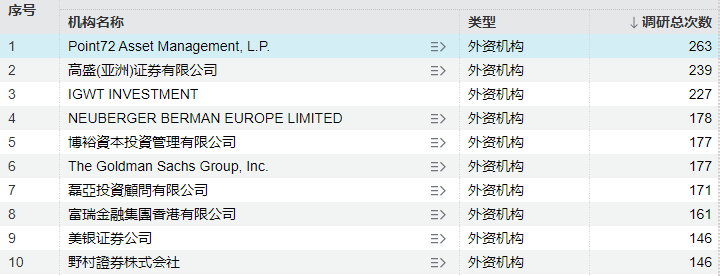
Group 1 - Nearly 800 foreign institutions have conducted approximately 9,308 research visits to A-share listed companies since 2025, with Point 72 Asset Management leading with 263 visits [1][2] - Major international banks such as Goldman Sachs and Bank of America have also conducted over 100 research visits this year [2][3] - The primary focus of foreign institutions is on the technology and pharmaceutical sectors, indicating strong interest in these areas [3][5] Group 2 - The top three companies receiving the most foreign institution research visits are Huichuan Technology (733 visits), Mindray Medical (404 visits), and Optoelectronics (331 visits) [3][4] - The technology sector, particularly AI, is expected to drive significant growth in corporate profits, with an estimated annual increase of 3% over the next decade due to cost savings and productivity improvements [5] - The pharmaceutical sector in China is gaining international recognition, with local innovative drug companies entering the global first tier in terms of research pipeline quantity [6]






Goldman Sachs Says Some Client Data May Have Been Exposed in Third-Party Data Breach
PYMNTS.com· 2025-12-26 19:09
Group 1 - Goldman Sachs informed investors in its alternative investment funds about a potential data breach linked to Fried Frank Harris Schriver & Jacobson LLP, indicating that some client data may have been exposed [2] - The law firm has assured that its network is now secure and the vulnerability has been addressed, stating that any exposed data is "unlikely to be distributed or used improperly" [2] - Goldman Sachs confirmed that its own systems were not affected by the incident and emphasized its commitment to safeguarding client data [2] Group 2 - Cyberattacks targeting third-party vendors are increasingly common, with a report indicating that 38% of invoice fraud cases and 43% of phishing attacks originate from compromised vendors [3] - Verizon's report highlighted that 30% of data breaches in the year ending October 31, 2024, involved third parties, a significant increase from 15% the previous year [4] - The report emphasized the importance of considering the security limitations of third parties when managing data [5]

I Have Goldman Sachs (GS) in My Charitable Trust, Says Jim Cramer
Yahoo Finance· 2025-12-26 17:24
Group 1 - The Goldman Sachs Group, Inc. (NYSE:GS) shares have increased by 56.8% year-to-date, benefiting from lower interest rates and increased market activity in 2025 [2] - The company acquired Innovator Capital Management for $2 billion to expand its asset management business, following a previous acquisition of Industry Ventures for $1 billion [2] - Goldman Sachs is involved in a $55 billion take-private deal with Electronics Arts (EA), which will generate $110 million in fees for the bank [2] - Jim Cramer has frequently discussed Goldman Sachs, suggesting it may be growing faster than many tech stocks, including the Magnificent Seven [2][3] Group 2 - Jim Cramer has included Goldman Sachs in his charitable trust, indicating a personal investment in the company [3] - There is a belief that while Goldman Sachs has potential, some AI stocks may offer higher returns with lower risk [3]
受监管放松推动,今年美国六大银行市值增加6000亿美元
Ge Long Hui A P P· 2025-12-26 15:21
Core Viewpoint - The article highlights that the six largest banks in the U.S. are projected to gain a combined market value of $600 billion by 2025, driven by regulatory rollbacks under the Trump administration and a recovery in investment banking [1] Group 1: Market Value Growth - The combined market value of the six largest U.S. banks—JPMorgan Chase, Bank of America, Citigroup, Wells Fargo, Goldman Sachs, and Morgan Stanley—rose to $2.37 trillion as of Tuesday's close, up from $1.77 trillion at the end of last year [1]


美国各大银行首席执行官谈人工智能对员工规模的影响
Xin Lang Cai Jing· 2025-12-26 09:20
Core Viewpoint - The CEOs of major U.S. banks are optimistic about the transformative efficiency changes that artificial intelligence (AI) can bring to the industry, but there are concerns about potential job reductions for bank employees [1][16]. Group 1: Statements from JPMorgan Chase - Jamie Dimon, CEO of JPMorgan Chase, stated that job cuts are inevitable due to the AI wave, emphasizing that AI will eliminate certain positions [3][17]. - Dimon mentioned that AI could serve as a "work assistant" and take over tedious tasks, potentially leading to job losses [3][17]. - In the short term, if AI implementation goes smoothly, JPMorgan Chase's employee count may remain stable or even slightly increase [3][17]. - The core goal of JPMorgan Chase's AI strategy is to enhance operational efficiency, with expectations of a 40% to 50% increase in productivity in the operations department over the next five years [4][19]. - The company is focusing on controlling hiring and shifting towards efficiency improvements [5][19]. Group 2: Statements from Goldman Sachs - David Solomon, CEO of Goldman Sachs, indicated that AI will be a key driver for efficiency improvements, which may lead to a slowdown in hiring and the streamlining of certain roles [6][20]. - Solomon believes that while AI will reduce manpower in some areas, it will also allow the firm to focus on attracting high-value talent for customer service [7][21]. - Goldman Sachs expects to see employee growth by the end of 2025, despite the current focus on optimizing recruitment structures [6][20]. Group 3: Statements from Citigroup - Jane Fraser, CEO of Citigroup, expressed that AI is expected to significantly enhance work efficiency in the short term and reshape all business segments in the long term [9][24]. - Fraser reported that AI has already led to over 1 million automated code reviews this year, saving approximately 100,000 hours of work per week [10][25]. - She acknowledged concerns that AI might initially compress job positions before the industry realizes its benefits, noting that the current AI penetration rate is only 10% [10][25][11][26]. Group 4: Statements from Wells Fargo - Charles Scharf, CEO of Wells Fargo, indicated that the bank's workforce has already decreased by nearly 25% since he took over in 2019, and this trend is likely to continue [12][27]. - Scharf emphasized that the potential of AI is undeniable and that many in the industry are aware that it will lead to job reductions [13][28]. - He noted that AI tools have improved the efficiency of engineers by 30% to 35%, allowing the bank to accomplish more with fewer employees [13][28]. Group 5: Statements from Bank of America - Brian Moynihan, CEO of Bank of America, stated that the implementation of AI has already led to reductions in workforce in certain departments [14][29]. - The bank's strategy focuses on employee training to prepare them for roles that AI cannot replace, emphasizing the importance of skill development [15][30]. - Moynihan highlighted that the bank's digital interactions reached 1.4 billion in November, which has saved approximately 11,000 full-time equivalent positions [15][30].
“AI裁员潮”即将到来!华尔街大行掌门人坦承,岗位削减不可避免
智通财经网· 2025-12-26 09:08
Core Insights - The discussion around artificial intelligence (AI) by CEOs of major banks indicates a significant shift in the financial industry, with predictions that generative AI will enhance or replace human jobs, impacting nearly 200 million employees in the banking sector [1] Group 1: CEO Perspectives on AI and Employment - Jamie Dimon, CEO of JPMorgan Chase, openly acknowledges that AI will eliminate jobs, stating that people should not avoid this reality. He emphasizes that AI will change job roles and improve efficiency, potentially stabilizing or even increasing the workforce if managed well [2] - Mary Erdoes, President of JPMorgan Chase, predicts a 40% to 50% productivity increase in operational departments over the next five years, but clarifies that this will not lead to mass layoffs, rather a slowdown in net workforce growth [3] - David Solomon, CEO of Goldman Sachs, indicates that AI will drive efficiency improvements, leading to slower hiring and job reductions. He believes that while some roles may be significantly reduced, the economy will adapt and create new jobs [5][6] Group 2: Company Strategies and AI Implementation - Goldman Sachs is focusing on controlling workforce growth and enhancing efficiency through AI, with a goal to find the best team structure and agility. The company expects to increase its total employee count by the end of 2025, despite slowing hiring [5] - Jane Fraser, CEO of Citigroup, highlights that generative AI will greatly enhance productivity in the short term and could fundamentally change various banking functions in the long term. She notes that AI-driven automation has already saved approximately 100,000 work hours weekly [6][7] - Charlie Scharf, CEO of Wells Fargo, acknowledges that the bank has reduced its workforce by nearly a quarter since 2019 and anticipates this trend will continue, emphasizing that AI will create significant opportunities for efficiency [8] Group 3: Training and Workforce Adaptation - Brian Moynihan, CEO of Bank of America, recognizes that while AI has led to some departmental reductions, the focus is on retraining employees for roles that AI cannot replace. The bank is prioritizing multi-dimensional training to adapt to the changing landscape [9]
高盛:2025年15个最受关注的争论(可能会延续到2026年)-Goldman_The_15_Most_Prominent_Debates_Of_2025_Which_Are_Likely_To
Goldman Sachs· 2025-12-26 02:12
Investment Rating - The report does not explicitly provide an investment rating for the industry Core Insights - The report highlights 15 key themes for 2025, many of which are expected to continue into 2026, focusing on significant debates such as artificial intelligence (AI) capital expenditure and its ecosystem risks [1] - There is a growing concern regarding the risks associated with private credit, particularly following significant losses and fraud allegations [12][13] - The report anticipates a favorable macro environment for 2026, driven by factors such as accelerated growth, fiscal stimulus, and a potential reduction in interest rates by the Federal Reserve [15] - The report notes a divergence in retail performance based on income demographics, with low-income consumer sentiment turning negative and only a 0.2% increase in same-store sales for low-income retailers compared to a 2.5% increase for middle to high-income retailers [22] - The report predicts a strong demand for physical assets due to rising inflation and a declining dollar, with expectations for copper prices to continue rising in the first half of 2026 [24] - The report indicates that the Chinese GDP growth forecast has been significantly revised upward, which may negatively impact global GDP growth outside of China [38] Summary by Sections - **Artificial Intelligence**: The focus remains on AI capital expenditure and the risks associated with companies having higher leverage within the AI ecosystem [4][6] - **Private Credit**: Concerns are raised about the risks in non-bank lending, particularly with the increasing interconnections within the financial system [12][13] - **U.S. Economic Outlook**: The report discusses the rebound in U.S. cyclical sectors and the pricing of a more favorable macro environment for 2026 [15] - **Fiscal Stimulus**: A combination of tax cuts, investment incentives, and new spending is expected to create a significantly positive fiscal stimulus by next year [17] - **K-shaped Economy**: The report highlights the disparity in consumer sentiment and sales growth between low-income and higher-income demographics [22] - **Commodities**: Expectations for rising copper prices and a tight supply of aluminum are noted, alongside a general bullish outlook for physical assets [24] - **China's Economic Impact**: The upward revision of China's GDP growth is expected to have substantial implications for foreign manufacturers and global GDP growth [38] - **Emerging Markets**: South Korea is highlighted as the best-performing market this year, with ongoing improvements in corporate performance [43] - **U.S.-China Tech Competition**: The report emphasizes the ongoing intense competition between the U.S. and China for technological superiority [45]
日元没有“速效药”!日本央行渐进紧缩难逆转结构性颓势 华尔街唱空声浪高涨
Zhi Tong Cai Jing· 2025-12-26 02:06
Core Viewpoint - The recent interest rate hike by the Bank of Japan has failed to provide sustained support for the yen, leading to increased bearish sentiment towards the currency, with predictions of further depreciation against the dollar by 2026 [1][2]. Group 1: Economic Factors - Analysts from major financial institutions, including JPMorgan and BNP Paribas, predict that the yen could weaken to 160 yen per dollar or lower by the end of 2026 due to persistent factors such as significant US-Japan interest rate differentials, negative real interest rates, and ongoing capital outflows [1][2]. - The yen has seen a slight increase of less than 1% against the dollar this year after four consecutive years of decline, but expectations for a reversal driven by the Bank of Japan's rate hikes and potential Fed rate cuts have not materialized [1][2]. - The return of arbitrage trading, where investors borrow low-yielding yen to invest in higher-yielding currencies, is creating additional headwinds for the yen [2]. Group 2: Market Sentiment - Market sentiment remains cautious, with the overnight index swap indicating that the next rate hike by the Bank of Japan is not fully priced in, expected at the earliest in September [2]. - The ongoing high inflation in Japan, which exceeds the Bank of Japan's 2% target, continues to exert pressure on Japanese government bonds [2]. - Japanese retail investors are showing a strong preference for overseas assets, with net purchases through investment trusts hovering around 9.4 trillion yen (approximately 60 billion USD), a ten-year high, which is likely to persist and further suppress the yen [3]. Group 3: Long-term Predictions - Some analysts, including those from Goldman Sachs, believe that the yen may eventually strengthen to 100 yen per dollar over the next decade, although they acknowledge the presence of multiple short-term negative factors [4]. - Concerns about intervention risks are rising as the yen approaches levels that previously prompted official action, but experts suggest that intervention alone may not be sufficient to reverse the yen's downward trend [4][5].

高盛就外部律师事务所数据泄露向部分另类基金客户发出警告
Xin Lang Cai Jing· 2025-12-26 01:00
Core Viewpoint - Goldman Sachs has warned investors in some of its alternative investment funds about potential data breaches due to a cybersecurity incident at its external legal advisor, Fried Frank Harris Shriver & Jacobson LLP [1][2]. Group 1: Incident Details - On December 19, Goldman Sachs received notification from Fried Frank regarding a "cybersecurity event" that may have compromised data related to multiple alternative funds [1][2]. - Fried Frank has stated that they took swift action to control the incident and have engaged leading external data security experts to assist in addressing the situation [3]. Group 2: Response and Security Measures - Goldman Sachs confirmed that its own systems were not affected by the incident and remain secure, emphasizing its commitment to protecting client data [1][2]. - Fried Frank reported that the vulnerability leading to the data breach has been fixed and that any leaked data is "unlikely to be disseminated or misused" [2][3]. - Goldman Sachs is conducting an independent assessment of Fried Frank's security controls to verify the effectiveness of their remedial measures [2][3].
对于2026年,这是高盛顶级科技交易员最关心的10个问题
美股IPO· 2025-12-26 00:24
Core Viewpoint - The focus of technology stocks is shifting from hardware speculation to a deeper examination of AI investment returns and market breadth as 2026 approaches, according to Goldman Sachs trader Callahan [1][3]. Group 1: Market Trends and Performance - Despite the Nasdaq 100 index rising over 20% in 2025, it was not an easy year, with the "Magnificent 7" contributing approximately $3.5 trillion to market cap growth, a slowdown from $5.4 trillion in 2024 and $4.8 trillion in 2023 [3]. - Over 30% of the Nasdaq 100 components ended 2025 in decline, indicating significant internal market differentiation [3]. Group 2: AI Investment and Sustainability - Investors are increasingly focused on whether generative AI (GenAI) can deliver on its high capital expenditure promises over the next 12 months, with discussions centering on the sustainability of AI infrastructure spending, which could reach $3 trillion to $4 trillion annually by 2030 according to Nvidia [5] [6]. - Callahan outlined ten key questions that will dominate the technology stock narrative in 2026, addressing both sector rotations and fundamental macroeconomic and technological cycles [6]. Group 3: Key Questions for 2026 - The ten core questions include the direction of AI debates, the potential shift towards "physical AI" (robots, autonomous vehicles, smart glasses), and which companies will emerge as productivity winners [7]. - Other questions involve how software companies will repair valuations, the implications of GenAI-driven efficiency, and the potential cyclical turning points in housing and commercial real estate [7][8]. - The report also questions the future of large language models (LLMs) and their market dynamics, including the role of Chinese models and the potential for productization versus remaining in the "primitive intelligence" competition [8]. Group 4: Investment Strategies and Outlook - Callahan suggests that the Nasdaq 100 index's return outlook remains robust, with potential gains skewed towards the first half of 2026 due to recent market consolidation and low expectations surrounding AI spending sustainability [9]. - The investment theme for 2026 should focus on "expansion trades," where capital flows from crowded AI infrastructure stocks to other sectors, seeking "second derivatives" of AI that leverage cost reductions and new revenue streams [9].