Goldman Sachs(GS)

Search documents
日元没有“速效药”!日本央行渐进紧缩难逆转结构性颓势 华尔街唱空声浪高涨
Zhi Tong Cai Jing· 2025-12-26 02:06
Core Viewpoint - The recent interest rate hike by the Bank of Japan has failed to provide sustained support for the yen, leading to increased bearish sentiment towards the currency, with predictions of further depreciation against the dollar by 2026 [1][2]. Group 1: Economic Factors - Analysts from major financial institutions, including JPMorgan and BNP Paribas, predict that the yen could weaken to 160 yen per dollar or lower by the end of 2026 due to persistent factors such as significant US-Japan interest rate differentials, negative real interest rates, and ongoing capital outflows [1][2]. - The yen has seen a slight increase of less than 1% against the dollar this year after four consecutive years of decline, but expectations for a reversal driven by the Bank of Japan's rate hikes and potential Fed rate cuts have not materialized [1][2]. - The return of arbitrage trading, where investors borrow low-yielding yen to invest in higher-yielding currencies, is creating additional headwinds for the yen [2]. Group 2: Market Sentiment - Market sentiment remains cautious, with the overnight index swap indicating that the next rate hike by the Bank of Japan is not fully priced in, expected at the earliest in September [2]. - The ongoing high inflation in Japan, which exceeds the Bank of Japan's 2% target, continues to exert pressure on Japanese government bonds [2]. - Japanese retail investors are showing a strong preference for overseas assets, with net purchases through investment trusts hovering around 9.4 trillion yen (approximately 60 billion USD), a ten-year high, which is likely to persist and further suppress the yen [3]. Group 3: Long-term Predictions - Some analysts, including those from Goldman Sachs, believe that the yen may eventually strengthen to 100 yen per dollar over the next decade, although they acknowledge the presence of multiple short-term negative factors [4]. - Concerns about intervention risks are rising as the yen approaches levels that previously prompted official action, but experts suggest that intervention alone may not be sufficient to reverse the yen's downward trend [4][5].


高盛就外部律师事务所数据泄露向部分另类基金客户发出警告
Xin Lang Cai Jing· 2025-12-26 01:00
Core Viewpoint - Goldman Sachs has warned investors in some of its alternative investment funds about potential data breaches due to a cybersecurity incident at its external legal advisor, Fried Frank Harris Shriver & Jacobson LLP [1][2]. Group 1: Incident Details - On December 19, Goldman Sachs received notification from Fried Frank regarding a "cybersecurity event" that may have compromised data related to multiple alternative funds [1][2]. - Fried Frank has stated that they took swift action to control the incident and have engaged leading external data security experts to assist in addressing the situation [3]. Group 2: Response and Security Measures - Goldman Sachs confirmed that its own systems were not affected by the incident and remain secure, emphasizing its commitment to protecting client data [1][2]. - Fried Frank reported that the vulnerability leading to the data breach has been fixed and that any leaked data is "unlikely to be disseminated or misused" [2][3]. - Goldman Sachs is conducting an independent assessment of Fried Frank's security controls to verify the effectiveness of their remedial measures [2][3].
对于2026年,这是高盛顶级科技交易员最关心的10个问题
美股IPO· 2025-12-26 00:24
Core Viewpoint - The focus of technology stocks is shifting from hardware speculation to a deeper examination of AI investment returns and market breadth as 2026 approaches, according to Goldman Sachs trader Callahan [1][3]. Group 1: Market Trends and Performance - Despite the Nasdaq 100 index rising over 20% in 2025, it was not an easy year, with the "Magnificent 7" contributing approximately $3.5 trillion to market cap growth, a slowdown from $5.4 trillion in 2024 and $4.8 trillion in 2023 [3]. - Over 30% of the Nasdaq 100 components ended 2025 in decline, indicating significant internal market differentiation [3]. Group 2: AI Investment and Sustainability - Investors are increasingly focused on whether generative AI (GenAI) can deliver on its high capital expenditure promises over the next 12 months, with discussions centering on the sustainability of AI infrastructure spending, which could reach $3 trillion to $4 trillion annually by 2030 according to Nvidia [5] [6]. - Callahan outlined ten key questions that will dominate the technology stock narrative in 2026, addressing both sector rotations and fundamental macroeconomic and technological cycles [6]. Group 3: Key Questions for 2026 - The ten core questions include the direction of AI debates, the potential shift towards "physical AI" (robots, autonomous vehicles, smart glasses), and which companies will emerge as productivity winners [7]. - Other questions involve how software companies will repair valuations, the implications of GenAI-driven efficiency, and the potential cyclical turning points in housing and commercial real estate [7][8]. - The report also questions the future of large language models (LLMs) and their market dynamics, including the role of Chinese models and the potential for productization versus remaining in the "primitive intelligence" competition [8]. Group 4: Investment Strategies and Outlook - Callahan suggests that the Nasdaq 100 index's return outlook remains robust, with potential gains skewed towards the first half of 2026 due to recent market consolidation and low expectations surrounding AI spending sustainability [9]. - The investment theme for 2026 should focus on "expansion trades," where capital flows from crowded AI infrastructure stocks to other sectors, seeking "second derivatives" of AI that leverage cost reductions and new revenue streams [9].


Goldman Sachs's Private-Credit Company Struggles to Clean Up Soured Bets
WSJ· 2025-12-25 10:30
Core Viewpoint - The stock and value of Goldman Sachs BDC have been declining [1] Group 1 - The decline in stock value indicates potential challenges for Goldman Sachs BDC in maintaining investor confidence [1] - The falling stock price may reflect broader market trends affecting business development companies (BDCs) [1]
华尔街强势回归:2025年六大行市值激增逾1/3 监管放松与投行业务成增长引擎
Zhi Tong Cai Jing· 2025-12-25 07:05
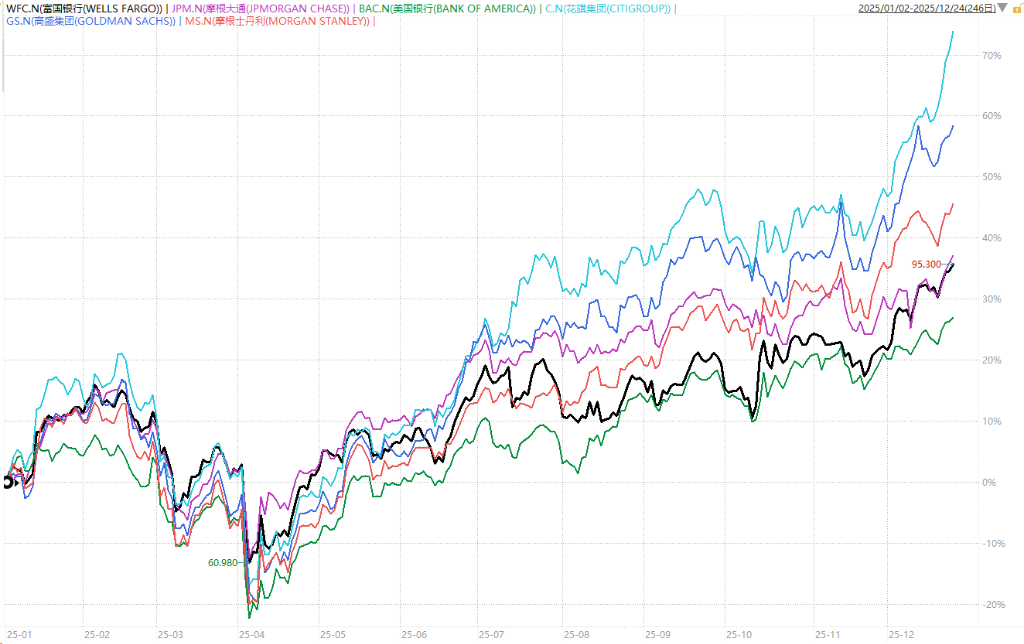
Group 1 - The total market capitalization of the six major U.S. banks has increased by $600 billion, reaching $2.37 trillion, a growth of over one-third in less than 12 months, attributed to the regulatory relaxation under President Trump and a recovery in investment banking [1] - The European banks' total market capitalization stands at $1 trillion, highlighting a significant disparity resulting from years of uneven regulations [1] - U.S. banks have finally shed the constraints imposed after the 2008 financial crisis, outperforming the broader S&P 500 index for the second consecutive year [1] Group 2 - The Trump administration has allowed major lending institutions to increase leverage by modifying annual stress test requirements and eliminating guidelines that restrict high-risk lending [2] - Analysts note that the regulatory changes are crucial for stock prices, as banks had previously seen profitability decline due to increased capital requirements following the financial crisis [2] - Major banks have accumulated excess capital, which can now be utilized for stock buybacks, dividends, and business growth rather than merely being held as a safety net [3] Group 3 - Citigroup's stock has surged nearly 70%, the best performer among the six banks, due to significant internal restructuring and cost-cutting measures [4] - Goldman Sachs' stock has risen by 60%, benefiting from a resurgence in large investment banking transactions and setting historical highs in 2025 [4] - Record revenues are anticipated in stock trading at $92 billion and fixed income trading at $163 billion, surpassing previous records [4] Group 4 - Concerns have been raised by Senator Elizabeth Warren regarding the extent of regulatory relaxation and the potential risks for banks [4] - Despite these concerns, investors remain optimistic, with analysts suggesting that banks have room to take on more risk given the modest growth in their balance sheets [4] - The current positive sentiment in the market is noted to feel almost unreal, with a solid fundamental backdrop, although questions remain about how much of this has already been priced in [4]

多家机构预期:2026年金价继续上涨
Sou Hu Cai Jing· 2025-12-25 06:58
Group 1 - The core viewpoint of the articles indicates a sustained trend in using gold to hedge against risks associated with dollar-denominated assets, with expectations for gold prices to rise further by 2026 [1] - Analysts from Schroders highlight that the U.S. is facing "policy uncertainty, fiscal fragility, and increasing investor doubts about the long-term role of U.S. Treasuries and the dollar," making gold a preferred choice for asset diversification due to its safe-haven properties and low correlation with traditional assets [1] - Goldman Sachs predicts that by the end of 2026, gold prices will reach approximately $4,900 per ounce, driven by strong structural demand from central bank purchases and cyclical support from potential Federal Reserve rate cuts [1] - JPMorgan forecasts that gold prices could rise to $5,055 per ounce by Q4 2026, with potential further increases up to $6,000 per ounce, emphasizing a clear long-term trend of gold allocation by official reserves and investors [1] - Forbes notes that global trade tensions initiated by the U.S., the rise of "de-dollarization" transactions to avoid dollar depreciation, increased demand for gold from private investors and cryptocurrency funds, and ongoing central bank purchases are significant drivers for the upward movement in gold prices [1] Group 2 - Reuters reports that the U.S. dollar index has declined by 9% since the beginning of 2025, potentially marking its worst annual performance in eight years [2] - The market widely anticipates that the new Federal Reserve chair may lean towards a dovish monetary policy stance, which could further weaken the dollar and reduce the attractiveness of dollar-denominated assets for investors [2]
多家机构预期2026年美元资产吸引力减弱 金价继续上涨
Xin Hua Wang· 2025-12-25 06:40
Group 1 - The core viewpoint of the articles indicates a sustained trend in using gold to hedge against risks associated with dollar-denominated assets, with expectations for gold prices to rise further by 2026 [1] - Analysts from Schroders highlight that the U.S. is facing "policy uncertainty, fiscal fragility, and increasing investor doubts about the long-term role of U.S. Treasuries and the dollar," making gold a preferred choice for asset diversification due to its safe-haven properties and low correlation with traditional assets [1] - Goldman Sachs projects that by the end of 2026, gold prices could reach approximately $4,900 per ounce, driven by strong structural demand from central bank purchases and cyclical support from potential Federal Reserve rate cuts [1] - JPMorgan forecasts that gold prices may rise to $5,055 per ounce by the fourth quarter of 2026, with potential further increases up to $6,000 per ounce, emphasizing a clear long-term trend of gold allocation by official reserves and investors [1] - Forbes notes that global trade tensions initiated by the U.S., the rise of "de-dollarization" transactions to avoid dollar depreciation, increased demand for gold from private investors and cryptocurrency funds, and ongoing central bank purchases are significant drivers for the upward movement of gold prices [1] Group 2 - Reuters reports that the U.S. dollar index has declined by 9% since the beginning of 2025, potentially marking its worst annual performance in eight years [2] - The market widely anticipates that the new Federal Reserve chairman may lean towards a dovish monetary policy stance, which could further weaken the dollar and reduce the attractiveness of dollar-denominated assets for investors [2]

特朗普“去监管”推动,美国银行股市值今年涨了6000亿美元
Hua Er Jie Jian Wen· 2025-12-25 03:51
Group 1 - The financial deregulation pushed by the Trump administration has led to a recovery in investment banking and an increase of $600 billion in market value for the six largest U.S. banks this year [1] - As of Wednesday's close, the total market capitalization of JPMorgan Chase, Bank of America, Citigroup, Wells Fargo, Goldman Sachs, and Morgan Stanley exceeded $2.38 trillion, a significant rise from $1.77 trillion at the end of last year, and they are expected to outperform the S&P 500 for the second consecutive year [1][2] - In contrast, the total market capitalization of the six largest European banks is only $1 trillion, highlighting the growing divergence between U.S. and European banking sectors since the 2008 financial crisis [2] Group 2 - Regulatory policy shifts have been a key factor driving stock price increases, with U.S. regulators proposing to allow the largest banks to increase leverage and reforming capital requirements [2][4] - Strong recovery in investment banking has further boosted market confidence, with Citigroup's stock rising over 70% this year, leading the six major banks, and Goldman Sachs' stock climbing nearly 60% to reach an all-time high [2][7] - Analysts predict that bank stock and fixed income trading revenues will exceed historical peaks this year, with projected trading revenues of $92 billion for equities and $163 billion for fixed income [8] Group 3 - The deregulation measures introduced by the Trump administration have directly enhanced bank stock performance, with analysts emphasizing the importance of regulatory changes on stock prices [4] - Banks are expected to have excess capital available for business expansion, stock buybacks, and dividends, as they have been holding more capital than necessary under previous proposals [5] - Despite concerns from some lawmakers regarding the risks of deregulation, investors have shown minimal apprehension towards the increased risk-taking by banks [6]
隔夜美股 | “圣诞老人行情”如期而至 标普500指数创历史新高
Zhi Tong Cai Jing· 2025-12-24 22:31
Market Performance - The three major U.S. indices closed higher, with the S&P 500 reaching an intraday all-time high of 6937.32 points [1] - The Dow Jones Industrial Average rose by 288.75 points, or 0.60%, closing at 48731.16 points; the Nasdaq increased by 51.46 points, or 0.22%, to 23613.31 points; and the S&P 500 gained 22.26 points, or 0.32%, finishing at 6932.05 points [1] European and Asian Markets - The UK FTSE 100 index fell by 0.19%, while the French CAC40 and Euro Stoxx 50 indices were nearly flat [2] - In Asia, the Nikkei 225 index decreased by 0.14%, the KOSPI index fell by 0.21%, the BSE SENSEX dropped by 0.14%, and the Indonesian Composite index declined by 0.55% [2] Currency Exchange Rates - The U.S. Dollar Index fell slightly, closing at 97.941 [2] - The Euro traded at 1.1775 USD, the British Pound at 1.3496 USD, and the Japanese Yen at 156.02 JPY against the dollar, all showing slight declines from the previous trading day [2] Commodity Prices - Spot gold decreased by 0.1%, settling at 4480.77 USD, with an intraday low of 4448.53 USD [4] - Crude oil prices saw minor declines, with light crude oil futures for February delivery at 58.35 USD per barrel, down 0.05%, and Brent crude oil futures at 62.24 USD per barrel, down 0.22% [4] Economic Indicators - Initial jobless claims unexpectedly fell by 10,000 to 214,000, while the unemployment rate for December is expected to remain high at 4.6% [5] - Barclays raised its forecast for Q4 GDP growth to 2.0%, citing strong consumer spending and demand momentum [6] Mortgage Rates - U.S. mortgage rates for 30-year fixed loans decreased to 6.18%, down from 6.21% the previous week [7] - The number of active homebuyers in the market was reported at approximately 1.43 million, the lowest since April 2020 [7] Federal Reserve Outlook - BlackRock analysts predict limited rate cuts by the Federal Reserve in 2026, with expectations for only two rate cuts [8] Cryptocurrency Regulations - The EU's new digital asset tax transparency regulations will take effect on January 1, 2026, requiring crypto service providers to report user transaction details [9] Company-Specific News - Tesla is under investigation by U.S. regulators regarding emergency door handles on Model 3 vehicles, affecting approximately 179,000 units [10] - Goldman Sachs warned clients about potential data breaches due to a security incident involving an external law firm [11]


高盛看多中国股市:盈利驱动接棒,至2027年潜在涨幅38%
Xin Lang Cai Jing· 2025-12-24 11:32
炒股就看金麒麟分析师研报,权威,专业,及时,全面,助您挖掘潜力主题机会! 21世纪经济报道 实习生 张长荣 记者 崔文静 2025年,中国股市延续修复行情。高盛数据显示,A股和H 股年内分别实现约16%和29%的回报,自2022年底各自周期低点以来,累计反弹幅度已扩大至30%和 75%。 高盛在最新报告中预测,到2027年底中国股市仍有38%的上涨空间。这一判断主要基于三方面因素:一 是企业盈利逐步修复,预计2026年和2027年盈利增速分别为14%和12%;二是估值存在约10%的温和修 复潜力;三是市场回报的驱动正从此前的估值修复转向盈利兑现与温和的市盈率扩张。 资金层面,此前股票资产配置偏低的国内资金正在加速入场。据高盛数据,今年以来南向资金持续流 入,年化规模已达1800亿美元,远超2024年的1040亿美元,创下历史纪录。同时,在超额储蓄与温和杠 杆的支撑下,个人投资者也在增加股票配置。 外资情绪亦出现回暖迹象。全球对冲基金已逐步提高对中国市场的风险敞口,其净敞口从年初的6.8% 上升至11月底的7.8%。与此同时,新兴市场及亚洲区域共同基金对中国市场的低配幅度也在小幅收 窄。 高盛表示,中国市场具备 ...