JD(JD)

Search documents
冲上热搜!美团、淘宝闪购、京东外卖集体发声
Xin Lang Cai Jing· 2025-12-05 10:14
Core Viewpoint - The release of the new national standard for food delivery services has prompted major platforms like Meituan, Taobao Flash, and JD Delivery to collectively announce their commitment to implement the standard, aiming to enhance service quality and ensure fair competition in the industry [1][6]. Group 1: Industry Response - Major platforms have stated their active participation in the development of the new standard, emphasizing their commitment to fair competition, food safety, service quality, and stakeholder rights [1][6]. - The platforms will integrate the standard into their operational management and service processes, aiming to improve the management of merchants and delivery personnel, enhance consumer experience, and protect the rights of all parties involved [1][6]. Group 2: Regulatory Context - The new standard, titled "Basic Requirements for Delivery Platform Service Management," was issued by the State Administration for Market Regulation to address irrational competition and insufficient protection of delivery personnel's rights in the food delivery industry [2][7]. - The standard focuses on four key areas: merchant management, pricing and promotional behavior, labor management, and dispute resolution, aiming to enhance accountability and transparency within the industry [3][8]. Group 3: Expected Outcomes - The implementation of the standard is expected to improve service quality, enhance consumer rights protection, and shift platforms' focus from merely pursuing traffic to prioritizing service quality and user experience, contributing to sustainable industry development [4][9]. - The standard serves as a significant regulatory measure that provides a scientific basis for market supervision, promotes industry self-discipline, and fosters a fair competitive environment, which is crucial for the high-quality development of the platform economy [10].



沈建光获批任京东消费金融董事
Bei Jing Shang Bao· 2025-12-05 10:11
北京商报讯(记者 岳品瑜 董晗萱)12月5日,据国家金融监督管理总局行政许可信息,天津金融监管局 核准沈建光天津京东消费金融有限公司董事的任职资格。 简历显示,沈建光现任京东集团副总裁、首席经济学家。 ...
宝兰黄金完成融资;茶芭乐油柑茉莉茶上新;Nike高层大调整
Sou Hu Cai Jing· 2025-12-05 09:00
Investment Dynamics - Baolan Gold has completed over 100 million RMB in Series A financing, led by Challenger Capital, with participation from Kering Group and Shunwei Capital [3] - The funds will be used to deepen brand value, expand channel layout, upgrade supply chain resilience, and empower core talent, further consolidating its advantage in the high-end gold jewelry sector [3] Acquisition Dynamics - JD.com has acquired 85.2% of Ceconomy, a leading European consumer electronics retailer, for approximately 2.2 billion euros (about 181 billion RMB) [6] - This acquisition allows JD.com to access Ceconomy's established offline store network and local supply chain, aiming to transform stores into instant retail warehouses and reduce delivery times from 2-3 days to hours [6] - This deal marks the largest acquisition by a Chinese e-commerce company in Europe, enhancing JD.com's overseas business growth [6] - Canadian plant-based snack company Trubar has been acquired by Turkish food company ETİ Gıda for approximately 201 million CAD (about 10 billion RMB) [8] - The acquisition is expected to be completed by Q1 2026, with Trubar's shares delisting from the Toronto Stock Exchange [8] - The deal may open a window for mergers among local startups in the Canadian plant snack market [8] Brand Dynamics - COS, a brand under H&M Group, will reopen its flagship store in Beijing's Sanlitun on December 24, with plans for additional stores in Dalian, Jinan, and Wuhan by early 2026 [9] - The flagship store's design integrates contemporary minimalist aesthetics with Beijing's cultural heritage, reflecting the brand's alignment with local culture [9] - COS aims to strengthen its presence in first-tier and new first-tier cities in China [9] - Let Tea has launched its "Guava Oil Kumquat Jasmine Tea" across all channels, expanding its no-sugar fruit tea category [16] - The new product features a health-focused formula with zero sugar and calories, combining guava and kumquat flavors for a unique taste [16] - This launch is expected to enhance Let Tea's position as a leader in the no-sugar fruit tea segment and drive industry upgrades [16] - French fashion brand Etam has announced its complete withdrawal from the Chinese market, closing its online stores on platforms like Tmall and Xiaohongshu [17] - This marks the end of Etam's operations in China after over 30 years in the market [17] Personnel Dynamics - Nike has announced significant executive changes, including the elimination of the Chief Commercial Officer position and the departure of the Chief Technology Officer [21] - A new Chief Operating Officer has been appointed, with expanded responsibilities including leadership of the technology department [21] - These changes are part of Nike's strategy to drive growth and performance [21] - Valentino has appointed Davide Tosi as Chief Merchandising Officer to lead global product planning and pricing strategies [24] - Tosi's experience with brands like Gucci and Prada is expected to help Valentino address revenue declines [24] - Former public relations head of Shui Jing Fang, Hong Zonghua, has joined PepsiCo as Vice President of Corporate Affairs for the Asia-Pacific region [27] - Hong's extensive background in public relations and government relations in foreign consumer companies is seen as a valuable asset for PepsiCo [27] - Fendi has appointed Francesca Leoni as the new Global Chief Communications Officer, succeeding Cristiana Monfardini [30] - Leoni brings over 25 years of experience in the luxury goods sector, aiming to enhance Fendi's brand strategy and public relations efforts [30]



外卖“新国标”落地,美团、淘宝闪购、京东发声:积极助力
Nan Fang Du Shi Bao· 2025-12-05 08:56
Core Viewpoint - The implementation of the new national standard for food delivery platforms, titled "Basic Requirements for Delivery Platform Service Management" (GB/T 46862—2025), aims to address issues such as "ghost deliveries," irrational competition, and insufficient protection of delivery personnel's rights within the industry [1][2][7]. Group 1: Standard Implementation - Major food delivery platforms, including Meituan, Taobao Flash Purchase, and JD Delivery, have committed to voluntarily implementing the new national standard and integrating its requirements into their operational management and service processes [1][7]. - All three platforms participated deeply in the drafting and formulation of the standard, contributing to discussions on core clauses and endorsing principles such as fair competition and service quality enhancement [2][4][6]. Group 2: Focus Areas of the Standard - The standard focuses on four main areas: merchant management, platform fees and promotional practices, labor management, and dispute resolution within the platform [1][7]. - Specific measures include requiring merchants to provide location-verified videos to combat "ghost deliveries," implementing dynamic review mechanisms for risk monitoring, and ensuring transparency in fee structures by detailing service charges to merchants [8]. Group 3: Industry Impact and Future Directions - The standard represents a shift from an "efficiency-first" approach to a "people-centered" philosophy, aiming to balance corporate profits with the rights of workers in the delivery sector [9]. - The market regulatory authority plans to promote the standard actively, encouraging the industry to adopt these guidelines to enhance service management and protect the rights of various stakeholders [9].
中国三大外卖平台:自愿执行“新国标”
Zhong Guo Xin Wen Wang· 2025-12-05 08:20
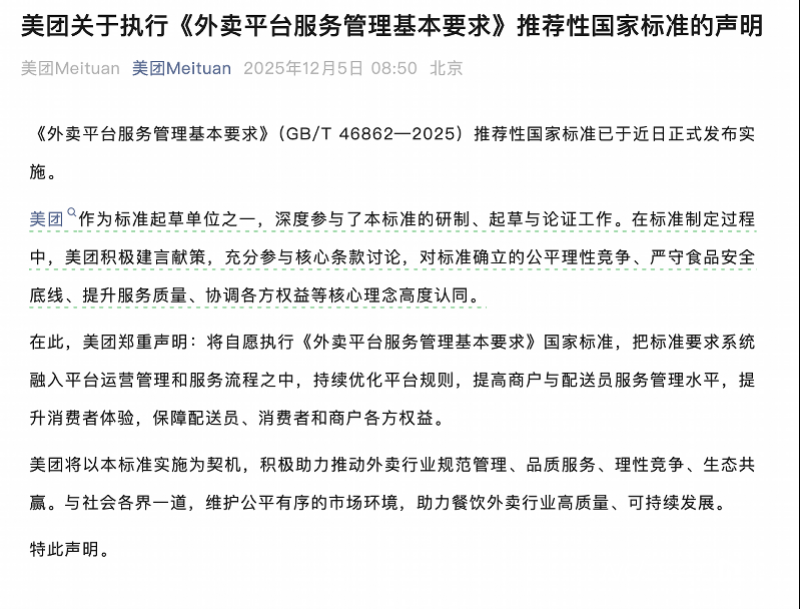
中国三大主要外卖平台4日至5日接连发文称,自愿执行外卖"新国标",积极助力推动外卖行业规范管 理、品质服务、理性竞争、生态共赢。 中国国家市场监管总局日前发布实施推荐性国家标准《外卖平台服务管理基本要求》(以下简称《基本 要求》),业内称之为外卖"新国标"。"新国标"针对近年来外卖行业存在的"幽灵外卖"、非理性竞争以及 外卖配送员权益保障不足等问题,进一步立下"新规矩"。 (文章来源:中国新闻网) 今年,外卖平台"补贴大战"引发社会高度关注,中国官方多次就市场公平有序竞争问题约谈多家外卖平 台企业。在官方"约谈"后,今年8月,饿了么、美团、京东平台同日发文抵制行业内恶性竞争,并提出 进一步规范外卖平台补贴行为等有关举措。 此次出台的《基本要求》9月下旬公开征求意见,聚焦平台内商户管理,强化主体责任落实,守护消费 者"舌尖上的安全";聚焦平台收费与促销行为,强化竞争秩序规范;聚焦平台用工管理,强化配送员权 益保障;聚焦平台内争议处理,引导平台建立完善消费者权益保护体系,完善消费者、商户、配送员等 多元主体投诉机制。 据中国互联网络信息中心统计,截至2024年底,中国网上外卖用户规模达5.45亿人,约占网民整体的 ...
淘宝闪购、美团、京东外卖齐发声明
Guan Cha Zhe Wang· 2025-12-05 08:15
Core Viewpoint - The market regulatory authority has implemented a recommended national standard for food delivery platforms to address issues such as "ghost deliveries," irrational competition, and insufficient protection of delivery personnel rights [1] Group 1: Key Focus Areas of the Standard - Focus on merchant management within platforms, emphasizing the responsibility of platforms to manage and serve merchants effectively, including compliance with food safety standards [1] - Focus on platform fees and promotional activities, aiming to clarify fee structures and promote fair competition by ensuring transparency in pricing and promotional rules [1] - Focus on labor management for delivery personnel, proposing measures to protect their rights, including reasonable working hours, professional training, and diverse protection mechanisms [1] - Focus on dispute resolution within platforms, encouraging the establishment of a consumer rights protection system and transparent complaint handling processes [1] Group 2: Industry Response - Major platforms such as Taobao Shangu, Meituan, and JD Delivery have publicly committed to implementing the national standard, recognizing its importance for fair competition and service quality [2] - These platforms participated in the drafting and discussion of the standard, expressing their commitment to integrate its requirements into their operations and improve service management for merchants and delivery personnel [2] - The platforms view the implementation of this standard as an opportunity to promote industry regulation, quality service, rational competition, and a win-win ecosystem, contributing to the sustainable development of the food delivery sector [2]

三大外卖巨头发布声明:自愿执行外卖平台“新国标”
Bei Jing Ri Bao Ke Hu Duan· 2025-12-05 06:15
Core Viewpoint - The newly implemented national standard "Basic Requirements for Delivery Platform Service Management" aims to address issues in the food delivery industry, such as "ghost deliveries," irrational competition, and insufficient protection of delivery personnel's rights. Group 1: Implementation of Standards - Major platforms including Taobao Flash Purchase, Meituan, and JD Delivery have announced their commitment to voluntarily implement the new national standard, integrating its requirements into their operational management and service processes [1][2] - These platforms participated in the drafting and discussion of the standard, emphasizing fair competition, food safety, service quality, and the protection of rights for all stakeholders [1] Group 2: Focus Areas of the Standard - The standard focuses on four key areas: merchant management, pricing and promotional practices, labor management for delivery personnel, and dispute resolution mechanisms [2] - It aims to enhance the responsibility of platforms in managing merchants, regulate competitive practices, ensure the rights of delivery workers, and improve the handling of disputes [2] Group 3: Industry Impact - The implementation of this standard is seen as a catalyst for promoting standardized management, quality service, rational competition, and ecological win-win scenarios within the food delivery industry [1] - The platforms express their commitment to work with various stakeholders to maintain a fair and orderly market environment, contributing to the high-quality and sustainable development of the food delivery sector [1]
美团、京东外卖、淘宝闪购集体声明:自愿执行!外卖新国标:骑手连续接单超4小时,暂停派单20分钟,保障骑手平均每周至少休息一天
Mei Ri Jing Ji Xin Wen· 2025-12-05 06:03
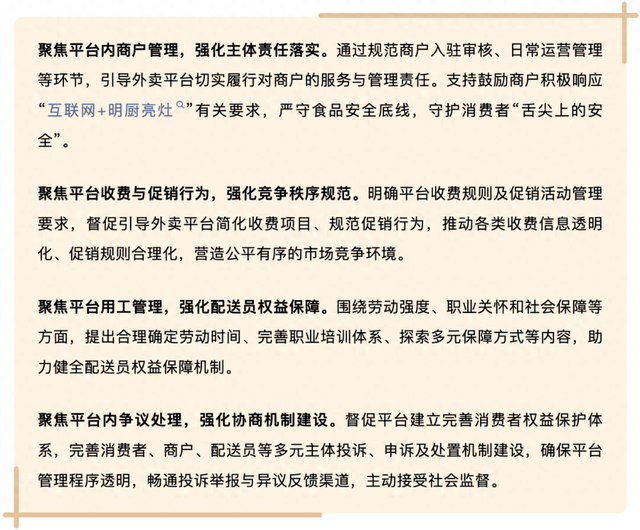
Core Viewpoint - The recent implementation of the national standard "Basic Requirements for Delivery Platform Services" aims to address issues in the food delivery industry, including "ghost deliveries," irrational competition, and insufficient protection of delivery personnel's rights. Group 1: Delivery Personnel Rights Protection - The new standard mandates that delivery platforms and partner companies must ensure adequate rest for delivery personnel, limiting their daily working hours to a maximum of 8 hours and requiring a fatigue alert after 4 continuous hours of work [5][6]. - Platforms are prohibited from using algorithms or incentives to force delivery personnel into overtime work, emphasizing the need for a fatigue alert mechanism and ensuring at least one day off per week for delivery personnel [6][15]. Group 2: Merchant Management - Merchants are required to provide a video for location verification, and platforms must ensure consistency between the video and merchant licenses [8]. - Platforms are encouraged to provide "order surge" alerts to merchants and consumers to promote rational ordering behavior [11]. Group 3: Pricing and Fees - The standard outlines three types of fees: technology service fees, delivery service fees, and promotional service fees, with a requirement for platforms to disclose detailed billing information to merchants [12][13]. - Platforms must not transfer promotional costs to merchants or impose unreasonable conditions for participation in promotional activities [13][14]. Group 4: Consumer Rights Protection - Platforms are required to establish a consumer rights protection system that ensures timely responses and safeguards consumer rights, including the right to information and fair treatment [15]. - Personal information collection must be reasonable and consensual, with restrictions on unsolicited commercial communications [15]. Group 5: Complaint and Appeal Mechanisms - Platforms must clarify the procedures for merchant and delivery personnel appeals, ensuring timely responses and simplified processes [16][17]. - A tiered response mechanism for consumer complaints must be established, with immediate human responses for serious safety issues [18].
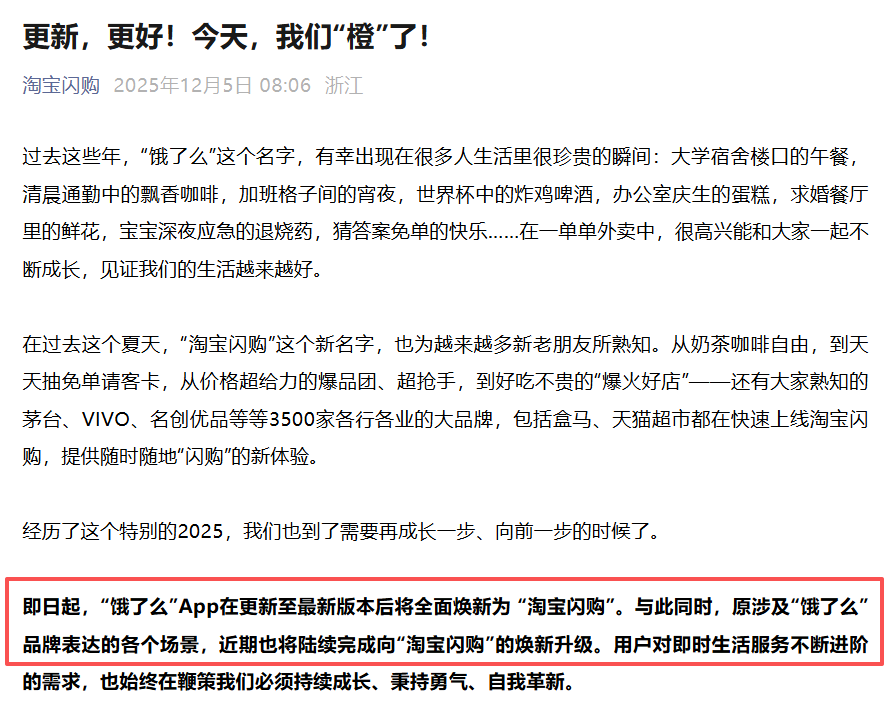
饿了么更名!外卖“三巨头”集体声明
Zhong Guo Zheng Quan Bao· 2025-12-05 05:20
Core Viewpoint - Ele.me has rebranded to Taobao Flash Purchase, marking a step towards integrating lifestyle services with e-commerce as part of Alibaba's strategy to create a large consumer platform [4]. Group 1: Company Updates - Ele.me and Taobao Flash Purchase will undergo a complete rebranding, with the transition starting immediately [1]. - Alibaba's revenue for Q2 of FY2026 (Q3 2025) was 2,477.95 billion yuan, a 5% year-on-year increase, but operating profit dropped by 85% to 53.65 billion yuan due to investments in instant retail and user experience [5]. - Meituan reported a slight revenue increase of 2% to 954.88 billion yuan for Q3 2025, but faced an adjusted net loss of 160.10 billion yuan, compared to a profit of 128.29 billion yuan in the same period last year [4]. Group 2: Market Competition - The intense competition in the food delivery sector has significantly impacted the financial performance of major players like Alibaba, Meituan, and JD.com [4]. - JD.com reported a total revenue of 2,991 billion yuan for Q3, a 14.9% year-on-year increase, but net profit fell by 54.7% to 53 billion yuan, with new business losses reaching 157.4 billion yuan [5]. Group 3: Strategic Focus - Both Alibaba and JD.com view instant retail as a long-term strategy, with JD.com focusing on establishing market share in the "quality takeaway" sector [5]. - Alibaba has seen significant improvements in unit economic efficiency (UE) for Taobao Flash Purchase since October, with losses per order halved compared to July and August [6]. - Meituan's CEO emphasized the unsustainability of the price war in the food delivery market, advocating for high-quality and sustainable development in the industry [6].
美团、京东外卖、淘宝闪购发布声明
证券时报· 2025-12-05 04:45
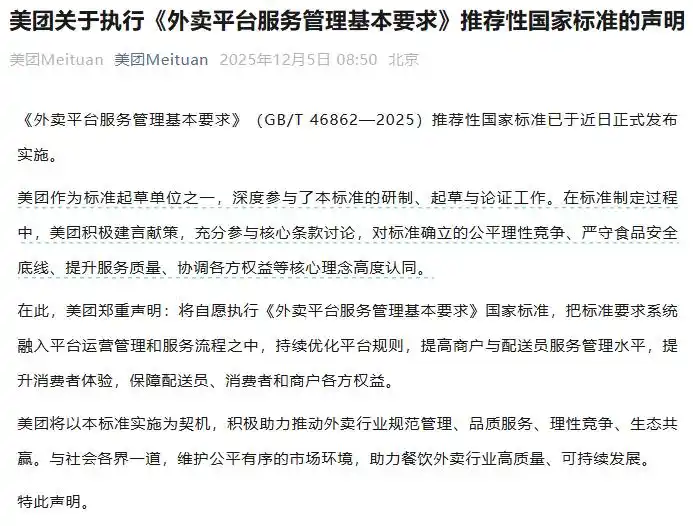
Core Viewpoint - The article discusses the implementation of the national standard "Basic Requirements for Delivery Platform Services" by Meituan, JD.com, and Taobao, emphasizing their commitment to improving service quality and ensuring fair competition in the food delivery industry [1][5]. Group 1: Standard Implementation - Meituan, JD.com, and Taobao, as drafting units, actively participated in the formulation of the national standard and expressed strong agreement with its core principles, including fair competition, food safety, service quality enhancement, and stakeholder rights coordination [5]. - All three companies declared their voluntary commitment to integrate the standard's requirements into their operational management and service processes, aiming to optimize platform rules and improve service management for merchants and delivery personnel [5]. Group 2: Regulatory Background - The National Market Supervision Administration announced the approval and implementation of the "Basic Requirements" standard to address issues such as "ghost deliveries," irrational competition, and insufficient protection of delivery personnel's rights [6]. - The administration has previously engaged in discussions with delivery platforms to ensure compliance with laws and regulations, emphasizing the need for platforms to uphold fair competition [6]. Group 3: Standard Development Process - The development of the standard involved extensive consultations with experts, platform companies, industry associations, and representatives from merchants and delivery personnel to enhance its practicality and effectiveness [7]. - The standard addresses key issues in the delivery industry, focusing on merchant management, competition order, delivery personnel rights protection, and dispute resolution mechanisms [7].