LI AUTO(LI)

Search documents
理想供应链出了文化主题曲《铁军之光》
理想TOP2· 2025-10-09 05:35
Core Viewpoint - The article emphasizes the cultural theme of "Iron Army" within the context of Li Auto's community engagement and innovation strategy, highlighting the company's commitment to collaboration and excellence in the automotive industry [1][2]. Group 1: Cultural Theme and Community Engagement - The article introduces the theme song "Iron Army's Light," which symbolizes the spirit of perseverance and ambition among Li Auto's community [1]. - The lyrics reflect a collective pursuit of dreams and overcoming challenges, portraying a strong sense of unity and determination [3]. Group 2: Innovation and Industry Growth - The lyrics mention the importance of joint innovation and collaboration, suggesting that these elements are crucial for enhancing vitality and achieving long-term success in the industry [3]. - The focus on AI empowerment and efficiency indicates Li Auto's strategy to leverage technology for creating a competitive edge and driving industry growth [3].



9月车市保持增长新势力高端亮眼 | 投研报告
Zhong Guo Neng Yuan Wang· 2025-10-09 02:58
Core Insights - The retail market for narrow passenger vehicles in September is estimated to be around 2.15 million units, showing a year-on-year increase of 2.0% and a month-on-month increase of 6.5%, with new energy vehicle (NEV) retail expected to reach 1.25 million units, achieving a penetration rate of approximately 58.1% [1][3] - The new energy vehicle market continues to see stable pricing and increasing penetration rates, which supports the overall automotive market [3] Company Performance - **Leap Motor**: Delivered 66,657 units in September, a year-on-year increase of 97.4% and a month-on-month increase of 16.8%. The growth is attributed to strong product offerings like C10 and B01, with C10 accounting for 27.1% of deliveries [4][5] - **Xpeng Motors**: Reported 41,581 units delivered in September, up 94.7% year-on-year and 10.3% month-on-month. The company has expanded its charging network significantly, with over 2,590 self-operated stations and more than 14,000 charging piles [5][6] - **NIO**: Achieved 34,749 units delivered in September, reflecting a year-on-year increase of 64.1% and a month-on-month increase of 11.0%. New models like ES8 and ET9 were launched, enhancing the product lineup [6] - **Li Auto**: Delivered 33,951 units in September, a year-on-year decrease of 36.8% but a month-on-month increase of 19.0%. The company is focusing on expanding its charging network to maintain competitiveness [7] - **Zeekr**: Reported 18,257 units delivered in September, with a year-on-year decrease of 14.4% but a month-on-month increase of 3.6%. The new Zeekr 9X model was launched, featuring advanced technology [8] - **Xiaomi**: Delivered over 40,000 units in September, with the new SUV YU7 positioned as a competitive product in the market [8] Market Trends - The overall automotive market is experiencing growth, with stable pricing and increasing penetration of new energy vehicles, which is expected to continue supporting market dynamics [3] - The trend towards intelligent driving technology is accelerating, with companies like Xpeng and Huawei leading the charge in promoting and iterating on smart driving capabilities [9] - The automotive industry is witnessing a shift towards smart technology, which is becoming a critical competitive factor among manufacturers [10]




9月零售销量预计+2%,L2强标公开征求意见稿发布 | 投研报告
Zhong Guo Neng Yuan Wang· 2025-10-09 02:42
Core Viewpoint - The retail sales growth of the passenger car market in September is expected to slow down due to a high base effect, with a projected year-on-year increase of 2% [1][2] - The release of the L2 strong standard draft is anticipated to enhance the safety and standardization of intelligent driving systems, increasing consumer trust and recognition of smart assisted driving features, which may lead to a steady rise in market penetration for related products [1][3] Retail and Wholesale Data - From September 1 to 21, the national retail of passenger cars reached 1.191 million units, a year-on-year increase of 1%, and a cumulative retail of 15.955 million units for the year, up 9% [2] - During the same period, wholesale of passenger cars was 1.307 million units, unchanged year-on-year, with a cumulative wholesale of 19.349 million units for the year, up 12% [2] - In the new energy sector, retail sales reached 697,000 units, a year-on-year increase of 10%, with a penetration rate of 58.5% [2] Market Trends and Projections - The passenger car market is expected to see a total retail of 2.15 million units in September, with a month-on-month increase of 6.5% and a year-on-year increase of 2% [2] - The new energy vehicle retail is projected at 1.25 million units for September, maintaining a penetration rate of 58.1% [2] Regulatory Developments - The Ministry of Industry and Information Technology has released a draft for mandatory national standards on intelligent connected vehicle driving assistance systems, which includes comprehensive safety requirements for various functionalities [3] - The draft emphasizes the need for driver monitoring systems to ensure safety, which is expected to drive the market for laser radar, high-performance driving chips, and driver monitoring systems [3] Market Performance - In the past two weeks, the automotive sector's performance ranked third among 30 industries, with a growth rate of 3.54% [4] - The price-to-earnings ratios for various segments are as follows: sales and services at 42.45x, components at 33.24x, motorcycles and others at 28.51x, passenger cars at 24.40x, and commercial vehicles at 16.04x [4] Investment Recommendations - Recommended companies in the complete vehicle sector include BYD, Li Auto, and Geely, while beneficiaries in the parts sector include Huayu Automotive, Bertel, and Desay SV [5] - New energy recommendations include Farah Electronics and Huawai Technology, with humanoid robot industry chain recommendations for Top Group and other related companies [5]


auto&robo X-零部件&整车agi
2025-10-09 02:00
Summary of Conference Call Records Industry and Companies Involved - **Industry**: Electric Vehicles (EVs) and AI Applications - **Key Companies**: Tesla, Li Auto, Xpeng Motors, Seres, Desay SV, and others Core Insights and Arguments 1. **Tesla's Valuation Shift**: Tesla's valuation has transitioned from vehicle sales to AI applications, with projections indicating that AI business valuation will exceed 90% in the medium term [4][11][10] 2. **Market Dynamics in China**: The domestic EV market is moving from short-term investment paradigms to long-term AI value reassessment, similar to Tesla's valuation shift, which may also occur for companies like Li Auto, Xpeng, and Seres [1][6][13] 3. **Autonomous Driving Penetration**: L2 autonomous driving penetration has reached 50%-60%, with new investment opportunities emerging in L3/L4 segments, where leading companies like Aptiv hold a competitive edge [1][8] 4. **Xpeng Motors' Growth**: Xpeng Motors is expected to achieve breakeven in Q4 2025, with plans to launch L4 autonomous vehicles and Robotaxi operations by mid-2026 [1][20] 5. **Li Auto's I6 Model Orders**: Li Auto's I6 model has secured orders until early 2026, with expected monthly sales of 20,000-30,000 units, while also expanding into AI business [1][24][29] 6. **Seres' Market Position**: Seres is benefiting from Huawei's AI strategy, with a significant increase in electric vehicle offerings and plans to launch a B-class vehicle, M6, in the first half of next year [1][30][31] 7. **Investment Opportunities in Robotics and AutoX**: The robotics and AutoX sectors present substantial investment opportunities, with historical performance of stocks like Ningde, Top, and Desay SV highlighting the importance of selecting the right stocks at the right time [3] 8. **Tesla's Market Capitalization**: Tesla's current market capitalization is approximately $1.5 trillion, with a significant portion attributed to AI applications, including FSD and Robotaxi services [4][12] 9. **Comparison with Overseas Markets**: The overseas market's response to Tesla's valuation shift serves as a model, with companies like Figure and Waymo achieving substantial valuations post-IPO [5] 10. **L2 and L3 Development Impact**: The development of L2 autonomous driving technology has led to new investment opportunities in L3 and L4 segments, with companies like Desay SV showing potential for high valuations despite current market corrections [7][15] Other Important Insights 1. **Xpeng's International Strategy**: Xpeng's international sales are projected to reach 50,000 units in 2025, with significant growth expected from the launch of new models [20][22] 2. **Li Auto's AI Developments**: Li Auto is advancing its AI capabilities with in-house chip development and plans for AI glasses and humanoid robots [28][29] 3. **Seres' Non-Automotive Business**: Seres is focusing on robotics, leveraging partnerships with Huawei and ByteDance to enhance its AI capabilities [32] 4. **Market Environment and Future Opportunities**: The current market is seen as a pivotal point for intelligent business expansion, with potential for new companies to emerge with valuations between $500 billion to $1 trillion [35]


9月第4周乘用车环比+26.7%,继续看好汽车板块 | 投研报告
Zhong Guo Neng Yuan Wang· 2025-10-09 01:08
Core Insights - The automotive industry is experiencing a shift with electric vehicle (EV) adoption nearing its peak while the focus is now on automotive intelligence and robotics innovation [5] Group 1: Market Performance - In September, the top 15 domestic new energy vehicle companies delivered 877,000 units, a year-on-year increase of 15% [4][5] - Xpeng, Xiaomi, and Great Wall's new energy vehicles each surpassed 40,000 units for the first time, while Hongmeng exceeded 50,000 units [4][5] - Li Auto's deliveries returned to over 30,000 units, and NIO set a new delivery record of 34,700 units [4][5] Group 2: Segment Performance - The performance of automotive segments for the week showed: SW commercial trucks (+3.8%) > SW passenger cars (+2.8%) > SW automotive (+1.7%) = SW automotive parts (+1.7%) > SW commercial passenger vehicles (-1.7%) [2][4] - The insurance premium for compulsory traffic insurance reached 644,000 units, with a week-on-week increase of 26.7% and a month-on-month increase of 25% [2] Group 3: Key Developments - Tesla released the FSD V14 version, expanding the model scale by ten times and increasing context length by three times [3] - Xpeng's deliveries in September reached 42,000 units, a year-on-year increase of 95% and a month-on-month increase of 10% [3] - Ideal Auto delivered 34,000 units in September, a year-on-year decrease of 37% but a month-on-month increase of 19% [3] Group 4: Investment Opportunities - The automotive sector is entering a new phase with three main investment opportunities: electric vehicle benefits nearing an end, the dawn of automotive intelligence, and innovations in robotics [5][6] - Key investment areas include Robotaxi and Robovan applications, with major players like Tesla, Xpeng, and various technology providers [6]

车企早已不再试探!十一车市加速放量,经销商“花式”让利抢客
Bei Jing Shang Bao· 2025-10-08 23:59
Core Viewpoint - The automotive industry is leveraging the National Day and Mid-Autumn Festival holidays to boost sales through new vehicle launches and promotional offers, aiming to capture market share in the fourth quarter and meet annual sales targets [1][7]. Group 1: New Vehicle Launches - Over 70 new vehicle models are set to be launched in September, with significant attention on models like Tesla's Model Y L, which has become a focal point for consumer inquiries and test drives during the holiday period [2][3]. - The introduction of new models has successfully driven foot traffic to dealerships, with some models experiencing long wait times for delivery due to high demand [3]. Group 2: Promotional Strategies - Automotive companies are implementing various promotional strategies, including cash discounts and trade-in subsidies, to attract consumers during the holiday season [4][5]. - For instance, GAC Honda and SAIC Volkswagen are offering special cash vouchers and trade-in bonuses to lower the purchase threshold for consumers [4]. Group 3: Consumer Behavior and Preferences - Consumers are increasingly opting for shopping at automotive supermarkets during the holidays, as it allows them to combine leisure activities with vehicle shopping, enhancing convenience [3]. - The holiday period has seen a surge in consumer interest, with many taking advantage of the time off to explore vehicle options they previously considered [3]. Group 4: Market Trends and Projections - The automotive market is expected to see a significant boost in sales during the fourth quarter, with projections indicating a year-on-year growth of 5% to 10% [8]. - The implementation of policies promoting vehicle trade-ins and updates has contributed to a recovery in automotive consumption, with production and sales figures showing positive growth compared to the previous year [7][8].
热门中概股周三多数上涨
Xin Lang Cai Jing· 2025-10-08 21:06
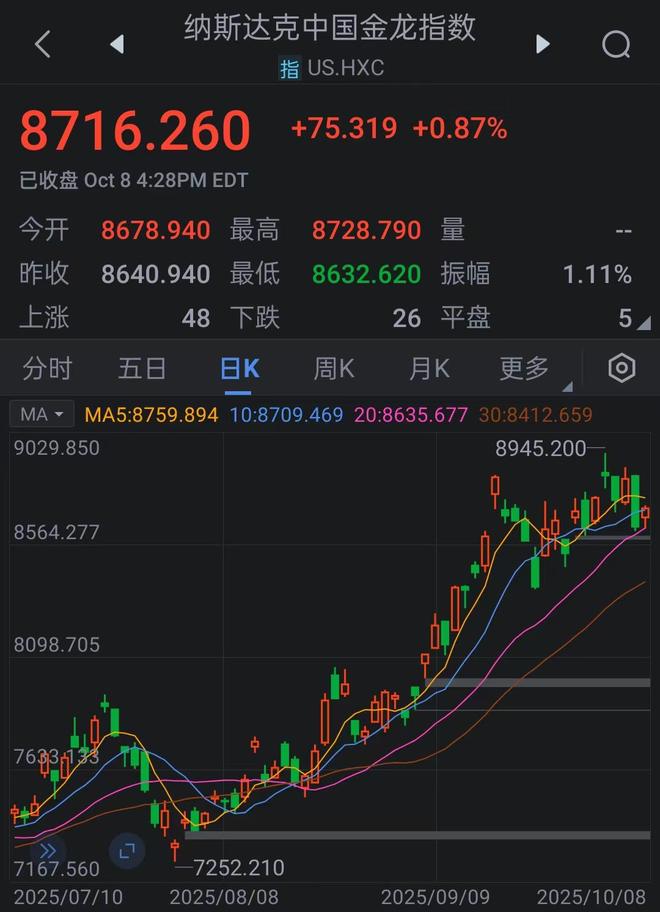
Core Viewpoint - The majority of popular Chinese concept stocks experienced an increase on Wednesday, with the Nasdaq Golden Dragon China Index rising by 0.87% [1] Company Performance - NetEase saw an increase of over 2% [1] - Li Auto rose by more than 1% [1] - Futu Holdings increased by over 4% [1] - Xpeng Motors gained over 2% [1] - NIO surged by over 4% [1] - Bilibili experienced an increase of over 2% [1]


联动破圈,构建绝佳流量转化平台
Xin Hua Ri Bao· 2025-10-08 20:55
Core Insights - The "Taihu Bay Music Festival" has transformed from a niche event to a national phenomenon, attracting over 130,000 attendees and generating over 10 billion discussions on social media since its inception in 2019 [1] - The festival serves as a platform for promoting local tourism and cultural integration, leveraging the popularity of the "Super League" to enhance the city's soft power [1] - The event has significantly boosted local businesses, with restaurants experiencing increased turnover and accommodations fully booked during the festival [2] Group 1: Event Impact - The festival has become a major cultural event, showcasing local talent and attracting a diverse audience, with nearly half of attendees under 25 years old and over 70% being female [2] - The presence of local brands like Li Auto at the festival highlights the city's identity as a hub for the new energy industry, enhancing its reputation on a national level [2] Group 2: Economic Benefits - Local businesses, including restaurants and hotels, have reported a surge in demand, with some establishments struggling to keep up with the influx of visitors [2] - The festival has created a comprehensive service ecosystem, connecting local resources and businesses to enhance the overall visitor experience [2]
乘用车“金九”销量稳步增长 上汽集团重回月销榜首
Zheng Quan Ri Bao Zhi Sheng· 2025-10-08 16:08
Core Viewpoint - The automotive market is experiencing significant growth driven by consumer demand for new energy vehicles (NEVs) and favorable policies, despite some regional challenges in vehicle replacement subsidies [2][5][8] Market Performance - During the National Day and Mid-Autumn Festival holiday, major auto shows in cities like Suzhou, Nanjing, and Guangzhou showcased thousands of models, leading to increased sales and transaction amounts [1][4] - In September, passenger car sales showed steady year-on-year growth, with NEVs becoming mainstream, while sales performance varied significantly among different automakers [5][6] Policy Impact - The upcoming restoration of the vehicle purchase tax for NEVs starting January 1, 2026, has prompted automakers like NIO, Zeekr, and Li Auto to introduce tax difference subsidy policies to encourage consumer purchases [2][3] - Some regions have seen a decline in customer traffic and sales due to the suspension of vehicle replacement subsidies, leading to a more cautious consumer sentiment [2][3] Sales Trends - In September, the overall passenger car market grew, but there was a notable divergence in sales among different brands, with domestic brands and new energy vehicle manufacturers showing varied performance [5][6][7] - Shanghai Automotive Group led with sales of 439,800 units, a 40.39% increase, while BYD's sales fell by 5.5% to 396,300 units, marking its first monthly decline since March 2024 [6][7] New Energy Vehicle Segment - New energy vehicle sales are becoming a focal point, with companies like Zhejiang Leapmotor achieving a 97% year-on-year increase in sales, while others like Li Auto faced a 36% decline [7][8] - The overall performance of joint venture brands in September showed stable sales for traditional fuel vehicles but struggled in the NEV segment, highlighting a slower transition to electric models [8] Future Outlook - Industry experts remain optimistic about the automotive market's trajectory, anticipating a moderate recovery in October sales due to holiday demand and year-end promotions [8] - Projections indicate that by 2025, China's NEV sales could reach 15.78 million units, with a penetration rate of 53.7% [8]

9月销量公布!小鹏创新高,零跑刷新记录,小米超越理想、蔚来
DT新材料· 2025-10-08 16:04
Core Viewpoint - The automotive market in September saw significant activity with nearly 80 new models launched, leading to record sales for several companies, particularly in the new energy vehicle sector [2]. Group 1: BYD - In September, BYD achieved total sales of 396,270 vehicles, a year-on-year decline of approximately 5.52% but a month-on-month increase of about 6.06% [3]. - Cumulatively, BYD sold 3.26 million vehicles from January to September, representing a year-on-year growth of 18.64% [3]. - Overseas sales of passenger cars and pickups reached 70,851 units in September, marking a year-on-year increase of 107% [3]. Group 2: SAIC Motor - SAIC Motor's sales for September included over 97,000 units from the Roewe and MG brands, a year-on-year increase of over 52% [4]. - The sales of Zhiji Automotive reached 11,107 units in September, a month-on-month increase of 81.8%, setting a brand record [4]. - The total sales for SAIC Volkswagen in September were 91,300 units, with a month-on-month growth of 1.4% [4]. Group 3: China FAW Group - In September, China FAW Group sold over 302,000 vehicles, a year-on-year increase of 6.3% [5]. - The Hongqi brand saw cumulative sales of 340,000 units, with a year-on-year growth of 8.8% [5]. - The sales of the new energy segment under the Benni brand increased by 164.5% year-on-year [5]. Group 4: Chery Group - Chery Group sold 280,469 vehicles in September, a year-on-year increase of 14.7% [5]. - The group’s new energy vehicle sales reached 91,590 units in September, a year-on-year increase of 55.4% [5]. - Cumulatively, Chery Group surpassed 2 million vehicle sales in 2023, achieving this milestone at the fastest pace in its history [5]. Group 5: Geely Automobile - Geely's September sales reached 273,125 vehicles, a year-on-year increase of 35% [6]. - The total sales for Geely from January to September reached 2.17 million units, a year-on-year growth of 46% [6]. - Geely's new energy vehicle sales in September were 165,201 units, with a year-on-year increase of 81% [6]. Group 6: Changan Automobile - Changan's total sales in September were 266,000 vehicles, a year-on-year increase of 25% [7]. - New energy vehicle sales reached 103,000 units, marking a year-on-year increase of 87% [7]. - The sales of the Deep Blue brand reached 33,626 units in September, a year-on-year increase of 48.1% [7]. Group 7: Great Wall Motors - Great Wall Motors sold 133,639 vehicles in September, a year-on-year increase of 23.29% [8]. - The sales of Great Wall's new energy vehicles reached 45,961 units, a year-on-year increase of 52.55% [8]. - Cumulatively, Great Wall Motors sold 923,358 vehicles from January to September, a year-on-year growth of 8.15% [8]. Group 8: Dongfeng Motor - Dongfeng's sales in September reached 157,000 vehicles, a year-on-year increase of 1.3% [9]. - The sales of the Yipai brand reached 30,256 units, a year-on-year increase of 15.8% [9]. - The Lantu brand delivered 15,224 vehicles in September, a year-on-year increase of 52% [9]. Group 9: GAC Group - GAC's Aion brand sold 29,113 vehicles in September, a month-on-month increase of 7.65% [10]. - Aion's sales in Portugal marked the brand's entry into the European market [10]. Group 10: New Energy Vehicle Startups - Leap Motor achieved a record monthly delivery of approximately 66,700 vehicles in September, a year-on-year increase of 97% [10]. - XPeng Motors delivered about 41,600 vehicles in September, a year-on-year increase of 95% [11]. - Xiaomi Motors also surpassed 40,000 deliveries in September, exceeding the figures of Li Auto and NIO [12].