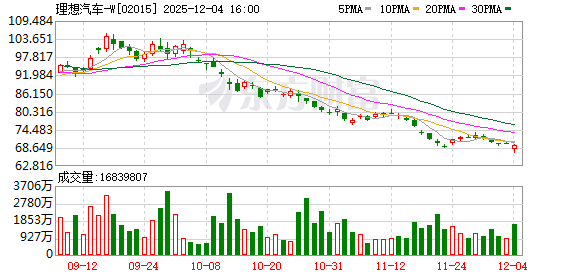
LI AUTO(LI)

Search documents
理想汽车发布AI眼镜Livis,可语音控车续航18.8小时
Zhong Guo Jing Ying Bao· 2025-12-05 04:47
Core Viewpoint - Li Auto has officially launched its first AI glasses, Livis, marking a significant expansion from the smart automotive sector into the smart wearable device market [1] Group 1: Product Features - Livis glasses weigh 36 grams and can operate continuously for 18.8 hours under typical usage scenarios [1] - The glasses are equipped with a 12-megapixel camera and features such as EIS electronic stabilization and automatic horizon correction [1] Group 2: Integration with Automotive Technology - Livis can execute voice commands through the "Li Xiang Classmate" system, allowing users to perform tasks like turning on the air conditioning and heating the steering wheel without needing to use their phones [1] Group 3: Strategic Vision - The Senior Vice President of Product at Li Auto, Fan Haoyu, stated that the company has been exploring smart device forms that can naturally and continuously accompany users, emphasizing that glasses are the most natural interaction entry point due to their long wear time [1]



Livis 上手体验:一个 “理想式” 产品,一次 “理想式” 取舍
晚点LatePost· 2025-12-05 04:00
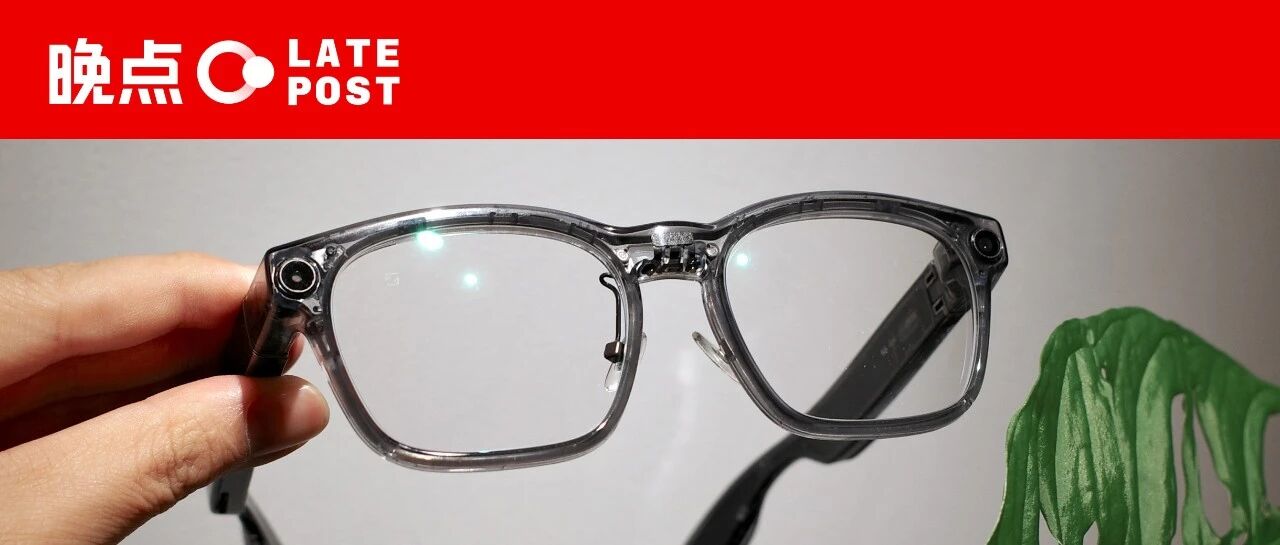
以下文章来源于晚点Auto ,作者晚点团队 晚点Auto . 从制造到创造,从不可能到可能。《晚点LatePost》旗下汽车品牌。 编辑 丨 龚方毅 创业公司来了,雷鸟、Rokid、影目等,发布了数十款形态、功能各异的产品,他们觉得这是建立新 公司的机会。手机厂商来了,华为、小米、OPPO、荣耀等,看中这是重要的增长空间。互联网大厂 来了,Meta、阿里、百度已经发布,字节正在研发,他们看重这是新的 AI 入口。现在,车企也来 了。 12 月 3 日晚,理想汽车发布智能眼镜 Livis,起售价 1999 元,算上国补为 1699 元,标配无度数防蓝 光镜片,可以加钱换墨镜或配光学镜片;采用自由环面定制镜片、能够实现感光变色的高度近视版本 最贵,国补后价格去到 2974 元。 理想今年初成立穿戴机器人部门,由高级副总裁范皓宇负责。这款眼镜他们在汽车之外的第一款新 品,从内部研究到产品定型用了两年。 我们提前拿到两副 Livis,它们都从广州黄埔的蔡司仓库发货。平光镜片款在发布会开始前一周送达; 另一幅带度数的蔡司变色镜片款 12 月 3 日才到货。我们挑选了多个日常使用场景,测评了它的功 能。 李想说,这是 " ...
A股AI眼镜概念股强势,可川科技涨停,博士眼镜涨超8%
Ge Long Hui· 2025-12-05 03:49
Core Viewpoint - The A-share market is witnessing strong performance in AI glasses concept stocks, driven by recent product launches and industry collaborations [1] Group 1: Market Performance - As of the half-day close, several AI glasses stocks have shown significant gains, with 可川科技 reaching the daily limit up, 中富通 increasing over 9%, 博士眼镜 up over 8%, 统联精密 up over 6%, 长盈精密 up over 5%, and both 联创电子 and 博杰股份 increasing over 4% [1] Group 2: Recent Developments - On December 3, 理想汽车 launched its first AI glasses, Livis, marking a significant entry into the market [1] - On November 27, 阿里巴巴's subsidiary launched the 夸克AI眼镜S1, further expanding the AI glasses product offerings [1] - 阿里巴巴 has formed the 夸克AI眼镜产业生态联盟 in collaboration with Qualcomm, 立讯精密, 博士眼镜, and 至格科技, indicating a strategic move to enhance the ecosystem around AI glasses [1]






汽车企业,压力来了!年终行情悬而未决,淘汰赛鸣笛!|人民智行
Zheng Quan Shi Bao Wang· 2025-12-05 03:01
Core Viewpoint - The Chinese automotive market faces significant uncertainty as it transitions into the "post-subsidy era," with many companies expressing concerns about market conditions and competition intensifying [1][2][5]. Group 1: Market Conditions - By the end of 2025, the anticipated "tail effect" in the automotive market remains uncertain, with many companies unprepared for year-end sales targets [2][5]. - The withdrawal of local replacement subsidies and the adjustment of the new energy vehicle purchase tax from full exemption to a 50% reduction are expected to increase purchase costs for consumers [2][5]. - The overall automotive sales in China from January to October reached 27.687 million units, reflecting a year-on-year growth of 12.4% [5]. Group 2: Competitive Landscape - Companies are increasingly adopting "bottom-line" subsidy strategies to boost year-end sales, which may raise sales costs and challenge smaller brands with limited profit margins [3][4]. - The competition is expected to become more transparent and brutal, focusing on product strength, cost control, and user experience as the market moves away from policy-driven growth [5][9]. - The market is predicted to see a significant divide, with leading companies leveraging scale advantages and brand influence, while smaller brands may struggle with cash flow and product iteration [8][10]. Group 3: Future Outlook - The automotive industry is entering a phase where only a few strong brands are likely to survive, with predictions suggesting that in the future, only five dominant brands will remain in the market [10][11]. - The shift away from policy reliance is expected to allow companies to focus on technological innovation and service upgrades, fostering healthier industry development [10][11].


比亚迪赚走6成利润,6家新势力亏掉107亿,14大车企前三季度业绩锐评
3 6 Ke· 2025-12-05 02:56
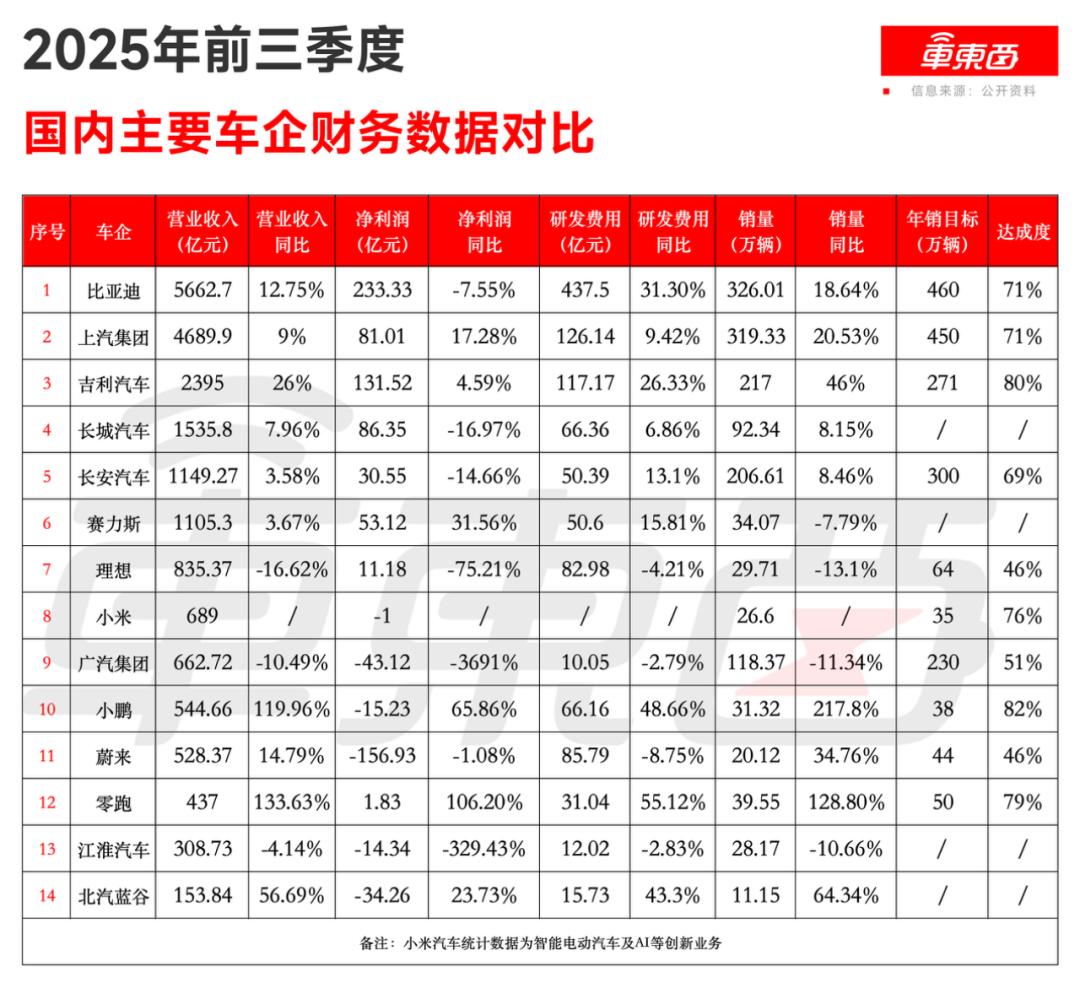
Core Insights - The financial reports of 14 major domestic car manufacturers for the first three quarters of 2025 show a total revenue of 2.07 trillion yuan and a net profit of 364 billion yuan, resulting in a net profit margin of only 1.76% [2][6][22]. Group 1: Financial Performance - Among the traditional car manufacturers, eight companies reported a combined net profit exceeding 471 billion yuan, with BYD leading with a net profit of 233 billion yuan, accounting for 64% of the total net profit of the 14 companies [4][8]. - Geely's revenue reached 239.5 billion yuan, a 26% increase year-on-year, with a net profit of 131.52 billion yuan, benefiting from its accelerated transition to new energy vehicles [8][22]. - The new energy vehicle sector is experiencing significant losses, with six new entrants collectively losing 107 billion yuan, while only Seres, Li Auto, and Leap Motor reported profits [4][6][22]. Group 2: Revenue and Profit Comparison - BYD's revenue was 566.27 billion yuan, a 12.75% increase, while its net profit decreased by 7.55% [5][7]. - SAIC Group reported a revenue of 468.99 billion yuan and a net profit of 81.01 billion yuan, both showing growth [11][22]. - NIO's revenue was 528.37 billion yuan, with a significant net loss of 156.93 billion yuan, highlighting the challenges faced by the company [22][24]. Group 3: R&D Investment - BYD led in R&D investment with 437.5 billion yuan, a 31.3% increase, indicating a commitment to technological expansion despite a slight decline in net profit [25][29]. - Geely's R&D expenditure was 117 billion yuan, up 26%, reflecting its focus on innovation [29][32]. - NIO, despite its losses, invested 85.79 billion yuan in R&D, maintaining a strong commitment to technology development [32][36]. Group 4: Sales Performance - The total sales volume for the 14 companies reached 15 million units, with BYD, SAIC, Geely, and others achieving significant growth [37][41]. - BYD sold 3.26 million vehicles, a year-on-year increase of 18.64%, while SAIC's sales reached 3.19 million units, growing by 20.53% [38][45]. - New entrants like Leap Motor and Xpeng saw substantial sales increases, with Leap Motor's sales up 128.8% and Xpeng's up 217.8% [49][50]. Group 5: Market Dynamics - The competitive landscape in the automotive industry is intensifying, with companies facing pressures from supply chain costs, rapid technological changes, and the need for substantial R&D investments [52]. - The performance of these 14 companies reflects a growing divide in profitability, with only a few achieving a balance between revenue growth and profit margins [22][52].



年终行情悬而未决,“后补贴时代”车市淘汰赛鸣笛
Zheng Quan Shi Bao· 2025-12-05 02:32
Core Viewpoint - The Chinese automotive market faces uncertainty as it transitions into the "post-subsidy era," with increased competition and policy changes impacting sales expectations for the end of 2025 [1][2][5]. Group 1: Market Conditions - Many car manufacturers are uncertain about their sales expectations for December, with some executives stating they are unprepared for the challenges ahead [2]. - The withdrawal of local trade-in subsidies and the upcoming reduction in purchase tax for electric vehicles are significant factors contributing to the market's unpredictability [2][6]. - The cumulative sales of automobiles in China from January to October reached 27.687 million units, reflecting a year-on-year growth of 12.4% [6]. Group 2: Competitive Landscape - The automotive industry is entering a new phase where competition will focus on product quality, cost control, and user experience, marking a shift away from reliance on subsidies [1][4][10]. - The introduction of "bottom-line" subsidy schemes by companies like Xiaomi and NIO indicates a strategic response to pressure from declining sales and inventory management [3][4]. - The market is expected to see a significant differentiation among brands, with larger companies better positioned to absorb profit pressures compared to smaller firms [8][9]. Group 3: Future Outlook - Analysts predict that the automotive market will experience a decline in sales pressure due to macroeconomic factors and policy changes, leading to a more stable and mature phase for the electric vehicle sector [8][10]. - The competition will intensify, with companies needing to innovate and improve efficiency to survive, as traditional factors like technology and cost control become critical in consumer decision-making [9][10]. - The industry is anticipated to undergo a significant reshaping, with only a few strong brands likely to survive in the long term, as indicated by industry leaders [11].
卖车的理想,用AI眼镜试探“具身智能”
Bei Ke Cai Jing· 2025-12-05 01:32
Core Viewpoint - Li Auto has launched its first AI glasses, Livis, priced from 1999 yuan, marking a significant exploration in the field of embodied intelligence [2][4]. Group 1: Product Features and Positioning - Livis is positioned as an important accessory for Li Auto, with Chairman Li Xiang stating it is "the best AI accessory" [2]. - Unlike other automakers focusing on humanoid robots, Li Auto has opted for AI glasses as its entry into the embodied intelligence sector [3]. - Livis emphasizes user experience with a weight of 36 grams, balanced design, and a battery life of 18.8 hours [8]. - The glasses do not feature optical displays or independent terminals, nor do they use Qualcomm chips, focusing instead on lightweight design and long battery life [7]. Group 2: Technological Integration and Functionality - Livis is equipped with a self-developed embedded operating system, Livis OS, and features enhanced interaction with vehicles [9]. - The glasses allow users to remotely unlock and control their vehicles, with future capabilities including summon and automatic parking [9]. - Li Auto defines Livis as a "wearable robot," indicating its role beyond just being an accessory for vehicles [10]. Group 3: Market Strategy and Competition - The company has modest expectations for the first generation of Livis, aiming for high conversion rates among its 1.4 million vehicle owners while also seeking to expand beyond this user base [11]. - Li Auto faces competition from traditional tech companies with broader user bases in the AI glasses market [12]. - The starting price of 1999 yuan positions Livis as a strategic product to capture market share in the AI glasses sector [13]. Group 4: Future Vision and Challenges - Li Xiang envisions the next decade focused on developing embodied intelligence, integrating it with existing machines to enhance their capabilities [14]. - The company sees AI glasses as a starting point in the embodied intelligence field, with aspirations to become a leading player in the next 3-5 years [16]. - Despite the potential for commercialization, challenges remain in technology, regulations, user acceptance, and market perception [17]. - Li Auto must balance its transition towards embodied intelligence with its core automotive business [18].
年终行情悬而未决 “后补贴时代”车市淘汰赛鸣笛
Zheng Quan Shi Bao· 2025-12-04 22:21
Core Viewpoint - The Chinese automotive market faces uncertainty as it transitions into the "post-subsidy era," with increased competition and policy changes impacting sales expectations for the end of 2025 [1][2]. Group 1: Market Dynamics - Many car manufacturers are uncertain about their sales expectations for December, with some indicating a lack of preparedness for the end-of-year sales push [2]. - The withdrawal of local trade-in subsidies and the adjustment of the new energy vehicle purchase tax from full exemption to a 50% reduction are significant factors affecting consumer purchasing decisions [2][3]. - The market is moving away from reliance on policy support, entering a phase where product quality and user experience will be the primary competitive factors [1][6]. Group 2: Competitive Landscape - The competition among car manufacturers is expected to intensify, with a focus on product strength, cost control, and user experience as key differentiators [1][9]. - Smaller brands may struggle to absorb increased sales costs associated with "bottom-line" subsidy schemes, leading to potential operational challenges [4][9]. - The market is predicted to undergo significant differentiation, with leading companies leveraging scale and brand influence to maintain competitiveness [8][10]. Group 3: Industry Trends - The automotive industry is witnessing a shift towards a more transparent and direct competition environment, with a potential "淘汰赛" (elimination race) for less competitive players [10][11]. - Companies that can innovate and maintain service quality are likely to thrive, while those lacking core technology and cost control may face difficulties [10][11]. - The overall sentiment indicates that the automotive market will see a consolidation of strong brands, with predictions that only a few dominant players will remain in the long term [11].
AI眼镜迎上新潮 赛道巨头竞相布局
Zheng Quan Shi Bao· 2025-12-04 17:55
Core Insights - The smart glasses market is experiencing a surge in new product launches, with notable entries from companies like Li Auto and Alibaba [1][2] - The global smart glasses market is projected to see significant growth, with IDC forecasting a shipment volume exceeding 40 million units by 2029 and a compound annual growth rate (CAGR) of 55.6% from 2024 to 2029 [3] Group 1: Product Launches - Li Auto launched its first AI glasses, Livis, which weigh only 36 grams and have a battery life of 18.8 hours, enabling vehicle control and information queries through voice commands [1] - Alibaba's Quark AI glasses S1, which integrates with Alibaba's Qianwen, topped sales charts shortly after launch, showcasing strong market demand [1][2] Group 2: Industry Collaborations - Alibaba has formed an AI glasses industry ecosystem alliance with Qualcomm, Luxshare Precision, and other companies to enhance the development and market presence of smart glasses [2] - XREAL and Google announced the upcoming release of Project Aura, the first AI glasses powered by the Android XR platform, featuring advanced AI capabilities [2] Group 3: Market Trends and Projections - The smart glasses market is expected to enter a phase of scaled growth, with a 64.2% year-on-year increase in shipments projected for the first half of 2025 [2] - The average price of AI glasses is maintained around 1500 yuan, which is expected to stimulate first-time purchases and transition the industry from concept validation to commercial scale [3] - The global user base for traditional glasses presents a significant opportunity for AI glasses, as the current AI penetration rate remains low, indicating substantial growth potential [3]



理想汽车发布首款AI眼镜
Zheng Quan Ri Bao· 2025-12-04 16:35
Core Insights - Li Auto has officially launched its first AI glasses, Livis, marking a significant crossover from the smart automotive sector to smart wearable devices [2][3] - Livis features a lightweight design at 36 grams, with a continuous operational time of 18.8 hours, and includes advanced functionalities such as a 12-megapixel camera and electronic image stabilization [2] - The launch aligns with Li Auto's "All-in-AI" strategy, aiming to position the company as a leading player in the global AI sector, with a projected R&D expenditure of 12 billion yuan by 2025, of which over 6 billion yuan will be dedicated to AI [3] Industry Trends - The smart glasses market is heating up, with major players like Meta and Xiaomi expected to release new products, leading to a predicted shipment volume of 2.846 million units in China by 2025, representing a 116.4% year-on-year growth [4] - The move by automotive companies into the AI glasses space signifies a shift towards becoming "full-scenario lifestyle service providers," extending the mobility ecosystem beyond just transportation [4] - Industry experts suggest that Li Auto's foray into AI glasses is a strategic step to enhance its product matrix and tap into the growing demand for integrated smart experiences among consumers [3][4]