Morgan Stanley(MS)

Search documents
大摩:强有力的美元走势领先指标,美股、美债与美元指数的“共振模式”
美股IPO· 2025-10-20 12:37
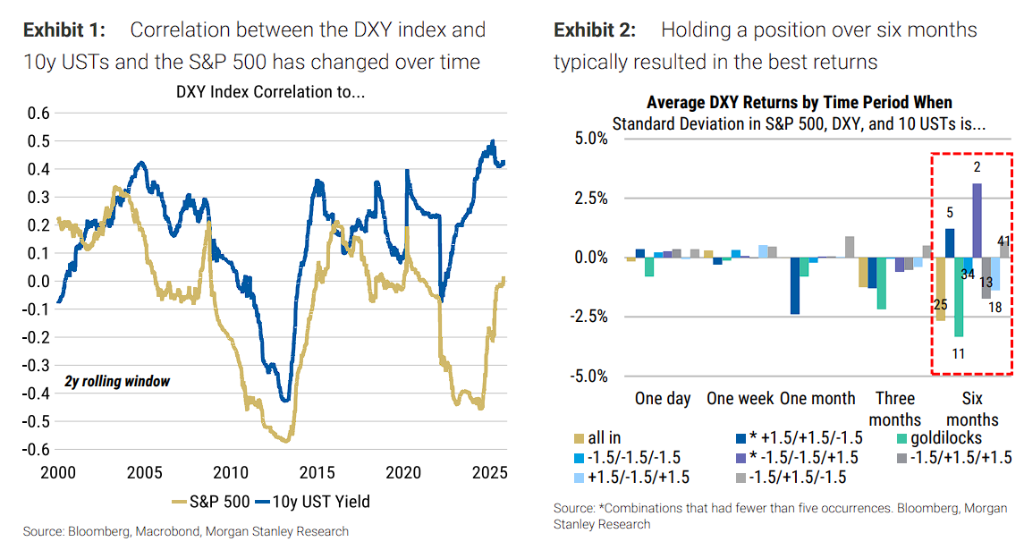
Core Insights - Morgan Stanley's research indicates that extreme "resonance" among the S&P 500, U.S. Treasury yields, and the U.S. dollar index often predicts a reversal in the dollar's strong cycle [3][7] - The analysis of the past 25 years shows two strong signals for a weaker dollar in the next six months: the "Goldilocks" scenario and the "Broad Up" scenario [3][10] Group 1: Goldilocks Scenario - The "Goldilocks" scenario occurs when the S&P 500 rises over 1.25 standard deviations while both the dollar index and Treasury yields fall over 1.25 standard deviations [8][15] - This scenario has appeared 12 times in the past 25 years, leading to an average dollar index decline of 3.3% over six months, with an 83% success rate for predicting dollar weakness [10][15] - The strong performance of the British pound in this scenario may reflect expectations of a soft landing for the economy [6][15] Group 2: Broad Up Scenario - The "Broad Up" scenario is characterized by simultaneous increases in the S&P 500, dollar index, and Treasury yields, each exceeding 1.25 standard deviations [16][20] - This scenario has occurred 26 times in the past 25 years, resulting in an average dollar index decline of 2.7% over six months, with a moderate success rate of 73% [16][20] - The occurrence of this scenario suggests a phase of global economic catch-up following a period of U.S. exceptionalism, with the Australian dollar often performing well during synchronized global economic recovery [20]



摩根士丹利:短期内美股投资者应保持谨慎
Xin Lang Cai Jing· 2025-10-20 12:11
Core Viewpoint - Morgan Stanley's Michael Wilson indicates that U.S. stocks still face unresolved risks from trade tensions and slowing earnings revisions, advising investors to remain cautious in the short term [1] Market Performance - The S&P 500 index has not recovered from losses incurred earlier in the month [1] Earnings Revisions - As the earnings season unfolds, earnings revisions are gradually slowing down [1] Credit Market Concerns - Following a crisis involving two regional banks due to loan issues, cracks have appeared in the credit market, exacerbating market panic [1] Strategic Recommendations - The strategy team emphasizes the need for clarity in trade relations, stabilization in earnings per share (EPS) revisions, and improved market liquidity before declaring that further downside risks are no longer present [1]
大摩:宣告股市警报解除为时尚早
Ge Long Hui A P P· 2025-10-20 12:05
格隆汇10月20日|摩根士丹利策略师Michael Wilson指出,股市仍面临贸易紧张局势和企业盈利修正放 缓等未解风险,这些因素将促使投资者在短期内保持谨慎。标普500指数尚未收复本月早些时候贸易关 系紧张升级带来的跌幅。与此同时,正当财报季进入高潮之际,盈利修正速度(即分析师上调与下调盈 利预测的数量比)正在放缓。两家地区银行贷款暴雷后信贷市场出现的裂痕,进一步加剧了市场不安。 Wilson在报告中写道:"必须看到更明确的贸易局势缓和迹象、每股收益预测趋于稳定、以及更充裕的 流动性,才能宣告短期进一步回调风险已彻底解除。"尽管短期持谨慎态度,但Wilson认为其"滚动式经 济复苏"理论在未来6-12个月内依然成立。 ...
KBW上调花旗和摩根士丹利的目标价
Ge Long Hui· 2025-10-20 07:46
KBW将花旗集团的目标价从112美元上调至118美元,将摩根士丹利的目标价从176美元上调至184美 元。(格隆汇) ...

大越期货原油周报-20251020
Da Yue Qi Huo· 2025-10-20 05:17
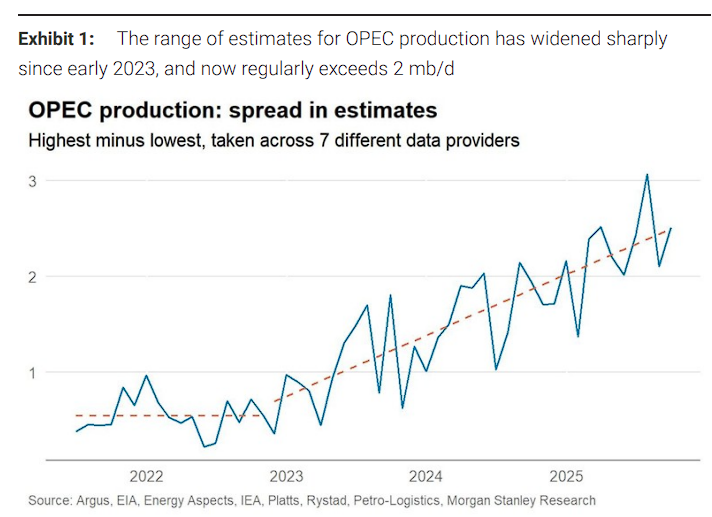
Report Summary 1. Report Industry Investment Rating No investment rating is provided in the report. 2. Core Viewpoints - Crude oil prices continued to decline last week due to factors such as supply surplus, geopolitical situation, and market sentiment. However, there was a slight rebound at the end of the week [3]. - Market expectations for the Ukraine peace agreement and the US - China trade attitude influenced the short - term fluctuations of oil prices. The short - term oil price is expected to fluctuate at a low level [3][6]. - Morgan Stanley believes that if Petro - Logistics' higher estimate of OPEC production is more accurate, it will change the market's understanding of OPEC's capacity, demand, and re - balancing path. The oil market may re - balance in the second half of 2027, with Brent crude oil expected to rise to $65 per barrel [4]. 3. Summary by Directory 3.1 Review - **Price Movement**: New York Mercantile Exchange's main light crude oil futures closed at $57.25 per barrel, down 1.02% for the week; London Brent crude oil futures closed at $61.16 per barrel, down 1.50% for the week; China's Shanghai crude oil futures closed at 437.7 yuan per barrel, down 5.24% for the week [3]. - **Supply Situation**: The IEA reported a larger - than - expected supply surplus in the global crude oil market, and OPEC's total crude oil production in September increased by 524,000 barrels per day to 28.44 million barrels per day [3]. - **Geopolitical Situation**: The easing of the Middle East geopolitical situation led to a decline in oil prices, but the uncertainty of the Ukraine peace agreement and the US - China trade attitude had an impact on the short - term oil price trend [3]. - **Fund Data**: The speculative net long positions in Brent crude oil futures decreased by 37,794 contracts to 109,606 contracts in the week of October 14. The speculative net long positions in WTI crude oil increased by 4,249 contracts to 102,958 contracts in the week of September 23 [3]. 3.2 Related News - **OPEC Production Estimate Discrepancy**: There is a significant difference in the estimates of OPEC crude oil production among different data providers. If Petro - Logistics' estimate is more accurate, it will have a major impact on the market's understanding of OPEC's production and market re - balancing [4]. - **India's Russian Oil Import**: A US White House official said that India had halved its purchase of Russian oil, but Indian sources said no immediate cuts were seen, and any cuts might be reflected in December or January import data [3]. 3.3 Outlook - **Geopolitical and Trade Factors**: Geopolitical concerns have weakened, and the US - China trade attitude has slightly softened. Short - term oil prices are expected to fluctuate at a low level. The recommended short - term trading range is between 430 - 465, and long - term investors are advised to wait and see [6][7]. 3.4 Fundamental Data - **Spot Prices**: The prices of various crude oil varieties decreased last week, with the British Brent Dtd down 6.68%, WTI down 4.87%, etc. [10]. - **Inventory Data**: The Cushing inventory and EIA inventory showed different trends over time, with some periods of increase and decrease [12][13]. 3.5持仓数据 - **CFTC and ICE Data**: The net long positions of CFTC funds and ICE funds in crude oil futures showed different changes over different time periods, reflecting the market's attitude towards the future trend of crude oil prices [19][20]
X @Bloomberg
Bloomberg· 2025-10-20 05:15
Industry Events - Goldman Sachs and Morgan Stanley CEOs are scheduled to attend Hong Kong's annual global finance summit [1] Geopolitical Factors - US-China tensions are flaring up again [1] Financial Risks - Global banks are facing a series of credit losses [1]

强有力的美元走势领先指标:美股、美债与美元指数的“共振模式”
Hua Er Jie Jian Wen· 2025-10-20 04:23
Core Insights - Morgan Stanley's latest research indicates that extreme "resonance" among the S&P 500, U.S. Treasury yields, and the U.S. dollar index often signals an impending reversal in the dollar's strong cycle [1][4] Group 1: Dollar Weakness Signals - The analysis of the past 25 years shows that extreme fluctuations (over 1.25 standard deviations) in the S&P 500, U.S. dollar index, and 10-year Treasury yields provide two strong signals indicating a weaker dollar in the next six months [1][5] - The "Goldilocks" scenario, characterized by a significant rise in the S&P 500 (over 1.25 standard deviations) while the dollar and Treasury yields decline (both over 1.25 standard deviations), has occurred 12 times historically, leading to an average 3.3% decline in the dollar index over six months [5][7] - The statistical analysis shows a high correlation between this scenario and dollar weakness, with an 83% success rate in predicting a weaker dollar following these occurrences [7] Group 2: Currency Performance Post Signals - In the "Goldilocks" scenario, the British pound tends to perform the best, reflecting expectations of a soft landing in the economy [4][10] - The "Broad Up" scenario, where all three indicators rise over 1.25 standard deviations, has occurred 26 times, indicating a 2.7% average decline in the dollar index over the following six months [13] - This scenario suggests a phase of global economic catch-up, where strong U.S. performance leads to a recovery in other regions, causing the dollar to give back gains [18]
全球宏观下一步 - 美国与中国:关系复杂-What's Next in Global Macro-The US and China It's Complicated
2025-10-20 01:19
Summary of Key Points from the Conference Call Industry and Company Involvement - The discussion primarily revolves around the **US-China relationship** and its implications for **global macroeconomic conditions** and **investment strategies**. Core Insights and Arguments - **Dynamic Trade Relationship**: The US and China are engaged in a tactical contest for economic advantage, characterized by rolling negotiations and truces rather than a definitive trade peace or economic decoupling [2][3][10]. - **Strategic Interdependencies**: Key sectors such as **rare earths** and **semiconductors** remain critical, with both nations calibrating their policies to maintain economic ties while exerting leverage [2][3]. - **US Industrial Policy**: The US is ramping up its industrial policy, particularly in sectors like **AI** and **semiconductors**, with significant capital expenditure (capex) incentives from recent tax legislation. This includes a projected **$2.9 trillion** in data center financing needs over the next three years [4][9]. - **Tariff Levels**: Effective US tariff levels are currently **4-5 times higher** than at the beginning of the year, indicating ongoing trade-related pressures on corporate decision-making [9]. - **Economic Growth Risks**: The US government shutdown adds uncertainty to economic forecasts, with predictions suggesting it may extend into November, complicating growth prospects [9]. Additional Important Insights - **Mixed Economic Signals**: Economic data presents a mixed picture, with the potential for a near-term correction in equities due to growth concerns, while large-cap US companies may benefit from favorable policy choices [9][10]. - **China's Economic Indicators**: Expectations for China's 3Q real GDP growth are projected to slow to **4.6%**, down from **5.2%** in 2Q, with industrial production growth remaining flat at **5.2%** [14]. - **Investment Opportunities**: The evolving US-China relationship and the focus on domestic investment in critical sectors present opportunities for credit investors, particularly in AI and technology-related fields [8][9]. This summary encapsulates the key themes and insights from the conference call, highlighting the complexities of the US-China relationship and its broader implications for investment strategies and economic forecasts.
机构研究周报:资产重估延续,关注高股息与高成长
Wind万得· 2025-10-19 22:35
Core Viewpoints - The article discusses the impact of recent U.S. tariffs on China, indicating that while there may be short-term disruptions in global assets, the medium-term trend of asset revaluation in China remains unaffected [1][6]. Credit Market - In September, M2 growth was 8.4%, down 0.4 percentage points from August, while M1 increased by 7.2%, up 1.2 percentage points from August, indicating a narrowing gap between M1 and M2 [3]. - New RMB loans in September were 1.29 trillion yuan, below the market expectation of 1.46 trillion yuan, reflecting a decrease of approximately 300 billion yuan compared to the same period last year [3]. Equity Market - Traditional manufacturing in China is poised to gain global pricing power due to a shift in capital expenditure structures and a slowdown in domestic capital spending [5]. - High-dividend blue-chip stocks and high-growth stocks are highlighted as key investment opportunities for the fourth quarter, with a focus on sectors like banking and utilities for stable returns, and new energy and AI for long-term growth potential [7]. Industry Research - The rebound in inbound tourism in China is expected to significantly boost the tourism sector, with total inbound tourism revenue projected to grow from $94 billion in 2024 to $525 billion by 2034 [11]. - The coal industry is anticipated to rebound in the fourth quarter due to supply constraints and increased demand, with expectations of higher coal prices supported by improved supply-demand dynamics [12]. - The non-ferrous metals sector is identified as a strong performer, driven by global political factors and trade disruptions, presenting investment opportunities in related resource sectors [13]. Macro and Fixed Income - The bond market is entering a recovery phase, with increased attractiveness for low-risk assets amid a declining risk appetite in the market [18]. - The bond market is expected to perform well in the fourth quarter, supported by a weak domestic demand environment and potential monetary policy easing [19]. - Interest rates are projected to remain low and volatile, influenced by economic recovery dynamics and the real estate market's stabilization [20]. Asset Allocation - The stock market is viewed positively in the long term, but caution is advised in the short term, with a focus on undervalued sectors and credit bonds offering yield spread opportunities [22].



石油市场的真相?大摩:OPEC增产有名无实、闲置产能更低、真实需求更强劲
Hua Er Jie Jian Wen· 2025-10-18 09:27
Core Insights - The global oil market may have been misled by "fake data" for years, with Morgan Stanley's latest report revealing significant discrepancies in OPEC's production estimates, suggesting that actual idle capacity is much lower than perceived and that strong demand is quietly reshaping future oil prices [1][4]. Group 1: OPEC Production Estimates - Morgan Stanley's analysis indicates that the announced OPEC production increases may be more about catching up to existing production rather than genuinely increasing supply [4][12]. - The report highlights a record divergence in OPEC production estimates among data providers, with discrepancies reaching up to 2.5 million barrels per day [6][9]. - The actual idle capacity of OPEC is estimated to be around 2.9 million barrels per day, significantly lower than historical averages [15]. Group 2: Demand Dynamics - If OPEC's production is indeed underestimated, it implies that global oil demand and its growth may also be systematically underestimated [4][16]. - The report suggests that a significant portion of the oil that is not accounted for in observable inventories has likely been consumed, rather than stored [16][17]. - The discrepancy in demand estimates among data providers indicates that there may be a 1% demand "omission," particularly in regions with limited reporting [17][21]. Group 3: Price Forecasts and Market Outlook - Morgan Stanley has adjusted its Brent price forecasts downward for the first half of 2026, with expectations of a price recovery to $65 per barrel by the second half of 2027 [5][24]. - The short-term outlook suggests significant oversupply, with estimates of a surplus of 2-3 million barrels per day in late 2025 and early 2026 [24][25]. - The medium-term outlook indicates that the oil market may rebalance by the second half of 2027, driven by stronger demand trends and limited supply growth [24][25].