
NTES(NTES)

Search documents
2月10日热门中概股涨跌不一 日月光半导体涨6.01%,理想汽车跌3.27%
Xin Lang Cai Jing· 2026-02-09 21:17
2月10日热门中概股涨跌不一,纳斯达克中国金龙指数(HXC)收高%。 上涨股当中(按市值从高到低),台积电涨1.83%,阿里巴巴涨0.28%,拼多多涨0.32%,网易涨 0.50%,百度涨0.71%,日月光半导体涨6.01%,中华电信涨0.42%,富途控股涨3.10%,中通涨0.15%, 华住酒店集团涨1.66%,中国新城农村涨2.40%。 下跌股当中(按市值从高到低),京东跌0.21%,携程跌1.38%,联电跌0.05%,腾讯音乐跌0.43%,贝 壳跌0.08%,理想汽车跌3.27%,小鹏汽车跌1.17%,哔哩哔哩跌2.41%,蔚来跌2.78%。 美股周一收高,科技股领涨,道指再创历史新高。投资者正等待关键经济数据和新一批企业财报。 道指涨20.20点,涨幅为0.04%,报50135.87点;纳指涨207.46点,涨幅为0.90%,报23238.67点;标普 500指数涨32.51点,涨幅为0.47%,报6964.81点。 领涨中概股列表: | | | 美股列表 | | | --- | --- | --- | --- | | ▲热股榜 | 中概股 | 科技股 知名美股 | 全部美股 | | 热门股 | 领涨 ...


2026,离职游戏人生存指南
3 6 Ke· 2026-02-09 12:14
Core Insights - The gaming industry has undergone significant changes, transitioning from a phase of rapid expansion to a prolonged period of stabilization and uncertainty, leading many individuals to reconsider their career paths and explore alternative opportunities [2][3][4] - The narrative highlights the diverse experiences of former gaming professionals who have transitioned into various fields, emphasizing that a career in gaming does not have to define one's identity or future [2][3][4] Group 1: Industry Dynamics - The gaming industry has created myths and opportunities but has never guaranteed stability, with projects often being canceled and team structures frequently changing [2][3] - As of 2024, the industry is expected to move away from aggressive growth, entering a phase of reflection and adjustment, which has resulted in layoffs and voluntary departures [2][3] - The experiences of individuals in the industry reveal a common theme: the need to redefine personal and professional identities beyond the confines of gaming [2][3][4] Group 2: Individual Experiences - Janson's journey illustrates the challenges faced in large gaming companies, where project failures often stem from misalignment between company capabilities and project demands [3][4][9] - The narrative of Sweet Rice Wine highlights the toxic work environment in certain project teams, where unhealthy competition and poor management practices led to a decline in mental well-being [24][30][31] - Summer's experience reflects the pressures of the gaming industry, where high expectations and project instability can lead to burnout, prompting a shift towards a more stable career in academia [42][54][62] Group 3: Career Transitions - Many former gaming professionals have successfully transitioned to diverse fields, such as consulting, academia, and independent game development, showcasing the versatility of skills acquired in the gaming industry [21][37][56] - The stories of individuals like Janson and Sweet Rice Wine emphasize the importance of finding a work environment that aligns with personal values and well-being, rather than merely pursuing high salaries [21][37][56] - The ongoing trend of individuals leaving the gaming industry for more stable and fulfilling careers suggests a broader reevaluation of work-life balance and job satisfaction within the sector [2][3][4]


米哈游、阅文、网易托举,卡牌第二梯队冲击上市
3 6 Ke· 2026-02-09 09:39
春节临近,卡牌赛道的竞争也日益升温。近日,卡游正式成为中央广播电视总台《2026年春节联欢晚 会》独家卡牌合作伙伴。 其他卡牌品牌也纷纷与央视达成合作:卡卡沃宣布与春晚联名,推出"小马奔奔卡"系列产品;吾流文化 则获得了央视86版《西游记》的卡牌独家授权。 与此同时,卡牌企业也集体在港交所外"排队"。随着Suplay向港交所递交招股书,掀开了2026年卡牌第 二梯队企业冲击上市的热潮。 比起盲盒潮玩赛道,冲击上市的卡牌企业背后站满了豪华资本阵容。闪魂由高瓴创投领投,高榕创投、 凯辉基金跟投。Hitcard背后站着红杉中国种子基金、泡泡玛特和千岛潮玩族等系列机构。而Suplay则因 为最大外部股东是米哈游,引起行业关注。 从营收规模来看,这些成立不久的卡牌企业与卡游还相距甚远。综合企业对外披露的数据以及招股书数 据来看,Hitcard2024年营收为4亿元,Suplay2024年营收为2.81亿元,到2025年前9个月,Suplay营收达 到2.83 亿元,超过2024年全年。相比之下,2024年卡游营收规模为100.57亿元,是卡游新贵们的四五十 倍。 但又因为如今卡牌企业依旧集体依赖授权IP,以及卡牌可拓展 ...
游戏行业:从“观看”到“推动”:《异环》有望重塑二次元开放世界体验
GF SECURITIES· 2026-02-09 07:52
Group 1 - Industry investment rating: Buy [2] - Previous rating: Buy [2] - Report date: February 9, 2026 [2] Group 2 - The core viewpoint is that the game "异环" is expected to reshape the experience of the two-dimensional open world by enhancing player agency, allowing players to transition from being mere observers to active participants in the narrative [6][34] - The two-dimensional game market is showing signs of recovery, with significant sales growth driven by key product launches, such as "明日方舟:终末地," which achieved over 1.2 billion yuan in revenue within two weeks of launch [6][16][34] - The report emphasizes that the success of "异环" is attributed to its innovative gameplay mechanics, including first-person perspective and multi-branch storylines that significantly enhance player immersion and engagement [19][20][34] Group 3 - The two-dimensional game market has experienced a typical "supply creates demand" characteristic over the past five years, with notable growth in market size during years of key product launches [13][16] - The report highlights that "明日方舟:终末地" has a strong user base, with over 20 million pre-registrations and significant engagement metrics, indicating robust market demand for high-quality two-dimensional products [33][34] - "异环" has introduced a rich interaction experience, evolving from simple dialogue options to deeper relationship-building mechanics, enhancing the emotional and social value of character interactions [27][33]

腾网米叠马年春节档打起来了
3 6 Ke· 2026-02-09 03:33
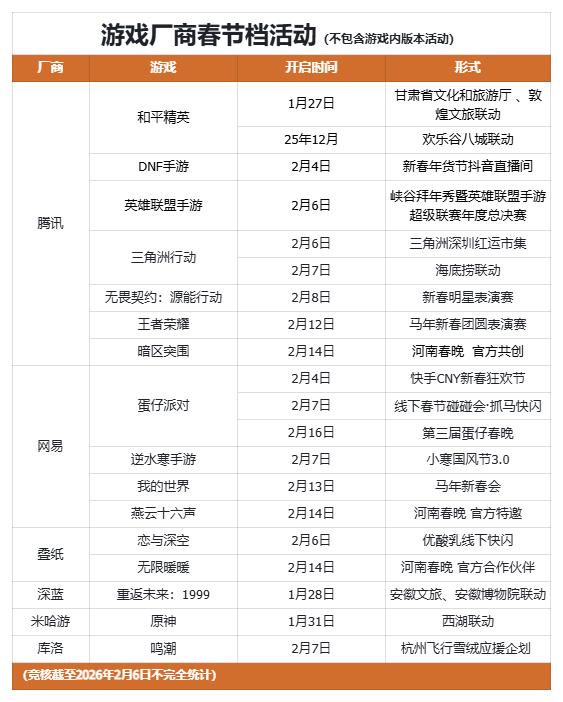
没几天就是大年三十了。 春节,不仅是阖家团圆的日子,也是文化娱乐消费的高峰期。对于游戏行业,春节档,已经变成了一场无声无息又硝烟弥漫的战役。 各大游戏的新春版本这段时间陆陆续续开放,大把福利轮番上阵,版本活动量大管饱,玩家每天的游戏时长直线上升。 游戏外的春节发行动作更是看得人眼花缭乱,有的游戏发力线下,有的游戏线上线下两手抓,有的游戏甚至登上了地方卫视的春晚舞台。 根据公开信息,竞核整理了各大游戏的春节档发行动作(不包含游戏内版本活动),如下图所示。 | | | 游戏厂商春节档活动(不包含游戏内版本活动) | | | --- | --- | --- | --- | | ■ | 游戏 | 开启时间 | 形式 | | | 和平精英 | 1月27日 | 甘肃省文化和旅游厅、敦 煌文旅联动 | | | | 25年12月 | 欢乐谷八城联动 | | | DNF手游 | 2月4日 | 新春年货节抖音直播间 | | 腾讯, | 英雄联盟手游 | 2月6日 | 峡谷拜年秀暨英雄联盟手游 超级联赛年度总决赛 | | | 三角洲行动 | 2月6日 | 三角洲深圳红运市集 | | | | 2月7日 | 海底捞联动 | | | 无 ...
下周资本市场大事提醒:美国通胀、非农数据连环发布 中芯、网易等财报将亮相 国产AI大模型扎堆上新
Xin Lang Cai Jing· 2026-02-08 13:27
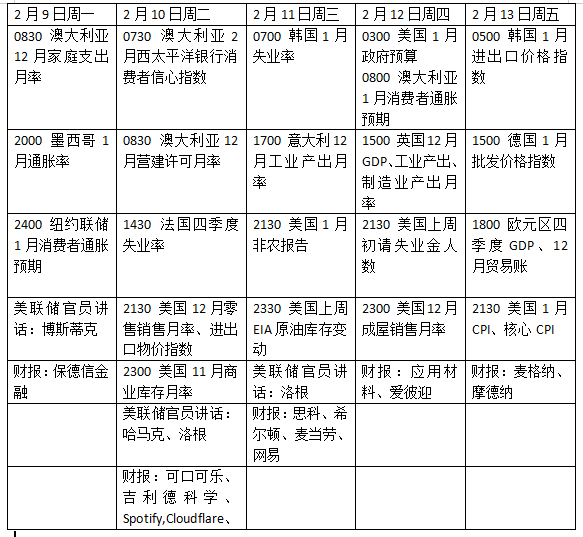
Economic Data - The People's Bank of China will release January CPI and PPI on February 11 [1] - The National Bureau of Statistics will publish the monthly report on January commodity residential sales price index on February 13 [1] - Financial data including January social financing and new RMB loans will also be released next week [1] - In the US, December retail sales month-on-month will be announced on February 10, followed by January unemployment rate and non-farm employment data on February 11 [1] Earnings Reports - The US earnings season continues with several notable companies reporting next week, including BP, Barclays, Marriott, Coca-Cola, and AstraZeneca on February 10 [2] - Other companies such as NetEase, Youdao, and Total will report on February 11, while TripAdvisor and Hyatt will report on February 12 [2] - In Hong Kong, SMIC will report earnings on February 10, followed by Budweiser APAC and NetEase Cloud Music on February 11 [2] New Stock Issuance - One new stock, Tongbao Optoelectronics, will be available for subscription on February 9, with Ai De Technology listing on the Beijing Stock Exchange on February 10 [2] - Several new stocks will list in Hong Kong, including Lanke Technology on February 9 and Aixin Yuanzhi on February 10 [2] Stock Unlocking - A total of 33 restricted stocks will be unlocked next week, with a total market value exceeding 36 billion yuan, led by Hunan YN with 24.096 billion yuan [3][10] Central Bank Operations - The central bank will have 4.055 billion yuan of reverse repos maturing next week, with specific amounts maturing each day [3][10] Government Bonds - The Ministry of Finance will issue the first phase of RMB government bonds in Hong Kong on February 11, with a scale of 14 billion yuan [13]



网易企业邮箱官网
Sou Hu Cai Jing· 2026-02-08 08:11
Core Functions and Basic Services - The primary function of enterprise email is the sending and receiving of emails, typically using the company's own domain for a professional brand image [4] - It supports large file attachments and offers ample storage space for long-term email and file retention [4] - Built-in contact management and calendar features facilitate efficient meeting scheduling and information sharing among team members [4] Security and Stability Assurance - Information security is a top priority, with multi-layered security measures including high-strength encryption and advanced spam and virus protection [5] - Service providers deploy high-performance data centers to ensure stable and continuous access, minimizing business interruptions [5] - Strict permission management and operation log auditing enhance internal data security management [5] Collaborative Office and Mobile Applications - Modern enterprise email has evolved into a collaborative platform, allowing document sharing and real-time discussions among team members [6] - Mobile client applications enable employees to manage work emails anytime and anywhere, ensuring continuity and flexibility in work [6] Management Backend and Value-Added Services - A powerful management backend is essential for system administrators to manage email accounts, security policies, and monitor system performance [7] - Additional value-added features may include integration with existing office systems and dedicated technical support services [9] Overall Value Proposition - Enterprise email enhances professional image, ensures communication security, promotes team collaboration, and simplifies internal management [12] - Organizations should evaluate functionality and service capabilities based on their size, industry characteristics, and security needs to make informed decisions [12]

网易史上最“荒谬”的项目:刚一露面,后劲太大了
3 6 Ke· 2026-02-08 03:51
Core Insights - The game "Forgotten Sea" challenges conventional gaming logic with its unique narrative and gameplay design, emphasizing a "ocean logic" that contrasts with traditional "continent logic" [5][12][41] - The game aims to provide a sense of freedom and exploration, appealing to younger players who seek emotional value and a break from linear experiences [20][35][41] Group 1: Game Design and Narrative - "Forgotten Sea" features a fragmented and abstract narrative structure that may initially confuse players accustomed to strong guidance [5][16] - The game employs a "puppet" aesthetic to create a whimsical atmosphere, distancing players from the weight of traditional RPG narratives [12][14] - The narrative revolves around themes of memory and freedom, allowing players to experience stories as observers rather than active participants [18][20] Group 2: Gameplay Mechanics - The game introduces a high tolerance for failure, allowing players up to 30 retries before facing permanent consequences, which encourages exploration [23] - A dynamic pricing system and resource categorization enhance the gameplay experience, linking effort to tangible rewards [25][27] - The incorporation of randomness through dice mechanics adds variability to combat and exploration, enhancing player engagement [27][29] Group 3: Market Positioning and Strategy - "Forgotten Sea" represents a strategic move by NetEase to differentiate itself in the gaming market by offering a product that prioritizes emotional engagement over traditional commercial efficiency [41][42] - The game is positioned as a response to player fatigue with conventional gaming experiences, betting on the appeal of freedom and romance in gameplay [41][42] - The development team’s focus on high-quality production values reflects a commitment to creating an immersive experience that encourages players to slow down and appreciate the game world [38][40]

就业通胀数据连番考验美联储,贵金属市场能否企稳
Di Yi Cai Jing· 2026-02-08 03:03
日本众议院选举结果受关注,美股财报季看点不少。 本周国际市场风云变幻,软件板块和加密货币市场巨震,人工智能发展溢出效应引发关注。 市场方面,美股涨跌互现,道指周涨2.50%,纳指周跌1.84%,标普500指数周跌0.10%。欧洲三大股指 全线走高,英国富时100指数周涨1.43%,德国DAX 30指数周涨0.74%,法国CAC 40指数周涨1.81%。 本周看点颇多,美国延迟发布的就业与通胀数据将成为市场核心关注点。欧洲市场需关注欧元区及英国 的国内生产总值数据(GDP),在亚洲,投资者密切关注2月8日日本众议院选举结果将如何重塑日本的 财政与货币政策,市场同时也在寻找日本央行下一次加息时点的线索。美股财报季进入后半期,应用材 料等与AI领域高相关的明星个股业绩值得留意。 美联储降息前景如何 美国1月非农就业数据将于当地时间11日发布,该数据因美国联邦政府部分停摆已由2月6日推迟至今。 作为核心经济数据,结果将引导投资者对美联储再度降息时点的判断。 近期数据显示,美国经济整体表现强劲,但劳动力市场走弱、通胀增速放缓。若此次数据表现疲软,推 升市场的降息预期。伦敦证券交易所集团(LSEG)数据显示,货币市场目前 ...


大行评级丨小摩:重申网易“增持”评级 目标价295港元
Ge Long Hui· 2026-02-07 12:54
Group 1 - The core viewpoint of the article is that Morgan Stanley finds the valuation of NetEase-S (9999HK) attractive, especially after a recent pullback, with a current P/E ratio of 13 times, which is a 25% discount compared to its average over the past five years [1] - Morgan Stanley reaffirms that NetEase is their top pick in the Chinese digital entertainment sector and maintains an "overweight" rating with a target price of HKD 295 [1]