UBS(UBS)

Search documents
中国债市要火?瑞银:第三波外资正赶来!
2 1 Shi Ji Jing Ji Bao Dao· 2025-08-12 14:43
Core Insights - UBS Asset Management's Director General highlighted the potential for increased foreign investment in China's bond market due to ongoing global currency diversification trends [1] - The anticipated interest rate cut by the US in September may narrow the interest rate differential between China and the US, making Chinese bonds more attractive [1] - Since March 2018, foreign holdings of Chinese bonds have grown from approximately $200 billion to around $600 billion by March 2025, indicating rapid growth [1] Group 1 - The current foreign investment proportion in China's bond market is relatively low at 2.3% as of March 2025, suggesting room for growth [1][2] - The low foreign investment is attributed to the short time foreign investors have been in the market since the introduction of the CIBM direct investment program in 2016 [2] - China's bond market, being the second largest globally, holds significant value for international investors, indicating a positive long-term outlook for foreign investment [2] Group 2 - In the current structure of China's bond market, interest rate bonds account for approximately 62.3%, while credit bonds make up about 37.7% [2] - Foreign investors tend to start with basic products such as government bonds and policy bank bonds, leading to a concentration in interest rate bonds [2] - There has been a noticeable increase in foreign investment in bank negotiable certificates of deposit (NCDs) over the past two years, driven by favorable yield conditions [2]

【环球财经】市场担忧通胀走高 纽约股市三大股指11日均下跌
Sou Hu Cai Jing· 2025-08-11 23:57
转自:新华财经 新华财经纽约8月11日电(记者 刘亚南)由于市场担忧关税导致美国通胀压力升高,纽约股市三大股指 11日高开,早盘窄幅盘整,午后走弱,收盘时纽约股市三大股指均下跌。 截至当天收盘,道琼斯工业平均指数比前一交易日下跌200.52点,收于43975.09点,跌幅为0.45%;标 准普尔500种股票指数下跌16.00点,收于6373.45点,跌幅为0.25%;纳斯达克综合指数下跌64.62点,收 于21385.4点,跌幅为0.30%。 板块方面,标普500指数十一大板块八跌三涨。能源板块和房地产板块分别以0.79%和0.65%跌幅领跌, 必需消费品板块和非必需消费品板块分别以0.17%和0.14%涨幅领涨。 美国劳工部将于12日盘前发布7月份消费者价格指数,市场担忧7月份物价上涨。 外汇经纪商嘉盛集团资深分析师Jerry Chen表示,市场预计将于12日公布的美国7月份消费者价格指数同 比涨幅将从前一个月的2.7%升至2.8%,核心消费者价格指数涨幅预计从6月份的2.9%升至3.0%。同时, 也需要关注前值的修正情况是否会像非农数据那样爆冷。总体来看,目前的通胀水平尚且可控,但在高 关税的影响下不能排 ...


UBS Group Touches 52-Week High: Should You Buy the Stock Now?
ZACKS· 2025-08-11 18:36
Core Viewpoint - UBS Group AG shares reached a 52-week high of $39.71, closing slightly lower at $39.54, with a 21.7% increase over the past three months, outperforming the industry average of 12.3% [1][4]. Financial Performance - UBS's net profit attributable to shareholders surged to $2.39 billion from $1.14 billion year-over-year, with revenues increasing by 1.7% to $12.11 billion [4]. - Operating expenses decreased by 5.6% to $9.75 billion, achieving 70% of the targeted $13 billion in gross cost savings from the Credit Suisse merger [5][12]. Strategic Developments - UBS expanded its global presence through strategic partnerships, including a deal with 360 ONE WAM Ltd in April 2025, acquiring a 4.95% share and selling its Indian wealth business [6]. - The completion of the Credit Suisse acquisition in June 2023 is expected to enhance UBS's wealth and asset management capabilities [7]. Integration and Cost Synergies - UBS is on track to achieve significant cost savings from the Credit Suisse integration, targeting over $6 billion in capital release by the end of 2026, having already cut risk-weighted assets in this division by 62% [11][12]. - The firm aims to reduce Non-Core and Legacy portfolio assets to below $8 billion by the end of 2025 and around $1.6 billion by the end of 2026 [12]. Capital Position - As of June 30, 2025, UBS's CET1 capital ratio stood at 14.4%, exceeding management guidance, with a stable CET1 leverage ratio of 4.4% [13]. - UBS targets an underlying return on CET1 capital of approximately 15% by the end of 2026 and 18% by the end of 2028 [13]. Revenue Growth - UBS has achieved a three-year CAGR of 11% in overall revenues, with net interest income growing at a 4.9% CAGR and fee income at an 8% CAGR [14]. - The company expects continued revenue growth supported by strong performances across its key business units [14]. Earnings Estimates - The consensus estimate for UBS's earnings per share (EPS) indicates a growth of 47.7% over the next three to five years, outperforming the industry growth of 11% [16]. - The consensus for earnings suggests a rise of 46.7% and 39.3% for 2025 and 2026, respectively, with upward revisions in estimates over the past month [17]. Expense Management - UBS's operating expenses have shown a 14.3% CAGR over the past four years, driven by integration costs and technology investments, although expenses declined in the first half of 2025 [18]. - Continued investments in digital infrastructure and integration costs are expected to keep the expense base elevated in the near term [18]. Capital Distribution Strategy - UBS raised its dividend by 26% to 90 cents per share in April 2025 and announced a two-year plan to buy back up to $4 billion in common stock [19]. - The company completed a $1 billion stock repurchase in the first half of 2025 and approved a new $2 billion repurchase program for the second half of 2025 [19]. Valuation Analysis - UBS's stock is currently trading at a P/E ratio of 14.3X, higher than the industry average of 10.17X, indicating a relatively expensive valuation compared to peers [21].

X @Bloomberg
Bloomberg· 2025-08-11 17:40
An institutional investor is selling a $619M stake in UBS after shares gained 15% this year https://t.co/El8wYCqVcI ...
每日机构分析:8月11日
Xin Hua Cai Jing· 2025-08-11 13:54
Group 1 - S&P Global indicates that recent tariff measures in the U.S. may exacerbate inflation pressures, but the overall consumer price increase in Q2 remained below 3.0% [1] - Goldman Sachs reports that U.S. companies have borne most of the costs of tariffs, with 64% of the burden falling on them, while consumers and foreign exporters bear 22% and 14%, respectively [2] - If recent tariffs follow the previous cost-shifting pattern, consumer burden could rise to 67%, while corporate burden may drop below 10% [2] Group 2 - Mitsubishi UFJ forecasts that emerging Asian currencies may benefit from a weaker dollar in the second half of the year, particularly those with high domestic market-driven economies [1][2] - The potential for a ceasefire in the Russia-Ukraine conflict could positively impact the euro, especially against the dollar, yen, and Swiss franc [4] - UBS highlights increased political uncertainty in Japan due to the ruling party's election losses, which may affect the timing of monetary policy changes [4]


瑞银认为美国股市在2025年下半年将呈现下跌
Sou Hu Cai Jing· 2025-08-11 13:07
Core Viewpoint - UBS strategists predict a decline in the US stock market in the second half of 2025, with a target for the S&P 500 index at 6100 points by the end of 2025, lower than current levels [3] Economic Indicators - Recent economic data indicates a downward trend in the US economy, with signs of weakness in the job market [3] - The negative effects of President Trump's tariff policies are becoming more apparent, contributing to a more pronounced downward trend in the US economy [3] Federal Reserve and Market Response - Even if the Federal Reserve resumes interest rate cuts in the remaining months of 2025, the cautious approach of Chairman Powell and rising economic pressures may limit significant stock market gains, increasing the likelihood of declines [3] - Wall Street institutions also recognize potential downward pressure on the US stock market, though the nature of this decline—whether a moderate correction or a panic sell-off—remains to be seen [3] Market Risks - Current indicators show increasing risks in the US stock market, both in terms of index levels and investment concentration [3] - Investors are advised to exercise caution in managing their positions and avoid blindly chasing high valuations [3] Notable Investor Actions - Warren Buffett currently holds over $340 billion in cash-like assets, a historical high, signaling his warning to investors about current market risks [3] - Buffett's quote, "Only when the tide goes out do you discover who's been swimming naked," emphasizes the importance of being aware of underlying risks in the market [3]
中国央行连续9个月增持黄金!外汇储备结构悄然生变
Sou Hu Cai Jing· 2025-08-09 04:51
Group 1 - The global gold market is experiencing significant changes due to increasing economic uncertainty, weakening dollar credibility, and rising geopolitical risks, with central banks actively increasing gold reserves, particularly China playing a crucial role [2][10] - UBS Wealth Management maintains an optimistic outlook for gold, setting a target price of $4000 per ounce, with potential for even higher prices if geopolitical or economic conditions worsen [2] - Citibank, traditionally bearish on gold, has revised its three-month gold price forecast from $3300 to $3500 per ounce, acknowledging previously underestimated short-term risks [2] Group 2 - CITIC Futures reports a shift in market sentiment towards gold due to weak U.S. non-farm data and stock market reversals, suggesting a return to a pricing logic of a weakening U.S. economy and a potential restart of the interest rate cut cycle [3] - As of August 6, spot gold prices fluctuated around $3300 per ounce after reaching a historical high of $3500 per ounce in April, influenced by geopolitical tensions and U.S. economic data [5][7] - China's central bank has increased its gold reserves for nine consecutive months, marking the longest period of sustained purchases in recent years, driven by the need to optimize international reserve structures [8][10]

“北京证券”,回来了
Jin Rong Shi Bao· 2025-08-08 08:00
Core Viewpoint - Beijing Securities has officially returned after nearly 19 years, with Credit Suisse Securities (China) Co., Ltd. rebranded as Beijing Securities Limited Liability Company, marking a significant shift in the Chinese brokerage landscape [1]. Group 1: Company Background and Ownership Changes - Beijing Securities is now controlled by Beijing State-owned Assets Management Co., Ltd., which acquired 85.01% of the shares from Founder Securities and UBS Group, while UBS retains 14.99% [1]. - The original Beijing Securities was established in 1993 with a registered capital of 1.515 billion yuan, and underwent restructuring in 2006, eventually becoming a wholly foreign-owned entity under UBS [1][2]. - The transition to Beijing Securities reflects a strategic adjustment and change in ownership structure amid increasing competition in the financial market [1]. Group 2: Financial Transactions and Agreements - In June 2024, Founder Securities announced a deal to transfer 85.01% of Credit Suisse Securities to Beijing State-owned Assets Management Co., with the total transaction value amounting to approximately 1.24 billion USD (about 8.85 billion yuan) and 913.5 million USD (about 6.505 billion yuan) for the respective shares [3]. - The acquisition was approved by the China Securities Regulatory Commission in March 2023, allowing Beijing State-owned Assets to become the main shareholder and actual controller of Credit Suisse Securities [3]. Group 3: Future Prospects and Strategic Goals - Following the acquisition, Beijing State-owned Assets Management Co. aims to leverage its advantages in the financial sector to support the development of Beijing Securities and contribute to the high-quality growth of the capital's financial industry [4][5]. - UBS Group's CEO indicated that the sale of shares to a long-term partner like Beijing State-owned Assets was the optimal solution, allowing UBS to maintain its focus on expanding its business in the Chinese market [5].
瑞银对美国经济“失速”发出警告,称已显现动力耗尽迹象
财富FORTUNE· 2025-08-07 13:05
Economic Outlook - UBS Global Research predicts a significant slowdown in the US economy by mid-2025, with real GDP annualized growth rate dropping to 1.2%, a sharp decline from the strong growth rates of 2023 and early 2024 [2] - Domestic demand growth has decreased from over 3% last year to approximately 1% in recent quarters, indicating a weakening economic momentum [2] Labor Market Trends - Non-farm payroll growth has slowed dramatically, with only 73,000 jobs added in July, significantly below expectations, and the average monthly job growth over the past three months is only 35,000 [3] - The unemployment rate has slightly increased to 4.25%, the highest level since 2021, while the broader U-6 unemployment rate is also rising, exceeding pre-pandemic levels by over 1 percentage point [3] - The decline in labor force participation rate, rather than sudden immigration or population shocks, is identified as the primary reason for weak labor growth [3][4] Tariff Impacts - New tariff measures are expected to further drag down economic growth, with the weighted average tariff rate projected to rise from about 16% to approximately 19% starting in early August [5] - This increase in tariffs is estimated to reduce economic growth by 0.1 to 0.2 percentage points over the next year, with significant price increases anticipated in sectors such as automotive, semiconductors, and pharmaceuticals [5] Monetary Policy Expectations - As evidence mounts of continued economic and labor market weakness, alongside potential inflationary pressures from tariff policies, the Federal Reserve faces increasing pressure to ease monetary policy [6] - UBS expects the Federal Open Market Committee to cut rates by 25 basis points in September and a total of 100 basis points by the end of 2025 [6] - The overall economic outlook suggests a demand-driven slowdown rather than a supply shortage, indicating that the Federal Reserve may soon take action to achieve a "soft landing" for the economy [6]
美元美债遭遇“信任崩盘”双杀 瑞银警告美元年内8%跌幅仍未结束
智通财经网· 2025-08-07 00:42
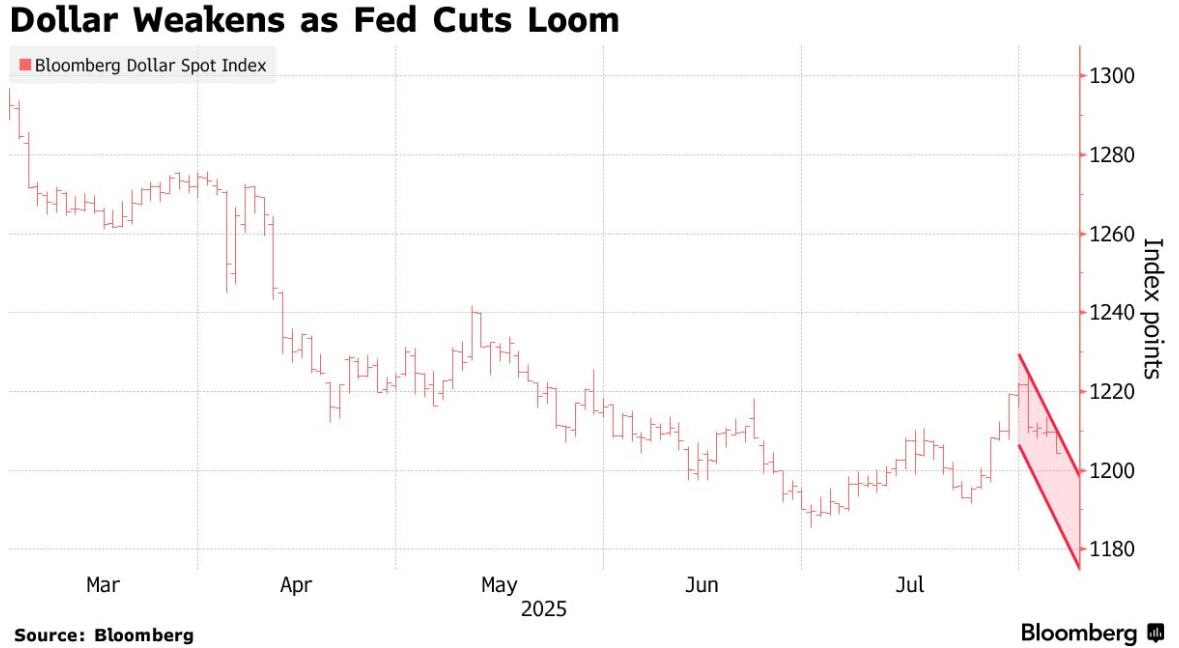
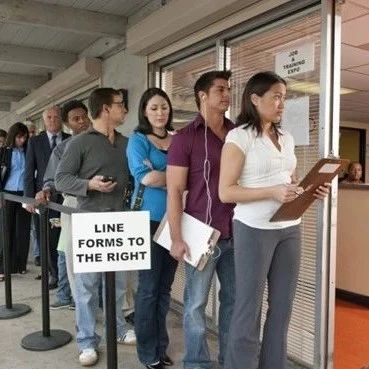
Core Viewpoint - UBS strategists warn that a weak U.S. labor market and personnel changes at the Federal Reserve and the Bureau of Labor Statistics may lead to a simultaneous decline in the U.S. dollar and U.S. Treasury yields [1][3] Group 1: Labor Market and Economic Indicators - The recent non-farm payroll report indicated a slowdown in hiring, which has not been fully absorbed by the market [1] - July's non-farm data fell short of expectations, and revisions to the previous two months' figures have raised concerns about the quality and credibility of U.S. economic data [3] Group 2: Federal Reserve and Political Pressure - Political pressure is eroding the independence of government agencies, leading to increasing worries among investors [3] - Former President Trump reacted strongly to the employment data, calling for the dismissal of the Bureau of Labor Statistics director and criticizing Federal Reserve Chairman Jerome Powell for not lowering interest rates [3] Group 3: Market Implications - The Bloomberg Dollar Spot Index has declined by 8% this year and may continue to fall due to rising risks, while currencies like the euro and yen are expected to appreciate [3] - The simultaneous emergence of traditional macro factors and risk premium elements that are negative for the dollar is noted as a significant development since spring [1]