XPENG(XPEV)

Search documents
盘点2026年部分车企销量目标
Zhong Guo Qi Che Bao Wang· 2026-01-08 07:15
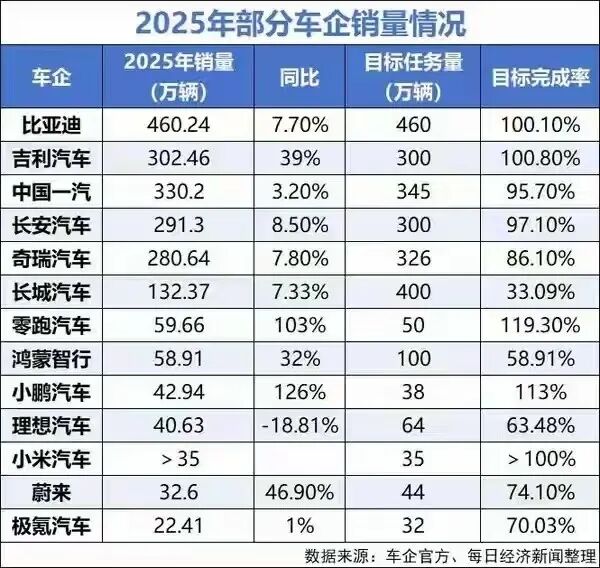
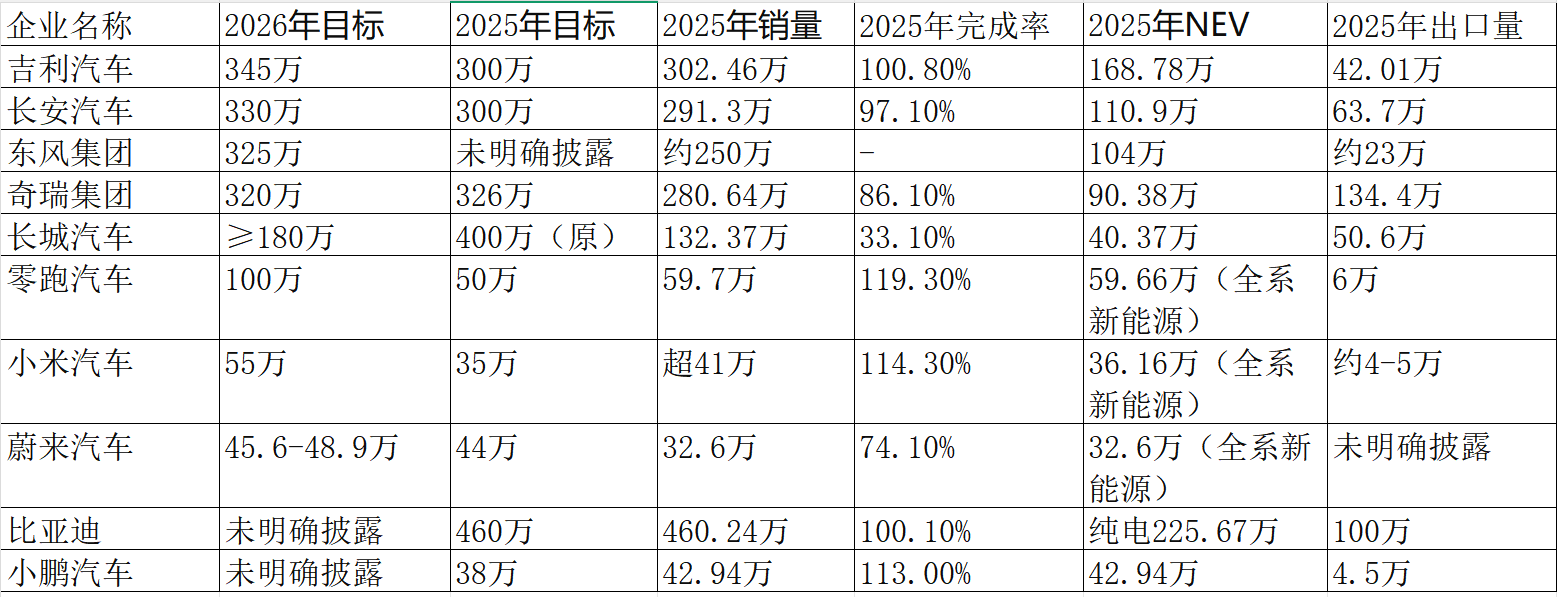
Core Viewpoint - Several automotive companies have announced their sales targets for 2026, and an analysis of their 2025 performance reveals the potential challenges they may face in achieving these goals [3]. Group 1: Company Performance and Targets - Geely Automobile aims for a target of 3.45 million units in 2026, having achieved 3.0246 million units in 2025, exceeding its target of 3 million units with a completion rate of 100.8% [3] - BYD's actual sales in 2025 reached 4.6024 million units, surpassing its adjusted target of 4.6 million units, with a significant pure electric sales figure of 2.2567 million units, ranking first globally [5] - Leap Motor set a target of 1 million units for 2026, achieving 597,000 units in 2025, exceeding its target of 500,000 units with a completion rate of 119.3% [8] - Changan Automobile has a target of 3.3 million units for 2026, with 2025 sales of 2.913 million units, achieving a completion rate of 97.1% [12] - Chery Group aims for 3.2 million units in 2026, having sold 2.8064 million units in 2025, with a completion rate of 86.1% [15] - NIO targets between 456,000 and 489,000 units for 2026, with 2025 sales of 326,000 units, achieving a completion rate of 74.1% [20] Group 2: Challenges Faced by Companies - Geely faces challenges such as EU anti-subsidy investigations and changes in Brazil's tax policies affecting exports [3][4] - BYD needs to improve sales in the high-end market, particularly for its luxury models, and address rising overseas transportation costs, which increased by 47% [6][7] - Leap Motor must compete in the 100,000-150,000 yuan market against Geely and Changan, while its gross margin is only 12%, below the industry average of 15% [10] - Changan's challenges include competition in the new energy market with BYD and Tesla, and reliance on Middle Eastern and Southeast Asian markets for exports, which are subject to geopolitical risks [14] - Chery's domestic market faces low new energy penetration at 32%, necessitating a faster transition, while its exports are vulnerable to currency fluctuations and trade barriers [15] - Great Wall Motors has significantly reduced its target from 4 million to 1.8 million units, indicating a strategic contraction, and faces delays in its new energy transition [18][19] - NIO's sales target increase of 40-50% requires monthly sales of 38,000-41,000 units, while its average monthly sales in 2025 were only 27,000 units, alongside ongoing financial losses [22] Group 3: Industry Trends and Insights - The competition in the automotive market is intensifying, with many companies having gross margins below the industry average of 15%, limiting their operational flexibility [23] - The price volatility of lithium carbonate, a key component for batteries, is expected to negatively impact cost reduction efforts for automotive companies in 2026 [23] - The automotive industry is entering a phase of "technology-driven + globalization" competition, requiring companies to balance scale, profit, and technology to achieve their 2026 targets [25]






汽车早报|雷军称改款小米SU7做不到“加量不加价”广汽集团2025年汽车销量同比下降14.06%
Xin Lang Cai Jing· 2026-01-08 00:37
Group 1: Industry Standards and Regulations - The Ministry of Industry and Information Technology is soliciting opinions on the revision plan for seven mandatory national standards, including "Safety Requirements for Automatic Parking Systems of Intelligent Connected Vehicles" [1] Group 2: Automotive Market Performance - In December, the national retail sales of passenger cars reached 2.296 million units, a year-on-year decrease of 13%, but a month-on-month increase of 3%. Cumulatively, retail sales for the year reached 23.779 million units, a year-on-year increase of 4% [2] - In December, wholesale sales of passenger cars were 2.759 million units, a year-on-year decrease of 10% and a month-on-month decrease of 8%. Cumulatively, wholesale sales for the year reached 29.524 million units, a year-on-year increase of 9% [2] Group 3: Company Announcements and Product Launches - Xiaomi's new generation SU7 is expected to launch in April 2026, with a starting pre-sale price of 229,900 yuan [3] - Xiaomi's founder Lei Jun stated that the new SU7 model's price increase of up to 14,000 yuan compared to the previous generation is due to rising costs and added features, indicating that price reductions are unlikely [4] - The new SU7 will feature a silicon carbide high-voltage platform and will have a range of 720 km for the standard version, 902 km for the Pro version, and 835 km for the Max version, all equipped with lidar and advanced driving assistance [4] - Ideal Auto announced the launch of 140 new charging stations, bringing the total to over 3,900 across 286 cities in China [6] Group 4: Company Performance and Sales Data - GAC Group reported a December automobile production of 165,302 units, a year-on-year decrease of 20.23%, with total production for the year at 1,744,429 units, down 8.98%. December sales were 187,453 units, down 33.82%, with total sales for the year at 1,721,489 units, down 14.06% [7] - Volvo Cars reported a December global sales figure of 75,049 units, a year-on-year increase of 2%, but a total annual sales decrease of 7% to 710,042 units [8] - Yueda Kia's December sales reached 20,666 units, maintaining over 20,000 units for ten consecutive months, with total annual sales of 253,964 units, a year-on-year increase of 2.3% [9][10] Group 5: Corporate Developments - Xiaopeng Motors has announced a patent for a robot vision calibration method that allows for fully automated calibration processes [10] - Horizon Robotics and the Omnivision Group's joint venture, Smart Driving Mainland neueHCT, has completed nearly $200 million in financing, with investments from several leading industry and market funds [10] - Volvo Cars appointed Thomas Ingenlath as Chief Design Officer, effective February 1, 2026, to lead the global design department [11]



2026年,这些“创二代”,谁能突围,谁是扶不起的阿斗?
3 6 Ke· 2026-01-07 13:07
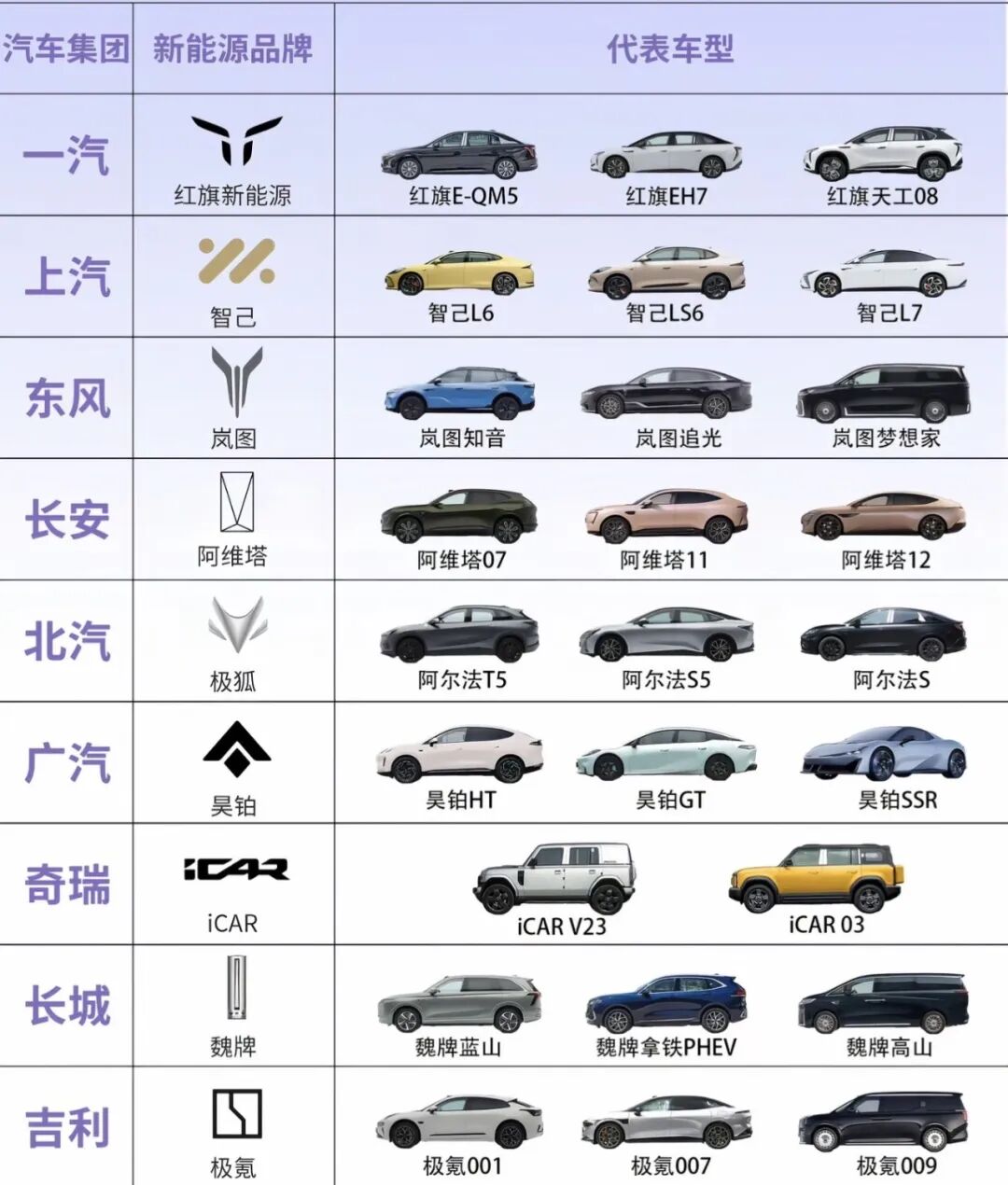
Core Insights - The new energy vehicle (NEV) industry in 2025 has seen a clear division between leading brands and those lagging behind, with companies like Leap Motor, Hongmeng Zhixing, and Xiaopeng firmly establishing themselves in the top tier, while traditional automaker-backed brands struggle to gain traction [1][6][11] Group 1: Market Performance - In 2025, the top three new car brands were Leap Motor (596,555 units, +103%), Hongmeng Zhixing (589,107 units, +32%), and Xiaopeng (429,445 units, +126%) [6][7] - The second tier includes Xiaomi Auto (over 411,625 units), Li Auto (406,343 units), and Deep Blue (333,117 units), while brands like Lantu, Avita, and Zhiji lagged with sales of 150,169, 128,772, and 81,017 units respectively [6][7][8] - The overall NEV market is expected to enter a phase of slower growth and intensified competition in 2026, with significant price cuts from major players like BMW and Tesla reigniting a price war [2][5] Group 2: Brand Dynamics - The "second-generation" brands, despite their backing from established automakers, have not been able to match the performance of pure new car brands, with significant sales gaps [6][11] - However, brands like Deep Blue and Lantu have shown impressive growth rates, with Lantu achieving a 87% increase in sales [8][21] - Traditional automakers are heavily investing in these "second-generation" brands, providing them with essential resources and support to compete in the high-end NEV market [11][13][15] Group 3: Future Outlook - Predictions for 2026 indicate a potential market growth of only about 2%, significantly lower than the previous year's growth [16] - Lantu is expected to expand its product lineup significantly and is on track for an IPO, which could enhance its market position [21][23] - Deep Blue is also positioned for growth, having achieved a high completion rate of its annual sales target [21][23] - Brands like Avita and Zeekr may stabilize but face challenges in maintaining competitive pricing and market share [26][29]


【AI智能汽车1月投资策略】特斯拉无接管横穿美国,工信部首批L3准入,看好智能化
东吴汽车黄细里团队· 2026-01-07 12:21
Core Viewpoint - The article emphasizes the significant advancements in L4 and L3 autonomous driving technologies, highlighting a dual stronghold in the U.S. and China, with notable developments in commercial applications and regulatory approvals [3][10]. Group 1: December Smartization Marginal Changes Summary - L4 commercialization is experiencing global resonance, while L3 policies have made a "0-1" breakthrough. Tesla has initiated pure unmanned testing in Austin without safety drivers or passengers, and the Chinese version of FSD has completed compliance construction in Shanghai [3][10]. - Waymo's monthly active users have increased by 96.6% year-on-year to 1.64 million, accelerating the validation of its business model. Domestic players like Pony.ai have integrated into the WeChat ecosystem, and CAOCAO's "Ten Years, One Hundred Cities, One Hundred Billion" Robotaxi strategy continues to expand [3][10]. - The policy side for L3 has seen a milestone breakthrough with the issuance of the first batch of L3 permits by the Ministry of Industry and Information Technology, marking a transition from assisted driving to conditionally automated driving in China [3][10]. Group 2: January Smartization Catalysts - The industry may enter a year of Robotaxi explosion, driven by both technology and policy, accelerating towards an "iPhone moment" for AI smart vehicles. CES 2026 is expected to be a key industry indicator, with NVIDIA's CEO focusing on the latest advancements in physical AI [4][10]. - In the L4 dimension, attention is on Tesla's FSD V14.2 performance across the U.S. without driver intervention and the expansion of its fleet. For L3, January 2026 will mark the first complete month for public road commercial trials in cities like Chongqing and Beijing, with a focus on operational takeover rates and accident liability cases [4][10]. Group 3: Investment Recommendations - The company maintains a strong outlook for the L4 RoboX theme in 2026, favoring B-end software stocks over C-end hardware stocks. Preferred H-shares include Xpeng Motors, Horizon Robotics, Pony.ai, WeRide, CAOCAO, and Black Sesame Intelligence, while A-shares include Qianli Technology, Desay SV, and Jingwei Hirain [5][10]. - Relevant downstream application stocks include those in the Robotaxi sector, such as Tesla and Xpeng Motors, as well as technology providers like Horizon and Baidu. The transformation of ride-hailing and taxi services involves companies like Didi, CAOCAO, and others [5][10]. Group 4: Supply Chain Insights - In the upstream supply chain, key players include B-end unmanned vehicle manufacturers like BAIC BluePark, GAC Group, and Jiangling Motors, along with core suppliers for testing services, chips, domain controllers, sensors, and other components [5][10]. - The investment landscape is characterized by a spiral upward iteration of hardware and software, with significant opportunities in both sectors as the industry transitions from the 0-1 stage to more advanced phases [15][10].

小鹏汽车(09868) - 截至二零二五年十二月三十一日止之股份发行人的证券变动月报表
2026-01-07 10:41
呈交日期: 2026年1月7日 I. 法定/註冊股本變動 | 1. 股份分類 | 不同投票權架構公司普通股 | 股份類別 | A | | 於香港聯交所上市 (註1) | 是 | | | | --- | --- | --- | --- | --- | --- | --- | --- | --- | | 證券代號 (如上市) | 09868 | 說明 | A類普通股 | | | | | | | | | 法定/註冊股份數目 | | | 面值 | | 法定/註冊股本 | | | 上月底結存 | | | 9,250,000,000 | USD | | 0.00001 USD | | 92,500 | | 增加 / 減少 (-) | | | 0 | | | USD | | | | 本月底結存 | | | 9,250,000,000 | USD | | 0.00001 USD | | 92,500 | | 2. 股份分類 | 不同投票權架構公司普通股 | 股份類別 | B | | 於香港聯交所上市 (註1) | | 否 | | | --- | --- | --- | --- | --- | --- | --- | --- ...
苏州鹏昭汽车销售服务有限公司成立
Zheng Quan Ri Bao· 2026-01-07 08:08
本报讯天眼查工商信息显示,近日,苏州鹏昭汽车销售服务有限公司成立,注册资本500万元,经营范 围含汽车销售、新能源汽车整车销售、新能源汽车电附件销售、汽车零配件批发、汽车零配件零售、商 务代理代办服务、信息技术咨询服务、信息咨询服务等。股东信息显示,该公司由小鹏汽车旗下苏州小 鹏汽车销售服务有限公司全资持股。 (文章来源:证券日报) ...
盈利冲刺期撞上信任危机,小鹏汽车遇高管变动
Guo Ji Jin Rong Bao· 2026-01-07 07:42
Group 1 - The core point of the article is the departure of Chen Yonghai, the Vice President of Product Center at XPeng Motors, and the subsequent appointment of Wang Fengying as his temporary replacement, highlighting the leadership changes within the company [1][2] - Chen Yonghai has a long history with the founder He Xiaopeng, having worked with him since 2010 at UC, and his departure comes after nearly four years at XPeng, where he faced challenges with product launches [2] - Wang Fengying, who has over 30 years of experience in the automotive industry, has implemented significant reforms at XPeng, focusing on core products, cost control, and channel optimization, which have positively impacted sales [2] Group 2 - XPeng's best-selling model, the MONA M03, has surpassed cumulative sales of 200,000 units, contributing to the company exceeding its annual sales target of 350,000 units for 2025, achieving a completion rate of 122.7% [3] - Despite the overall sales success, XPeng's December delivery figures fell short of expectations, with only 37,500 units delivered in December and a total of 116,200 units in Q4, below the guidance of 125,000 to 132,000 units [3] - The company is set to launch its second-generation VLA model in Q1 2026, with plans for seven new models featuring advanced configurations, which are expected to significantly expand market reach and sales potential [3] Group 3 - XPeng is currently facing allegations of false advertising related to the reduction of millimeter-wave radar in some models, leading to a collective complaint from over 100 car owners who claim the company misrepresented vehicle specifications [5] - The company has responded to the allegations by stating that the reduction in radar was due to a technical upgrade to a pure visual driving assistance system, asserting that all changes were communicated through official channels [5]
港股科技股继续走弱



Jin Rong Jie· 2026-01-07 06:17
Group 1 - The Hang Seng Tech Index has declined by 2.3%, indicating a broader downturn in the technology sector in Hong Kong [1] - Tencent Music has dropped over 5%, while Alibaba and BYD have seen declines exceeding 4% [1] - Other companies such as NIO, Bilibili, Xiaopeng Motors, Kuaishou, and Li Auto have all fallen by more than 3%, with Tencent, Meituan, NetEase, and SMIC experiencing declines of over 2% [1]
港股科技股继续走弱,阿里巴巴、比亚迪股份跌超4%

Ge Long Hui· 2026-01-07 06:07
Core Viewpoint - The Hong Kong technology sector is experiencing a significant decline, with the Hang Seng Technology Index dropping by 2.3% [1] Group 1: Stock Performance - Tencent Music has seen a decline of over 5% [1] - Alibaba and BYD have both dropped by more than 4% [1] - NIO, Bilibili, Xpeng Motors, Kuaishou, and Li Auto have all decreased by over 3% [1] - Tencent, Meituan, NetEase, and SMIC have fallen by more than 2% [1]
复盘2025新能源汽车下半场:在喧嚣、焦虑与体验升级中打响淘汰赛
Xin Lang Cai Jing· 2026-01-07 05:57
Core Insights - The 2025 year for the electric vehicle (EV) industry is characterized by aggressive growth, a backlash against internal competition, and uncertainty heading into 2026 [2][17][19] Group 1: Aggressive Growth - The EV industry is projected to sell 12.852 million units in 2025, with a market penetration rate surpassing 50% [3] - BYD leads the market with 4.6024 million units sold, achieving a 7.7% year-on-year growth [6] - New players like Leap Motor and Xiaomi are also showing significant growth, with Leap Motor achieving a 103% year-on-year increase [4][6] Group 2: Backlash Against Internal Competition - The industry has faced issues of malicious competition, with average price reductions of 9.2% leading to a decline in profit margins from 6.2% in 2020 to 4.3% in 2025 [17][18] - Regulatory bodies are advocating for a shift towards innovation and service differentiation rather than price wars [18] - The backlash aims to guide companies towards better product definitions and fair competition practices [18] Group 3: Uncertainty in 2026 - The competition in the EV sector is expected to intensify, with a slowdown in growth rates and increased pressure on product iteration [19][20] - Key factors influencing competition will be autonomous driving capabilities and expansion strategies [20][25] - The industry may face a dilemma regarding price wars as average vehicle prices have decreased from 184,000 yuan in 2024 to 178,000 yuan in 2025 [27]