腾讯

Search documents
午评:港股恒指跌0.43% 科指跌0.68% 黄金股普涨 中资券商股走弱 宝济药业首日涨超125%
Xin Lang Cai Jing· 2025-12-10 04:04
Market Overview - The Hong Kong stock market indices collectively declined, with the Hang Seng Index down by 0.43% to 25,324.75 points, the Hang Seng Tech Index down by 0.68%, and the State-Owned Enterprises Index down by 0.51% [1][9][10] Sector Performance - Technology stocks showed mixed results, with NetEase and Bilibili each dropping over 1%, Tencent down by 1%, while Meituan rose by over 1% [1][9] - Gold stocks experienced a general increase, with Lingbao Gold rising over 10% [1][4][10] - Solar energy stocks weakened, with GCL-Poly Energy falling over 3% [1][5][10] - Chinese brokerage stocks opened high but closed lower, with China Merchants Securities dropping over 3% [1][6][10] New Listings - Two new stocks were listed today, with Tudatong rising by 34% and Baoji Pharmaceutical increasing by over 125% [1][7][10] - Tudatong, through a merger with TechStar Acquisition Corporation, raised approximately HKD 1.027 billion [7][16] Gold Market Insights - The gold market strengthened ahead of the Federal Reserve's decision, with spot silver surpassing USD 61 per ounce, marking a historical high and a year-to-date increase of over 100%; spot gold exceeded USD 4,210 per ounce [4][10] Solar Industry Analysis - The solar industry is undergoing a phase of "de-involution," with significant improvements expected in Q3 for upstream segments, focusing on supply-side measures and demand-side support from the "14th Five-Year Plan" [5][13]


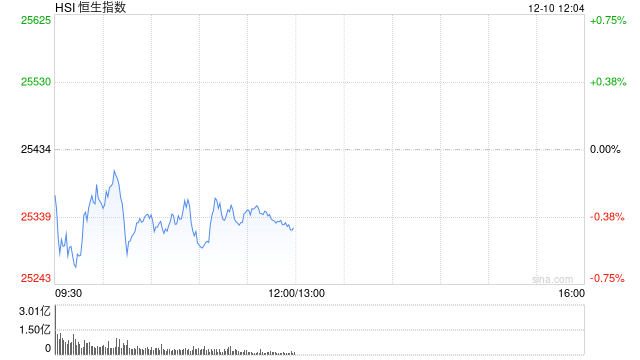
港股午评:恒指跌0.43%,科技股分化,有色金属股齐涨,海运股大跌
Ge Long Hui· 2025-12-10 04:04
Core Viewpoint - The Hong Kong stock market continues to show weakness, with major indices experiencing declines for three consecutive days, indicating a bearish trend in the market [1] Group 1: Market Performance - The Hang Seng Index fell by 0.43%, while the Hang Seng China Enterprises Index decreased by 0.51%, both reflecting a three-day losing streak [1] - The Hang Seng Tech Index declined by 0.68%, showcasing a mixed performance among major tech stocks [1] Group 2: Individual Stock Movements - Meituan's stock rose by 1%, contrasting with Tencent's decline of 1%, highlighting the divergence in performance among key technology companies [1] Group 3: Commodity and Shipping Indices - Precious metals showed strong performance ahead of the Federal Reserve's decision, with silver reaching a historical high and gold and other non-ferrous metal stocks also rising [1] - The Baltic Dry Index (BDI) hit a near two-week low, leading to significant declines in shipping stocks [1] Group 4: Sector Performance - Solar, Chinese brokerage, oil, and domestic bank stocks generally experienced declines, reflecting broader market weakness [1]
机构预计Labubu年销售额或将达到155亿元人民币,较2023年增长41倍
Mei Ri Jing Ji Xin Wen· 2025-12-10 02:29
港股消费ETF(513230)跟踪中证港股通消费主题指数,一键打包互联网电商龙头+新消费,成分股近 乎囊括港股消费的各个领域,包括泡泡玛特、老铺黄金、蜜雪集团等新消费龙头,又包含腾讯、快手、 阿里巴巴、小米等互联网电商龙头,科技+消费属性突出。 (文章来源:每日经济新闻) 12月10日,港股三大指数涨跌不一,恒指开盘微涨,恒科指跌0.04%,国企指数涨0.01%。板块方面, 科网股涨跌不一,航空股高开,黄金股普遍上涨,内房股活跃,宝济药业上市首日涨超129%。港股消 费板块早盘窄幅震荡,港股消费ETF(513230)现小幅微跌近0.2%,持续打开布局通道。持仓股涨跌互 现,古茗、万洲国际、老铺黄金、美团、吉利汽车、名创优品等涨幅居前,思摩尔国际、中国儒意、泡 泡玛特、小鹏汽车、中升控股等跌幅居前。 大摩预计,Labubu今年的销售额将达到155亿元人民币,较2023年增长41倍,但估计增长速度明年放 缓,主要因部分消费者的流失。鉴于较低的广告与推销费用比率、较低的降价幅度、较高比例的线上直 销及较低的租金比率,大摩认为,泡泡玛特能够维持约30%的净利润率增长。德银最新研报指出,为应 对需求激增,泡泡玛特将La ...
“国产英伟达”上市三天后,英伟达H200解禁
吴晓波频道· 2025-12-10 01:49
Core Viewpoint - Nvidia has missed the optimal opportunity to enter the Chinese market, particularly in the AI sector, with the recent approval to sell the H200 chip being a delayed response to changing geopolitical dynamics [2][46]. Group 1: Market Dynamics - The U.S. government has allowed Nvidia to sell the H200 AI chip to China under specific conditions, including limited customer approval and a 25% revenue share with the U.S. government [2][19]. - The release of the H200 coincides with the IPO cycles of domestic GPU companies, such as Moore Threads, which saw a significant stock price increase upon listing [3][4]. - The U.S. has defined China as its primary economic competitor, aiming to restrict China's industrial upgrade to high-end technologies [7]. Group 2: Competitive Landscape - The H200 chip, released in November 2023, boasts nearly double the inference performance of its predecessor, the H100, but is now considered outdated compared to upcoming Nvidia chips [15][16]. - Nvidia's market share in China has drastically declined from 20%-25% to single digits, and it has completely missed the rapid growth phase of China's AI market [16][36]. - Domestic AI chip companies, such as Huawei and Cambrian, have gained significant market share, with Huawei's AI chip market share reaching 40% [34][36]. Group 3: Regulatory Environment - There is significant internal debate within the U.S. regarding the sale of advanced chips to China, with proposed legislation aiming to prioritize U.S. customers over foreign sales [21][24]. - The approval of the H200 was expedited to counteract potential legislative restrictions that could limit chip exports to China [26][27]. Group 4: Market Acceptance and Future Outlook - Despite the H200's entry into the Chinese market, it faces challenges in market acceptance due to the rise of domestic alternatives that are increasingly integrated with local AI models [41][42]. - The existing domestic chips, while not matching Nvidia's top-tier performance, are sufficient for most inference tasks and are preferred for their security and reliability [41][42]. - The demand for Nvidia's chips may surge due to previously unmet orders, but the overall market landscape has shifted, making it less reliant on Nvidia than before [45][46].


12.10犀牛财经早报:全球资金寻找AI“新战场”
Xi Niu Cai Jing· 2025-12-10 01:38
Group 1 - Over 120 new funds are being launched or are about to be launched, focusing on equity funds for high-risk investors and "fixed income +" products for stable investment needs [2] - A-share listed companies have shown increased enthusiasm for establishing industrial merger funds, with 336 funds set up this year, expected to raise a total of 279 billion yuan [2] - Global capital is increasingly targeting Chinese tech stocks, particularly in the AI sector, as international funds seek to diversify and mitigate risks [2] Group 2 - The terminal market is experiencing a cross-industry trend as traditional terminal manufacturers, internet giants, and automotive companies compete for AI "entry points" [3] - The demand for a one-stop smart living experience is driving the need for integrated terminal devices, moving beyond single-function products [3] - The lithium battery industry is entering a new development cycle characterized by long-term agreements, with significant order volumes reported [4] Group 3 - Phosphate rock prices remain high due to a tight supply-demand balance, with prices for 30% grade phosphate rock at 1,016 yuan per ton [4] - The North Exchange market has seen a surge in institutional research interest, with 272 companies being investigated, particularly in sectors like robotics and low-altitude economy [5] - The retail price of Wuliangye's "Pu Wu" has dropped to 949 yuan per bottle, with reports of price inversion in the high-end liquor market [5] Group 4 - Tesla's humanoid robot, Optimus, faced scrutiny after a public demonstration where it fell, raising questions about its autonomy and potential remote control [6] - Tencent has rebranded its large model from "Hunyuan" to "HY" for better market recognition [6] - The Zhejiang Financial Asset Trading Center has faced issues related to the "Xiangyuan system" and its financial products, with significant investor concerns [6]



北航一篇304页的Code Agent综述!近30家机构参与
自动驾驶之心· 2025-12-10 00:04
Core Insights - The article discusses the transformative shift in code intelligence from being an "assistive tool" to becoming an "autonomous developer" driven by advancements in large language models (LLMs) [2][8] - A comprehensive review paper by 28 institutions outlines the evolution of code models and establishes a complete technical framework for intelligent software engineering [2][8] Evolution of Code Intelligence - The evolution of code intelligence spans six distinct phases from manual coding in the 1960s to the anticipated AI autonomous era post-2025, highlighting key technological advancements at each stage [8][9] - The core driving force behind this evolution is the transition from rule-based systems to transformer-based models, enabling significant improvements in code understanding and generation capabilities [9][11] Code Foundation Models - Current mainstream models are categorized into General LLMs and Code-Specialized LLMs, each with unique advantages and technological synergies [11][12] - Code-specialized models have emerged through focused data, architectural innovations, and task-specific fine-tuning, surpassing general models in coding tasks [15][18] Training and Evaluation - The paper outlines a comprehensive evaluation system for code tasks, categorized into statement/function/class-level tasks, repository-level tasks, and intelligent agent system tasks [18][19] - Evaluation metrics have evolved to include execution-based indicators, emphasizing the importance of not just generating code but ensuring its functionality [19][22] Alignment Techniques - Two primary alignment techniques are discussed: Supervised Fine-Tuning (SFT) and Reinforcement Learning (RL), both crucial for ensuring models meet human requirements [22][28] - Various data synthesis methods for alignment tasks are highlighted, including single and multi-round SFT, as well as RL methods that leverage human and AI feedback [25][27] Software Engineering Agents (SWE Agents) - SWE Agents are described as advanced systems capable of autonomously completing complex engineering tasks across the software development lifecycle [31][32] - The paper identifies four key stages of SWE Agents' application: requirements engineering, software development, software testing, and software maintenance [31] Future Trends - The article identifies three core trends for the next 3-5 years: the shift from general to specialized models, increased autonomy of SWE Agents, and the integration of multimodal inputs for enhanced code intelligence [33][34][35] - The ultimate goal of code intelligence is to automate repetitive coding tasks, thereby allowing human developers to focus on higher-level creative tasks [37][38]
百度启动昆仑芯分拆上市评估 能否打破大厂造芯“身份困局”?
Mei Ri Jing Ji Xin Wen· 2025-12-09 14:40
Core Viewpoint - The market is increasingly focused on AI underlying computing power, with Baidu Group announcing plans to evaluate the spin-off and independent listing of its subsidiary Kunlun Chip, which could potentially be submitted for IPO in early 2026 and completed by early 2027 [1][2]. Group 1: Company Overview - Kunlun Chip, originally part of Baidu's AI chip and architecture department, was established as an independent entity in 2021 and has completed multiple rounds of financing, with a valuation of approximately 13 billion yuan in its first round [2][3]. - The company has developed its first-generation AI chip, Kunlun 1, which was launched in July 2018 and achieved mass production in 2020, utilizing Baidu's self-developed XPU architecture [2][3]. Group 2: Market Dynamics - The demand for AI chips in China is surging as the industry is in a rapid growth phase, creating a favorable window for domestic AI chip manufacturers [3]. - Baidu's decision to consider a spin-off aligns with the current industry cycle and Kunlun Chip's development stage, as it has begun external sales and received positive feedback from domestic applications [3][4]. Group 3: Competitive Landscape - The competition in the domestic AI chip market is evolving from a focus on technology to engineering capabilities, ecosystem development, and scalability [4][5]. - Major internet companies in China, including Baidu, Alibaba, and Tencent, are increasingly investing in chip development to reduce costs and ensure supply chain security, with each adopting different strategies for chip development [6][7]. Group 4: Strategic Implications - The spin-off of Kunlun Chip is seen as a strategic move to shed its identity as a Baidu subsidiary, allowing it to compete more effectively in the market [7]. - The trend of large companies developing their own AI chips is common globally, driven by the need to enhance efficiency and meet internal demands, but it also presents challenges in terms of market competition and collaboration [7].

优酷网络故事片最高120%分成,优酷流媒体之争该咋看?
Xin Lang Cai Jing· 2025-12-09 13:35
Core Viewpoint - Youku, a subsidiary of Alibaba's Whale Entertainment Group, announced a new revenue-sharing model for online story films starting January 1, 2026, allowing content providers to receive 100% of membership viewing revenue and an additional 20% incentive through a "new user coefficient," leading to a total revenue share of up to 120% [1][4]. Group 1 - The introduction of the "up to 120% revenue share" policy represents a renegotiation of the revenue structure between platforms and content providers, aiming to reconstruct the ecological incentive mechanism in the long video industry, which is currently facing high investment and low returns [3][6]. - Youku's strategy breaks away from the traditional exclusive copyright monopoly, allowing non-exclusive content to enjoy a 100% base share plus a 20% new user incentive, directly linking content value to user growth [3][6]. - This initiative aligns with the regulatory guidance from the National Radio and Television Administration regarding the new medium-length content format of "online story films" and seeks to carve out a differentiated path in a competitive landscape dominated by iQIYI and Tencent Video [3][6]. Group 2 - The new revenue-sharing model addresses structural contradictions in the streaming media market, where platforms have relied on exclusive copyrights, leading to inflated content procurement costs and deteriorating ROI, while smaller producers struggle with weak bargaining power and long payment cycles [7]. - By adopting a "de-exclusive + effect-oriented" dual approach, Youku aims to reduce its content procurement risks and enhance creator engagement, with the "new user coefficient" dynamically adjusted based on 90-day membership conversion effectiveness [7]. - If successful, this model could enhance Youku's content diversity and user engagement, potentially triggering a chain reaction in the industry, compelling other platforms to follow suit with similar revenue-sharing reforms, thus accelerating the transition of the long video industry from "capital burning" to "ecological win-win" [4][7].

外卖大战刚打完,大厂新一轮「烧钱抢市场」又来了
3 6 Ke· 2025-12-09 12:15
Core Viewpoint - The competition in the AI glasses market is intensifying as major companies like Baidu, Alibaba, and Li Auto launch their products, with Li Auto's Livis glasses selling out quickly after release [1][3]. Group 1: Market Dynamics - Li Auto's AI glasses Livis were launched without pre-sale, directly shipping at a competitive price of 1699 yuan, leading to rapid sell-out within two hours [1]. - Other major players, including Google, Vivo, and Xiaomi, are also exploring AI glasses, with Google reportedly in the POC stage for two products [3][4]. - The entry of various companies into the AI glasses market indicates a significant shift, with many viewing it as a strategic necessity for data collection and user interaction [4][18]. Group 2: Strategic Importance - AI glasses are seen as a critical extension of existing hardware experiences for consumer electronics companies, while for internet giants, they represent a necessary entry point for data collection and model enhancement [4][17]. - Companies like Alibaba and Baidu are aggressively pursuing AI glasses as a strategic product, with Baidu defining it as an S-level strategic initiative [20][22]. - The competition is not just about hardware but also about the underlying data that can be collected through these devices, which is crucial for future AI developments [12][17]. Group 3: Industry Trends - The hardware barrier for entering the AI glasses market has lowered significantly, allowing a wide range of players to participate [25][29]. - The supply chain for AI glasses is rapidly evolving, with companies like Qualcomm and Foxconn involved in production, leading to shorter project cycles and controlled hardware costs [28][29]. - The market is characterized by a "comprehensive competition," where the ability to deliver high-quality products without flaws is essential for success [30].

外卖大战刚打完,大厂新一轮「烧钱抢市场」又来了
36氪· 2025-12-09 10:38
Core Insights - The article discusses the emerging competition in the AI glasses market, highlighting the aggressive strategies of major tech companies like Google, ByteDance, Vivo, Xiaomi, Tencent, and others in developing AI glasses products [4][10][12]. Group 1: Market Dynamics - Major companies are entering the AI glasses market, with Ideal's AI glasses priced at 1699 yuan, leading to rapid sell-out within two hours of launch [6][7]. - Google is reportedly in the POC stage for two AI glasses products, collaborating with Qualcomm, Samsung, and Foxconn for development [9]. - ByteDance is pursuing multiple AI glasses projects, with plans to release a light display version by Q4 next year and a non-display version by Q1 [12][12]. Group 2: Strategic Importance - For consumer electronics companies, AI glasses represent an extension of existing hardware experiences and a strategic defense move [14]. - For internet giants, AI glasses are seen as a necessary entry point to enhance their models and applications, with significant data implications [15][30]. Group 3: Data Collection and Competition - AI glasses are viewed as optimal devices for collecting real-world data, which is becoming increasingly valuable for AI development [22][25]. - The competition in the AI glasses market is fundamentally a data competition, as these devices will serve as data collection points for improving AI models [30]. Group 4: Hardware and Supply Chain - The entry of major players has lowered the hardware barriers, allowing for rapid development cycles and cost control in the AI glasses supply chain [48][52]. - The industry is witnessing a surge in AI glasses prototypes, with a typical timeline of three months for samples, six months for mass production, and nine months for shipping [51]. Group 5: Challenges and Risks - The AI glasses market is characterized by high competition, where any shortcomings in product quality can lead to significant failures [55]. - Previous product launches have faced challenges, such as Xiaomi's first-generation AI glasses experiencing a 40% return rate due to issues like Bluetooth connectivity and chip selection [56].