
吉利汽车

Search documents
1月26日早餐 | 腾讯、百度打响春节AI红包大战
Xuan Gu Bao· 2026-01-26 00:00
Core Viewpoint - The overall sentiment in the market remains optimistic, with a focus on performance and thematic investments, indicating a potential continuation of a "slow bull" market trend [3][4][5]. Market Strategy - Various brokerage strategies suggest that the market is seeing structural changes, with increased capital inflow into sectors like real estate, resource products, and price increase chains [3]. - The focus for the upcoming period includes commercial aerospace and AI applications, as well as sectors with high profit elasticity [3]. - The market is supported by a relatively stable RMB exchange rate and a loose liquidity environment, which is expected to sustain high-elasticity assets [3]. Long-term Outlook - A long-term perspective indicates that the current market is still in the mid-stage of a bull market, with ample room for growth compared to previous bull market peaks [4]. - The risk premium for the CSI 300 index is currently at 5.27%, suggesting that there is still significant investment opportunity [4]. Cloud Computing - Amazon Web Services (AWS) has raised its EC2 machine learning capacity block prices by approximately 15%, breaking a long-standing trend of declining cloud service prices [6]. - This price increase is expected to benefit cloud computing and related service providers, indicating a potential valuation restructuring in the sector [6]. Semiconductor Industry - Samsung Electronics has raised NAND flash memory prices by over 100% in Q1 2023, highlighting severe supply-demand imbalances in the semiconductor market [8]. - This price increase is part of a broader trend of rising prices in the storage industry, driven by structural shortages and increased demand from AI technologies [8]. Gene Sequencing and Health - The Nipah virus outbreak in India has prompted health screenings at international airports in Thailand, indicating a heightened focus on health monitoring and potential impacts on the healthcare sector [9]. New Stock Offerings - North Star Life Sciences is set to launch an IPO on the Sci-Tech Innovation Board at a price of 17.52 yuan per share, with a subscription threshold of 90,000 yuan [11]. Company Announcements - Hunan Gold expects a net profit of 1.27 billion to 1.608 billion yuan for 2025, driven by rising sales prices of gold, antimony, and tungsten products [12]. - YJ New Materials plans to acquire 100% of Aokening Qinhuangdao and 95% of Aokening Kunshan, focusing on aluminum plate production [12]. - Xian Dao Intelligent anticipates a net profit of 1.5 billion to 1.8 billion yuan for 2025, reflecting a significant increase in orders due to rising production rates among major battery companies [13]. - Zhongwei Company expects a net profit of 2.08 billion to 2.18 billion yuan for 2025, indicating a growth of approximately 28.74% to 34.93% [14].


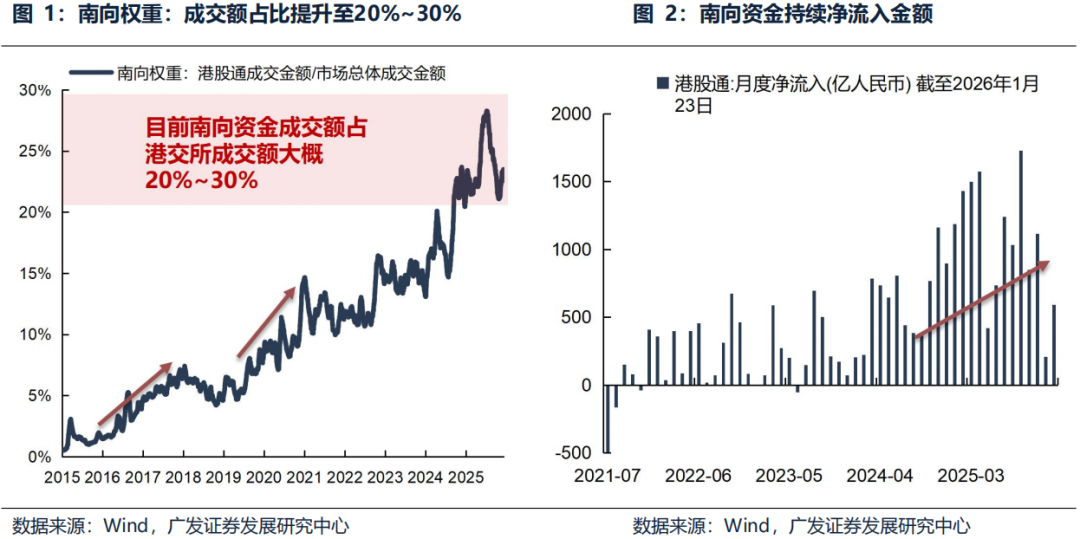
广发策略:从不买就跑输到买了就跑输——再看南下定价权
智通财经网· 2026-01-25 23:38
Group 1 - Since September 2024, the proportion of southbound capital transactions has rapidly increased to 20%-30%, nearly doubling compared to before 2024 [2][5] - In 2025, both active and passive foreign capital have become synchronous indicators of the Hong Kong stock market, showing no leading characteristics [2][5] - During sharp declines or corrections in the Hong Kong stock market, southbound capital tends to buy against the trend [2][5] Group 2 - Each round of pricing power competition typically begins with the optimization of the Stock Connect policy or the influx of incremental capital, which usually flows into dividend and scarce assets [5] - Net outflows of southbound capital often occur in response to adverse industry policies or external macroeconomic environments, particularly in sectors where foreign capital pricing power is increasing, such as software services, hardware equipment, consumer services, and discretionary retail [5][12] - Industries less likely to experience significant net outflows include those favored by long-term capital, such as banking, telecommunications, and public utilities, unless there are clear adverse policies affecting the sector [5][12] Group 3 - The proportion of medium to long-term capital in the current round of southbound capital inflow into Hong Kong stocks has increased, with insurance capital making 41 stakes, 35 of which are in H-shares, marking the highest record in the past decade [8] - Key industries for increased holdings include discretionary retail, finance (banking, insurance), innovative pharmaceuticals, software services, and hardware equipment [8] Group 4 - Current industries with pricing power for southbound capital and Chinese capital include semiconductors and dividend stocks, while industries lacking pricing power include internet, hardware equipment, software services, home appliances, and media [11][12] - Active management public funds have low pricing power in the Hong Kong stock market, focusing heavily on AI-related CSP giants, electronics, and innovative pharmaceuticals [16]
吉利官宣:全固态电池首个Pack即将下线
DT新材料· 2026-01-25 16:05
同年6月,浙江绿色智行科创有限公司成立,聚焦固态电池等8大方向攻关,明确"3-5年实现核心材料量产与 电芯示范应用"的目标。 2023年1月,绿色智行启动固态电池实验室设计建设招标,强化核心材料与电芯技术研发能力。 2023年6月,"固态电池联合实验室建设项目"启动并逐步取得阶段性成果。 2023年10月,耀宁新能源发布S+研发战略,确立三大核心创新领域,为中试转化明确技术方向。 2. 小试突破期(2023-2024年):电芯制备与性能达标 【DT新材料】 获悉,1月22日, 吉利控股集团 战略解析会在北京举行。会上,吉利控股正式宣布: 2026 年,吉利自研全固态电池将完成首个Pack下线,并进行装车验证。 据悉,吉利固态电池项目主要依托两大核心载体推进,分别为 浙江绿色智行科创有限公司 (吉利100%控 股)与 湖州耀宁固态电池研究院 ,形成"工艺放大验证+全流程研发"的双中试平台格局。 吉利将硫化物固态电解质作为核心研发方向 ,目前自研硫化物固态电解质电导率已突破7mS/cm,达到行业 头部水平,该路线具备高离子电导率、与电极兼容性好的优势,为电池能量密度提升与快充能力优化提供 基础。 同时,通过耀宁固 ...

多家车企推出7年车贷!我国新能源充电设施突破2000万!德国启动电动车购车补贴!银河V900、新款宝马i3上市!丨一周大事件
电动车公社· 2026-01-25 16:01
New Car Launches - Geely Galaxy V900 launched with a price range of 309,800 to 369,800 yuan, offering three models [1][3] - Leado L90 "Ma Dao Cheng Gong" version launched with a price range of 296,800 to 316,800 yuan, with rental options starting at 210,800 yuan [10][12] - New BMW i3 launched with a price range of 278,000 to 338,000 yuan, featuring significant configuration upgrades and a price reduction of 75,900 yuan [15][19] Company Dynamics - Renault Group aims for over 2.336 million vehicle sales in 2025, a year-on-year increase of 3.2% [26][27] - Toyota targets 1.7804 million vehicle sales in China for 2025, marking a 0.2% year-on-year growth, ending a four-year decline [30][31] - Hongqi has initiated vehicle testing for its solid-state battery technology, marking a significant step in battery innovation [34][35] Domestic News - China's electric vehicle charging infrastructure has surpassed 20 million units, with 4.717 million public and 15.375 million private charging facilities [55][57] International News - Germany has reintroduced electric vehicle purchase subsidies, ranging from 1,500 to 6,000 euros, applicable to both domestic and Chinese brands [58][60]

如何解读“良苦用心”——A股一周走势研判及事件提醒
Datayes· 2026-01-25 14:42
Market Overview - The market experienced a significant net outflow of 323.7 billion, reversing the previous trend of continuous net inflow, with ETFs accounting for a major portion of this outflow at 325.2 billion [1] - The trading volume of major broad-based index ETFs reached a historical high of 152.5 billion on January 23 [1] ETF Analysis - East Wu Securities interprets the current market as a need to stabilize the index and repair volatility, noting that the 20-day volatility index for the Shanghai Composite Index reached 95.2, indicating a need for a correction [3] - Citic Securities suggests that the rapid reduction of broad-based ETF holdings is primarily due to profit-taking in a strong market environment, rather than a direct impact on the overheating of small-cap stocks and thematic trading [5] - The remaining holdings in major ETFs include approximately 647 billion in the CSI 300 ETF and around 236 billion in the ChiNext ETF, indicating substantial institutional investor presence with about 1 trillion in total ETF holdings [5][6] Fund Management Insights - In Q4, active equity funds significantly increased their positions in resource sectors, with a record allocation of 13.3% in resource stocks, particularly in non-ferrous metals and basic chemicals [14] - Approximately 40% of existing active equity funds have net values exceeding their highs from 2020-2022, indicating a strong recovery among mid to high net worth individuals [8] Industry Trends - The commercial aerospace sector is gaining momentum, with significant developments such as the completion of the listing guidance for Zhongke Aerospace and advancements in reusable rocket technology by SpaceX [22][23] - The semiconductor industry is highlighted as a key area for investment, with expectations of continued growth driven by demand for AI applications and advanced manufacturing technologies [20][21] Commodity Market - Precious metals have seen a substantial increase, with gold prices reaching 4,991.4 USD/ounce, marking the largest weekly percentage gain since 2020, while silver prices also hit record highs [34] - The copper price has rebounded to 13,000 USD, nearing its earlier monthly peak, indicating strong demand in the commodities market [34] A-Share Market Performance - The A-share market saw a net inflow of 82.8 billion, with the top sectors attracting capital being electric equipment, non-ferrous metals, and basic chemicals [41] - Northbound trading volume decreased to 1.69 trillion, down from 2 trillion the previous week, reflecting a shift in investor sentiment [42]
周观点 | 特斯拉计划2027年销售机器人 关注机器人板块【国联民生汽车 崔琰团队】
汽车琰究· 2026-01-25 13:40
Market Performance - The automotive sector outperformed the market this week, with a 2.6% increase in A-share automotive stocks from January 19 to January 25, ranking 14th among Shenwan sub-industries, compared to a decline of 0.6% in the CSI 300 index [1] - Sub-sectors such as automotive services, commercial vehicles, automotive parts, motorcycles, and others saw increases of 6.9%, 4.8%, 4.0%, 1.4%, and 0.7% respectively, while passenger vehicles decreased by 1.4% [1] Investment Recommendations - Recommended core stocks include Geely Automobile, Xpeng Motors, BYD, Bertley, Top Group, New Spring Co., and Chunfeng Power [2] - For passenger vehicles, Geely, Xpeng, and BYD are recommended, with Jianghuai Automobile suggested for attention [5] - In the parts sector, recommendations include Bertley and Horizon Robotics for intelligent driving, and Top Group and New Spring Co. for new forces in the industry chain [5] - For motorcycles, recommended companies are Chunfeng Power and Longxin General [6] - In the tire sector, SAILUN and Senqilin are recommended [7] - For commercial vehicles, recommended companies include Weichai Power and China National Heavy Duty Truck for heavy trucks, and Yutong Bus for passenger vehicles [8] Strategic Collaborations - Changan Automobile signed a comprehensive strategic cooperation agreement with Midea Group to deepen the "people-car-home" smart ecosystem collaboration, allowing users to control 20 types of Midea smart appliances via voice and to check vehicle status remotely [4][11] Robotics Sector Insights - Tesla plans to sell humanoid robots to the public by 2027, with deliveries to enterprises expected to start in the second half of 2026. This development is anticipated to catalyze the robotics sector [3][10] - The focus is on the production and technological iteration of Tesla's robots, with domestic manufacturers like Yushutech expected to enter the IPO phase soon, which could serve as a strong catalyst for the sector [3][10] - Key hardware segments such as dexterous hands and lightweight components are expected to see significant changes, and the valuation of leading automotive robotics manufacturers is anticipated to undergo reconstruction [3][10][23] Policy and Market Trends - The new national subsidy policy for 2026 aims to stimulate demand by extending the scope of vehicle replacement subsidies, which is expected to improve the structure of subsidized models [12][18] - The subsidy for scrapping and replacing vehicles will be based on a percentage of the vehicle price, with electric vehicles receiving up to 20,000 yuan and fuel vehicles up to 15,000 yuan [14][16] - The overall discount rate for vehicles in December 2025 increased compared to November, indicating a competitive market environment [53][54] Motorcycle Market Dynamics - The sales of motorcycles above 250cc reached 69,000 units in December 2025, showing a year-on-year increase of 1.8% and a month-on-month increase of 12.9% [30] - The domestic sales of motorcycles above 250cc in December were 28,000 units, up 32.8% year-on-year, while exports showed a decline [31] Heavy Truck Market Recovery - The heavy truck market saw sales of approximately 95,000 units in December 2025, a year-on-year increase of about 13%, supported by the expanded scope of the vehicle replacement subsidy policy [34] - The average subsidy for scrapping and updating eligible trucks is 80,000 yuan, which is expected to stimulate demand significantly [34][36]





荣耀、倍思、努比亚等50+品牌签约速卖通品牌出海;《明日方舟:终末地》全球公测,阿里云提供技术支撑丨36氪出海·要闻回顾
36氪· 2026-01-25 13:30
Core Viewpoint - The article highlights the significant growth and strategic partnerships in the cross-border e-commerce and technology sectors, particularly focusing on brands expanding into overseas markets and the increasing demand for innovative technologies in various industries [4][5][6]. Group 1: Brand Expansion and E-commerce Growth - Over 50 leading brands, including Honor, Baseus, and Nubia, have signed with AliExpress for the "Super Brand Outbound Plan" to accelerate their overseas market expansion, particularly in high-value categories like consumer electronics and smart home devices [4]. - TikTok Shop in Southeast Asia is projected to double its GMV by 2025, with daily GMV increasing by 90% year-on-year, indicating a strong consumer upgrade trend in the region [5][6]. - Cainiao's global overseas warehouse is expected to see a 32% year-on-year increase in order processing volume by 2025, with operations in over 40 overseas warehouses across 18 countries [8]. Group 2: Technological Innovations and Collaborations - Eagle Network's new game "Arknights: End of the World" has launched globally, supported by Alibaba Cloud to handle high concurrency demands during the launch [4]. - NineSight has initiated Malaysia's first autonomous vehicle testing project in collaboration with local postal services, showcasing the company's expansion into Southeast Asia [7]. - Baidu's "LuoBo Kuaipao" has launched a fully autonomous driving service in Abu Dhabi, marking its first overseas public service deployment [8]. Group 3: Investment and Market Trends - Zhongke Kelan has completed a multi-million angel round financing to accelerate its biodegradable plastic products' overseas expansion, targeting applications in ecological agriculture and marine environments [10]. - Yanhe Technology has secured nearly 100 million yuan in A1 round financing to enhance its global market presence and production capabilities for perovskite batteries [11]. - The overseas micro-short drama market is expected to exceed $5 billion by 2026, with Chinese apps capturing 90% of the market share [12][13].

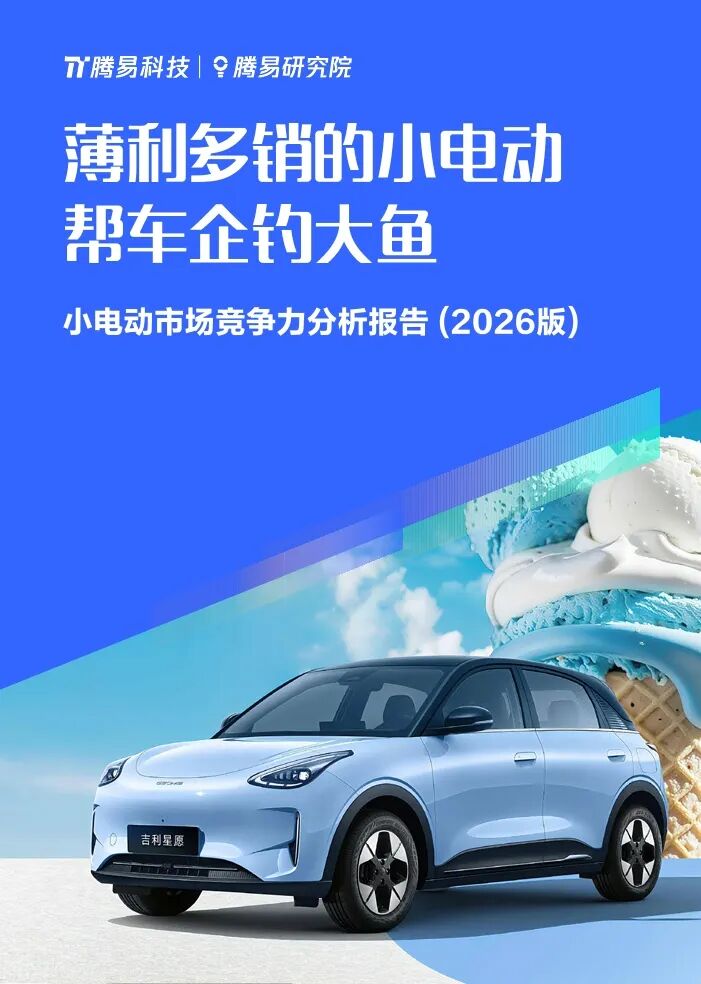
腾易:薄利多销的小电动帮车企钓大鱼:小电动市场竞争力分析报告(2026版)
Xin Lang Cai Jing· 2026-01-25 13:14
Core Insights - The core insight of the article is that the sales of small electric vehicles (EVs) in China have surged from less than 500,000 units in 2020 to over 3 million units by 2025, with Chinese brands being the primary beneficiaries, capturing nearly 96% of the market share in this segment [4][6][95]. Group 1: Market Growth - From 2020 to 2025, the sales of small electric vehicles in China increased more than sixfold, with their market share rising from less than 3% to over 14% of total passenger vehicle sales [6][95]. - The contribution of small electric vehicles to the overall market has been significant, accounting for over 10% of the market sales and helping to boost the market share of Chinese brands from over 30% to more than 60% [6][95]. Group 2: Brand Performance - Chinese brands have been the sole beneficiaries of the small electric vehicle boom, maintaining a sales ratio of over 90%, which is expected to approach 96% by 2025 [6][95]. - Notable Chinese brands such as Wuling and Geely have experienced a rebound in sales due to their small electric vehicle offerings, with Geely's sales projected to reach nearly 2 million units by 2025 [11][13]. Group 3: User Demographics and Preferences - By 2025, nearly 60% of small electric vehicle users will come from households that previously owned foreign brands, with over 80% of these users being female [25][33]. - The satisfaction and recommendation rates for small electric vehicles are higher than the overall market, indicating a positive shift in consumer perception towards Chinese brands [33][36]. Group 4: Competitive Landscape - As of January 2026, major foreign brands like Volkswagen and Toyota have struggled to respond effectively to the rise of Chinese small electric vehicles, lacking systematic strategies to counter this trend [12][103]. - The article suggests that if the sales of small electric vehicles continue to approach 5 million units and capture over 20% market share by 2030, foreign brands will face significant challenges [12][103]. Group 5: Strategic Implications - The rise of small electric vehicles has not only created new market opportunities for Chinese brands but has also disrupted the traditional user upgrade ecosystem established by foreign brands [55][62]. - The article emphasizes the importance of viewing small electric vehicles as a key component in building a user upgrade ecosystem rather than merely low-margin products [55][68].
整车有望反弹,零部件仍聚焦新产业方向:汽车行业周报(20260119-20260125)-20260125
Huachuang Securities· 2026-01-25 13:12
Investment Rating - The report maintains a "Buy" recommendation for the automotive sector, indicating a potential rebound in vehicle sales in the first quarter driven by retail and export growth [3][4]. Core Insights - The automotive sector is expected to see a rebound in vehicle sales, particularly in the first quarter, with catalysts from retail and export activities. The focus for auto parts remains on new industries such as intelligent driving, robotics, and liquid cooling technologies [3][4]. - Traditional automotive stocks have shown relative stability in prices, while the robotics sector is expanding into second-tier markets [3]. - The report highlights significant growth in new energy vehicle deliveries, with companies like NIO and Li Auto showing notable month-on-month increases [6][7]. Data Tracking - In early January, the discount rate for traditional vehicles remained stable at 9.6%, with an average discount amount of 22,259 yuan, reflecting a year-on-year increase of 2,192 yuan [5]. - December saw a decline in wholesale and retail sales of passenger vehicles, with wholesale sales down 8.7% year-on-year and retail sales down 16.8% [5][6]. - New energy vehicle deliveries in December showed a mixed performance, with BYD delivering 420,398 units (down 18.3% year-on-year) while NIO and Li Auto reported significant increases in deliveries [6][7]. Industry News - The report notes that the German government announced subsidies of up to 6,000 euros for families purchasing new electric vehicles to boost the domestic electric vehicle industry [10]. - The report also mentions that the Chinese government is implementing policies to promote the replacement of old vehicles and appliances, which is expected to enhance the automotive market [10][30]. - Geely's new MPV model, the Galaxy V900, was launched with a price range of 269,800 to 329,800 yuan, featuring advanced AI capabilities [30].


2025年度乘用车品牌影响力指数发布 自主品牌全面崛起引领格局重塑
Zheng Quan Ri Bao Wang· 2026-01-25 12:53
Core Insights - The 2025 China Passenger Car Brand Influence Index report reveals significant changes in brand influence within the Chinese automotive market, highlighting the dominance of domestic brands like Geely, BYD, and AITO in terms of technological advancements and user reputation [1] Group 1: Brand Performance - Geely ranks first with a comprehensive influence score of 810.96, supported by a brand network voice of 1.106 million and market sales of 2.081 million vehicles, showcasing its dual strength in communication and market presence [2] - BYD follows closely with a score of 802.90, demonstrating its leadership in the new energy sector with sales of 3.105 million vehicles and a high positive sentiment rate of 99.18% [2] - Tesla China maintains third place with a score of 798.53, leveraging its unique brand premium and media presence [3] Group 2: Emerging Brands and Technology - AITO stands out with a network voice of 2.7863 million and a user voice share of 93.34%, driven by Huawei's technological support, marking a significant breakthrough in the high-end market [4] - Traditional automakers are also launching competitive new energy sub-brands, with Geely's Galaxy series rapidly increasing sales and becoming a core growth driver [4] Group 3: Challenges for Joint Ventures - Traditional joint venture brands face pressure from the rise of domestic brands, leading to a critical phase of adjustment and strategic transformation [5] - Despite maintaining a strong market position, brands like SAIC Volkswagen and FAW-Volkswagen show signs of fatigue in user engagement and satisfaction compared to their domestic counterparts [5][6] - The need for accelerated local development of electric products and better alignment with Chinese consumer preferences is crucial for sustaining brand influence [6]