蔚来

Search documents
国内首个不锈钢火箭超级工厂开工拟年产25发;日本欲打造本土版“星链”系统;机构:内存市场已进入“超级牛市”——《投资早参》
Mei Ri Jing Ji Xin Wen· 2026-01-08 00:23
Market News - The U.S. stock market closed mixed, with the Nasdaq up 0.16%, while the S&P 500 and Dow Jones fell by 0.34% and 0.94% respectively. Major tech stocks mostly rose, with Intel increasing over 6% and Google rising more than 2%. Google's market capitalization reached $3.89 trillion, surpassing Apple's $3.85 trillion for the first time since 2019 [1] - International oil prices continued to decline, with WTI crude oil down 1.44% at $56.31 per barrel and Brent crude down 0.61% at $60.33 per barrel. Precious metals also saw a decrease, with spot gold down 0.92% at $4453.34 per ounce and silver down 3.8% at $78.16 per ounce [2] Industry Insights - Arrow Technology's large liquid carrier rocket assembly and recovery reuse base project commenced in Hangzhou, with a total investment of 5.2 billion yuan. This is China's first offshore recovery reusable rocket production base, expected to have an annual production capacity of 25 rockets [3] - Japan is developing a "Japanese version of Starlink" to establish a low-orbit satellite constellation for autonomous communication services, enhancing domestic control over communication networks [3] - The satellite communication industry is projected to exceed 200-400 billion yuan by 2030, with an annual compound growth rate of 10%-28%. This sector is transitioning from "concept verification" to "scale application," becoming a key driver for high-quality digital economic development [4] - The memory market has entered a "super bull market," surpassing historical highs from 2018. Prices for 64GB RDIMM memory are expected to rise significantly, with projections of a 40%-50% increase by Q4 2025 and another 40%-50% by Q1 2026 [4][5] - The postal industry plans to promote the application of unmanned delivery technologies by 2026, including the use of drones and automated sorting systems, to enhance logistics capabilities and support green development [6][7] Company Updates - Desay SV Automotive announced that its largest shareholder, Desay Group, plans to reduce its stake by up to 710,625 shares, representing no more than 1.19% of the company's total shares [8] - New Link Electronics plans to reduce its shares by up to 25.02 million, or 3% of its total shares, through various trading methods [8] - Yili Group's chairman plans to reduce his stake by up to 62 million shares, accounting for 0.98% of the total shares, with proceeds used to repay financing loans [10]
美股涨跌不一,英特尔涨超6%,谷歌市值超苹果,中概指数跌1.58%
Ge Long Hui· 2026-01-08 00:20
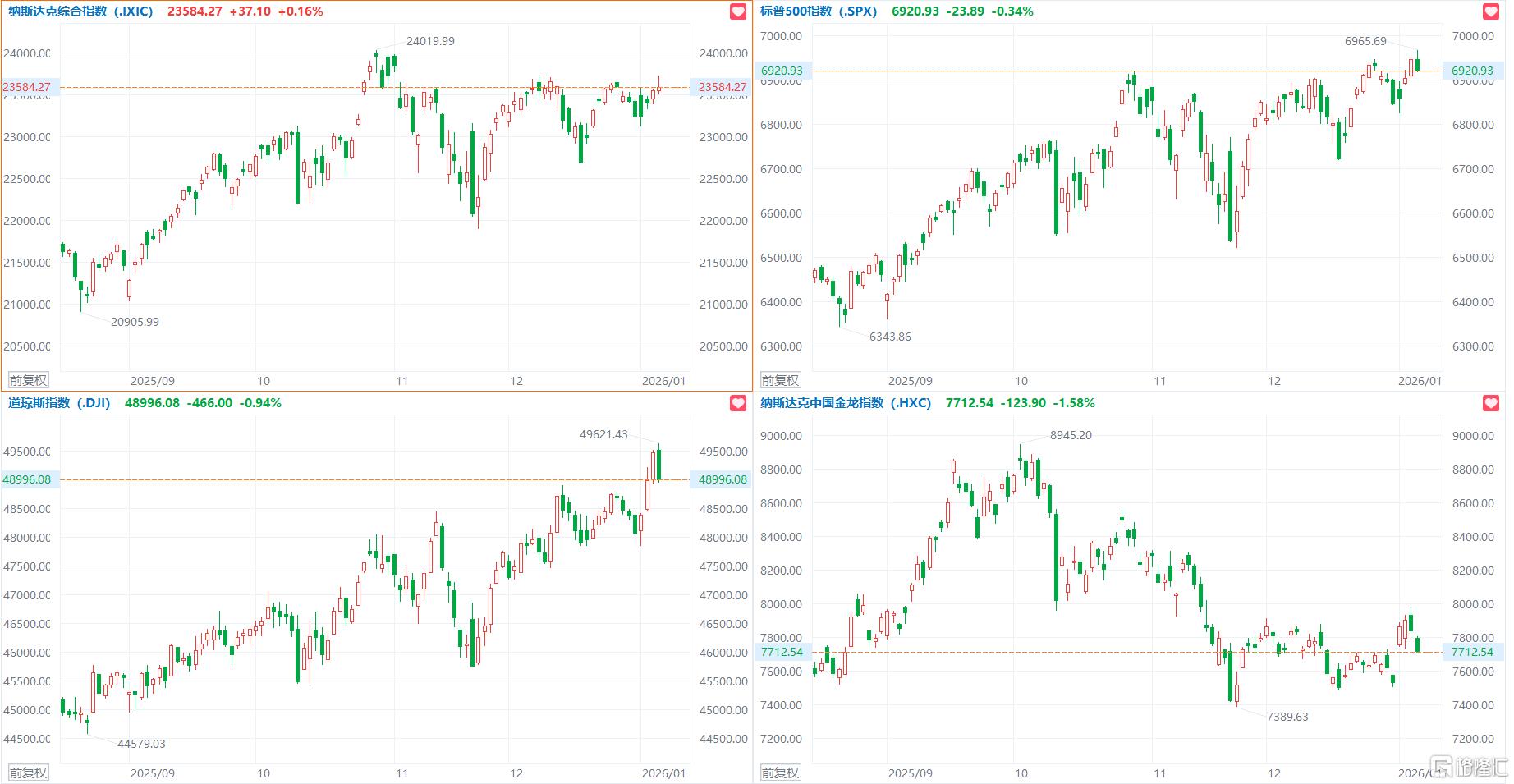
美股三大指数收盘涨跌不一,纳指涨0.16%,标普500指数跌0.34%,道指跌0.94%。大型科技股多数上涨,英特尔涨超6%,谷歌涨逾2%,微软、英伟达涨超 1%,亚马逊小幅上涨;Meta跌逾1%,苹果、特斯拉小幅下跌。其中,谷歌市值达到3.89万亿美元,超过苹果公司的3.85万亿美元,为2019年以来首次。 国防军工股NORTHROP GRUMMAN股价收跌超5%,洛克希德马丁跌近5%,此前特朗普向国防承包商回购股票的做法发出威胁。黑石跌超5%,特朗普称, 将在达沃斯演讲中讨论住房问题,将禁止大型投资者购买独栋住宅。 纳斯达克中国金龙指数收跌1.58%,热门中概股中,新东方收涨0.4%,百度涨0.3%,蔚来涨0.1%,拼多多、小米、腾讯音乐、京东、美团跌超1%,阿里巴 巴跌2.6%,网易跌3%。 ...

8点1氪丨和府捞面否认是预制菜;雷军称绝对不能容忍任何诋毁诅咒车主的KOL;乔布斯私人物品Apple I原型机被拍卖
3 6 Ke· 2026-01-08 00:04
Group 1: Memory Prices and Market Impact - The price of memory modules is surging, with some units exceeding 40,000 yuan, and a box of 100 units could cost nearly 500 million yuan, comparable to the price of a house in Shanghai [1][3] - The global demand for AI computing power is causing a severe shortage in memory semiconductors, leading to significant price increases [3] - Companies like Samsung and Hynix have announced price hikes for DRAM products, with increases expected to be between 60% to 70% in Q1 compared to Q4 of the previous year [3] Group 2: Automotive Industry Developments - NIO's CEO Li Bin indicated that rising memory prices are creating cost pressures for the automotive industry, suggesting consumers consider purchasing vehicles sooner [3] - ByteDance has denied rumors about entering the automotive sector, clarifying that there are no plans to manufacture cars [3] - Changan Automobile refuted claims regarding the cancellation of year-end bonuses, asserting that the company is maintaining its incentive plans based on performance [6] Group 3: Corporate Leadership Changes - Berkshire Hathaway has increased the salary of its new CEO Greg Abel to $25 million, which is 250 times higher than Warren Buffett's long-standing salary of $100,000 [9] - Lenovo announced a collaboration with NVIDIA to launch an "AI Cloud Super Factory," aimed at enhancing AI deployment capabilities [7] Group 4: Regulatory Developments - The State Administration for Market Regulation and the National Internet Information Office released the "Regulations on the Supervision of Online Trading Platform Rules," aimed at regulating platform rules and protecting consumer rights [4] - The market regulator has adjusted the certification model for certain products, shifting from self-declaration to third-party certification for 16 types of products, including electric tools and automotive safety components [9] Group 5: Technology and Innovation - Intel is developing a dedicated gaming platform with custom chips to enhance its presence in the portable gaming device market [13] - OpenAI has introduced a new feature for ChatGPT that allows users to analyze medical test results and receive health guidance, marking a significant step into the healthcare sector [17] - Microbotics has successfully completed the world's first "large model autonomous surgery" animal experiment, pushing the boundaries of AI in the medical field [18]



蔚来第100万辆量产车下线 李斌称有信心实现单季盈利
Chang Jiang Shang Bao· 2026-01-08 00:03
Core Viewpoint - NIO has achieved a significant milestone by producing its one-millionth vehicle, marking the beginning of a new phase focused on high-quality growth and aiming for annual growth rates of 40%-50% [2][5] Group 1: Production and Delivery Milestones - On January 6, NIO's one-millionth vehicle, a green ES8, rolled off the production line at its Hefei factory, representing a key milestone in the company's development [2][3] - In 2025, NIO delivered a record 326,000 vehicles, a year-on-year increase of 46.9%, with the NIO brand contributing 178,800 vehicles, the Lido brand 107,800 vehicles, and the Firefly brand 39,400 vehicles [4] Group 2: Financial Performance and Profitability Outlook - NIO reported a revenue of 52.837 billion yuan for the first three quarters of 2025, a year-on-year increase of approximately 15%, but incurred a net loss of 15.693 billion yuan [7] - The company aims to achieve profitability in the fourth quarter of 2025, with confidence stemming from the strong performance of the new ES8 model, which has a high gross margin [6][7] Group 3: Strategic Goals and Market Position - NIO's CEO Li Bin outlined the company's strategic goals, including a commitment to technological leadership, infrastructure development, and maintaining a strong market presence in China and globally [5][8] - The company anticipates that by 2030, the penetration rate of new energy vehicles in China will exceed 90%, with pure electric vehicles making up at least 80% of that figure [8] Group 4: Partnerships and Collaborations - NIO has signed a five-year strategic cooperation agreement with CATL to enhance collaboration in technology, ecology, and market promotion, focusing on battery longevity and battery swap technology [8][9]

存储价格飙升背后的博弈:云服务厂商“财大气粗” 支付溢价超手机厂商50%至60%
Mei Ri Jing Ji Xin Wen· 2026-01-07 23:57
Core Insights - The storage industry is experiencing a significant price surge, primarily driven by the increased demand for AI computing power, leading to a severe supply-demand imbalance [1][8] - Major storage manufacturers like Samsung, SK Hynix, and Micron are reallocating production capacity towards HBM and DDR5, which is squeezing the supply of older memory types like DDR4 [1][8] - Cloud service providers are aggressively purchasing storage, accepting higher prices, and are willing to pay a premium of 50% to 60% over mobile manufacturers [2][8] Price Trends - The memory market has entered a "super bull market," surpassing historical highs from 2018, with suppliers' bargaining power at an all-time high [9] - Counterpoint Research forecasts memory prices to rise by 40% to 50% in Q4 2025 and again by 40% to 50% in Q1 2026, with an additional 20% increase expected in Q2 2026 [3][9] - The rising memory costs are impacting the Bill of Materials (BoM) for hardware manufacturers, with memory costs potentially exceeding 20% for flagship models [10][9] Supply Chain Dynamics - The supply of NAND Flash is tightening, with delays reported by manufacturers like Transcend due to supply chain issues from major suppliers [11] - New factory constructions by storage manufacturers will take at least two years to complete, meaning supply constraints are expected to persist until late 2027 [5][11] - The forecast for global smartphone production has been downgraded from a 0.1% increase to a 2% decrease for 2026 due to rising memory prices [12] Demand Projections - Demand for DRAM and NAND Flash in general and AI servers is projected to grow significantly, with a 20% increase in DRAM demand and a 19% increase in NAND Flash demand for general servers in 2026 [13] - AI server demand for LPDDR is expected to grow by 15%, while NAND Flash demand is anticipated to surge by over 70% [13] - The current cycle in the storage industry is expected to last longer than previous cycles, driven by the financial strength and resilience of cloud service providers [14]

多家车企公布2026销量目标
智通财经网· 2026-01-07 22:35
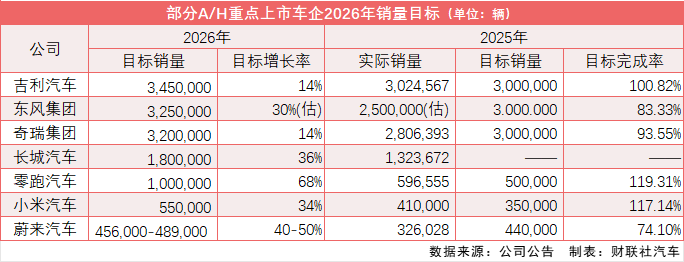
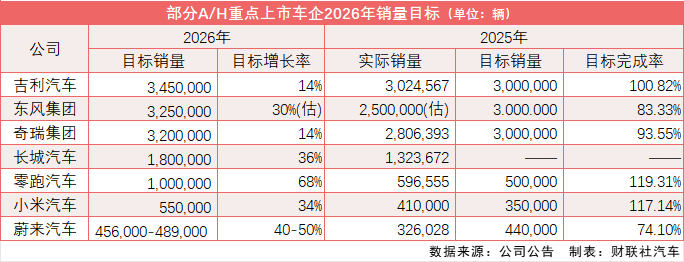
已连续多年未达成年度目标的长城汽车,下调了2026年员工持股计划业绩考核目标,将原计划中2026年 的汽车销量考核目标从不低于249万辆下调至不低于180万辆,较去年实际销量增长36%;净利润考核目 标(不低于100亿元)保持不变。 新能源汽车购置税减半政策的实施及"两新"补贴政策的调整延续,为2026年国内汽车市场带来了新的变 量。 在此背景下,多家车企相继披露的2026年销量目标呈现出截然相反的走势——尚处于全面智电转型、且 背负较大燃油车时代存量资产、销量基数较大的传统车企普遍给出了较为审慎的增长目标,而新造车企 业对市场估计则更为乐观。其中,在2025年均超额完成KPI的零跑、小米汽车今年销量目标的增幅分别 达到68%和34%;意欲在2026年实现全年盈利的蔚来汽车,年度目标增幅同样高达40-50%。 | | | 部分A/H重点上市车企2026年销量目标(单位:辆) | | | | | --- | --- | --- | --- | --- | --- | | 公司 | 2026年 | | 2025年 | | | | | 目标销量 | 目标增长率 | 实际销量 | 目标销量 | 目标完成率 | | 吉 ...



多家车企公布2026销量目标
财联社· 2026-01-07 16:07
Core Viewpoint - The implementation of the half-price purchase tax policy for new energy vehicles and the continuation of the "two new" subsidy policy have introduced new variables for the domestic automotive market in 2026, leading to divergent sales targets among traditional and new car manufacturers [2]. Group 1: Traditional Automakers - Geely has set the highest sales target for 2026 at 3.45 million units, with a growth rate of 14%, including 2.75 million units for the Geely brand, 300,000 for Zeekr, and 400,000 for Lynk & Co [4]. - Dongfeng Group aims for a total sales target of 3.25 million units in 2026, with an estimated growth rate of over 30%, including 1.7 million units for new energy vehicles, representing a 63% increase [5]. - Chery Group has set a target of 3.2 million units for 2026, reflecting a 14% growth compared to 2025, with a total of 2.806 million units sold in 2025 [5]. - Great Wall Motors has lowered its 2026 sales target from at least 2.49 million to at least 1.8 million units, indicating a 36% increase from last year's actual sales [5][6]. Group 2: New Car Manufacturers - Leap Motor has set an aggressive target of 1 million units for 2026, following a record sales performance in 2025 [7]. - Xiaomi aims for a sales target of 550,000 units in 2026, a 34% increase from the previous year, with new models expected to launch [7]. - NIO has set a target of 456,000 to 489,000 units for 2026, with a growth rate of 40-50%, supported by the introduction of several new models [8]. Group 3: Market Outlook - The automotive market is expected to experience a "front low and back high" trend in 2026, with overall growth driven by favorable national policies [9]. - The continuation of the vehicle replacement subsidy policy is anticipated to mitigate the impact of the half-price purchase tax policy, providing a stabilizing effect on market growth [8][9].

特斯拉吹响号角,2026年新能源汽车竞赛进入下一轮
Xin Lang Cai Jing· 2026-01-07 12:53
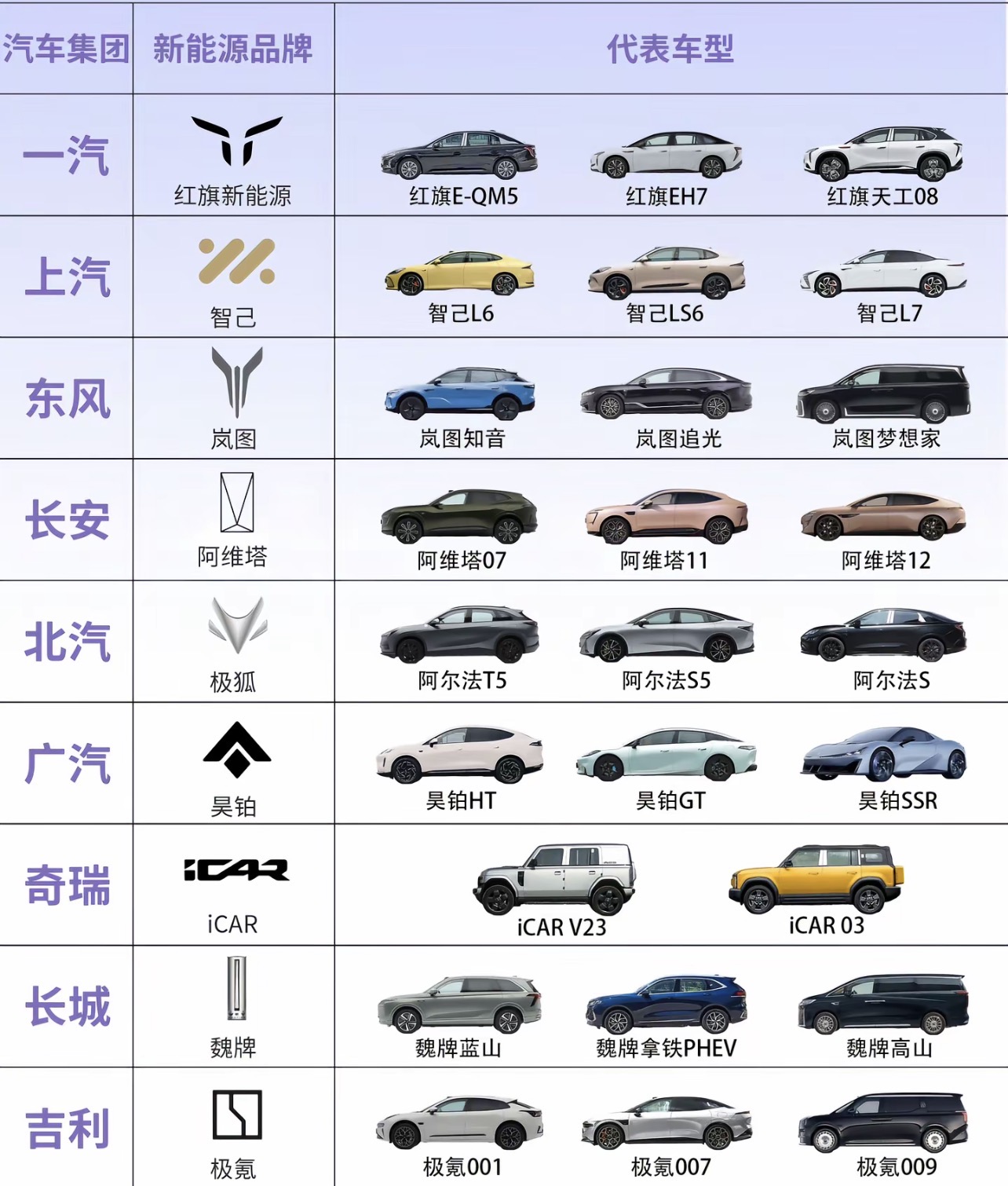
Core Insights - The new energy vehicle (NEV) industry in 2025 has shown a clear division between leading brands and those lagging behind, with a notable performance from new entrants like Leap Motor, Hongmeng Zhixing, and Xiaopeng, which have solidified their positions in the first tier of the market [2][5][6] - Traditional automakers' second-generation brands, such as Deep Blue, Zhiji, and Avita, despite having strong backing, have struggled to compete and remain in the second tier [2][5] Market Performance - In 2025, the top three new car brands were Leap Motor (596,555 units, +103%), Hongmeng Zhixing (589,107 units, +32%), and Xiaopeng (429,445 units, +126%) [5][7] - Other notable brands included Xiaomi Auto (over 411,625 units), Li Auto (406,343 units), and Deep Blue (333,117 units) [5][7] - The bottom performers were Avita (128,772 units), Zhiji (81,000 units), and Deep Blue (150,169 units), with Zhiji being the only brand with sales below 100,000 units [6][7][8] Competitive Landscape - The NEV market is transitioning from growth to intensified competition, with a resurgence of price wars as seen with BMW's significant price cuts across multiple models [3][4][14] - The first-tier brands are primarily pure new car manufacturers, while many second-tier brands are traditional automakers' second-generation brands, which have shown promising growth rates despite lower overall sales [8][11] Future Outlook - The NEV market is expected to see slower growth in 2026, with predictions of only about 2% increase in sales, leading to a more competitive environment [14][15] - Brands like Lantu and Deep Blue are anticipated to perform well in 2026, with Lantu expected to expand its product lineup significantly and Deep Blue achieving high delivery rates [19][21] - Conversely, brands like Avita and Zeekr may face challenges in maintaining momentum due to market saturation and pricing pressures [22][25] Consumer Sentiment - Consumers show a preference for traditional automakers' NEV brands, citing concerns over the stability and reliability of newer entrants [26][27] - The backing of established manufacturers provides a sense of security for consumers, influencing their purchasing decisions [26][27]
多家车企公布2026销量目标:“双新”政策调整延续下传统车企审慎、新势力乐观
Xin Lang Cai Jing· 2026-01-07 11:36
Core Viewpoint - The implementation of the half-price purchase tax policy for new energy vehicles and the adjustment of the "two new" subsidy policies have introduced new variables for the domestic automotive market in 2026, leading to divergent sales targets among various automakers [1] Group 1: Traditional Automakers - Geely has set the highest sales target for 2026 at 3.45 million units, with a growth rate of 14%, including 2.75 million for the Geely brand, 300,000 for Zeekr, and 400,000 for Lynk & Co [2] - Dongfeng Group aims for a total sales target of 3.25 million units in 2026, with an estimated growth rate of over 30%, including 1.7 million for new energy vehicles, representing a 63% increase [3] - Chery Group has set a sales target of 3.2 million units for 2026, reflecting a 14% increase from 2025, with its five brands aiming for a total of 3 million units [3] - Great Wall Motors has lowered its 2026 sales target from 2.49 million to 1.8 million units, indicating a 36% growth from the previous year, while maintaining its net profit target [4] Group 2: New Energy Vehicle Startups - Leap Motor has set an ambitious sales target of 1 million units for 2026, following a record of 597,000 units sold in 2025, which is a 103.1% increase [5] - Xiaomi Auto aims for a sales target of 550,000 units in 2026, representing a 34% increase from the previous year, with new models expected to launch [5] - NIO has set a sales target of 456,000 to 489,000 units for 2026, with a growth rate of 40-50%, following a total of 326,000 units sold in 2025 [5] Group 3: Market Outlook - The automotive market is expected to experience a "front low and back high" trend in 2026, with overall growth driven by supportive national policies, countering previous expectations of negative growth [6] - The new policies, including the early implementation of replacement subsidies, are anticipated to positively impact market growth and consumer upgrades [6]
科网股、汽车股拖累指数下跌
中国基金报· 2026-01-07 10:26
Market Overview - The Hong Kong stock market experienced a decline, ending a three-day winning streak since 2026, with all three major indices closing lower [2][4] - The Hang Seng Index fell by 0.94%, the Hang Seng China Enterprises Index decreased by 1.14%, and the Hang Seng Technology Index dropped by 1.49% [4][6] - Southbound funds recorded a net inflow of 9.2 billion HKD [4] Sector Performance - Technology and automotive stocks underperformed, contributing to the decline of the Hang Seng Technology Index [5][7] - Financial stocks showed weakness, with Chinese brokerage stocks turning negative [5][11] - Conversely, the innovative pharmaceutical sector, along with certain materials and coal stocks, saw gains despite the overall market downturn [5][14] Technology Sector - Major technology stocks such as Tencent Music, Alibaba, and Netease saw significant declines, with Tencent Music dropping over 5% and Alibaba falling more than 3% [8][10] - The recent regulatory changes in the live-streaming e-commerce sector are aimed at enhancing industry supervision and protecting consumer rights, which may impact market dynamics [8] Automotive Sector - Multiple research institutions predict a potential 7% decline in China's automotive market sales for 2026, marking the first annual negative growth since 2020 [9] Financial Sector - The financial sector faced a downturn, particularly among brokerage stocks, with notable declines including over 6% for China Merchants International and over 5% for Guotai Junan [12][13] Pharmaceutical Sector - The innovative pharmaceutical sector showed resilience, with stocks like Rongchang Bio rising by 12.93% and other companies like Kangfang Bio and WuXi Biologics also performing well [14][15] - A report from Zhongtai Securities indicates positive changes in the CRO and CDMO industries, driven by improving investment environments and supportive policies [16] Materials and Coal Sector - The materials sector, particularly aluminum and coal stocks, performed well, with Nanshan Aluminum rising over 10% [18][19] - Research from GF Securities suggests that the coal industry is experiencing structural demand optimization, with a projected 5% growth in coal demand from the chemical sector [19][20]