圆通速递

Search documents
长江大宗2025年8月金股推荐
Changjiang Securities· 2025-07-27 10:13
Group 1: Metal Sector - China Hongqiao's net profit forecast for 2024 is CNY 223.72 billion, with a PE ratio of 8.14[12] - Hualing Steel's net profit is projected to increase from CNY 20.32 billion in 2024 to CNY 28.54 billion in 2025, with a PE ratio of 19.72[12] - Xiamen Tungsten's net profit is expected to rise from CNY 17.28 billion in 2024 to CNY 21.01 billion in 2025, with a PE ratio of 22.97[12] Group 2: Construction and Transportation - Sichuan Road and Bridge's net profit is forecasted to grow from CNY 72.10 billion in 2024 to CNY 82.86 billion in 2025, with a PE ratio of 10.35[12] - YTO Express's net profit is expected to decrease from CNY 40.12 billion in 2024 to CNY 35.39 billion in 2025, with a PE ratio of 13.03[12] - China Merchants Highway's net profit is projected to be CNY 55 billion in 2025, with a PE ratio of 14.56[12] Group 3: Chemical and Energy Sector - Yara International's net profit is expected to rise from CNY 9.50 billion in 2024 to CNY 17.94 billion in 2025, with a PE ratio of 30.56[12] - Funiu Power's net profit forecast for 2025 is CNY 28.95 billion, with a PE ratio of 9.18[12] - Huajin's net profit is projected to recover to CNY 0.92 billion in 2025 after a loss of CNY 27.95 billion in 2024[12] Group 4: Strategic Metals and New Materials - Xiamen Tungsten's strategic metal segments are expected to contribute 79% to profits in 2024, with a focus on tungsten and rare earths[21] - Zhongcai Technology's special glass fiber is projected to see significant demand growth due to AI hardware requirements, with expected profits of CNY 0.2 billion in 2024[30] - The company anticipates a profit contribution from special glass fiber of CNY 7.2 billion by 2026[30]


交通运输产业行业周报:Q2交运板块持仓市值及占比提升,快递板块增幅明显-20250727
SINOLINK SECURITIES· 2025-07-27 07:34
Investment Rating - The transportation sector has shown a positive trend with a 3.2% increase in the transportation index, outperforming the Shanghai Composite Index by 1.5% during the week of July 19-25, 2025 [1][12]. Core Insights - The transportation sector's fund holdings increased to 32.5 billion yuan, a 17.0% rise compared to the previous quarter, with a market share of 1.95% [2]. - The express delivery segment saw a significant year-on-year growth of 15.8% in June, with SF Express leading the growth [2]. - The logistics sector is under pressure, particularly in hazardous materials logistics, but there is a push towards smart logistics, with Hai Chen Co. being recommended [3]. - The aviation sector is experiencing a steady recovery, with a 3% increase in domestic passenger volume in June compared to the previous year [4]. - The shipping sector is stabilizing, with the Baltic Dry Index (BDI) increasing by 10.9% week-on-week, indicating a positive trend in dry bulk shipping [5][34]. Summary by Sections Transportation Market Review - The transportation index rose by 3.2%, with the airport sector showing the highest increase of 5.6% [1][12]. Industry Fundamentals Tracking Shipping and Ports - The export container freight index (CCFI) was 1261.35 points, down 3.2% week-on-week and down 40.9% year-on-year [20]. - The domestic container freight index (PDCI) increased by 1.1% week-on-week, indicating a slight recovery in domestic shipping [28]. Aviation and Airports - The average daily flights reached 16,945, a 3.68% increase year-on-year, with domestic flights up by 2.51% [4]. - The introduction of a new ticket purchasing feature on the airline service platform is expected to enhance customer experience [4]. Rail and Road - National highway freight traffic increased by 0.67% week-on-week, with a year-on-year increase of 2.01% [6][76]. - The railway passenger volume in June was 373 million, a 3.61% increase year-on-year [73]. Express Delivery - The express delivery business volume reached 16.87 billion pieces in June, with a notable increase in the market share of SF Express [2][44].





申万宏源交运一周天地汇(20250720-20250725):申通收购丹鸟快递预期扭转高弹性,反内卷商品驱动航运资产共振
Shenwan Hongyuan Securities· 2025-07-26 15:03
Investment Rating - The report maintains a positive outlook on the express delivery and shipping industries, particularly highlighting the potential for significant elasticity in the market following the acquisition of Daniao Express by Shentong [2][25]. Core Insights - The express delivery industry is expected to continue its high growth rate in 2025, with the market currently pricing in pessimistic expectations due to price wars. A reversal in these expectations could lead to substantial market elasticity [2]. - The acquisition of Daniao by Shentong is seen as a catalyst for further consolidation in the supply side, which may shift market focus from transaction expectations to actual transactions, benefiting quality companies like YTO Express and Shentong Express [2]. - The shipping sector is highlighted as a crucial part of commodity trade, with high mineral prices driving active shipments. The report recommends China Merchants Energy Shipping and notes the performance of various shipping companies in the Hong Kong and US markets [2][25]. - The report emphasizes the resilience of railway freight and highway truck traffic, with steady growth expected in these sectors [2]. Summary by Sections Express Delivery - The express delivery sector is projected to maintain a high growth rate, with institutional holdings in major players at low levels. The market is currently pricing in a pessimistic outlook due to ongoing price wars, but a potential reversal could lead to significant market elasticity [2]. - The acquisition of Daniao by Shentong is expected to draw attention to further supply-side consolidation, with quality companies like YTO Express and Shentong Express likely to gain market share [2]. Shipping - Shipping is identified as a vital link in commodity trade, with high mineral prices leading to increased shipments. The report recommends China Merchants Energy Shipping and highlights the performance of various shipping companies in the Hong Kong and US markets [2][25]. - New ship prices have stabilized, and the performance of Chinese shipyards is expected to outperform their Japanese and Korean counterparts [2][25]. Railway and Highway - Railway freight volume and highway truck traffic are showing resilience, with steady growth anticipated. Data from the Ministry of Transport indicates a slight increase in freight volume [2]. - The report suggests that the highway sector has two main investment themes for 2025: high dividend yield investments and potential value management catalysts for undervalued stocks [2]. Aviation - The aviation sector is expected to benefit from a recovery in supply chains and an increase in wide-body aircraft utilization, with a positive long-term outlook for airline profitability [2]. - The report recommends several airlines, including China Eastern Airlines and Cathay Pacific, as potential investment opportunities [2]. Overall Market Performance - The transportation index increased by 2.95%, outperforming the Shanghai Composite Index by 1.26 percentage points, with the aviation sector showing the highest growth at 4.84% [3][11]. - The report notes that the shipping and aviation sectors are experiencing fluctuations in freight rates, with specific indices reflecting these changes [3][11].

每日报告精选-20250725
GUOTAI HAITONG SECURITIES· 2025-07-25 11:44
Group 1: Strategy Report on "Anti-Involution" International Experience - The report highlights the increasing focus of China's macro policies on "anti-involution" competition since the second half of 2024, aiming to reshape industry structures and promote sustainable high-quality growth [5][6][8] - The U.S. government encourages mergers and acquisitions to eliminate outdated capacities, leading to an oligopolistic market structure that mitigates fierce competition [6] - Japan's response to economic stagnation involved "grouping out to sea" and industry restructuring, significantly increasing market concentration and reducing competition through mergers [7] - Europe addresses "involution" through regulatory frameworks that set competitive boundaries and promote a "slow consumption" culture, allowing companies to focus on product differentiation [8] Group 2: Logistics and Warehousing Industry - In June 2025, the national express delivery volume reached 16.87 billion pieces, a year-on-year increase of 15.8%, driven by e-commerce promotions [9][10] - The express delivery industry saw a revenue growth of 9.0% in June 2025, with a decrease in single-ticket revenue by 5.8%, indicating a moderation in price competition [11] - The report anticipates that the "anti-involution" policies will help stabilize competition and improve the operational environment for express delivery companies [11][12] Group 3: Real Estate Industry - The real estate market in 27 major cities shows signs of weakness, with only 19% indicating a bottoming out, characterized by declining transaction volumes and increasing inventory pressure [15][17] - The second-hand housing market is experiencing regional disparities, with some cities showing significant growth while others remain stagnant [16][18] - The report notes that the inventory clearance cycle is lengthening, particularly in second-tier cities, reflecting structural issues such as declining population attraction and excess land supply [18] Group 4: Robotics Industry - ByteDance's launch of the GR-3 model demonstrates significant improvements in generalization and complex task execution capabilities, indicating potential for future commercialization [20][22] - The GR-3 model outperforms industry competitors in task execution success rates, particularly in new object manipulation [22] - The report suggests that advancements in robotics technology could lead to increased market opportunities as the industry matures [21] Group 5: Semiconductor Industry - The report emphasizes the critical role of semiconductor manufacturing in supporting AI development, highlighting the need for domestic capabilities amid increasing export controls from the U.S. [35][36] - The demand for AI technologies is expected to drive significant growth in the semiconductor sector, with a focus on advanced logic and memory technologies [35][37] Group 6: Investment Banking and Brokerage Industry - The report indicates a significant increase in new fund issuance in June 2025, with a total of 122.12 billion units, reflecting a recovery in investor risk appetite [39][40] - The introduction of new regulations is driving changes in fund products and distribution channels, with a focus on mixed FOF products and floating fee rate products [41]
无人车开进公交场站,深圳南京试水“公交车送快递”跨界融合
Nan Fang Du Shi Bao· 2025-07-25 11:41
Core Insights - The collaboration between Shenzhen Bus Group, SF Express, and New Stone Technology aims to create an innovative model that integrates public transport, logistics, and autonomous systems, marking a significant step in enhancing urban resource utilization and service efficiency [1][3] Group 1: Collaboration and Innovation - The partnership focuses on utilizing Shenzhen Bus Group's extensive bus station network as efficient supply and transfer hubs for autonomous delivery vehicles, integrating logistics into the public transport framework [2][3] - New Stone Technology provides L4-level autonomous driving technology, which is currently being tested in various districts of Shenzhen to improve last-mile delivery efficiency for SF Express [2][3] Group 2: Operational Efficiency - Shenzhen Bus Group plans to leverage big data and road network knowledge to optimize delivery routes for autonomous vehicles, ensuring safety through integrated monitoring and support systems [3] - As of now, over 300 functional autonomous vehicles are operational in Shenzhen, with ongoing efforts to expand the delivery network and explore collaborative innovation between public transport and logistics [3] Group 3: Broader Applications - Other cities, such as Nanjing and Zhengzhou, are also exploring similar "bus delivery" models to enhance delivery efficiency and reduce costs, with Nanjing successfully implementing a same-day delivery service through public transport [4][5] - In Zhengzhou, SF Express plans to utilize excess bus capacity for urgent deliveries and transform bus stations into multifunctional logistics hubs, enhancing urban logistics efficiency [5]

国泰海通|交运:快递价格降幅收窄,反内卷促良性竞争
国泰海通证券研究· 2025-07-25 10:12
Core Viewpoint - The express delivery industry is experiencing a slowdown in price decline, which may lead to a more stable competitive environment. The focus on leading e-commerce express companies is expected to enhance their market share and catalyze valuation recovery opportunities, while the timing for cyclical bottoming in express delivery services is also favorable [1][3][4]. Industry Overview - In June 2025, the total express delivery volume increased by 15.8% year-on-year, with a total of 16.87 billion packages expected to be delivered by the end of the month. The second quarter of 2025 saw a year-on-year growth of 17.3%, driven by e-commerce promotions and convenient return policies [1][2]. - The express delivery industry is projected to maintain a growth rate exceeding 8% for the entire year of 2025, surpassing the predictions made by the postal administration [1]. Company Performance - In June 2025, the business volume growth rates for major listed companies were as follows: SF Express +31.8%, YTO Express +19.3%, Yunda Express +7.4%, and Shentong Express +11.1%. For Q2 2025, the growth rates were +31.2%, +21.8%, +11.2%, and +16.0% respectively [1][2]. - The single-package revenue for the four major companies in June 2025 showed declines: SF Express -13.3%, YTO Express -6.7%, Yunda Express -4.5%, and Shentong Express -1.0%. In Q2 2025, the declines were -13.7%, -6.3%, -5.4%, and -2.5% respectively [3]. Market Concentration - The concentration of the express delivery industry continues to increase, with the CR8 index reaching 87.0 in the first half of 2025, reflecting a year-on-year increase of 1.7. The market shares for major companies in June 2025 were SF Express 8.7%, YTO Express 15.6%, Yunda Express 12.9%, and Shentong Express 12.9% [2]. Pricing Trends - The express delivery industry's revenue grew by 9.0% year-on-year in June 2025, while the single-package revenue decreased by 5.8%. In Q2 2025, the revenue growth was 9.3%, with a single-package revenue decline of 6.8%. The narrowing of the price decline indicates a potential easing of price competition [3][4].


首席周观点:2025年第30周-20250725
Dongxing Securities· 2025-07-25 08:34
Investment Rating - The industry investment rating is "positive," indicating a relative performance stronger than the market benchmark index by over 5% [33]. Core Insights - The global silver market has entered a new phase of structural supply-demand gap expansion, with signs of a rightward shift in the demand curve [1]. - Industrial demand is the primary component of silver demand, accounting for 58.5% of the total demand in 2024, with a total global silver demand projected at 36,207 tons [1][2]. - The compound annual growth rate (CAGR) for global silver demand from 2019 to 2024 is 3%, with industrial silver demand growing at a CAGR of 5.4% during the same period [2]. - The electronic and electrical sectors are the main drivers of industrial silver demand, with the photovoltaic industry being a significant contributor [3][5]. Summary by Sections Silver Demand Composition - In 2024, silver demand is composed of industrial demand (21,165 tons, 58.5%), jewelry (6,491 tons, 17.9%), and physical investment (5,939 tons, 16.4%) [1]. - The demand from the silverware and photography sectors is relatively minor, at 1,684 tons (4.7%) and 792 tons (2.2%) respectively [1]. Industrial Silver Demand Growth - From 2019 to 2024, industrial silver demand increased from 16,281 tons to 21,165 tons, contributing 98% to the total growth in silver demand during this period [2]. - The electronic and electrical sector's silver demand is projected to reach 14,323 tons in 2024, accounting for 67.7% of industrial silver demand [3]. Photovoltaic Industry Impact - The shift from P-type to N-type solar cells is expected to increase silver consumption in the photovoltaic sector, with N-type cells requiring significantly more silver per gigawatt [6]. - The projected silver consumption in the photovoltaic sector for 2025-2027 is expected to grow steadily, reaching 6,552 tons, 7,128 tons, and 7,500 tons respectively [6]. Automotive Sector Contribution - The growth of the new energy vehicle sector is anticipated to further drive silver demand, with projected consumption in the automotive sector reaching 2,566 tons, 2,799 tons, and 2,926 tons from 2025 to 2027 [7]. Overall Silver Demand Forecast - The global silver demand is expected to grow at a CAGR of 2.9% from 2024 to 2027, reaching 39,457 tons by 2027, with industrial demand's share increasing from 58.5% to 59.7% [9]. - The supply-demand gap for silver is projected to widen, with supply growth expected to lag behind demand growth, leading to a tightening market [9].


快递价格降幅收窄,反内卷促良性竞争
GUOTAI HAITONG SECURITIES· 2025-07-25 08:28
Investment Rating - The report assigns an "Accumulate" rating for the express delivery industry [6]. Core Insights - The report highlights that the decline in express delivery prices has narrowed, indicating a potential for healthier competition in the industry. The focus is on leading e-commerce express companies, which are expected to see an increase in market share and valuation recovery opportunities [2][5]. Summary by Sections Industry Overview - In June 2025, the total express delivery volume reached 16.87 billion pieces, marking a year-on-year increase of 15.8%. The revenue for the same month was 126.32 billion yuan, up 9.0% year-on-year. The average revenue per piece was 7.49 yuan, down 5.9% [5][8]. Company Performance - In June 2025, the business volume growth rates for major listed companies were as follows: SF Express +31.8%, YTO Express +19.3%, Yunda Express +7.4%, and Shentong Express +11.1%. For Q2 2025, the growth rates were +31.2%, +21.8%, +11.2%, and +16.0% respectively [5][30][31]. Market Concentration - The market concentration index (CR8) for the express delivery industry was 87.0 in the first half of 2025, reflecting a year-on-year increase of 1.7. The market shares for major companies in June 2025 were: SF Express 8.7%, YTO Express 15.6%, Yunda Express 12.9%, and Shentong Express 12.9% [5][27][31]. Price Trends - The report notes that the decline in express delivery prices has slowed down, with the industry experiencing a 9.0% year-on-year revenue growth in June 2025, while the average revenue per piece decreased by 5.8% [5][8]. Long-term Outlook - The report suggests that the express delivery industry is moving towards healthier competition, with leading companies expected to gain market share. The regulatory environment is anticipated to support this trend, ensuring a controlled level of price competition [41][52]. Investment Recommendations - The report recommends focusing on leading e-commerce express companies for potential valuation recovery opportunities, particularly highlighting SF Express as a key investment target [55][56].
国泰海通:快递价格降幅收窄 反内卷促良性竞争
智通财经网· 2025-07-25 06:29
Core Insights - The report from Guotai Junan indicates that the express delivery industry is expected to maintain a rapid growth rate in 2025, despite a temporary slowdown in growth due to an earlier promotional cycle in June [1] - The industry is experiencing intensified price competition in the first half of 2025, but the State Post Bureau's call to "reduce internal competition" is likely to control the intensity of this competition, promoting long-term high-quality development [1] - The report highlights the importance of focusing on leading companies with more certain growth in performance, particularly in the e-commerce express delivery sector [1] Industry Performance - In June 2025, the total express delivery volume in China reached 16.87 billion pieces, a year-on-year increase of 15.8%, with a slight month-on-month decline due to the early 618 promotional cycle [1] - For Q2 2025, the total express delivery volume was 50.51 billion pieces, reflecting a year-on-year growth of 17.3% [1] - The trend towards smaller packages and the convenience of e-commerce promotions and returns are driving the growth in express delivery volume, surpassing the State Post Bureau's forecast of over 8% growth for the entire year [1] Company Market Share - The market share of major express delivery companies has increased in Q2 2025, with SF Express, YTO Express, Yunda Express, and Shentong Express achieving market shares of 8.7%, 15.6%, 12.9%, and 12.9% respectively in June 2025 [2] - The CR8 (concentration ratio of the top 8 companies) for the express delivery industry reached 87.0 in the first half of 2025, an increase of 1.7 compared to the previous year, indicating a notable rise in the focus on leading companies [2] Pricing Trends - In June 2025, the express delivery industry revenue grew by 9.0% year-on-year, while the average revenue per package decreased by 5.8% [3] - For Q2 2025, the industry revenue increased by 9.3%, with a 6.8% decline in average revenue per package [3] - The decline in average revenue per package has narrowed both year-on-year and month-on-month, suggesting a moderation in price competition [3] - The State Post Bureau's emphasis on opposing "internal competition" is expected to alleviate pressure on companies and franchisees, promoting a healthier competitive environment in the long term [3]

A股午评:沪指调整半日跌0.34%,AI应用概念股逆市走高
news flash· 2025-07-25 03:33
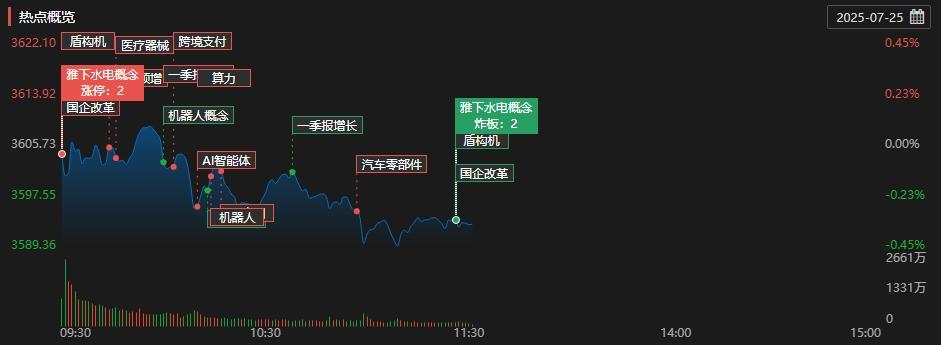
Market Overview - The three major A-share indices collectively declined in the morning session, with the Shanghai Composite Index down 0.34%, the Shenzhen Component Index down 0.29%, and the ChiNext Index down 0.32% [1] - The total trading volume in the Shanghai, Shenzhen, and Beijing markets reached 1,124.1 billion yuan, a decrease of 8.9 billion yuan compared to the previous day [1] - Over 3,000 stocks in the market experienced declines [1] Sector Performance - Sora concept, medical devices, cloud computing, pet economy, and logistics sectors saw the highest gains, while Hainan Free Trade Zone, hydropower, liquor, and rare earth permanent magnet sectors faced the largest declines [1] - AI application concept stocks, including InSai Group and Dahan Technology, experienced a collective rebound, with several stocks hitting the daily limit [1][10] - The medical device and pharmaceutical sectors initially rose, with stocks like Kangtai Medical and Zhengchuan Co. hitting the daily limit [1][11] - The logistics sector also saw a surge, with Shentong Express hitting the daily limit [1][12] Notable Stocks - Stocks with five consecutive daily limits include Xining Special Steel, Tibet Tianlu, Tibet Tourism, and Southern Road Machinery [2] - Stocks with three consecutive daily limits include Tuoshan Heavy Industry and Rainbow Group [3] - Stocks with two consecutive daily limits include Yiming Pharmaceutical and Dahan Technology [4] Hot Sectors - The strongest sector is Artificial Intelligence, with 11 stocks hitting the daily limit and three stocks with consecutive limits, including Shanhe Intelligent and Southern Road Machinery [5] - The Data Element sector had nine stocks hitting the daily limit, with Dahan Technology and Hubei Broadcasting as notable mentions [6] - The Medical Device sector had eight stocks hitting the daily limit, with Rainbow Group and Tianmu Pharmaceutical highlighted [7] Key Insights - The Sora concept is gaining attention due to OpenAI's preparation for launching a new video generation AI model, Sora 2, to compete with Google's Veo 3 [10] - The medical device sector is undergoing a shift as the National Medical Insurance Administration announced that the 11th batch of centralized procurement will no longer solely rely on the lowest price, promoting a transition from "price wars" to "value wars" [11] - The logistics sector is expected to continue growing due to the expansion of e-commerce and the rise of live-streaming e-commerce, indicating excess growth potential compared to upstream e-commerce [12]