成都银行

Search documents
建设银行总行最新组织架构
数说者· 2025-05-18 23:00
Core Viewpoint - As of the end of 2024, China Construction Bank maintains its organizational structure with 41 headquarters departments and 2 branch-level specialized institutions, consistent with the structure at the end of 2023 [1]. Company Financial Sector - The corporate finance sector consists of 7 departments: Corporate Business Department, Strategic Client Department, Institutional Business Department, Inclusive Finance Business Department, Settlement and Cash Management Department, Investment Banking Department, and International Business Department [1]. Asset Management Sector - The asset management sector includes 4 headquarters departments and 1 branch-level specialized institution: Group Asset Management Department, Financial Intermediary Department, Asset Custody Business Department, Financial Market Department, and Precious Metals and Bulk Commodities Business Department [2]. Personal Finance Sector - The personal finance sector comprises 4 headquarters departments and 1 branch-level specialized institution: Personal Finance Department (Consumer Rights Protection Department), Rural Revitalization Finance Department, Private Banking Department, Housing Finance and Personal Credit Department, and Credit Card Center [3]. Risk Management Sector - The risk management sector consists of 7 departments: Risk Management Department, Asset Protection Department, Credit Management Department, Credit Approval Department, Internal Control Compliance Department, Legal Affairs Department, Security Department, and Audit Department [4]. Technology and Operations Sector - The technology and operations sector includes 5 departments: Digital Construction Office, Online Finance Department, Channel and Operations Management Department, Data Management Department, and Financial Technology Department [5]. Comprehensive Management Sector - The comprehensive management sector comprises 13 departments: Board Office, Supervisory Office, General Office, Asset and Liability Department, Financial Accounting Department, Human Resources Department, Equity Investment and Subsidiary Management Department, Strategic and Policy Coordination Department, Party Committee Inspection Office, Public Relations and Corporate Culture Department, Retired Personnel Management Department, Party Affairs Department (Trade Union), and Party School (Advanced Research Institute) [6]. Employee Structure - As of the end of 2024, China Construction Bank has 37 primary branches and a total of 376,800 employees, with 15,081 at the headquarters. The gender distribution is 53.04% female and 46.96% male, with 14.71% holding a master's degree or higher and 18.00% having a college degree or lower [7].


5月信贷投放有望改善 银行“剧透”经营新动向
Shang Hai Zheng Quan Bao· 2025-05-18 18:08
◎记者 黄坤 经历4月信贷"小月"后,5月信贷投放有望改善。 上海证券报记者近日从业内了解到,伴随一揽子政策落地,5月信贷增长可能明显好于4月,并且银行信 贷投放节奏更注重均衡和质效提升。投向上,银行加大了科技金融、普惠金融等领域的投放力度;零售 方面,消费贷仍是各家银行发力的主战场。 一些银行近期披露的机构投资者调研纪要还"剧透"了经营动向。面对净息差收窄、竞争加剧的市场环 境,银行正在想方设法推进业务,稳住经营业绩。 预计5月信贷投放明显改善 记者自业内了解到,预计5月信贷投放有明显改善。 一家股份制银行上海分行公司部总经理向记者说,进入5月,银行信贷投放明显更加注重质量和均衡, 信贷经理都在外面忙着跑客户,以完成月度和年中考核指标。 科技金融正成为银行发力的重中之重。"'五篇大文章'是带动银行经营能力持续提升的重要方向。"前述 股份制银行上海分行人士说,目前金融资源向科技型企业倾斜更多,希望通过培育专业特色,帮助该行 赢得未来的核心竞争力。 光大证券首席固收分析师张旭判断,5月出台了大量支持性政策,信贷增长情况很可能明显好于4月。"5 月我国外贸环境出现了积极变化,这有助于企业有效信贷需求的恢复甚至进一 ...
2025年一季度商业银行主要监管指标点评:盈利维持稳定,基本面韧性强
EBSCN· 2025-05-18 11:13
Investment Rating - The report maintains a "Buy" rating for the banking industry, indicating a projected investment return exceeding the market benchmark index by more than 15% over the next 6-12 months [1]. Core Insights - The banking sector demonstrates strong resilience in fundamentals, with stable profitability and asset quality. In Q1 2025, commercial banks achieved a net profit of 656.8 billion, with a year-on-year profit growth decline of 2.3% [4][5]. - The report highlights that the decline in profit growth is consistent with the previous year, with non-interest income contributing 25% to total revenue, an increase of 2.5 percentage points compared to 2024 [5][6]. - The report emphasizes the stability of asset quality, with a non-performing loan (NPL) ratio of 1.51%, slightly up by 1 basis point from the end of the previous year [23][24]. Summary by Sections Profitability and Revenue - In Q1 2025, the profitability of commercial banks decreased by 2.3%, with state-owned banks showing a profit growth of 0.1%, while joint-stock banks, city commercial banks, and rural commercial banks experienced declines of 4.5%, 6.7%, and 2% respectively [5][7]. - The report notes that the net interest margin (NIM) narrowed to 1.43%, down 9 basis points year-on-year, with state-owned banks having a NIM of 1.33% [15][18]. Credit and Asset Quality - The report indicates that credit issuance remains strong, with total assets of commercial banks growing at a rate of 7.2% year-on-year. New loans and non-credit assets increased by 9.1 trillion and 4.6 trillion respectively [8][9]. - The NPL ratio remains stable at 1.51%, with a provision coverage ratio above 200%, indicating a robust capacity to absorb potential losses [23][24]. Capital Adequacy - As of Q1 2025, the risk-weighted assets (RWA) of commercial banks grew by 6.4%, leading to a slight decline in capital adequacy ratios across various bank types [29][30]. - The core Tier 1 capital adequacy ratio for commercial banks stands at 10.7%, reflecting a decrease from the previous year [29]. Investment Recommendations - The report suggests focusing on banks with strong fundamentals and high dividend yields, particularly large state-owned banks, which exhibit solid investment value due to their high dividend rates [31][44]. - It also highlights the potential of mid-sized banks with convertible bonds, which have shown strong performance recently [44][46].
银行业周报(20250512-20250518):当前五大行A股股息率处于何种水平?-20250518
Huachuang Securities· 2025-05-18 08:16
证 券 研 究 报 告 银行业周报(20250512-20250518) 推荐(维持) 当前五大行 A 股股息率处于何种水平? 银行 2025 年 05 月 18 日 华创证券研究所 2015-2025 年,大致可以划分为四个阶段:1)2Q15-1Q16,五大行季度平均股 息率震荡上行,平均股息率从 4.4%升至 5.3%;2)2Q16-1Q18,五大行季度平 均股息率震荡下行,从 5.3%降至 4.0%;3)2Q18-1Q23,五大行季度平均股息 率开启较长时间的震荡上行,从 4.4%升至 7.2%;4)2Q23-2Q25,五大行季度 平均股息率呈现较快下行趋势,从 6.3%降至 4.4%。当前水平处于 2015 年以 来的较低分位,与 2Q15 和 2Q18 水平相当。 与历史上当期的国债收益率相比,除了 1Q18 跑输 10 年期国债收益率之外, 其余时间五大行季度平均股息率均高于 10 年期国债收益率。其中 1Q20-2Q21, 高于 10 年期国债收益率 2pct;3Q21-2Q24,高于 10 年期国债收益率 3-4pct。 25 年以来仍然高于 10 年期国债收益率 2pct。 24 年所有 A ...


多项金融合作签约 成都温江区常态化举办政银企对接活动
Mei Ri Jing Ji Xin Wen· 2025-05-17 06:27
截至目前,温江区科学技术局已累计帮助区内企业获得"科创贷"27亿元,助力570余家科技企业成长为 国家高新技术企业。 "下一步,我们将常态化举办'创投天府'等政银企对接活动。同时,加快推进财政科技资金'先投后股'改 革试点,提升'投新、投早、投小、投硬'能力,构建'债权+股权+基金'多元联动、接续发力的金融服务 生态,全方位赋能科创企业发展壮大。"温江区科学技术局相关负责人表示。 活动中还进行了多轮签约,中国农业银行成都分行、成都生产力促进中心、温江区科学技术局共同签 署"科创贷"三方合作协议,成都海峡中小企业孵化园等温江区产业载体、健诺维(成都)生物科技有限 公司等温江区企业纷纷与金融机构达成合作或签署投融资意向协议。 近年来,温江区科学技术局紧扣科技型企业需求,从出台科技创新若干政策、培育科技金融服务机构、 搭建投融资对接平台、大力推广"科创贷"等多个维度同时发力,切实解决科技型企业资金难题。去年, 在全省率先探索财政科技资金"先投后股"改革试点,并建立2000万元风险资金池,通过杠杆效应带动农 业银行和成都银行(601838)两家合作银行安排2.5亿元贷款资金用于"科创贷"业务,满足科技型中小 企业日益 ...
机构建议继续将红利类资产作为底仓配置,国企红利ETF(159515)近3月新增份额居可比基金首位
Sou Hu Cai Jing· 2025-05-16 06:30
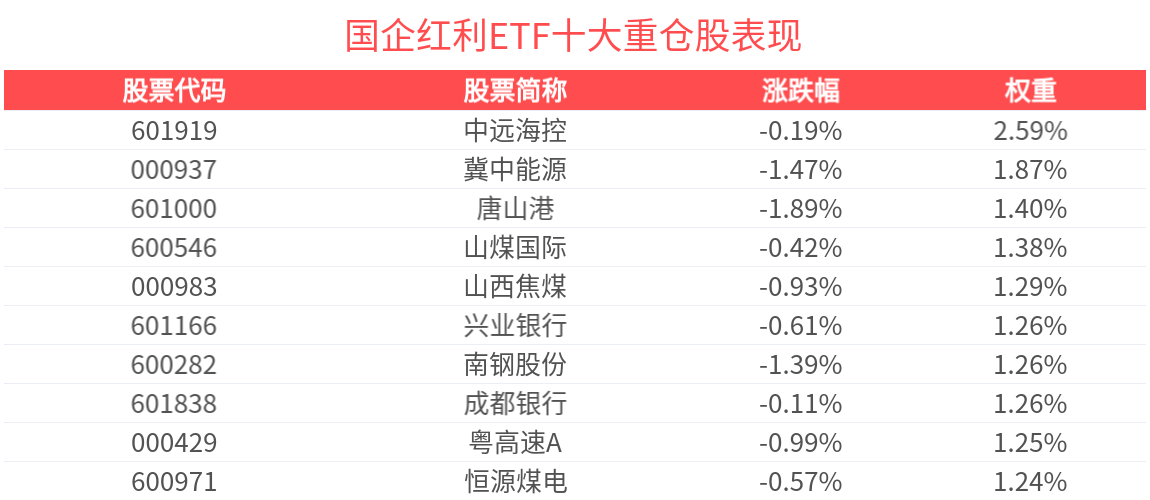
Group 1 - The China Securities State-Owned Enterprises Dividend Index (000824) decreased by 0.64% as of May 16, 2025, with mixed performance among constituent stocks [1] - Leading gainers included Kailuan Energy Chemical (600997) up 3.04%, Shenneng (600810) up 2.47%, and Fu'ao (000030) up 2.45%, while China Petroleum & Chemical (600028) led the declines down 2.08% [1] - The State-Owned Enterprises Dividend ETF (159515) fell by 0.55%, with the latest price at 1.09 yuan, and saw a significant increase in shares by 6.6 million over the past three months, ranking it in the top half among comparable funds [1] Group 2 - The China Securities State-Owned Enterprises Dividend Index is composed of 100 listed companies selected for high cash dividend yields, stable dividends, and certain scale and liquidity [2] - As of April 30, 2025, the top ten weighted stocks in the index included COSCO Shipping Holdings (601919) and Jizhong Energy (000937), collectively accounting for 15.18% of the index [2] Group 3 - Guohai Securities noted that recent joint statements indicate a positive shift in the economic and trade relations between the parties, marking a new phase of "offensive and defensive shifts" since the trade frictions began in 2018 [1] - The recommendation is to maintain dividend assets as a core allocation to mitigate potential volatility, while also considering segments of the export industry that have been overly pessimistic and undervalued [1]
低基数下社融提速,信贷靠前投放后回落
Huachuang Securities· 2025-05-16 04:44
Investment Rating - The industry investment rating is "Recommended," indicating an expected increase in the industry index by more than 5% over the next 3-6 months compared to the benchmark index [26]. Core Insights - The report highlights a significant increase in social financing, with April 2025 seeing a new social financing scale of 1.16 trillion yuan, which is an increase of 1.22 trillion yuan year-on-year, resulting in a year-on-year growth rate of 8.7%, the highest monthly growth rate in nearly a year [2][7]. - The report notes a decline in credit demand, particularly in corporate loans, which have decreased significantly after an initial surge, while household short-term loans are also under pressure [7][8]. - The report suggests that the banking sector is likely to see an increase in overall positioning, driven by medium to long-term capital inflows and public fund reforms, recommending a diversified investment strategy focusing on state-owned banks and quality regional banks [7][8]. Summary by Sections Social Financing Overview - In April 2025, the new social financing scale reached 1.16 trillion yuan, with a year-on-year increase of 1.22 trillion yuan, and a social financing stock growth rate of 8.7%, up 0.3 percentage points from the previous month [2][7]. - Direct financing saw a significant contribution from government bonds, which increased by 1.07 trillion yuan year-on-year, while corporate bonds improved slightly due to a low base effect [7][8]. Credit Data - New RMB loans in April amounted to 280 billion yuan, a decrease of 450 billion yuan year-on-year, primarily due to weakened corporate financing demand [7][8]. - Corporate loans decreased by 250 billion yuan year-on-year, with short-term loans and medium to long-term loans also showing declines [7][8]. Monetary Growth - M1 growth rate decreased to 1.5%, while M2 growth rate increased to 8% due to a low base effect from the previous year [7][8]. - The report indicates a significant reduction in both household and corporate deposits, with non-bank deposits increasing by 1.9 trillion yuan [7][8]. Investment Recommendations - The report emphasizes the importance of positioning in the banking sector, suggesting that banks with high dividend yields and strong asset quality should be prioritized for investment [7][8]. - It recommends focusing on state-owned banks and stable joint-stock banks, as well as regional banks with high provisioning coverage ratios [7][8].
银行2024年年报与2025年一季报综述:重定价冲击叠加债市震荡,25Q1业绩承压
China Post Securities· 2025-05-16 02:16
Industry Investment Rating - The industry investment rating is maintained at "Outperform the Market" [1] Core Viewpoints - The report highlights that the overall operating income, pre-provision profit, and net profit attributable to shareholders of listed banks for 2024 are expected to grow at rates of 0.08%, -0.72%, and 2.35% respectively. In Q1 2025, these growth rates are projected to decline to -1.72%, -2.15%, and -1.20%, indicating a downward trend in performance due to the impact of interest rate adjustments and market fluctuations [3][10][13] - The report emphasizes that the non-interest income growth of banks has slowed down due to market volatility, which has affected trading positions and overall performance [4][10] - The asset quality of listed banks is showing slight improvement, with the non-performing loan ratio decreasing from 1.24% in 2024 to 1.23% in Q1 2025, and the overall provision coverage ratio remaining stable around 239.91% in 2024 and 237.92% in Q1 2025 [4][10][13] Summary by Sections 1. Impact of Repricing and Market Fluctuations - The report notes that the combination of repricing impacts and market volatility has led to a decline in performance for Q1 2025, with significant drops in revenue and profit growth rates compared to 2024 [3][10] - The performance of city commercial banks has been notably better than other types of banks, with positive revenue growth in both 2024 and Q1 2025 [10][13] 2. Growth of Interest-Generating Assets - The growth rate of interest-generating assets for listed banks was 0.44% in 2024, with a slight increase to 0.79% in Q1 2025. However, the growth in deposits remained stable at 5.59% in 2024 and 6.22% in Q1 2025 [4][10] 3. Interest Margin Performance - The report indicates that both the yield on interest-generating assets and the cost of interest-bearing liabilities have decreased significantly in Q1 2025, affecting the interest margin performance across banks [4][10] 4. Non-Interest Income Growth - Non-interest income growth for listed banks was 6.71% in 2024, but it fell to -1.87% in Q1 2025, primarily due to the impact of market conditions on fee income and other non-interest revenues [4][10] 5. Asset Quality Improvement - The report highlights a slight improvement in asset quality, with a marginal decrease in the non-performing loan ratio and stable provision coverage ratios, indicating a cautious but positive trend in credit quality [4][10][13] 6. Investment Recommendations - The report suggests focusing on major state-owned banks such as Industrial and Commercial Bank of China, China Construction Bank, and Bank of Communications, as well as regional banks like Chongqing Bank and Chengdu Bank, which may benefit from supportive fiscal policies [5][10]

申万宏源证券晨会报告-20250516
Shenwan Hongyuan Securities· 2025-05-16 00:43
Group 1: Financial Data Overview - In April 2025, new social financing amounted to approximately 1.16 trillion, an increase of 1.22 trillion year-on-year, with stock social financing growing by 8.7% year-on-year, and a month-on-month increase of 0.3 percentage points [11][13][14] - New credit in April was 280 billion, a decrease of 450 billion year-on-year, reflecting a weak demand in the corporate sector and a low retail demand under pressure [11][13][17] - M1 grew by 1.5% year-on-year, while M2 increased by 8.0%, with a month-on-month rise of 1 percentage point [11][13][17] Group 2: Robotics Industry Insights - The core of embodied intelligence lies in algorithms, which are divided into upper-level "brain" for task planning and decision-making, and lower-level "cerebellum" for real-time motion planning and joint control [12][10] - Data quality and diversity are crucial for algorithm performance, with real data being the primary source, supplemented by synthetic data generated through simulation platforms [12][10] - The control system serves as the foundation for embodied intelligence, with the brain executing complex algorithms and the cerebellum controlling robot movements, primarily using SoC chips [12][10] Group 3: Company Performance Highlights - Nocera's revenue in Q1 2025 increased by 130% year-on-year, reaching 381 million, with a net profit of 18 million, compared to a net loss of 142 million in the same period last year [16][19] - The sales of the core product, Acalabrutinib, grew by 89% to 311 million in Q1 2025, leading to an upward revision of the annual sales target from over 30% to over 35% growth [16][19] - The company is actively expanding its pipeline for autoimmune diseases and has submitted an IND application for its first ADC product [19][16]
A股银行市值首破10万亿,公募调仓、险资加持“故事”能否持续?
Di Yi Cai Jing· 2025-05-15 14:00
Core Viewpoint - The recent surge in bank stocks has made them a prominent feature in the A-share market, driven by high dividends, low valuations, and their safe-haven characteristics amid uncertainty [2][4]. Group 1: Market Performance - The China Securities Bank Index reached a high of 7751.80 points on May 15, 2023, following a nearly 7% increase over the previous six trading days [2]. - The total market capitalization of A-share banks surpassed 10 trillion yuan, increasing by 600 billion yuan from the beginning of the year [3]. - Year-to-date, the bank sector has risen over 8%, ranking fifth among all primary industries, with several banks experiencing gains exceeding 20% [5]. Group 2: Investment Drivers - Recent policy changes, including interest rate cuts and the expansion of financial asset investment companies, have contributed to the positive sentiment towards bank stocks [6][7]. - The new public fund assessment mechanism is expected to increase the allocation of funds to bank stocks, as active equity funds are likely to reduce their deviation from benchmark indices [8]. Group 3: Institutional Buying - Insurance funds have been actively increasing their holdings in bank stocks, with significant purchases noted in several banks this year [9]. - High dividend yields remain a key attraction for insurance investors, with many bank stocks offering yields above 4% [9]. Group 4: Risks and Challenges - Despite the positive outlook, there are concerns regarding the sustainability of bank stock performance, as factors such as narrowing interest margins and asset quality issues in retail lending pose risks [11][12]. - The overall non-performing loan ratio is rising, particularly in personal loans, indicating potential stress in the banking sector [12].