上美股份

Search documents
240亿潮汕美妆首富,陷入质检风波
2 1 Shi Ji Jing Ji Bao Dao· 2026-01-01 12:48
Core Viewpoint - The recent controversy surrounding the ingredient EGF in the core brand Han Shu of Shangmei Co. has led to significant stock price fluctuations and raised concerns about the company's future growth plans [4][5][8]. Group 1: Company Developments - Chairman Lv Yixiong announced that executive director Luo Yan purchased 364,000 shares at approximately HKD 75.5 each, totaling about HKD 66.32 million, indicating strong confidence in the company's future [2]. - The company aims to achieve a revenue target of 30 billion yuan by 2030, requiring a doubling of current revenue within five years [12][38]. - In the first half of the year, the company's revenue reached 4.1 billion yuan, with a goal of hitting 10 billion yuan in annual revenue for the new brand Newpage [11][22]. Group 2: Controversy and Market Reaction - The controversy originated from the detection of EGF in two Han Shu face masks, leading to a significant drop in stock price, with a loss of over 10 billion yuan in market value [5][8]. - Han Shu's official response included presenting third-party testing results to refute the claims, but investor concerns persisted, resulting in a 30% drop in stock price on the first trading day after the holiday [8][39]. - The Chinese Fragrance and Cosmetic Industry Association noted that there is currently no commercial ELISA kit available for testing EGF in cosmetics, which complicates the situation [9]. Group 3: Strategic Expansion Plans - The company is in a critical expansion phase, planning to launch 20 new brands between 2025 and 2027, primarily leveraging the Douyin platform for marketing [10][22]. - The company is also focusing on international markets, with a significant investment of 300 million yuan in a factory in Southeast Asia [24]. - The strategy includes hiring top talent and implementing a rigorous selection process to enhance brand development and marketing effectiveness [29][32].

美容护理系列深度报告2:技术、需求双轮驱动,PDRN应用提速
Orient Securities· 2025-12-31 15:40
Investment Rating - The report maintains a "Positive" investment rating for the beauty and personal care industry, specifically focusing on PDRN applications [6]. Core Insights - The report highlights that PDRN (Polydeoxyribonucleotide) is expected to unleash stronger commercial potential due to increasing registrations and search metrics. The extraction of PDRN is transitioning from animal sources to microbial fermentation and synthetic biology, laying a solid foundation for accelerated applications in the medical beauty and skincare sectors [3][4]. - The report emphasizes that domestic beauty companies are likely to redefine the value boundaries of PDRN, with leading firms accelerating their strategies in this competitive landscape [3][4]. Summary by Sections PDRN Overview - PDRN, derived from salmon and other sources, has a high similarity to human DNA (98%) and is known for its skin repair and cell regeneration properties. Its historical development spans from the 15th century to its current applications in medical aesthetics and cosmetics [8][13][19]. Market Growth Potential - The PDRN market is projected to grow significantly, with estimates indicating an increase from USD 0.72 billion in 2024 to USD 8.55 billion by 2031, reflecting a CAGR of 43%. The demand for anti-aging products is a core driver of this growth [8][30]. Competitive Landscape - Domestic companies are actively entering the PDRN medical and skincare sectors, with significant advancements in extraction technologies. Companies like Huaxi Biological and Lepu Medical are leading the charge in developing PDRN-based products [8][30][34]. Key Mechanisms and Benefits - PDRN operates through two main mechanisms: acting as an agonist for the adenosine A2A receptor to suppress inflammation and providing nucleotides for DNA synthesis, thus promoting cell regeneration and tissue repair [34][36]. - The primary benefits of PDRN include skin repair, anti-inflammatory effects, and anti-aging properties, making it suitable for various cosmetic and medical applications [34][39].





十年一觉新消费:从病痛到醒悟,一个创业者的生命课
新消费智库· 2025-12-31 13:03
Group 1 - The article reflects on the past ten years of the "New Consumption Think Tank," emphasizing that the initial passion for the project has evolved into a deeper understanding of its significance [2][4][5] - The author highlights that surviving without debt is a significant achievement in entrepreneurship, suggesting that longevity and self-sufficiency are more important than grand ambitions [7][8][9] - The narrative critiques the glorification of entrepreneurship, arguing that the journey itself holds more value than the end results, and that true wealth comes from daily experiences [10][14][15] Group 2 - The article posits that happiness is derived from the ability to be present and engaged in daily life, rather than from material wealth [17][18] - It discusses the importance of focusing on personal growth and self-acceptance, rather than seeking external validation or societal approval [25][26][27] - The author emphasizes the need for clarity in direction after reconciling with oneself, shifting focus from acquiring to contributing [29][30] Group 3 - The article mentions health challenges faced by the author, which served as a wake-up call to appreciate the fleeting nature of time and the importance of living meaningfully [31][33][34] - It suggests that true fulfillment comes from internal alignment and the pursuit of personal passions, rather than conforming to external expectations [38][40] - The narrative concludes with a commitment to a future focused on personal values and helping others, rather than chasing conventional success [49][51]


韩束被央视曝光“非法添加”!多名消费者要求退货退款
Guo Ji Jin Rong Bao· 2025-12-31 02:53
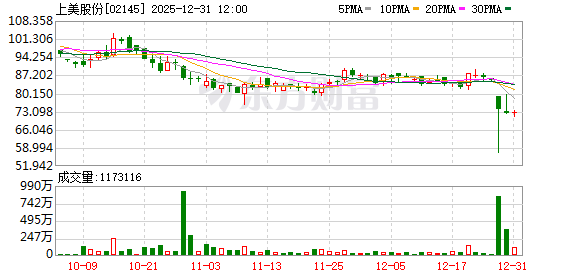
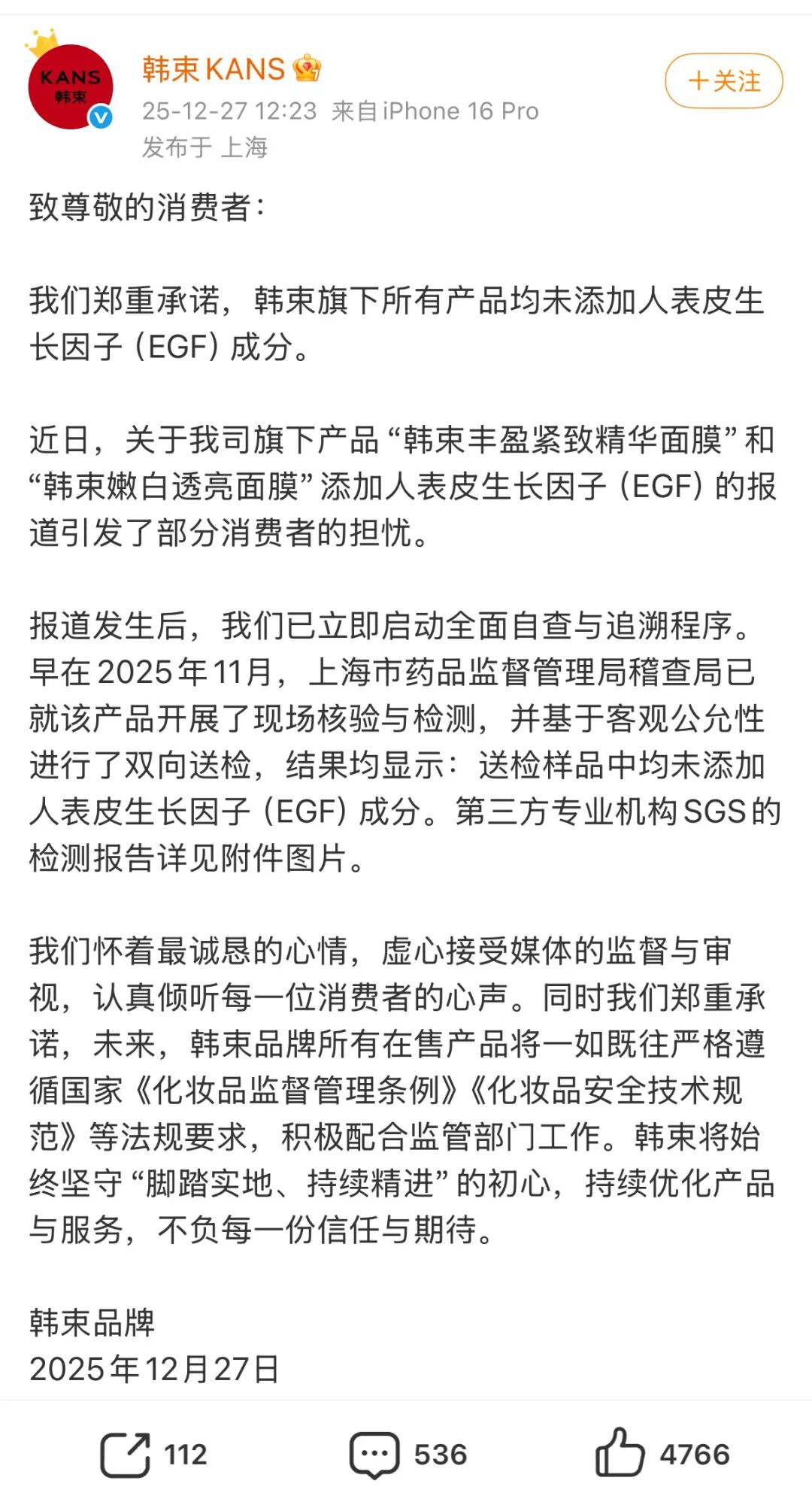
Core Viewpoint - The crisis surrounding Up Beauty Co., Ltd. continues to escalate, with significant stock price fluctuations and allegations of illegal additives in its products, particularly affecting its core brand, Han Shu [1][2][10]. Stock Performance - On December 30, Up Beauty's stock fell by 2.5%, closing at HKD 72.2, marking a total decline of over 15% over two days [1]. - The stock experienced a sharp drop on December 29, reaching a low of HKD 57, a decline of over 33% during the trading session [1]. Product Controversy - Han Shu's products were found to contain epidermal growth factor (EGF), which is not permitted in cosmetics due to safety concerns [2]. - Following the allegations, Han Shu removed the affected products from e-commerce platforms and issued a statement denying the presence of EGF in its products [2][4]. Consumer Reaction - Consumers have expressed distrust and demanded refunds, citing concerns over the safety of the products after the illegal additive allegations [4]. - Previous incidents of illegal additives in Han Shu products have raised further doubts about the brand's integrity [9]. Financial Performance - In the first half of 2025, Han Shu contributed approximately 81.4% of Up Beauty's revenue, amounting to CNY 3.344 billion, a 14.3% increase year-on-year [10]. - The company's online self-operated channel revenue reached CNY 3.421 billion, a 24.6% increase, with its share of total revenue rising from 78.4% to 83.3% [10]. Marketing Strategy - Up Beauty has heavily invested in marketing, particularly through collaborations with influencers and short dramas, leading to a significant increase in revenue [10][11]. - However, this strategy has resulted in rising marketing expenses, with the sales expense ratio increasing from 47.01% in 2022 to 56.88% in the first half of 2025, while R&D spending has decreased [11]. Strategic Shift - The company is shifting its strategic focus towards other brands, aiming for a pre-tax sales target of CNY 4.36 billion for 2026, with specific targets for brands like NEW PAGE and Anminyou [12][13]. - Concerns remain regarding the feasibility of these targets, given the current revenue performance of these brands [13].
从破产边缘到百亿市值,东北网红家族的“高端”之路
36氪未来消费· 2025-12-30 14:53
Core Viewpoint - Lin Qingxuan has successfully positioned itself as a leading high-end domestic skincare brand in Hong Kong, marking a significant milestone in the consumer market with its recent IPO, which reflects the growing trend of domestic brands gaining traction in the high-end segment [4][5][6]. Group 1: Company Overview - Lin Qingxuan was founded in 2003 during the SARS outbreak, initially starting with handmade soaps priced at 25 yuan, and later transitioned to high-end products with the launch of camellia oil in 2014 [6][12]. - The company has a notable shareholder base, including major players like Youngor Fashion and L'Oréal, which enhances its market credibility [6]. - The brand's growth trajectory has been marked by a significant increase in online sales, with a compound annual growth rate (CAGR) of 51.2% from 2022 to 2024, and online revenue accounting for 65.4% of total revenue by mid-2025 [20][22]. Group 2: Market Position and Financial Performance - Lin Qingxuan is positioned as the top domestic high-end skincare brand in China, with over 80% gross profit margins, which is a key indicator of its successful high-end strategy [27][28]. - The company's gross margin has consistently remained above 81% from 2023 to mid-2025, with its core product, camellia oil, achieving a gross margin of 86.2% [29]. - The number of Lin Qingxuan's retail stores has increased from 366 in 2022 to 554 by mid-2025, with a strategic focus on high-traffic shopping malls in major cities [30][31]. Group 3: Marketing and Sales Strategy - Lin Qingxuan has invested heavily in marketing, with sales and distribution expenses totaling 2.263 billion yuan from 2022 to mid-2025, representing 55.2% of revenue in the first half of 2025 [32]. - The brand has adopted a unique family-based influencer marketing strategy, leveraging the founder and family members to create a strong content-driven approach to engage consumers [23][22]. - Despite high marketing expenditures, the company's research and development investment has been relatively low, with less than 100 million yuan cumulatively from 2022 to 2024, indicating a focus on marketing over product innovation [33][34].

2025洗护赛道复盘:从外资主导到中外博弈,国货差异化破局
Xin Jing Bao· 2025-12-30 11:41
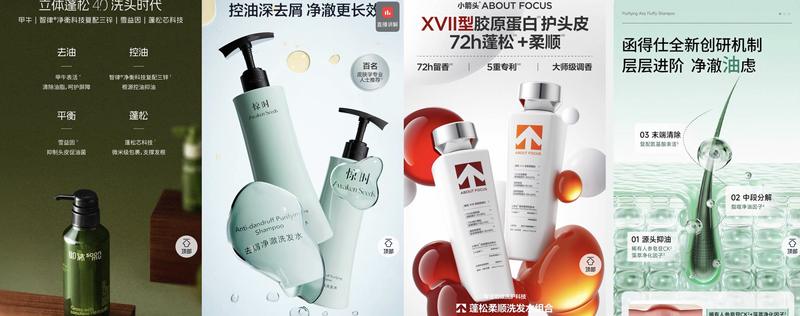
Core Insights - The Chinese hair care market is undergoing a transformation driven by consumption upgrades and heightened health awareness, shifting from basic cleaning and care to a focus on scientific maintenance and precision care [1] - Domestic brands are rapidly entering the hair care sector, creating a competitive landscape that challenges the dominance of foreign brands [1][2] Market Overview - The market size of China's hair care industry is projected to grow from 57.3 billion yuan in 2019 to 67.8 billion yuan in 2024, indicating steady growth [1] - International giants like Procter & Gamble, L'Oréal, and Unilever currently dominate the market, holding over 60% market share, but the rise of domestic brands is beginning to shift this balance [2][10] Competitive Landscape - The top 10 hair care products on platforms like JD.com and Taobao are still largely occupied by foreign brands, but domestic brands are beginning to make inroads [2] - The emergence of Gen Z as a primary consumer group is creating opportunities for domestic brands to capture market share through innovative and targeted products [2][9] New Product Launches - Domestic brands are launching new products focused on specific consumer needs, such as scalp health and efficacy, with companies like Proya and Fuda introducing brands that emphasize micro-ecological care [4][5] - The introduction of differentiated products, such as "Awaken Seeds" by Proya and "ABOUT FOCUS" by Xiaokuo Group, highlights the trend towards scientific and emotional care in hair products [4][13] Pricing Strategy - Domestic brands are strategically pricing their new products in the mid-to-high-end range, filling a gap in the market that has been dominated by foreign brands [6][8] - For example, the pricing of new products from brands like Memfa and Proya ranges from 0.229 to 0.457 yuan/ml, targeting the mid-to-high-end segment [8] Future Trends - The competition in the mid-to-high-end market is expected to intensify over the next one to two years, driven by innovation and quality improvements from domestic brands [9][12] - The ability of domestic brands to capture new consumer trends, overcome technological trust barriers, and enhance brand value will be crucial for their success against established foreign competitors [10][12][16]
美妆行业深度报告:国货崛起、模式分化与营销提效下的竞争新局
Shanghai Aijian Securities· 2025-12-30 09:07
Investment Rating - The report rates the beauty and personal care industry as "Outperform" compared to the market [1] Core Insights - The beauty industry is experiencing significant growth driven by domestic brands, with a shift towards online sales channels, particularly through platforms like Douyin [2][3] - Domestic brands are gaining market share, with 43% of consumers preferring domestic beauty brands over international ones by 2025 [2][3] - The industry is characterized by high sales expense ratios due to intense competition and the need for substantial marketing investments [2][3] Summary by Sections 1. Beauty Industry Overview - The beauty sector is primarily focused on skincare and makeup, with online sales accounting for over 70% of revenue [2] - Facial care is the core category within skincare, with domestic brands experiencing growth despite overall market challenges [2][3] - The current channel structure is dominated by online sales, which account for 79% of revenue, with platforms like Taobao and Douyin leading the way [2][3] 2. Market Growth and Domestic Brand Rise - The Chinese cosmetics market is expanding, with domestic brands driving this growth [2][3] - The market size is projected to grow from 934.6 billion yuan in 2024 to 1,200 billion yuan by 2029, with a CAGR of 6.6% [2][3] - Domestic brands are expected to surpass international brands in market share by 2025, with a projected share of 52.9% by 2029 [2][3] 3. Business Model Differentiation - The domestic beauty industry has developed three main business models: efficacy research, brand deepening, and a combination of agency operations with self-owned brands [2][3] - Companies are transitioning from reliance on agency models to creating their own brands to enhance profitability [2][3] 4. Industry Characteristics and Competition - High gross margins and sales expense ratios are common in the beauty industry, driven by the need for extensive marketing to build brand recognition [2][3] - Companies are employing multi-faceted marketing strategies to balance costs and growth [2][3] 5. Investment Recommendations - The report suggests focusing on companies that excel in efficacy research, brand deepening, and transitioning from agency operations to self-owned brands [2][3] - Specific companies to watch include Juzhibio in efficacy research and Proya and Maogeping in brand deepening [2][3]
林清轩上市成功,国货美妆十强变天
Sou Hu Cai Jing· 2025-12-30 04:31
Core Viewpoint - Lin Qingxuan has officially listed on the Hong Kong Stock Exchange, becoming the first high-end domestic skincare stock, with an opening price of 85 HKD per share, reflecting a market capitalization of approximately 12.6 billion HKD [2][4]. Company Overview - The stock price increased by about 9.3% from the issue price of 77.77 HKD, reaching a peak of 91.65 HKD on the first trading day, maintaining a high valuation for beauty stocks in Hong Kong [4][6]. - Lin Qingxuan's global offering consisted of approximately 13.97 million shares, raising over 1 billion HKD, with significant backing from cornerstone investors [6][10]. Financial Performance - Revenue grew from 691.15 million RMB in 2022 to 1.21 billion RMB in 2024, with a compound annual growth rate exceeding 30% [8][22]. - The company achieved a net profit of approximately 1.87 billion RMB in 2024, reversing previous losses, and reported a revenue of 10.52 billion RMB in the first half of 2025, nearly matching the entire revenue of 2024 [8][11]. Market Position - Lin Qingxuan ranks among the top fifteen high-end skincare brands in China by retail sales, being the only domestic brand in this category [10][11]. - The company has established over 554 stores nationwide, with online sales accounting for more than 60% of its revenue [10][11]. Competitive Landscape - The listing has reshuffled the ranking of domestic beauty companies, pushing Lin Qingxuan into the top ten by revenue, surpassing competitors like Shuiyang [11][12]. - The competitive environment is intensifying, with other brands like Shuiyang and Naturals poised to challenge Lin Qingxuan's position [13][14]. Investment Appeal - Investors are attracted to Lin Qingxuan due to its strong brand recognition, high gross margins, and rapid revenue growth, which suggest a promising financial outlook [20][21]. - The company's reliance on a single flagship product, the Camellia Oil, has raised questions about sustainability and the need for diversification in its product offerings [21][23].

上美股份(02145.HK)获执行董事罗燕斥2744万港元增持36.36万股
Jin Rong Jie· 2025-12-30 03:45
于上述股份增持前,罗女士曾分别于2025年12月12日、16日、17日、18日及19日使用其个人资金购入合 共47.23万股股份,总代价约为3890万港元。连同上述交易中购入的股份,截至12月29日,其本月总购 股金额约为6632万港元。 本文源自:财华网 【财华社讯】上美股份(02145.HK)公布,执行董事罗燕于2025年12月29日,在公开市场以平均价每股约 75.4608港元购入合共36.36万股公司H股,总代价约为2744万港元。紧随上述购买后,罗燕于合共286.72 万股股份中拥有权益,相当于公司已发行股本总额1.39%。 ...
东方证券:2026年零售美护行业展望 聚焦内需、出海与美护创新
智通财经网· 2025-12-30 02:05
Group 1: Retail Industry Insights - The retail sector is a key focus for domestic demand in the "15th Five-Year Plan" period, with channel adjustments and emotional consumption driving growth [2] - The central economic work conference emphasizes the importance of retail, with expectations for leading regional retail companies to achieve strong performance in Q1 due to the long Spring Festival in 2026 [2] - Retail enterprises are accelerating their adjustment efforts, focusing on compensation mechanisms, supply chains, and customer engagement strategies [2] Group 2: Cross-Border E-Commerce Trends - The cross-border e-commerce sector remains optimistic, with significant potential for penetration growth, supported by product innovation and brand strength among leading companies [3] - By 2026, a decrease in tariff costs is expected to improve profit margins for most companies, while compliance development driven by tax audits will enhance industry standards [3] - The rise of AI tools in cross-border B2B enterprises is anticipated to further increase revenue [3] Group 3: Beauty and Personal Care Sector Developments - The A-share beauty and personal care sector is experiencing improved revenue growth and net profit margins, indicating a new phase of industry development [4] - Innovations in raw materials, such as plant extracts and biological fermentation, are becoming focal points for companies, with expectations for new applications by 2026 [4] - The integration of online and offline channels is becoming increasingly critical due to rising online advertising costs [4] Group 4: Investment Recommendations - Recommended investments in offline retail include Chongqing Department Store, Miniso, Dongfang Selection, and Kidswant [4] - Suggested stocks in the cross-border e-commerce chain include Small Commodity City, Focus Technology, Anker Innovations, Ugreen, and Sumida [4] - Beauty-related investment targets include Shiseido, Mao Ge Ping, Proya, Ruoyuchen, and Meili Tianyuan Medical Health [4] - AI-related investment opportunities include Konnect Optical and Aishide [4]