红旗连锁

Search documents
18家成都企业上榜!“中国独角兽毕业榜”首次发布
Sou Hu Cai Jing· 2026-01-18 08:13
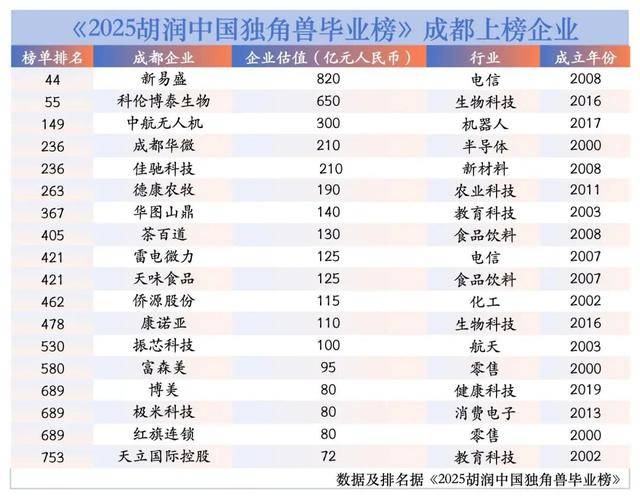
Group 1 - The 2025 Hurun China Unicorn Graduation List identifies 796 companies that have graduated as unicorns, valued at over $1 billion, established after 2000 [1][3] - Chengdu ranks seventh in the number of listed companies, with 18 enterprises making the list [1][4] - The total value of these unicorn graduates across China reaches 24 trillion RMB, with an average establishment year of 2006 and an average age of 19 years [2][3] Group 2 - The top five industries by the number of listed companies are semiconductors, industrial equipment, biotechnology, new energy, and software services, accounting for 46% of the total [3] - The highest valued industries are semiconductors, new energy, industrial equipment, consumer electronics, and biotechnology [3] - Among the 796 unicorn graduates, 33 companies are valued over 100 billion RMB, with 3 exceeding 1 trillion RMB [3][4] Group 3 - Chengdu's notable companies include: - Xinyi Technology (New Easy Win) ranked 44th with a valuation of 82 billion RMB in telecommunications [2][5] - Kelong Botai Biotechnology ranked 55th with a valuation of 11 billion RMB in biotechnology [2][5] - Zhonghang Unmanned Aerial Vehicle ranked 149th with a valuation of 30 billion RMB in robotics [2][5] - Chengdu Huami and Jiachitech both ranked 236th with valuations of 21 billion RMB in semiconductors and new materials respectively [2][5] - Other notable companies include Dekang Agriculture Technology, Huatuo Shanding, and Tea Hundred Road, with valuations ranging from 13 billion to 19 billion RMB [2][5]


16元盒饭自助杀疯了,这届打工人彻底不装了
虎嗅APP· 2026-01-18 03:27
Core Viewpoint - The article discusses the shift in consumer preferences in the Chinese dining industry, highlighting the rise of affordable self-service meals and the decline of high-end dining experiences, reflecting a broader trend towards value for money and practicality in consumer behavior [4][10]. Group 1: Rise of Affordable Dining - The emergence of "box lunch self-service" meals priced under 20 yuan has become a popular choice among workers, serving as a "lifeline" for many [5][12]. - By May 2025, the number of self-service restaurants in China is projected to reach 66,000, with a net increase of over 10,000 locations compared to the previous year, driven primarily by affordable fast-casual dining options [5]. - The appeal of these self-service meals lies in their variety, affordability, and the ability to satisfy hunger without breaking the bank, contrasting sharply with the struggles of high-end dining establishments [9][15]. Group 2: Decline of High-End Dining - High-end restaurants are facing significant challenges, with notable closures including Opera BOMBANA and L'Atelier 18, indicating a downturn in the luxury dining sector [6][7]. - The closure of establishments like the Michelin-starred Ultraviolet by Paul Pairet, which charged 6,800 yuan per meal, underscores the shift in consumer spending away from luxury dining experiences [7]. Group 3: Changing Consumer Behavior - The trend towards value-driven dining reflects a broader change in consumer attitudes, with a focus on practicality and cost-effectiveness becoming paramount [10][18]. - The rise of brands like Mixue Ice City and the popularity of low-cost meal options illustrate a market shift where consumers prioritize affordability over brand prestige [19][22]. - Data indicates that while the Engel coefficient for Chinese households is decreasing, indicating a rise in living standards, consumer spending is becoming more cautious and value-oriented [19][22]. Group 4: Generational Shifts in Consumption - The Z generation, characterized by their strong sense of national identity and skepticism towards brand premiums, is driving a new wave of consumption focused on cost-effectiveness [28][30]. - Over 85% of the Z generation prioritize value for money, leading to a culture where frugality is celebrated and luxury is scrutinized [28][30]. - This generation's consumption patterns reflect a strategic retreat from traditional markers of success, opting instead for practical spending in the face of economic pressures [30][34]. Group 5: The Complexity of Modern Consumption - The article posits that the current consumer landscape is marked by a duality of frugality and indulgence, where consumers are both budget-conscious and willing to splurge on experiences that matter to them [41][42]. - The popularity of affordable self-service meals serves as a reflection of a broader societal trend towards finding balance between survival and dignity in consumption choices [36][40].

任泽平年度演讲:中国经济十大预测2025
泽平宏观· 2026-01-17 02:42
Core Viewpoint - The article presents ten major predictions for the Chinese economy in 2025, emphasizing the emergence of a new cycle and era, the global interest rate reduction, the fourth technological revolution, and the importance of adapting to new trends and opportunities in various sectors [2][3][4][5][6][7][8][9][10][11]. Group 1: New Economic Cycle and Global Trends - A new economic cycle and era are emerging, encouraging adaptation to new trends and opportunities [2][3]. - The global economy is entering a new interest rate reduction cycle, with significant implications for monetary policy and economic growth [3][40]. - The return of Trump to the White House (Trump 2.0) is expected to create uncertainties, including inflation and trade tensions, impacting global economic dynamics [3][42][44]. Group 2: Technological Revolution - The fourth technological revolution is underway, with breakthroughs in artificial intelligence, renewable energy, commercial aerospace, low-altitude economy, and biomanufacturing [4][55][57]. - AI is expected to experience explosive growth, with applications in image recognition, humanoid robots, AI assistants, and consumer electronics [6][11]. - The low-altitude economy is gaining traction, with potential applications in logistics and urban management, creating a multi-trillion market [8][59]. Group 3: Economic Policies and Domestic Growth - China is initiating macroeconomic easing to boost confidence and economic growth, focusing on new infrastructure and productivity [5][73]. - The government is implementing policies to stabilize the real estate market and promote consumption, with a focus on enhancing the business environment for private enterprises [78][87]. - The emphasis on new infrastructure includes advancements in new energy systems, digital economy, and artificial intelligence, positioning China for future growth [81][84]. Group 4: Globalization and Market Expansion - Chinese enterprises are shifting from export to global expansion, tapping into larger international markets [6][92]. - The rise of successful Chinese companies in overseas markets, such as SHEIN and TikTok, illustrates the potential for growth beyond domestic borders [96][111]. - Southeast Asia is identified as a key target for Chinese companies due to its growing market and favorable conditions for investment [101]. Group 5: Aging Population and Consumer Trends - The aging population presents opportunities in the silver economy, emphasizing the need for policies to boost birth rates and early childhood development [11]. - Consumer behavior is shifting towards interest-based spending, with cultural consumption and local trends gaining popularity among younger demographics [9][30].



2025年第53周:跨境出海周度市场观察
艾瑞咨询· 2026-01-17 00:03
Group 1: Cross-Border E-commerce Trends - Goldman Sachs' "2025 Global E-commerce Handbook" highlights a slowdown in global e-commerce growth, recommending Chinese sellers focus on ASEAN, Latin America, and the EU as potential markets [2] - ASEAN has low penetration but certain growth, Latin America shows rapid growth, and the EU offers stable returns [2] - Emerging platforms like TikTok Shop, Shopee, and MercadoLibre are challenging Amazon's dominance, with online food and beverage being a key growth area [2] Group 2: Investment in South Africa - The Belt and Road Initiative has led to significant Chinese investment in South Africa, projected to reach $13.21 billion in 2024, shifting from traditional infrastructure to consumer goods and renewable energy [4] - Political and economic risks exist in the South African market, necessitating compliance with China's ODI filing requirements for Chinese enterprises [4] - Simplified ODI filing processes can provide policy support and risk reduction for companies [4] Group 3: Automotive Industry Globalization - China's automotive industry is entering a critical phase of globalization, with an expected global market share of 38% [5] - The industry is shifting from cost-effectiveness to technological leadership, emphasizing "industry chain collaboration" and "deep localization" as key strategies [5] - Future growth may slow in the next two years, but by 2030, overseas sales could account for 15%-20% of total sales [5] Group 4: 2025 as a Turning Point for Chinese Exports - By 2025, China's export model is expected to shift from single-point sales to systematic capability output, with platforms like Temu and AliExpress rapidly gaining global traffic [6] - The success of these platforms is attributed to supply chain density, organizational efficiency, and fulfillment systems [6] - Chinese products are moving beyond the "cost-performance" label, indicating a shift towards emotional value and identity expression [6] Group 5: Hainan's Role in Trade - Hainan's free trade port is set to enhance "institutional openness" with zero tariffs on 6,637 items, aiming to improve trade efficiency [8] - The Hainan International Economic Development Bureau is focused on attracting investment and facilitating enterprise services [8] - The Hainan Expo is highlighted as a significant platform for policy implementation and international trade [8] Group 6: C-beauty Brand Expansion - Huaxizi's entry into Ulta Beauty marks a significant milestone for Chinese beauty brands in the U.S. market, reflecting a shift from transaction-oriented to system-oriented approaches [9] - Ulta Beauty's rigorous selection process underscores Huaxizi's maturity in product, supply chain, and brand narrative [9] - This event signifies the growing recognition of "C-beauty" in mainstream retail [9] Group 7: Trust in Globalization - The discussion at GTC2025 emphasized that the core barrier for Chinese companies going global is the lack of international thinking among founders [10] - Building long-term trust is likened to a marathon, requiring a deep integration into local cultures [10] - Leadership qualities and values are deemed crucial for successful internationalization [10] Group 8: Sports Brand Globalization - Chinese sports brands are quietly expanding overseas to address domestic competition and seize global opportunities [11] - Brands like DJI and Soundcore are leveraging technological innovation and international partnerships to enhance their global presence [11] - Emerging brands are using unique designs and community penetration strategies to enter international markets [12] Group 9: Innovative Pharmaceuticals - The Chinese innovative pharmaceutical sector is entering a phase of value realization, with authorized transactions exceeding $92 billion in the first three quarters of 2025 [13] - Companies like BaiLi Tianheng and HengRui Pharma are achieving significant milestone payments and strategic collaborations [13] - The establishment of a multi-tiered payment system for high-value innovative drugs is expected to open new pathways for market access [13] Group 10: Brand Globalization Strategies - Yuanqi Forest has entered over 40 countries, emphasizing the importance of brand value and cultural attitude in its globalization strategy [14] - The brand has adapted to local tastes and regulations while maintaining its core product quality [14] - The focus is on product strength, compliance, and cultural resonance rather than low prices [14] Group 11: New Tea Beverage Expansion - The Chinese tea brand Tianlala has opened over 200 overseas stores, focusing on balancing global standards with local engagement [15] - The brand's strategy includes a dual supply chain and deep localization to meet diverse market demands [15] - This approach allows for a broad consumer base while avoiding low-price competition [15] Group 12: INTO YOU's Global Strategy - INTO YOU's globalization has shifted from product output to brand output, focusing on building a cohesive brand identity [18] - The brand has achieved significant sales in 49 countries, with overseas sales exceeding 150 million yuan [18] - This transition reflects a broader trend of Chinese brands moving towards systematic brand building for long-term recognition [18] Group 13: SwiftX Logistics Company - Former Meituan executive Zhang Chuan founded SwiftX to provide end-delivery services for e-commerce in the U.S. market [19] - The company has received investments from Meituan and leading logistics firms, aiming to innovate in the U.S. logistics sector [19] - SwiftX plans to leverage peak shopping seasons to scale operations and compete with established logistics companies [20] Group 14: Xiangpiaopiao's Southeast Asia Expansion - Xiangpiaopiao is investing $38 million to build a factory in Thailand as part of its strategy to address declining domestic sales [21] - The company faces challenges from established competitors in the Southeast Asian market [21] - Despite efforts to revitalize sales through new products and marketing, revenue has continued to decline [21] Group 15: Yuanji Cloud Dumplings as a Benchmark - Yuanji Cloud Dumplings has been recognized as a benchmark for Chinese cuisine going global, utilizing cross-border supply chain integration and localized operations [22] - The brand's model emphasizes cultural preservation while adapting to local market needs [22] - The success of this approach highlights the importance of systematic and localized capabilities in the competitive landscape of international markets [22] Group 16: JD's European Market Strategy - JD.com is accelerating its expansion into the European market with its Joybuy platform, focusing on brand flagship stores and local services [23] - The company has acquired a majority stake in German retail group Ceconomy to enhance its local presence [23] - JD's strategy emphasizes long-term investment in local infrastructure and compliance, aiming to differentiate itself from traditional cross-border e-commerce models [23]

“小果子”转动“大产业”
Xin Lang Cai Jing· 2026-01-16 18:01
Core Viewpoint - The 2026 Second China Papaguan Conference successfully concluded in Sichuan, promoting the high-quality development of the Papaguan citrus industry, with an expected production of 800,000 tons this year and a market value exceeding 10 billion yuan [3][4]. Group 1: Industry Development - The Papaguan region is the core area for Papaguan citrus, with an annual harvest of approximately 20 million pounds expected this year [3]. - The conference attracted top domestic and international channel merchants, including Baiguoyuan, Xianfeng Fruits, Costco, and QAZAK, facilitating comprehensive cooperation across production, sales, technology, and finance [3][4]. - The conference featured the release of the "2025 China Papaguan Industry Development White Paper," outlining industry trends and future directions [4]. Group 2: Market Expansion - Agreements were signed to enhance production and sales cooperation, targeting international markets such as Russia, Singapore, Thailand, Indonesia, and Kazakhstan [3]. - The Papaguan citrus is set to enter major domestic retail systems through partnerships with companies like Shenzhen Agricultural Products Group, Chengdu Hongqi Chain, JD Supermarket, and SF Express [3][4]. - The Papaguan region currently has 450,000 acres dedicated to Papaguan citrus cultivation, making it the largest single variety planting area in China [4].

京东外卖发力自提业务
Bei Jing Shang Bao· 2026-01-16 13:28
Group 1 - JD.com is enhancing its self-pickup service by launching the "JD Takeaway·Big Brand Treat" event on January 18 [1] - The event features promotional offers such as 0.01 yuan for a Zunbao pizza and 1.68 yuan for a drink from Mixue Ice City [1]

全球亿万富翁人数和财富再创纪录,普通人却艰难度日,K型分化撕裂全球
3 6 Ke· 2026-01-16 13:16
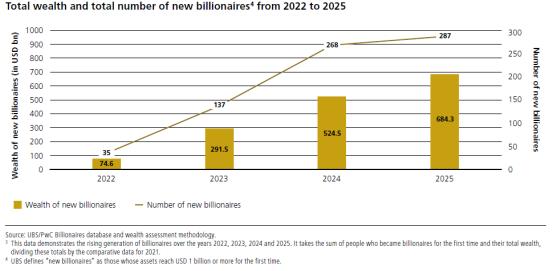
Core Insights - The UBS report indicates that by 2025, the number of billionaires globally will reach a historic peak of 2,900, with an increase of 287 billionaires in one year, marking a growth rate second only to 2021 [1][4] - The total wealth controlled by billionaires is projected to reach $15.8 trillion, a 13% increase from $14 trillion in 2024, highlighting a trend of accelerated wealth concentration [1][4] Group 1: Wealth Growth Drivers - The primary drivers for the increase in the number and wealth of billionaires are the rising valuations of global tech stocks and overall stock market strength, which provide robust support for the wealth appreciation of the ultra-rich [2] - Judy Spalthoff from UBS predicts continued growth in the billionaire population and wealth in the coming year [2] Group 2: Wealth Distribution and Inequality - The report highlights a stark contrast between the soaring wealth of billionaires and the structural inequalities in global wealth distribution, with a K-shaped divergence becoming increasingly evident [3] - The global Gini coefficient is nearing the warning threshold of 0.7, significantly exceeding the risk threshold of 0.6, indicating extreme wealth distribution imbalance [3][25] Group 3: Billionaire Demographics - Among the 2,919 billionaires, 2,059 are self-made, while 860 inherited their wealth, showcasing a dual path to billionaire status [5][6] - In 2025, 91 individuals became billionaires through inheritance, with a total inherited wealth of $298 billion, predominantly in the U.S. [6] Group 4: Regional Distribution - The Asia-Pacific region is identified as the core engine for billionaire growth, with the number of billionaires increasing from 981 to 1,036, led by mainland China with 470 billionaires [9] - The U.S. remains home to nearly one-third of the world's billionaires, with their total wealth rising by 18% to $17.5 trillion [9] Group 5: Investment Preferences - Billionaires are showing a strong preference for equities, particularly in the U.S., with 43% planning to increase their public equity holdings in the next 12 months [11] - Confidence in the U.S. as an investment destination has declined, with the percentage of billionaires seeing opportunities dropping from 80% to 63% [13] Group 6: Mobility Trends - Over one-third (36%) of billionaires have relocated, with many seeking better quality of life and favorable tax conditions, indicating a trend towards wealth concentration in policy-friendly regions [16] - The UAE, Hong Kong, and Singapore are emerging as key hubs for wealthy individuals, while cities like London are experiencing outflows due to declining living conditions [16] Group 7: Socioeconomic Implications - The report underscores the growing divide between the wealthy and the general population, with ordinary citizens facing rising inflation and stagnant wages, leading to a K-shaped economic recovery [17][18] - The wealth concentration among the top 1% is becoming increasingly unsustainable, posing risks to social stability and economic growth [25][29]

全球首个机器人租赁平台擎天租完成种子轮融资,上线三周用户突破20万
机器人圈· 2026-01-16 09:10
Core Insights - The article discusses the launch and rapid growth of the world's first robot rental platform, Qingtian Rental (Shanghai) Technology Co., Ltd., which has completed its seed round of financing led by GL Ventures and other investors [2][3]. Group 1: Company Overview - Qingtian Rental aims to expand its market presence and enhance its technology and service systems with the newly acquired funds [2]. - The platform was officially launched on December 22, 2025, and has quickly gained traction, surpassing 200,000 registered users within three weeks and maintaining over 200 daily rental orders [3]. Group 2: Business Model and Strategy - The platform utilizes an innovative model of "shared rental + platform scheduling," transforming high-cost robot products into on-demand, standardized service capabilities [3]. - Qingtian Rental's design logic positions robots as flexible, quickly deployable "production factors" rather than one-time sale devices, creating a service network that connects supply and demand [5]. Group 3: Industry Challenges and Solutions - The company addresses the industry's "last mile" challenge by systematically reducing barriers to entry and improving delivery efficiency, facilitating the transition from technology validation to commercial application [7]. - The platform's rapid growth is seen as a validation of its scalable model, with the potential to significantly enhance the commercialization of robots in the real economy [7]. Group 4: Market Applications and Partnerships - Qingtian Rental has established partnerships with various high-frequency commercial and restaurant brands, such as Meiyijia and Haidilao, to implement robot services in customer engagement and brand activities [11]. - The platform's standardized service system and operational support enable local service providers to participate in the robot industry's value chain, promoting scalability [11]. Group 5: Future Plans - The company has outlined a clear "1234 strategy" aiming to connect with over 10 robot manufacturers, develop 200 premium service providers, gather 3,000 content creators, and serve 400,000 rental customers by 2026 [13]. - Qingtian Rental plans to expand its service network to 200 cities nationwide, making robot services a fundamental capability in commercial and urban operations [13].

红旗连锁1月15日获融资买入2925.05万元,融资余额3.35亿元
Xin Lang Cai Jing· 2026-01-16 01:30
Group 1 - The core viewpoint of the news is that Hongqi Chain's stock performance and financial metrics indicate a challenging environment, with a decline in revenue and net profit, alongside notable trading activity in margin financing and securities lending [1][2]. Group 2 - On January 15, Hongqi Chain's stock fell by 1.38%, with a trading volume of 350 million yuan. The margin financing data showed a net outflow of 3.6864 million yuan for the day, with a total margin balance of 335 million yuan, representing 3.84% of the circulating market value [1]. - The company reported a revenue of 7.108 billion yuan for the period from January to September 2025, reflecting a year-on-year decrease of 8.48%. The net profit attributable to shareholders was 383 million yuan, down 1.89% year-on-year [2]. - As of December 10, the number of shareholders for Hongqi Chain increased by 5.19% to 68,600, while the average circulating shares per person decreased by 4.93% to 16,699 shares [2].
中国消费板块 2026 展望:消费信心复苏是否已开启?-China Consumer Sector_ 2026 Outlook_ are we at the beginning of consumer confidence recovery_
2026-01-15 06:33
Summary of the Conference Call Transcript Industry Overview - **Industry**: China Consumer Sector - **Outlook**: The sector is believed to be in the early stage of a multi-year recovery cycle that began in Q3 2024, with expectations for gradual improvement in consumer sentiment and spending through 2026E [2][11][12] Key Insights - **Valuation**: MSCI China Consumer Discretionary and Staples are trading at 17x and 15x 12-month forward PE, approximately one standard deviation below the 10-year averages, indicating that current valuations do not reflect a potential consumption recovery [2][9] - **Consumer Confidence**: The China Consumer Confidence Index has been trending upwards since September 2024, suggesting a gradual restoration of consumer confidence despite ongoing challenges in the property market [12][19] - **K-shaped Recovery**: The recovery is characterized by a K-shaped trend, where mid- to high-income consumers in tier-1 cities are expected to lead spending, while lower-tier city consumers remain focused on value for money [3][48] Consumer Behavior Trends - **Shifting Preferences**: A UBS Evidence Lab survey indicates a divergence in consumer behavior, with over 50% of mid- to high-income consumers reporting investment gains and showing strong spending intentions, particularly in premium and experiential categories [3][37] - **Spending Intentions**: The strongest spending intentions are noted in beauty and skincare (41%) and tourism (37%), reflecting a shift towards experiential and premium spending [51] - **Investment Gains**: 64-74% of mid- to high-income consumers reported increased investment returns, with many planning to reinvest or spend on travel, health services, and consumer electronics [40][41] Stock Implications - **Company Ratings**: - Upgrades to Neutral for Fenjiu due to expected benefits from non-business baijiu consumption - Buy ratings maintained for companies like MIXUE, Guming, China Foods, CR Beer, and YUM China, among others [4] - **Dividend Payouts**: Premium baijiu companies are noted for their >75% dividend payout, which is expected to protect share prices from downside risks [4] Structural Growth Opportunities - **Emerging Themes**: Key investment themes for 2026E include changing consumer preferences, corporate restructuring, and industry consolidation, particularly in sectors like home appliances and mass-market consumption [14][50] - **Corporate Restructuring**: Companies are expected to adapt their business models to align with changing consumer behaviors, which may lead to sustainable long-term earnings growth [4][50] Risks and Challenges - **Property Market Downturn**: The ongoing downturn in the property market is anticipated to weigh on household balance sheets, potentially impacting consumer spending [13][48] - **Policy Support**: The pace of recovery is contingent on stabilizing the property market and effective policy implementation to boost consumption [13][48] Conclusion - The China consumer sector is poised for a recovery, driven by improving consumer confidence and shifting spending patterns. However, the recovery will be uneven across different income groups and city tiers, necessitating a nuanced investment approach to capture emerging opportunities while being mindful of potential risks associated with the property market downturn.