古茗

Search documents
消费企业密集境外上市 “新消费”概念站到资本风口
Zheng Quan Shi Bao· 2025-05-11 18:37
2024年下半年以来,消费企业赴境外上市已蔚然成风。 据了解,2025年以来,消费类企业如茶饮品牌中的蜜雪冰城、古茗、沪上阿姨、霸王茶姬纷纷在港股和 美股上市,同时还有老乡鸡、遇见小面、绿茶、鸣鸣很忙等众多消费类企业正在上市进程中。值得注意 的是,这里面有不少是新消费企业。 对于这一轮消费类企业赴境外上市的热潮,分析人士指出,在契合促消费的政策纲领下,一方面前几年 是消费类股权投资高潮期,在当前时点其背后的机构有着退出需求,尤其对赌协议带来了迫切的上市需 求;而另一方面,则是目前头部消费类企业面临着国际化需求,上市对其国际化扩张以及品牌提升均有 相应助力,以整合更多资源。此外,消费类企业尤其是新消费企业上市,更是顺应消费趋势变化的必然 举措。 消费企业密集上市 消费类企业正在迎来上市高潮。以新式茶饮品牌为例,今年2月古茗、3月蜜雪集团赴港上市,4月霸王 茶姬赴美上市,5月沪上阿姨在港上市,在短短4个月内就有4家同行业公司上市。 不仅如此,2025年以来,港股市场还有纽曼思、布鲁可、舒宝国际等消费类企业已经上市,目前,另一 家餐饮企业绿茶正处于招股期,即将登陆港股市场。而港股还有众多消费企业已经递表,如老乡鸡、 ...
财报会说话:真实的茶饮出海现状
FBIF食品饮料创新· 2025-05-11 16:14
Core Viewpoint - The article discusses the significant trend of Chinese tea brands expanding internationally, particularly in Southeast Asia, highlighting the strategies and challenges faced by various companies in this competitive landscape [5][4]. Group 1: Market Overview - The global ready-to-drink beverage market is projected to exceed $1.1 trillion by 2028, with a compound annual growth rate (CAGR) of 7.2% from 2023 to 2028 [4]. - Southeast Asia's tea beverage market is expected to grow from $20.1 billion in 2023 to $49.5 billion by 2028, achieving a CAGR of 19.8%, making it one of the fastest-growing regions globally [4]. Group 2: Company Strategies - Different Chinese tea brands are at various stages of international expansion: - Mixue Ice City focuses on scaling up [7]. - Nayuki targets high-end markets [7]. - Cha Bai Dao emphasizes differentiation [7]. - Gu Ming concentrates on regional deep cultivation [7]. - Mixue Ice City leverages its supply chain advantages to build a tea empire, with a significant increase in overseas store openings [10][11]. - Nayuki's strategy involves positioning itself as a luxury brand in Southeast Asia, with high average order values and premium pricing compared to local competitors [20][21]. - Cha Bai Dao adopts a localized approach, ensuring product quality and flavor by sourcing local ingredients and adapting to regional tastes [27][28]. - Gu Ming remains cautious about international expansion, focusing on deepening its presence in lower-tier cities within China [31][32]. Group 3: Financial Performance - Mixue Ice City's financial report indicates a substantial increase in overseas store count, with 4,895 stores outside mainland China as of December 31, 2024, up from 4,331 the previous year [10][11]. - Nayuki reported a revenue of 4.921 billion yuan in 2024, a decline of 4.7% year-on-year, and a shift from profit to a net loss of 919 million yuan [21][24]. - Cha Bai Dao has successfully opened multiple stores in Southeast Asia, with plans for continued expansion in 2025 [28][30]. Group 4: Challenges and Market Dynamics - The international expansion of Chinese tea brands faces challenges such as local competition, regulatory changes regarding environmental policies, and the need for effective supply chain management [34][36]. - The capital market's response to these brands is polarized, with some experiencing significant stock price declines while others, like Mixue and Gu Ming, have seen substantial increases in market value [37][39]. - The article emphasizes that the next phase of competition in the Southeast Asian tea market will hinge on innovation and the ability to adapt to local consumer preferences [38][40].


4 月中国餐饮行业数据跟踪:需求波动,外卖补贴撑起一片天
Zhi Tong Cai Jing· 2025-05-11 14:30
Core Insights - Goldman Sachs released the latest data tracking high-frequency indicators for China's restaurant industry, revealing mixed results for same-store sales in April [1] Group 1: Market Trends - The market sentiment has been negatively impacted by the U.S. tariff increases, leading to fluctuations in demand [1] - Despite a low base compared to pre-pandemic levels, Haidilao's table turnover rate in April saw a significant year-on-year decline, worsening from a low single-digit drop in March to a double-digit drop [1] - Labor Day holiday sales growth outpaced overall consumption growth, with key restaurant retail sales increasing by 8.7%, compared to a 6.3% rise in total retail sales [1] Group 2: Company Performances - **Haidilao (6862.HK; Neutral)**: In April, Haidilao's average table turnover rate dropped to approximately 3.4 times, down from 3.6 times in March, indicating a recovery to about 70% of pre-pandemic levels [2] - **Guming (1364.HK; Buy)**: Guming's same-store sales growth accelerated in April, benefiting from a low base and delivery platform subsidies, with plans to open 2,500 new stores this year [3] - **Jiumaojiu (9922.HK; Neutral)**: During the Labor Day holiday, Jiumaojiu's same-store sales decline narrowed, with new stores performing well, indicating potential for future growth despite short-term pressures [4] - **Naixue (2150.HK; Sell)**: Naixue's same-store sales increased by 3% in April, driven by a 7% rise in order volume, although the average transaction value decreased by 4% [6] Group 3: Sales Dynamics - Guming's management remains confident in its expansion plans, with a focus on new product launches to attract customers [3] - Naixue's delivery revenue surged by 77% during the Labor Day holiday, accounting for 52% of total orders, while dine-in revenue fell by approximately 10% [6] - Haidilao's table turnover rate during the Labor Day period exceeded 5 times, although it still represented a year-on-year decline of about 10% [2]
新茶饮狂掀上市潮!“盛宴”还是“剩宴”?
Zhong Guo Ji Jin Bao· 2025-05-11 11:39
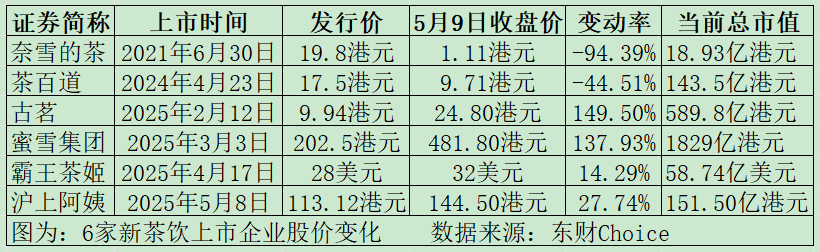
Core Insights - The new tea beverage industry is experiencing a significant wave of IPOs, with major companies like Gu Ming, Mixue Group, and others going public since February 2025, leading to notable stock price increases on their debut [1][4] - However, a clear differentiation in stock performance has emerged among these companies post-IPO, indicating a shift into a more competitive phase characterized by homogenization and excessive scaling [1][4][15] Group 1: IPO Performance - Gu Ming and Mixue Group saw stock price increases of 149.50% and 137.93% respectively since their IPOs, while other companies like Bawang Chaji and Hushang Ayi had more modest gains of 14.29% and 27.74% [2][4] - Naixue Tea and Chabaidao, which went public earlier, have faced significant declines in stock prices, with decreases of 94.39% and 44.51% respectively since their IPOs [10][14] Group 2: Market Dynamics - The new tea beverage industry is transitioning from a growth phase focused on market share acquisition to a more mature phase emphasizing differentiation and refined strategies [22][23] - The industry faces challenges such as product homogenization, oversupply of stores, and declining operational efficiency, which have led to a decrease in profitability for several companies [15][16] Group 3: Financial Performance - In 2024, Mixue Group, Bawang Chaji, and Gu Ming reported net profit growth rates of 39.8%, 213.3%, and 36.2% respectively, while Hushang Ayi and Chabaidao experienced declines of 15.2% and 58.55% [14] - Gu Ming's single-store GMV decreased by 4.3% year-on-year, and the average daily sales per store fell by 8.59%, indicating challenges in maintaining sales performance [16][17] Group 4: Strategic Responses - Companies are increasingly focusing on differentiation strategies, with Mixue Group leveraging its supply chain capabilities to gain competitive advantages [24][25] - The industry is also exploring international expansion, with several companies listing overseas to support their global business initiatives [28]
番茄资本创始人卿永:国内餐饮可出手的机会不多了
经济观察报· 2025-05-10 04:57
Core Viewpoint - The future of restaurant investment will move away from a scattergun approach to a more focused and meticulous strategy, emphasizing the need for investment institutions that understand both capital and industry, capable of identifying and nurturing opportunities [1][14] Group 1: Recent Developments in Restaurant IPOs - New tea beverage brand Bawang Chaji (CHA.O) officially listed on NASDAQ on April 17, becoming the first new-style tea beverage company to enter the US stock market, with a market capitalization exceeding $5 billion after a 12% opening day increase [2] - In the week prior, Hong Kong restaurant brand Niu Daren successfully listed on NASDAQ, raising $120 million, while another brand, Yujian Xiaomian, submitted its prospectus to the Hong Kong Stock Exchange, aiming to become the first listed Chinese noodle restaurant [2] - The recent surge in restaurant IPOs has drawn attention, with several brands, including Mixue Ice Cream and Guming, also having listed in Hong Kong [2] Group 2: Investment Trends and Market Dynamics - According to Qing Yong, founder of Tomato Capital, the current wave of IPOs is a continuation of the investment boom in the restaurant sector that peaked in 2021, which saw 178 financing events totaling over 21 billion yuan [3] - The 2021 investment frenzy led to inflated valuations, with brands like Manner and Hutouju achieving single-store valuations exceeding 100 million yuan and 375 million yuan respectively [4] - However, investment in the restaurant sector has cooled significantly, with a 20% year-on-year decrease in financing events in 2023, as capital shifts towards mature enterprises [4] Group 3: Challenges and Future Outlook - Current restaurant investments face the challenge of limited available projects, with many enterprises under pressure to exit their investments, making IPOs a necessary choice [4][5] - The investment landscape has shifted, with a more cautious valuation approach now prevalent, with PE ratios for quality projects at 15 times and ordinary projects at 10 times [10] - The market is witnessing a transformation where only those with sustainable cash flow and reasonable growth will receive valuations aligned with their fundamentals [10][12] Group 4: Investment Strategies and Focus Areas - The financing logic in the restaurant industry has changed, with three main types of companies seeking funding: those nearing IPO, those facing exit pressure, and those with validated single-store models ready for scaling [11][12] - Investment institutions are increasingly focusing on nurturing quality entrepreneurs and building a comprehensive industry ecosystem, moving away from traditional financial investment models [12][13] - Companies are exploring overseas markets for greater investment opportunities, with the US market offering stable single-store profit models and mature exit mechanisms [15]

新茶饮“五一”表现亮眼,有门店销量激增3000%
Nan Fang Nong Cun Bao· 2025-05-09 12:03
Core Insights - The new tea beverage industry experienced explosive growth during the "May Day" holiday, with some stores reporting sales increases of up to 3000% [4][10][12]. Group 1: Sales Performance - During the "May Day" holiday, the domestic tourism market saw 314 million trips, a year-on-year increase of 6.4%, with total spending reaching 180.269 billion yuan, up 8.0% [7]. - Key retail and catering enterprises reported a sales increase of 6.3% year-on-year, with new tea beverages performing particularly well in popular tourist cities [9]. - Specific stores, such as those in scenic areas, saw significant sales growth, with some locations reporting over 1700% increase in sales [11]. Group 2: Consumer Trends - The combination of tea beverages and cultural tourism has created new consumption scenarios, with promotional activities driving sales [10][14]. - Non-first-tier cities and scenic areas showed significant consumption potential, while first-tier cities remained popular [16]. - Foreign tourist spending at tea beverage stores increased by over 60% during the holiday, indicating a growing interest in Chinese-themed drinks [19][24]. Group 3: Product Innovations - New product launches, such as the "Wood Ginger and Papaya" series by Heytea, achieved daily sales of over 5000 cups in popular shopping districts [28]. - Sweetlala's "Watermelon Smoothie Bucket" became the top-selling product during the holiday, with sales exceeding 1.2 million cups [31]. Group 4: Delivery and E-commerce Impact - The competition among delivery platforms significantly boosted sales for new tea beverages, with some brands experiencing order increases of nearly 10 times [33][36]. - The overall tea beverage delivery volume increased by 106% during the holiday period [36].


资本疯抢沪上阿姨
36氪· 2025-05-09 10:12
Core Viewpoint - The article discusses the successful IPO of "沪上阿姨" (Hushang Ayi), a tea beverage company that has capitalized on the growing demand in lower-tier cities in China, highlighting its unique market positioning and growth strategy in the competitive new tea beverage sector [3][4][6]. Group 1: Company Overview - "沪上阿姨" is the largest milk tea company in Shanghai and ranks third in the new tea beverage industry by total number of stores, with over 9,000 locations [4][12]. - The company was founded by a couple, 单卫钧 and 周蓉蓉, who initially started their business in Shanghai but later expanded into lower-tier cities, particularly in northern China [18][19]. - The brand's unique selling proposition is its focus on the mid-range price segment (7-22 RMB) and its strong presence in lower-tier cities, where it has captured a significant market share [12][13]. Group 2: Market Position and Growth - The IPO of "沪上阿姨" occurred during a favorable market environment for new tea beverage companies, with significant investor interest reflected in a subscription rate of 3,400 times the offering [6][11]. - The company has experienced rapid growth, with revenue projections of approximately 21.99 billion RMB in 2022, increasing to 33.48 billion RMB in 2023, and a slight decline to 32.85 billion RMB in 2024 [11]. - The brand's expansion strategy includes a focus on franchise operations, with 99.7% of its stores being franchisee-operated, generating 96.5% of its revenue from franchise-related activities [11][12]. Group 3: Competitive Landscape - "沪上阿姨" faces stiff competition from established brands like "蜜雪冰城" (Mixue Ice City) and "古茗" (Guming), which have also expanded into lower-tier markets [13][21]. - The company has adapted its product offerings to include a lower-priced "轻享版" (Light Enjoyment Version) aimed at price-sensitive consumers, further enhancing its competitive edge in the market [13][14]. - Despite its growth, the company has seen a decline in average store sales and profitability, with average GMV per store dropping from 156 million RMB in 2023 to 137 million RMB in 2024 [29][31]. Group 4: Future Challenges and Strategies - The company is now tasked with maintaining its growth trajectory amid increasing competition and market saturation, particularly in northern China [32][33]. - "沪上阿姨" plans to leverage its recent IPO funding to enhance its market presence, develop new products, and improve its supply chain efficiency [32][33]. - The brand's future success will depend on its ability to differentiate itself in a crowded market and effectively utilize the capital raised from its IPO [33].

财报会说话:真实的茶饮出海现状
3 6 Ke· 2025-05-09 10:08
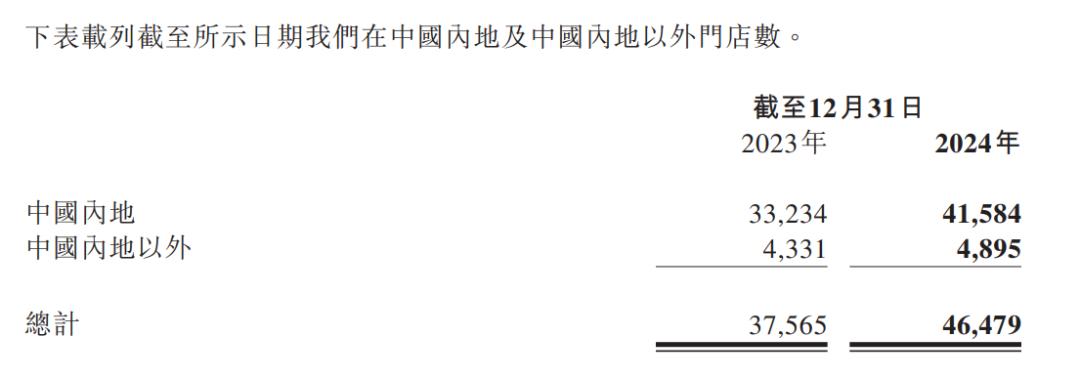
Core Insights - The tea beverage industry is experiencing a significant trend of international expansion, with Chinese brands making their presence felt globally, particularly in Southeast Asia and other regions [1][2][3] - The global ready-to-drink beverage market is projected to exceed $1.1 trillion by 2028, with a compound annual growth rate (CAGR) of 7.2% from 2023 to 2028. Southeast Asia's market is expected to grow from $20.1 billion in 2023 to $49.5 billion by 2028, with a CAGR of 19.8% [1] Group 1: Company Strategies - Several new tea beverage companies are at different stages of international expansion: Mixue Ice Cream and Tea (scale), Nayuki (premium), Cha Bai Dao (differentiation), and Gu Ming (regional focus) [3] - Mixue is leveraging its supply chain advantages to build a tea empire, while Nayuki is focusing on high-end urban areas for expansion [3] - Cha Bai Dao is using fruit tea to attract coffee drinkers in Korea, and Gu Ming is relying on a differentiated image and positioning [3] Group 2: Mixue Ice Cream and Tea - As of December 31, 2024, Mixue had 4,895 stores outside mainland China, an increase of 564 stores from the previous year, averaging 10 new openings per week [4][5] - The company maintains a competitive pricing strategy, with prices in Vietnam ranging from 3-6 RMB and in Indonesia from 3.7-4.6 RMB, significantly lower than mid-to-high-end brands [6] - Mixue's gross profit margin increased from 28.8% in 2023 to 31.6% in 2024, surpassing the industry average of 25% [7] Group 3: Nayuki - Nayuki is positioning itself as a luxury tea brand, with average order values in Thailand reaching 26.7 RMB and daily orders per store at 270.5 [13] - Despite its high-end positioning, Nayuki reported a revenue decline of 4.7% year-on-year, with a net loss of 919 million RMB in 2024 [11][16] - The company plans to adjust its strategy to focus on profitability and product line adjustments for 2025 [16] Group 4: Cha Bai Dao and Gu Ming - Cha Bai Dao opened its first store in Malaysia in November 2023, adapting its product offerings to local tastes and establishing a local operational team [17][18] - The company has developed a training system for tea drinkers in Korea and has tailored its product offerings to local preferences [19] - Gu Ming remains focused on domestic markets, with 80% of its stores in lower-tier cities, and is cautious about international expansion [22][23] Group 5: Market Challenges - The tea beverage industry faces challenges from new environmental regulations in various countries, increasing operational costs [25][26] - Local brands in Southeast Asia are responding aggressively to Chinese brands, often undercutting prices [26] - The competition is expected to intensify as companies must establish robust supply chains and adapt to local cultures to succeed in international markets [27][28]
沪上阿姨登陆港交所,刷新新茶饮板块首日涨幅纪录
Bei Jing Ri Bao Ke Hu Duan· 2025-05-09 10:07
Core Viewpoint - Hu Shang A Yi officially listed on the Hong Kong Stock Exchange on May 8, becoming the fifth new tea beverage company in the Hong Kong market, with a significant first-day price increase of 68.5% from the issue price [1] Group 1: Company Performance - On its first trading day, Hu Shang A Yi opened at HKD 190.6 per share, reaching a market capitalization of over HKD 18.4 billion, setting a record for first-day gains in the new tea beverage sector [1] - The company's store count is projected to reach 9,176 by the end of 2024, representing a 73% increase from 2022, with 50.4% of stores located in third-tier cities and below [1] - Revenue for Hu Shang A Yi from 2022 to 2024 is forecasted at CNY 2.199 billion, CNY 3.348 billion, and CNY 3.284 billion respectively, with adjusted net profits of CNY 154 million, CNY 416 million, and CNY 418 million during the same period [1] Group 2: Market Context - The new tea beverage market in China is expected to exceed CNY 400 billion by 2028, but has shifted from an incremental market to a stock market since 2022, leading companies to focus on high-quality development rather than just expansion [1] - The stock performance of new tea beverage companies has shown significant divergence, with notable gains for Gu Ming, Mi Xue Ice City, and Ba Wang Tea Ji, while earlier entrants like Nai Xue's Tea and Cha Bai Dao have seen substantial declines in their stock prices [2] - The initial success of Hu Shang A Yi's listing is attributed to the confidence instilled in the market by Mi Xue Ice City, indicating a "domino effect" among new tea brands [2]
财经观察|听奶茶“敲”钟看凉茶“泡”面,“椰”风挡不住价格战
Qi Lu Wan Bao· 2025-05-09 09:23
Group 1 - The core viewpoint of the articles highlights the rapid growth and competitive landscape of the tea beverage market in China, with significant capital interest and multiple companies going public in 2023 [1][2][3] - The new tea beverage market in China is projected to reach a scale of 3,547.2 billion yuan in 2024, but the growth rate is expected to drop sharply from 44.3% in 2023 to 12.4%, indicating a shift to a phase of stock competition [3] - Several new tea beverage companies have recently gone public, with notable stock performance; for instance, "Hushang Ayi" saw its stock price surge over 68% on its first day of trading [2] Group 2 - The strategic partnership between Wanglaoji and South Korean food giant Nongshim marks a significant move in the tea beverage sector, focusing on channel sharing, brand promotion, and joint product development [8][11] - Wanglaoji's recent initiatives, including the establishment of its headquarters in the Guangdong-Hong Kong-Macao Greater Bay Area, aim to enhance its global presence and digital transformation [11] - The tea beverage industry is increasingly viewed as a cultural carrier, with brands like "Jasmine Milk White" expanding internationally and emphasizing cultural resonance rather than mere market entry [12]