微软

Search documents
计算机行业点评报告:英伟达(NVDA.O):Blackwell系列与数据中心推动公司业绩创高
Huaxin Securities· 2025-11-23 13:35
Investment Rating - The report maintains a "Recommendation" rating for the industry [10] Core Insights - The report highlights that NVIDIA achieved a revenue of $57 billion in Q3 2025, representing a year-on-year growth of 62% and a quarter-on-quarter growth of 22%. The data center business generated $51.2 billion, with a year-on-year increase of 66% and a quarter-on-quarter increase of 25% [3][4] - NVIDIA's GAAP gross margin was 73.4%, and net profit reached $31.91 billion, reflecting a year-on-year growth of 65% [4][7] - The Blackwell architecture has been fully implemented, driving product updates and performance breakthroughs across multiple product lines [4][6] Revenue and Profit Performance - Total revenue for NVIDIA in Q3 2025 was $57 billion, with the data center segment contributing $51.2 billion, accounting for nearly 90% of total revenue [4] - The gaming, professional visualization, and automotive and robotics segments also saw year-on-year growth of 30%, 56%, and 32%, respectively [4] - GAAP net profit was $31.91 billion, with a GAAP gross margin of 73.4%, indicating stable profitability [4] Product and Technology Layout - The Blackwell architecture has led to significant updates in NVIDIA's product offerings, including the new GPU "NVIDIA Rubin CPX" designed for large-scale context processing [4][6] - New gaming titles such as "Borderlands 4" and "Battlefield 6" were released, enhancing player experience with advanced technologies [4] - NVIDIA introduced the world's smallest AI supercomputer, DGX Spark, and upgraded its automotive and robotics platforms with the DRIVE AGX Hyperion 10 development platform [4][6] Customer and Ecosystem Cooperation - NVIDIA has expanded its global strategic partnerships, including a collaboration with OpenAI for AI infrastructure deployment [6] - Partnerships with major companies like Google Cloud, Microsoft, and Oracle aim to build AI infrastructure in the U.S. and Europe [6] - In Asia, NVIDIA is working with the South Korean government and major corporations to enhance AI infrastructure [6] AI Technology Empowerment - AI remains the core driver of NVIDIA's strategy, with breakthroughs in training and inference achieved during the quarter [6] - The Blackwell platform set records in MLPerf Inference v5.1 benchmarks, showcasing its capabilities [6] - NVIDIA launched the NVQLink open system architecture, integrating GPU computing with quantum processors [6] Investment Recommendations - The report suggests that investors should continue to monitor NVIDIA's advancements in AI technology, global ecosystem collaborations, and multi-industry solution expansions [7]
投资大佬但斌“晒单”引热议:海外基金三年赚138%全球第三,投资者质疑
Mei Ri Jing Ji Xin Wen· 2025-11-23 09:52
Core Insights - The article highlights the performance of Dongfang Hongwan's overseas fund, which achieved a three-year return of 138.98%, ranking third among 9,970 global hedge funds, and a one-year return of 26.63% [1][5] - There is a mixed market interpretation of these results, with the one-year return being slightly above the domestic average of 24.32% but significantly lower than the top 5% return of 82.48% [1][5] - Concerns have been raised regarding the underperformance of domestic products, which recorded returns around 15%, well below the average [1][5] Investment Strategy - Dongfang Hongwan's investment strategy is heavily focused on AI, with a significant portion of its $1.292 billion portfolio allocated to AI-related stocks, including major holdings in Nvidia and Google [3][4] - The fund's top holdings include Nvidia at $236 million, Google at $224 million, and new positions in Alibaba and Broadcom, reflecting a strong belief in the AI sector [3][4] - The fund also invested in key players in the AI supply chain, such as Astera Labs and BitMine Immersion Technologies, indicating a comprehensive approach to the AI industry [4] Performance Analysis - The long-term performance of Dongfang Hongwan is praised for its effectiveness in value investing, with a three-year return of 138.98% demonstrating strong asset judgment [5][7] - However, the one-year performance has sparked debate, as it falls short compared to peers, raising questions about the sustainability of its strategy [5][7] - The domestic products have shown significant volatility, with notable losses earlier in the year, leading to investor concerns about short-term performance [6][7] Market Perspective - Analysts suggest that the performance disparity reflects the inherent differences between value investing and short-term speculation, especially in a structural bull market [7] - The current market environment has created numerous short-term opportunities, but high volatility is expected, making long-term strategies more appealing [7] - The ongoing debate centers on whether to pursue short-term gains or to invest in long-term growth, with Dongfang Hongwan's strategy leaning towards the latter [7]
银行、科技持续拉升,中概股终结八连跌,黄金探底回升
Ge Long Hui· 2025-11-23 05:30
Market Performance - The three major indices closed higher, with the Dow Jones up 1.08%, Nasdaq up 0.88%, and S&P 500 up 0.98% [1] - The banking and technology sectors showed mixed strength, while Chinese concept stocks ended an eight-day decline [1] Banking Sector - Bank stocks continued to rise, with Alliance West Bank increasing by 4.19%, Zion Bank up 3.33%, and US Bancorp up 2.77% [3] - Major banks like Bank of America and Citigroup saw gains of over 1%, while JPMorgan and US Steel experienced slight declines [3] Technology Sector - Technology stocks showed mixed performance, with Google up 3.53%, Intel up 2.62%, and Qualcomm up 2.32% [3] - However, Tesla, Microsoft, and Netflix faced declines, each dropping over 1% [3] Chinese Concept Stocks - Chinese concept stocks opened lower but rebounded, with the China Golden Dragon index rising by 1.23% [3] - Notable gains included NIO up 3.33%, with Li Auto, Bilibili, Beike, and Tencent Music also seeing increases of over 2% [3] - iQIYI faced a decline of 2.74%, while Alibaba and NetEase experienced slight drops [3] Gold Market - COMEX gold opened high but saw fluctuations, ultimately closing up 0.07% at $4062.8 per ounce, with a low of $4018.1 and a high of $4101 during the session [3]


谷歌(GOOG.US)、微软(MSFT.US)“双杀”逼近,OpenAI陷入空前危机!
智通财经网· 2025-11-22 09:58
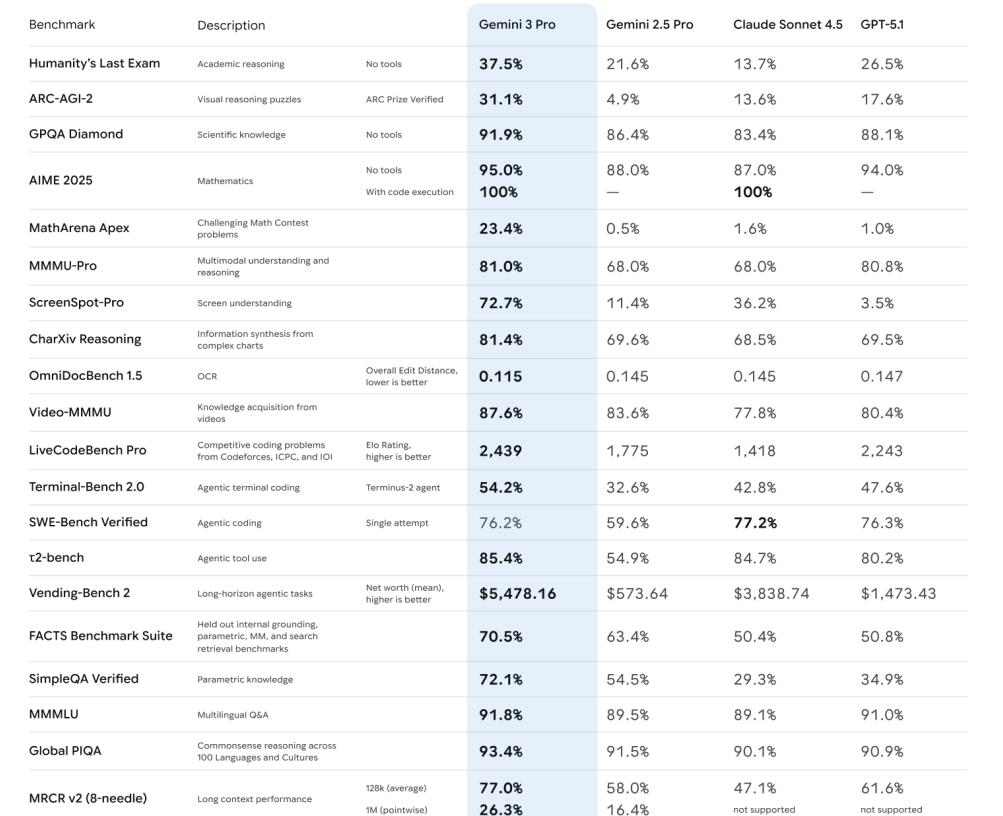
Core Insights - OpenAI faces significant challenges as its main partner Microsoft collaborates with competitor Anthropic in a $350 billion strategic partnership, doubling Anthropic's valuation since September [1] - Google's new AI model, Gemini 3, reportedly outperforms OpenAI's recently released GPT-5.1, indicating a shift in competitive dynamics within the AI sector [1] - Market sentiment remains unstable, with concerns over an AI bubble leading to a tech stock sell-off, despite Nvidia's strong earnings report reigniting investor interest [1] Competitive Landscape - Analysts express divided opinions on OpenAI's ability to maintain its market dominance, with some predicting that Anthropic and Google will continue to erode OpenAI's lead [1][2] - Google’s Gemini model is expected to capture market share due to its scale and established position in the search industry, potentially leaving OpenAI and others behind [2] - The user gap between OpenAI and its competitors is narrowing, with Google reporting 650 million monthly active users for Gemini compared to OpenAI's 800 million weekly active users for ChatGPT [5] Technological Advancements - Gemini 3 Pro demonstrates significant advantages in multimodal processing capabilities, outperforming both its predecessor Gemini 2.5 Pro and OpenAI's GPT-5.1 across various benchmarks [3][4] - In specific tests, Gemini 3 Pro achieved notable scores, such as 95.0% in mathematics and 91.9% in scientific knowledge, surpassing competitors [4] Financial Implications - OpenAI plans to invest over $1.4 trillion in data center construction over the next few years, while still incurring substantial quarterly losses [6] - The aggressive capital expenditure strategy raises concerns about the sustainability of OpenAI's high valuation amid increasing competition and potential revenue growth limitations [6]



微软CEO纳德拉最新万字访谈:AI时代,范式正确不代表就能赢
Tai Mei Ti A P P· 2025-11-22 06:05
Group 1 - The future of software is envisioned as a task control center that integrates various interfaces, allowing professionals from different fields to micro-steer numerous AI agents [1][5][18] - Companies should focus on building their own AI factories rather than envying others, emphasizing the importance of organizing data to meet intelligent demands [1][8] - The concept of "company sovereignty" is redefined, highlighting the value of internal tacit knowledge and the need for companies to own their foundational models to protect their unique advantages [3][28][30] Group 2 - The current infrastructure build-out is characterized as a "capacity hell," contrasting with the 2000 internet bubble, as all computational resources are sold out, with bottlenecks in power and supply [4][26][27] - Microsoft is developing a two-layer AI stack, focusing on capital efficiency in the infrastructure layer and maximizing the value of tokens in the application layer [4][26] - The return of Integrated Development Environments (IDEs) is anticipated, where every professional will have their own IDE to manage AI interactions effectively [5][18] Group 3 - Historical lessons from Microsoft's past, particularly regarding the internet, emphasize that recognizing the right paradigm is crucial, but the specific architectural choices and business models ultimately determine success [6][20][23] - The emergence of a new organizational layer in the AI era is expected, with the potential for new entities to dominate, similar to how search engines did in the past [7][24] Group 4 - The integration of AI into enterprise environments is still in its early stages, with challenges in data governance and the need for better data architecture to facilitate AI's effectiveness [10][11] - The future of software interfaces will blend various formats, creating a more intuitive user experience that allows for seamless interaction with AI agents [5][18][36] Group 5 - The concept of "agentic commerce" is gaining traction, where AI can facilitate transactions and enhance user experiences in e-commerce [34][37] - The importance of data sovereignty is highlighted, with companies needing to navigate regulatory landscapes while building their AI capabilities [28][29]
万亿美元骗局?英伟达靓丽财报背后的危险信号
Sou Hu Cai Jing· 2025-11-22 05:24
Core Viewpoint - Michael Burry warns of potential fraud in the AI investment landscape involving major tech companies, highlighting concerns over "suspicious revenue recognition" practices [3][11]. Group 1: Financial Performance - NVIDIA reported impressive Q3 earnings with revenue of $57.01 billion and earnings per share of $1.30, surpassing market expectations [4]. - Following the earnings announcement, NVIDIA's stock surged by 5%, adding approximately $130 billion to its market capitalization [5]. - However, within 54 hours, NVIDIA's stock experienced a dramatic fluctuation of over $1 trillion in market value, indicating investor uncertainty [6]. Group 2: Financial Data Concerns - A significant red flag was raised with NVIDIA's accounts receivable reaching $33.4 billion, leading to a Days Sales Outstanding (DSO) of 53.3 days, a 15.9% deterioration compared to historical averages [7]. - NVIDIA's inventory surged to $19.8 billion, a 32% increase from the previous quarter, contradicting claims of "crazy" demand [7][8]. Group 3: Insider Selling - Notable investors, including Michael Burry, have begun to exit their positions in NVIDIA, with Burry's firm disclosing substantial put options against the stock [10]. - SoftBank's Masayoshi Son completely liquidated an $5.8 billion position in NVIDIA, shifting focus to "application layer" AI investments [10]. - Peter Thiel's hedge fund also closed its entire NVIDIA position, drawing parallels between the current tech environment and the dot-com bubble [10]. Group 4: Circular Financing Allegations - Burry's concerns extend to a "circular financing" scheme among major tech firms, where companies like NVIDIA and xAI engage in transactions that may inflate revenue figures [11][12]. - This scheme involves NVIDIA providing capital to xAI, which in turn uses that capital to purchase NVIDIA products, creating a loop that artificially boosts NVIDIA's revenue [12][13]. Group 5: Geopolitical Risks - The U.S. Department of Justice has charged four individuals with illegally exporting advanced NVIDIA AI chips to China, highlighting the geopolitical tensions surrounding AI technology [15][16]. - The black market demand for NVIDIA chips underscores the intense global competition for AI computing power [17]. Group 6: Historical Comparisons - Current concerns about NVIDIA's financial practices bear resemblance to past accounting fraud cases, such as Enron and Lucent Technologies, which involved misleading revenue recognition [18]. - The structure of NVIDIA's dealings with xAI mirrors past fraudulent practices, raising questions about the sustainability of its reported revenues [18][19]. - As of November 21, NVIDIA's stock traded at $180.32, maintaining a market cap of $4.39 trillion, but underlying debates about the AI industry's integrity persist [19][20].
AI算力竞争转向,英伟达业绩亮眼,寒武纪营收大增近24倍
21世纪经济报道· 2025-11-22 01:39
Core Viewpoint - Nvidia's latest performance has created significant market fluctuations, with its revenue and guidance remaining strong, yet the stock price has shown volatility, reflecting concerns about future growth sustainability amid external uncertainties [1][3]. Market Performance - Nvidia's stock price initially rose over 5% on the earnings release day but closed down 3.15%, with a cumulative decline of nearly 12% in November [1][3]. - The AI computing sector in the A-share market has also been impacted, with a 3.38% drop in the computing power concept sector and a net outflow of 141.2 billion yuan on November 21 [4]. Investment Trends - The computing power sector is undergoing a reevaluation of its valuation against fundamentals, with some institutions needing to liquidate funds as the year-end approaches [4]. - Long-term demand for AI computing remains strong, driven by major tech companies like Microsoft, Google, Meta, and Amazon increasing capital expenditures [4][6]. Domestic Market Dynamics - Domestic internet companies are experiencing a mixed capital expenditure trend due to chip supply constraints, with Alibaba planning to invest over 380 billion yuan in AI and cloud infrastructure over three years, while Tencent's capital expenditure has decreased by 24% year-on-year [6]. - The domestic computing power ecosystem is rapidly evolving, with a significant shift towards local chip suppliers, projected to increase their market share from 37% to 40% by 2025 [6][7]. Technological Advancements - The focus in the computing power industry is shifting from hardware accumulation to efficiency optimization, with significant advancements in model performance and cost reduction [8][9]. - Research indicates that the capability density of large models is expected to double approximately every 3.5 months, suggesting a move away from merely increasing model size [8]. Industry Collaboration - The domestic computing power ecosystem is forming a more comprehensive division of labor, with improvements across all stages from chip design to data center deployment [7]. - System-level innovations, such as the adoption of supernode technology, are helping domestic companies enhance computing performance despite limitations in chip capabilities [9]. Emerging Opportunities - The AI computing sector is becoming a primary growth engine for the communications industry, with investment opportunities emerging in various sub-sectors, particularly in optical modules and chips [12]. - The liquid cooling technology market is projected to grow significantly, with a compound annual growth rate of 46.8% from 2024 to 2029, indicating a shift towards more efficient cooling solutions [10][13]. Investment Shifts - Investment in the computing power industry is transitioning from infrastructure to application innovation, reflecting a maturation of the sector [13]. - The core drivers of the computing power industry are evolving from mere scale expansion to a dual focus on efficiency enhancement and self-sufficiency [13].
大佬们先跑了
创业邦· 2025-11-21 10:39
Core Viewpoint - The article discusses the recent surge in the U.S. stock market, particularly driven by the AI revolution, with significant gains in major tech stocks like Microsoft, Apple, Google, and Nvidia, while also highlighting the recent stock sell-offs by prominent investors like Warren Buffett, Bill Gates, and Masayoshi Son [5][6][18]. Market Performance - The Dow Jones Industrial Average reached a historical high of 48,431.57 points, up 46% since the beginning of 2023 [5]. - The Nasdaq index hit a record high of 24,019.99 points, more than doubling with a 131.25% increase since the start of 2023 [5]. Key Tech Stocks - Nvidia's stock price surged over 1300%, making it the first company to exceed a market capitalization of $5 trillion [5]. - Microsoft and Apple both saw their stock prices double, with their market capitalizations around $4 trillion [5]. - Google (Alphabet-A) experienced a stock price increase of over 200%, reaching a market cap of $3.5 trillion [5]. Investor Actions - Warren Buffett's Berkshire Hathaway reduced its Apple stock holdings by 15%, with a market value decline exceeding $10 billion [10][11]. - Buffett's recent investment in Google amounted to 17.85 million shares, valued at $4.34 billion, marking a significant shift in his portfolio [11]. - Bill Gates' foundation sold 17 million shares of Microsoft, reducing its stake by 65%, while also increasing its investment in Berkshire Hathaway [18]. Notable Sell-offs - Nvidia's CEO Jensen Huang has been selling shares consistently, offloading 829,700 shares since the beginning of 2025, with a total value of approximately $15.48 million [14][15]. - Masayoshi Son completely liquidated his Nvidia holdings, marking his second exit from the company [19][21]. - Investor Duan Yongping sold 38% of his Nvidia shares, reflecting a cautious approach to the stock's valuation [19]. Financial Metrics - Nvidia's revenue for the fiscal year ending January 26, 2025, reached $130.5 billion, with a growth rate of 114% and a gross margin of 75% [14]. - As of the third quarter of 2025, Nvidia's quarterly revenues were $44.1 billion and $46.7 billion, showing year-on-year growth of 69% and 56%, respectively [14]. - Apple's revenue for the fourth fiscal quarter of 2025 was $102.47 billion, with a growth rate of 7.94%, while Google's revenue for the third quarter was $102.35 billion, growing at 16% [12].

英伟达力挽AI泡沫论 潜在风险信号浮现
Bei Jing Shang Bao· 2025-11-21 03:33
Core Viewpoint - The recent earnings report from NVIDIA has temporarily alleviated concerns about a potential AI bubble, showcasing strong financial performance while also revealing some underlying risk signals [1][2]. Financial Performance - For Q3 of FY2026 (ending October 26, 2025), NVIDIA reported a revenue increase of 62.5% year-over-year and a net profit growth of 65%, with data center revenue surpassing $50 billion for the first time [2]. - NVIDIA's guidance for the next quarter anticipates total revenue of $65 billion, exceeding analyst expectations of $61.7 billion, and does not include revenue from data centers in China [3]. Demand and Inventory Concerns - Despite strong earnings, NVIDIA's accounts receivable have been rising, reaching $33.391 billion in Q3, with 65% coming from four major clients [4][5]. - Inventory levels have also increased to $19.784 billion, with days inventory outstanding (DIO) rising to 117.5 days, significantly higher than the average of the past five years [4]. Customer Concentration Risks - NVIDIA's revenue is heavily reliant on a few major clients, with four direct customers contributing 61% of total revenue, up from 56% in the previous quarter [5][6]. - This high customer concentration poses risks to revenue stability if these clients alter their capital expenditure plans [6]. Market Sentiment and Analyst Opinions - Analysts have mixed views, with some maintaining bullish ratings on NVIDIA, citing strong AI demand and growth potential for cloud service providers [7]. - Conversely, notable investors like Peter Thiel and Bridgewater Associates have significantly reduced their holdings in NVIDIA, indicating caution regarding its high valuation and associated risks [8]. Broader AI Market Context - The AI sector is experiencing both excitement and skepticism, with discussions around potential bubbles and the long-term impacts of AI on various industries [8]. - Experts suggest that while there may be short-term speculative bubbles, the transformative potential of AI should not be underestimated [8].
早报 (11.21)| 史诗级突发!美联储降息生变,美股崩了;谷歌AI生图新工具亮相;磷酸铁锂行业推进反内卷
Ge Long Hui· 2025-11-21 00:21
美国劳工统计局周四公布9月非农就业数据。美国9月非农就业人数增加11.9万人,市场预估为增加5.2万 人。美国9月失业率为4.4%,预估4.3%。 费城联储行长哈玛克指出,就业报告"略显稳定",基本符合预期,但强调高通胀仍是美国经济面临的现 实问题。芝加哥联储行长古尔斯比则坦言,利率在未来"将有相当大的下调空间",但在短期内,他对12 月会议再次降息仍持谨慎态度。 市场对政策路径的预期也随之调整。根据CME"美联储观察"工具最新数据显示,美联储12月降息25个 基点的概率已降至39.6%,而维持利率不变的概率则升至60.4%。 谷歌推出新一代AI图像生成器Nano Banana Pro,谷歌Labs和Gemini的副总裁乔希·伍德沃德(Josh Woodward)称,Nano Banana Pro的功能超越了8月底推出的第一代产品。"它在信息图表方面令人难以 置信。它可以做幻灯片。它可以使用多达14个不同的图像,或者五个不同的角色,并保持角色的一致 性。" 美股方面,三大指数集体收跌,道琼斯指数跌0.84%,标普500指数跌1.56%,纳斯达克综合指数跌 2.15%。 大型科技股集体下挫,AMD跌超7%,甲骨 ...