
协鑫科技

Search documents
【行业动态】最高113.8%,中国对美韩多晶硅反倾销税再延五年
Sou Hu Cai Jing· 2026-01-15 04:10
Core Viewpoint - The Chinese Ministry of Commerce announced the extension of anti-dumping duties on imported solar-grade polysilicon from the US and South Korea, effective from January 14, 2026, for a period of five years, to protect the domestic polysilicon industry [2][3]. Group 1: Anti-Dumping Measures - The anti-dumping duties will range from 0% to 2.1% for related products from the US, with specific rates for different companies: Hemlock Semiconductor Corporation at 53.3%, and others at 57% [2]. - South Korean companies will face varied rates, with OCI Corporation at 4.4%, Hanwha Solutions at 8.9%, and others up to 113.8% due to severe dumping circumstances [3]. Group 2: Historical Context - The current measures are a continuation of trade relief actions initiated in 2014, when it was found that US and South Korean companies were exporting polysilicon at prices below normal value, harming domestic producers [3][4]. - The initial duties were set for five years, with adjustments made in 2017 and a review in 2020 leading to the extension of these measures [3]. Group 3: Industry Impact - The policy aims to enhance the cost threshold for US and South Korean imports, thereby stabilizing market shares for domestic leaders like Tongwei and GCL, while also facilitating investment recovery and technological development [4]. - The short-term effect may pressure component manufacturers due to rising raw material costs, but long-term benefits include reduced dependency on foreign supply chains and enhanced competitiveness in the global market [4][5]. Group 4: Global Trade Dynamics - The policy is expected to shift the global polysilicon trade flow, as US and South Korean companies may redirect exports to regions like Southeast Asia, India, and Europe, where no anti-dumping measures are in place [5]. - This move is seen as a countermeasure to previous US tariffs on Chinese solar products, preserving negotiation leverage for China in international trade discussions [5]. Group 5: Strategic Importance - The extension of these duties is crucial for China's energy transition goals, as polysilicon is a key material in the photovoltaic industry, directly impacting the stability of the entire supply chain [5]. - The five-year policy period provides a valuable window for technological upgrades in the domestic polysilicon industry, promoting advancements in high-end materials like N-type and electronic-grade silicon [5].


硅业分会:市场观望氛围浓厚 本周多晶硅供需平衡迹象再现
智通财经网· 2026-01-14 09:25
Group 1 - The domestic polysilicon market is experiencing a lack of trading activity, with only a few companies achieving small exploratory orders, as both upstream and downstream enterprises adopt a wait-and-see attitude [1] - The recent export tax rebate policy for photovoltaic products has provided short-term support for battery and module exports, but some demand has been preemptively pulled forward to 2025, limiting its actual impact on current demand [1] - Rising silver prices have significantly increased production costs for battery cells and modules, creating uncertainty regarding the downstream acceptance of these cost increases, which affects operational rates [1] Group 2 - According to Antaike, the transaction price range for n-type polysilicon this week is between 50,000 to 63,000 yuan per ton, with an average transaction price of 59,200 yuan per ton, remaining stable compared to the previous week [1] - In January, some leading companies are gradually halting production, with plans to continue for six months, while two other companies are implementing significant production cuts, leading to an expected monthly polysilicon output of 70,000 to 90,000 tons in Q1 2026 [2] - The current polysilicon market is at a critical stage of supply-demand rebalancing, with price stability primarily driven by significant supply-side reductions [2] Group 3 - The average transaction prices for various types of polysilicon as of January 14, 2026, are as follows: n-type re-investment material at 59,200 yuan per ton, n-type dense material at 55,300 yuan per ton, and n-type granular silicon at 55,800 yuan per ton, all showing no fluctuation [3] - The price data is based on weighted averages from nine polysilicon production companies, which accounted for 89.3% of domestic production in Q4 2025, with n-type materials comprising 91.6% of the total [3][4]
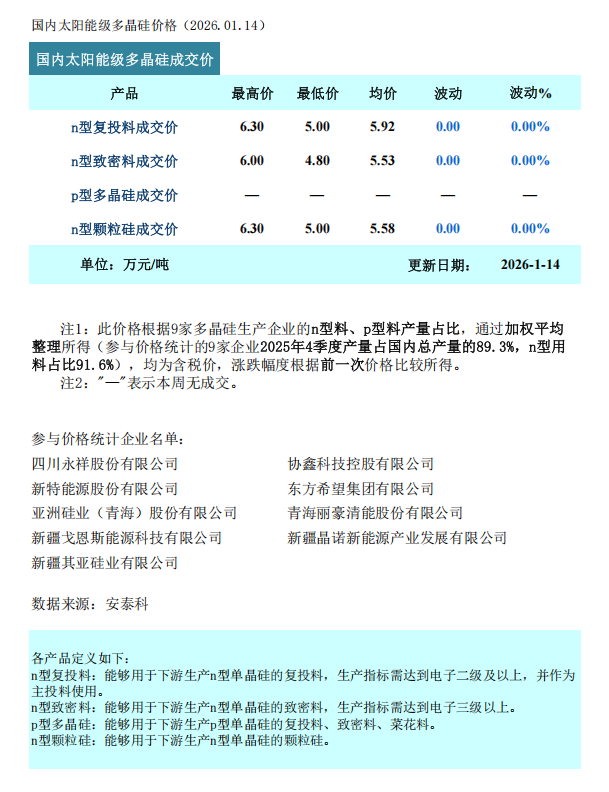
[安泰科]多晶硅周评-市场观望氛围浓厚 供需平衡迹象再现(2026年1月14日)
中国有色金属工业协会硅业分会· 2026-01-14 09:07
Group 1 - The core viewpoint of the article indicates that the domestic polysilicon market is experiencing a lack of significant trading activity, with prices remaining stable due to cautious sentiment among upstream and downstream enterprises [1][2] - The transaction price range for n-type polysilicon re-investment material is reported at 50,000 - 63,000 yuan/ton, with an average price of 59,200 yuan/ton, showing no change compared to the previous period [1][3] - The market is currently in a critical phase of supply-demand rebalancing, with expectations that polysilicon prices will remain stable in the short term, influenced by actual changes in downstream operating rates and demand recovery [2] Group 2 - In January, some leading companies are expected to fully halt production for up to six months, while others will implement significant production cuts, leading to a forecasted monthly polysilicon output of 70,000 - 90,000 tons in Q1 2026 [2] - The supply-demand dynamics are expected to provide important bottom support for the market, as silicon wafer production remains relatively stable and social inventory begins to decrease slightly [2] - The market participants are currently awaiting clearer demand signals, which will determine future price fluctuations based on the evolving supply-demand landscape [2]
中泰国际:近日环球不明朗因素渐增,美国有意缓和格陵兰的言论,升温,或实质动摇美
ZHONGTAI INTERNATIONAL SECURITIES· 2026-01-13 05:20
Market Overview - The Hang Seng Index closed at 26,608 points, up 1.4%, while the Hang Seng China Enterprises Index rose 1.9% to 9,220 points[1] - Total turnover in Hong Kong stocks reached HKD 306.2 billion, a 24.9% increase from HKD 245.1 billion last Friday, indicating positive investor sentiment[1] - Key sectors such as consumer discretionary, information technology, and materials rose by 3.5%, 2.2%, and 2.2% respectively, while energy fell by 0.3%[1] Stock Performance - Alibaba Health (241 HK) and Kuaishou (1024 HK) led the gains, rising by 10.2% and 7.4% respectively[1] - Midea Group (300 HK) and Shenzhou International (2313 HK) were the biggest losers, both down by 2.8%[1] Global Economic Factors - Increasing global uncertainties include investigations into Fed Chair Powell and rising tensions regarding Greenland, which may impact US-EU relations[1] - Oil prices fluctuated between USD 58 and 59 due to expectations of ample supply, while gold prices approached a new high of USD 4,600[1] US Market Insights - The Dow Jones Industrial Average closed at 49,590 points, up 0.2%, amid concerns over Trump's potential interventions in the financial sector[2] - The Hang Seng Index futures closed at 26,994 points, indicating a premium of 386 points, suggesting a continuation of the upward trend in Hong Kong stocks[2] Real Estate Dynamics - In mainland China, the transaction volume of new homes in 30 major cities reached 1.16 million square meters, a year-on-year decline of 39.9%[3] - The decline in transactions was more severe than the previous week's drop of 15.1%, with first, second, and third-tier cities experiencing declines of 41.5%, 34.6%, and 46.8% respectively[3] Industry Highlights - The AI sector in Hong Kong saw significant gains, with companies like SenseTime (20 HK) and Fourth Paradigm (6682 HK) rising by 6.9% and 17.5% respectively[4] - The healthcare index rose by 1.1%, with WuXi Biologics (2269 HK) expected to achieve double-digit revenue growth by 2025[5] Renewable Energy Sector - The photovoltaic sector rebounded, with stocks like Xinyi Solar (968 HK) and Flat Glass Group (6865 HK) increasing by 1.9% to 3.8%[6] - The cancellation of VAT export rebates for photovoltaic products is expected to stabilize export prices in the long term[6]
山西证券研究早观点-20260113
Shanxi Securities· 2026-01-13 00:47
Group 1: Market Overview - The domestic market indices showed positive performance, with the Shanghai Composite Index closing at 4,165.29, up by 1.09% [4] - The SW textile and apparel sector rose by 2.65%, while the SW light industry manufacturing sector increased by 2.98%, indicating a general upward trend in the market [8] Group 2: Company Insights - Fast Retailing Group reported a revenue of 1,027.745 billion JPY for FY2026 Q1, a year-on-year increase of 14.8%, and raised its FY2026 revenue guidance to 3,800 billion JPY, up from the previous estimate of 3,570 billion JPY [6] - Ximai Foods achieved a revenue of 1.896 billion CNY in 2024, reflecting a year-on-year growth of 20.16%, and is positioned as the leading player in the oat industry in China [15][16] - Blue Sky Technology is expected to see revenues of 2.286 billion CNY in 2025, with a growth rate of 20.6%, driven by advancements in small nucleic acid technology [17] Group 3: Industry Trends - The solar energy sector experienced a decline in new installations, with a year-on-year decrease of 11.9% in November 2025, while the cumulative installed capacity for the year reached 274.89 GW, a 33.2% increase [11] - The retail sector is witnessing a shift towards community stores, as evidenced by Walmart's expansion in Shenzhen, indicating a competitive landscape in community retail [7] - The oat industry in China is projected to exceed 10 billion CNY in market size by 2024, driven by increasing health consciousness among consumers [15]
智通港股通资金流向统计(T+2)|1月13日





智通财经网· 2026-01-12 23:32
Core Insights - The article highlights the net inflow and outflow of funds in the Hong Kong stock market, with Xiaomi Group, Tencent Holdings, and China Construction Bank leading in net inflows, while the Yingfu Fund, Hang Seng China Enterprises, and Southern Hang Seng Technology experienced the highest net outflows [1] Group 1: Net Inflows - Xiaomi Group-W (01810) recorded a net inflow of 1.07 billion, representing a 16.36% increase in its closing price [2] - Tencent Holdings (00700) saw a net inflow of 863 million, with a 7.49% increase in its closing price [2] - China Construction Bank (00939) had a net inflow of 699 million, with a significant 41.06% increase in its closing price [2] Group 2: Net Outflows - Yingfu Fund (02800) experienced the largest net outflow of 6.289 billion, reflecting a -31.44% change in its closing price [2] - Hang Seng China Enterprises (02828) had a net outflow of 2.880 billion, with a -17.89% change in its closing price [2] - Southern Hang Seng Technology (03033) faced a net outflow of 1.289 billion, showing a -11.37% change in its closing price [2] Group 3: Net Inflow Ratios - 361 Degrees (01361) led with a net inflow ratio of 74.40%, with a net inflow of 8.9117 million [3] - BRILLIANCE CHI (01114) followed with a net inflow ratio of 64.04%, amounting to a net inflow of 36.4910 million [3] - Qin Port Co. (03369) had a net inflow ratio of 61.05%, with a net inflow of 846,600 [3] Group 4: Net Outflow Ratios - Wisdom Hong Kong 100 (02825) had a net outflow ratio of -100.00%, with a net outflow of -18,200 [3] - Stone Pharmaceutical Group (02005) recorded a net outflow ratio of -68.86%, with a net outflow of -14.1501 million [3] - Dexion Shipping (02510) experienced a net outflow ratio of -53.53%, with a net outflow of -10.0204 million [3]
实体资产上链就能融资?RWA 商业模式的核心逻辑是什么?
Sou Hu Cai Jing· 2026-01-12 11:52
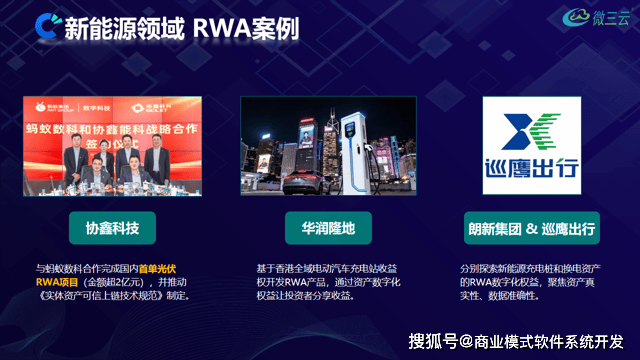
Core Insights - The article emphasizes the growing significance of RWA (Real World Asset tokenization) in Hong Kong's financial sector, predicting a surge in global on-chain RWA asset value from $25 billion to $10 trillion by 2030, a 400-fold increase [1][3]. Group 1: Understanding RWA - RWA serves as a bridge connecting tangible assets like charging stations and office buildings to global capital markets through blockchain technology, allowing these assets to be tokenized and traded easily [3]. - The core concept of RWA involves issuing a "digital ID" for physical assets, enabling them to be traded globally, thus redefining asset ownership, transaction methods, and profit distribution [3][5]. Group 2: Key Conditions for RWA Projects - Four essential conditions for a successful RWA project include having stable cash-generating physical assets, utilizing blockchain and AIoT technologies, establishing a cross-regional compliance framework, and ensuring global circulation channels [5]. - The three main advantages of RWA are: strict correspondence between digital tokens and physical assets, the ability to fragment high-value assets into smaller, affordable tokens, and a fully digitalized process from ownership verification to transaction [7]. Group 3: Steps to Implement RWA - The first step involves selecting suitable assets that can generate stable cash flow and are amenable to digital monitoring, followed by digital transformation to ensure data integrity [6]. - The second step focuses on building a compliance framework, which is crucial for RWA success, especially for cross-border projects, often involving the establishment of SPV companies in Hong Kong to meet regulatory requirements [9]. - The final step is the issuance and circulation of compliant products, typically through private placements to institutional investors, with automated profit distribution via smart contracts [11]. Group 4: Regulatory Landscape - In mainland China, assets must be verified domestically, and retail investors are prohibited from participating, while in Hong Kong, licensed operations are required, with a focus on professional investors [12]. - Singapore emphasizes compliance disclosures, ensuring transparency regarding asset conditions and associated risks [12]. Group 5: Application Scenarios - RWA is being applied in the renewable energy sector, with companies like Longxin and GCL tokenizing their revenue rights to quickly raise funds without relying on traditional bank loans [12]. - In the real estate sector, properties like Dubai's office buildings are being tokenized into millions of shares, allowing lower investment thresholds and automated rental income distribution through smart contracts [12].
东兴证券:太空光伏或成行业第二成长曲线 利好HJT、钙钛矿新技术等方向
智通财经网· 2026-01-12 08:02
Core Viewpoint - The report from Dongxing Securities highlights that solar energy is the preferred energy source for space activities, with the potential for significant growth in the space photovoltaic market driven by the concept of space data centers and advancements in technology [1][2]. Market Demand - Solar energy is identified as the primary energy source for space activities, with current demand mainly for satellite solar wings. The industry is small but rapidly expanding. If the concept of space data centers is realized, it could lead to over 800GW of space photovoltaic installation demand, surpassing current global ground photovoltaic annual additions [2]. - Leading domestic companies are focusing on the space photovoltaic market, accelerating technology research and scenario exploration, indicating a shift from concept validation to explosive growth in the sector [2]. Technology Development - The main requirements for space photovoltaic technology include high efficiency, lightweight, and adaptability to extreme temperatures and strong radiation. The current mainstream technology on the ground is TOPCON, which faces limitations in radiation resistance and lightweight modifications [3]. - Gallium arsenide (GaAs) is the current mainstream technology for space photovoltaics, achieving over 30% efficiency but with high production costs due to the scarcity of gallium, leading to prices around 1000 RMB/W, significantly higher than ground photovoltaic systems [3]. - P-type HJT batteries are seen as a potential replacement for GaAs due to their compatibility with space conditions, offering lightweight and excellent low-temperature performance [3]. Future Prospects - Perovskite tandem batteries are expected to become a significant option for next-generation space photovoltaics, with theoretical efficiencies reaching 45%, surpassing GaAs. They are lightweight and flexible, which could lead to substantial weight reductions for satellites and lower launch costs [4]. - Perovskite's flexibility allows for diverse solar wing designs, making it suitable for the unique requirements of space equipment [4]. Related Companies - Companies to watch include Junda Co., Ltd. (02865), Dongfang Risheng (300118.SZ), Mingyang Smart Energy (601615.SH), and GCL-Poly Energy (03800) [5].

沪指16连阳,成交额再超3万亿丨周度量化观察
申万宏源证券上海北京西路营业部· 2026-01-12 03:24
Market Overview - The A-share market has shown strong performance, with the Shanghai Composite Index rising nearly 1% to surpass 4100 points, achieving a 16-day winning streak, marking a new high in over 10 years. The market's trading volume exceeded 3.1 trillion yuan, the highest in nearly four months [2][10] - The weekly performance saw the Shanghai Composite Index increase by 3.82%, the Shenzhen Component Index by 4.40%, and the CSI 500 by 7.92%, with the comprehensive, defense, and media sectors leading the gains [2][24] Equity Market Insights - The market is expected to maintain an optimistic outlook, with a stable economic growth forecast for 2026 and inflation expectations likely to stabilize, reducing deflation concerns. The nominal GDP is anticipated to recover, creating a favorable environment for A-shares [4] - The market is currently experiencing active capital flows and a high sentiment for buying, with a notable expansion of market hotspots. The increase in trading volume and price suggests that any potential pullbacks could present buying opportunities [4] Bond Market Analysis - The bond market sentiment has eased following the implementation of new fund sales regulations, although there is pressure on long-term bonds due to supply concerns. The strategy recommended is to focus on medium to short-term bonds under a generally loose monetary policy [5] - The bond market is expected to remain volatile, with key variables being the progress of anti-involution and inflation recovery [5] Commodity Market Trends - Gold prices have entered a high volatility phase after a rapid adjustment, with key observation points including U.S. non-farm payroll data and changes in Federal Reserve interest rate expectations. The long-term view suggests that gold is transitioning from a "safe-haven asset" to a stabilizer in the global monetary system [6] - The South China Commodity Index rose by 2.54% this week, with significant increases in precious metals and non-ferrous metals [34][37] International Market Developments - The U.S. stock market has shown slight upward movement, with small-cap stocks outperforming large-cap stocks. The overall sentiment remains positive, with expectations of continued growth in the AI sector despite high valuations [7] - Foreign investment firms have expressed strong confidence in China's economic resilience and market potential, with predictions of significant index growth for 2026 [28] Sector Performance - In the weekly sector performance, the comprehensive, defense, and media sectors showed remarkable gains, with increases of 14.55%, 13.63%, and 13.11% respectively. The banking sector, however, experienced a decline of 1.90% [24][26]
美国低招聘+低裁员延续:环球市场动态
citic securities· 2026-01-12 03:08
Market Overview - US non-farm payrolls for December were below expectations, with a decrease in unemployment rate to 4.4%[5] - The S&P 500 index reached a record high, closing at 6,966.3 points, up 0.6%[9] - European markets showed positive sentiment, with the Euro Stoxx 600 index rising by 1.0%[9] Commodity and Currency Insights - Oil prices increased significantly due to geopolitical uncertainties, with WTI crude oil rising to $59.12 per barrel, up 2.35%[25] - Gold prices surged above $4,500 per ounce, reflecting market concerns over geopolitical instability[25] - The US dollar index rose by 0.2%, closing at 99.13[24] Employment and Economic Indicators - The US added 58,400 non-farm jobs in 2025, significantly lower than the levels seen in 2023 and 2024[5] - The Michigan Consumer Sentiment Index for January reached its highest level in four months[5] Stock Market Performance - A-shares continued their strong performance, with the Shanghai Composite Index rising by 0.92% to 4,120.43 points[14] - The Hang Seng Index increased by 0.32%, closing at 26,231.79 points, with notable gains in materials and gold sectors[11] Investment Strategies - Alibaba's revenue for FY2026Q3 is expected to grow by approximately 4% to 290.2 billion yuan, with a focus on AI and cloud computing[8] - Chinese oil companies are expected to show resilience despite pressure from falling oil prices, with a projected 5% decrease in capital expenditure for 2026[11]