
百威亚太

Search documents
百威亚太(01876) - 非执行董事、替任董事及审核及风险委员会成员变更
2025-12-31 10:00
香港交易及結算所有限公司及香港聯合交易所有限公司對本公告的內容概不負責,對其準確性 或完整性亦不發表任何聲明,並明確表示概不就因本公告全部或任何部份內容而產生或因倚賴 該等內容而引致的任何損失承擔任何責任。 Budweiser Brewing Company APAC Limited 百威亞太控股有限公司 (於開曼群島註冊成立的有限公司) (股份代號:1876) 非執行董事、替任董事及 審核及風險委員會成員變更 茲提述百威亞太控股有限公司(「本公司」,連同其附屬公司,統稱「本集團」)日期 為2025年11月4日的公告,內容有關本公司內若干董事會成員變動。 本公司董事(「董事」)會(「董事會」)謹此宣佈,以下董事職務變動自2026年1月1 日起生效: Jamel先生已確認其與董事會概無意見分歧,亦無有關其辭任事宜須提請本公司股 東垂注。 1 1. Nelson Jamel先生(「Jamel先生」)為尋求其他機會將辭任本公司非執行董 事及審核及風險委員會成員; 2. Fernando Tennenbaum先生(「Tennenbaum先生」)將獲委任為本公司非執 行董事及審核及風險委員會成員;及 3. John B ...

中金公司港股晨報
CICC· 2025-12-31 03:21
Core Insights - The report indicates that the Hang Seng Index has recently rebounded to around 25,855 points, influenced by easing US-China trade relations and ongoing tariff news, with short-term market conditions expected to be affected by these factors [9][10]. - The People's Bank of China maintained the 5-year LPR at 3.50% and the 1-year LPR at 3.00%, while the US Federal Reserve lowered interest rates by 0.25% to a range of 3.50-3.75% [9]. - The report highlights the performance of major indices, with the Hang Seng Index up 28.9% year-to-date, and the H-share Index up 23.3% [3]. Market Overview - The Hang Seng Index closed at 25,855 points, up 219 points or 0.86%, with a total market turnover of HKD 1,998 million [10]. - The H-share Index rose to 8,991 points, gaining 99 points or 1.12%, while the Hang Seng Technology Index increased by 95 points or 1.74% [10]. - The report provides a summary of the best and worst performing stocks within the Hang Seng Index, with Baidu Group (9888) leading with an increase of 8.9% and a year-to-date gain of 56.8% [3]. Company Analysis: Midea Group (0300.HK) - Midea Group reported a revenue of RMB 111.9 billion for Q3 2025, reflecting a year-on-year increase of 10.06%, and a net profit attributable to shareholders of RMB 11.87 billion, up 8.95% year-on-year [24]. - For the first three quarters of 2025, the company achieved a revenue of RMB 363.1 billion, a year-on-year increase of 13.82%, with a net profit of RMB 37.88 billion, up 19.51% [24]. - The total assets of Midea Group were RMB 593.3 billion, down 1.8% year-on-year, while total liabilities decreased by 4.6% to RMB 359.2 billion [25]. New IPO Dynamics - The report outlines upcoming IPOs, including Zhiyu (2513) in the artificial intelligence sector, with a proposed price of HKD 116.20 and a maximum fundraising amount of approximately HKD 4.348 billion [30]. - Tian Shu Intelligent Chip (9903) is also set to launch with a proposed price of HKD 144.60, aiming to raise around HKD 3.677 billion [30]. - The report notes that these IPOs are expected to generate significant market interest due to their medium to large scale [30][31].
今年十大最惨板块,跌麻了
3 6 Ke· 2025-12-30 12:11
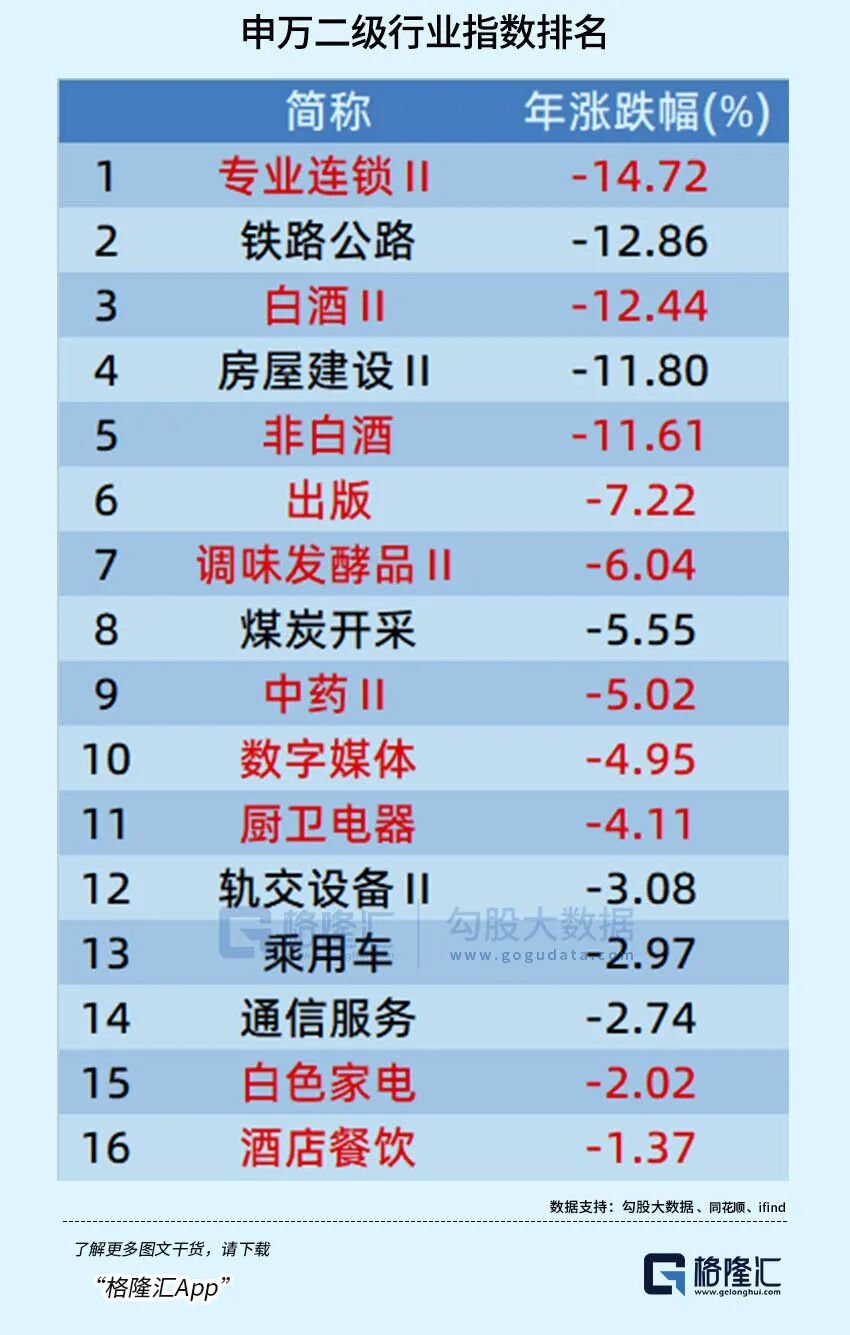
Core Viewpoint - The consumer sector has faced significant challenges in the past year, with many industries within this sector experiencing declines despite overall market growth. The focus on domestic demand and consumption has not translated into positive performance for many consumer-related industries [1]. Group 1: Consumer Sector Performance - In the first half of the year, 10 out of 16 industries that saw declines were from the consumer sector, indicating a troubling trend for consumer-related stocks [1]. - The white liquor sector, a key component of the consumer market, has seen a year-to-date decline of 12.44%, with major brands like Wuliangye experiencing significant drops in revenue and profit [5][8]. - The professional chain sector has been particularly hard hit, with a year-to-date decline of 14.72%, as traditional retail models struggle to adapt to changing consumer behaviors [13][14]. Group 2: White Liquor Industry - The white liquor industry is facing its eighth consecutive year of production decline, with both volume and price dropping, leading to increased inventory pressure and cash flow issues for many companies [9]. - Wuliangye reported a 10.26% decline in revenue and a 13.72% drop in net profit for the first three quarters, marking its first negative growth in nearly a decade [8]. - The changing consumer landscape, with a shift towards lower-alcohol and healthier options, is forcing white liquor companies to adapt or risk further declines [12]. Group 3: Professional Chain Sector - The professional chain sector is experiencing a crisis, with many traditional stores closing and business models failing to adapt to the digital age [14][19]. - The decline of major players like Renrenle, which has seen its market value plummet and faced continuous losses, exemplifies the struggles within this sector [18]. - The shift towards online shopping and personalized consumer experiences is reshaping the retail landscape, leaving traditional large-format stores at a disadvantage [20]. Group 4: Non-White Liquor Sector - The non-white liquor sector, including beer and wine, has also faced challenges, with a year-to-date decline of 11.61% [22]. - Budweiser APAC reported an 8.2% drop in domestic sales and a 24.4% decline in net profit, reflecting broader issues within the beer industry [25]. - The rise of cross-industry competition, with liquor companies diversifying into other beverage categories, indicates a shift in market dynamics [27]. Group 5: Publishing Industry - The publishing industry has seen a decline in the overall market, with a 10.4% drop in the domestic paper book market, yet some companies have managed to increase profits through cost control [35][38]. - Chinese Media, a leading player in the sector, has faced significant revenue and profit declines, highlighting the challenges of adapting to changing educational policies [36][38]. Group 6: Seasoning Industry - The seasoning industry has experienced a 6.04% decline, with companies like Qianhe Flavor struggling due to a drop in sales across key product lines [43][47]. - The industry is facing increased competition and changing consumer preferences, necessitating a shift in strategy for many companies [52]. Group 7: Traditional Chinese Medicine - The traditional Chinese medicine sector has seen a 5.02% decline, with companies like Pian Zai Huang facing significant revenue and profit drops due to rising costs and regulatory pressures [53][56]. - The industry is undergoing a transformation as companies seek to innovate and diversify their product offerings in response to market challenges [62]. Group 8: Digital Media - The digital media sector has faced a 4.95% decline, with traditional advertising models struggling to keep pace with new digital trends [67]. - Companies like Mango TV have reported significant revenue declines, indicating the need for adaptation in a rapidly changing media landscape [66]. Group 9: Kitchen and Bathroom Appliances - The kitchen and bathroom appliance sector has seen a 4.11% decline, largely due to a slowdown in new housing demand and increased competition [69][70]. - Companies like Boss Appliances are experiencing revenue declines for the first time in years, reflecting broader industry challenges [69]. Group 10: White Goods - The white goods sector has faced a 2.02% decline, with major players like Gree Electric experiencing significant revenue and profit drops due to increased competition and market saturation [76][80]. - The industry is shifting towards a focus on product quality and operational efficiency as traditional growth drivers diminish [80]. Group 11: Hotel and Catering - The hotel and catering sector has seen a 1.37% decline, with many businesses struggling to convert increased travel demand into profits due to high commission fees from online platforms [84][85]. - The industry is witnessing a shift towards more refined operational models as companies seek to adapt to changing consumer behaviors and market conditions [86].

2025年A股十大最惨板块,跌麻了
Ge Long Hui· 2025-12-30 11:30
Core Viewpoint - The consumer sector has faced significant challenges in the past year, with many sub-sectors experiencing declines despite overall market growth. The focus on domestic demand and consumption has not translated into positive performance for many consumer-related industries [1][5]. Consumer Sector Performance - In the first half of the year, 10 out of 16 declining industries were from the consumer sector, indicating a broader trend of underperformance [1]. - The white liquor sector, a key component of the consumer market, has seen a year-to-date decline of 12.44%, with major brands like Wuliangye experiencing significant drops in revenue and profit [6][9]. - The professional chain sector has been particularly hard-hit, with a year-to-date decline of 14.72%, exemplified by the struggles of companies like Renrenle [16][20]. White Liquor Sector - The white liquor industry is facing its eighth consecutive year of production decline, with both volume and price dropping simultaneously [10]. - Wuliangye reported a 10.26% decline in revenue and a 13.72% drop in net profit for the first three quarters, marking its first negative growth in a decade [9]. - The industry is shifting from a growth-driven model to one focused on consumer choice, with a need for companies to adapt to changing consumer preferences [15]. Professional Chain Sector - The professional chain sector is experiencing a crisis, with many physical stores closing and traditional business models failing [16][20]. - Renrenle, once a leading private supermarket, has seen its market value plummet and is now facing delisting due to ongoing financial struggles [21][24]. - The shift towards online shopping and personalized consumer demands has further exacerbated the challenges faced by traditional retail chains [24][25]. Non-White Liquor Sector - The non-white liquor sector, including beer and wine, has also faced declines, with the beer segment seeing a notable drop in sales and profits [27][32]. - Budweiser APAC reported an 8.2% decline in domestic sales and a 24.4% drop in net profit, reflecting broader industry challenges [32][33]. - The market is witnessing a trend of cross-industry competition, with liquor companies diversifying into new beverage categories [34]. Publishing Sector - The publishing industry has shown resilience despite a 10.4% decline in the overall market for printed books, with listed companies managing to increase net profits by 14.65% [43][44]. - However, leading companies like Zhongwen Media are struggling, with significant revenue and profit declines due to changes in educational material procurement policies [45][48]. Seasoning Sector - The seasoning industry has faced a 6.04% decline, with companies like Qianhe Flavor struggling due to falling revenues and a loss of consumer trust [51][55]. - The industry is experiencing a shift in consumer preferences and increased competition, necessitating a reevaluation of business strategies [60]. Traditional Chinese Medicine Sector - The traditional Chinese medicine sector is facing challenges, with companies like Pian Zai Huang reporting significant declines in revenue and profit due to rising costs and regulatory pressures [61][66]. - The industry is undergoing a transformation as companies seek to innovate and diversify their product offerings [70]. Digital Media Sector - The digital media industry has seen a 4.95% decline, with companies like Mango TV reporting significant drops in revenue and profit due to changing consumer behaviors and market dynamics [71][74]. - The sector is grappling with the need to adapt to new content consumption trends while facing pressure from traditional advertising models [75]. Kitchen and Bathroom Appliances Sector - The kitchen and bathroom appliance sector has experienced a 4.11% decline, largely due to reduced demand from the real estate market [78][79]. - Companies like Boss Electric are facing revenue declines for the first time in years, highlighting the challenges of adapting to a changing market landscape [79][80]. White Goods Sector - The white goods sector has seen a 2.02% decline, with major players like Gree Electric facing significant revenue and profit pressures due to increased competition and market saturation [83][84]. - The industry is shifting towards a focus on product quality and brand strength as external stimuli diminish [88]. Hotel and Restaurant Sector - The hotel and restaurant sector has faced a 1.37% decline, with revenue pressures stemming from changing consumer spending habits and increased competition from online platforms [89][92]. - Companies are beginning to adopt more refined operational strategies to navigate the challenging market environment [96].




今年十大最惨板块,跌麻了
格隆汇APP· 2025-12-30 11:04
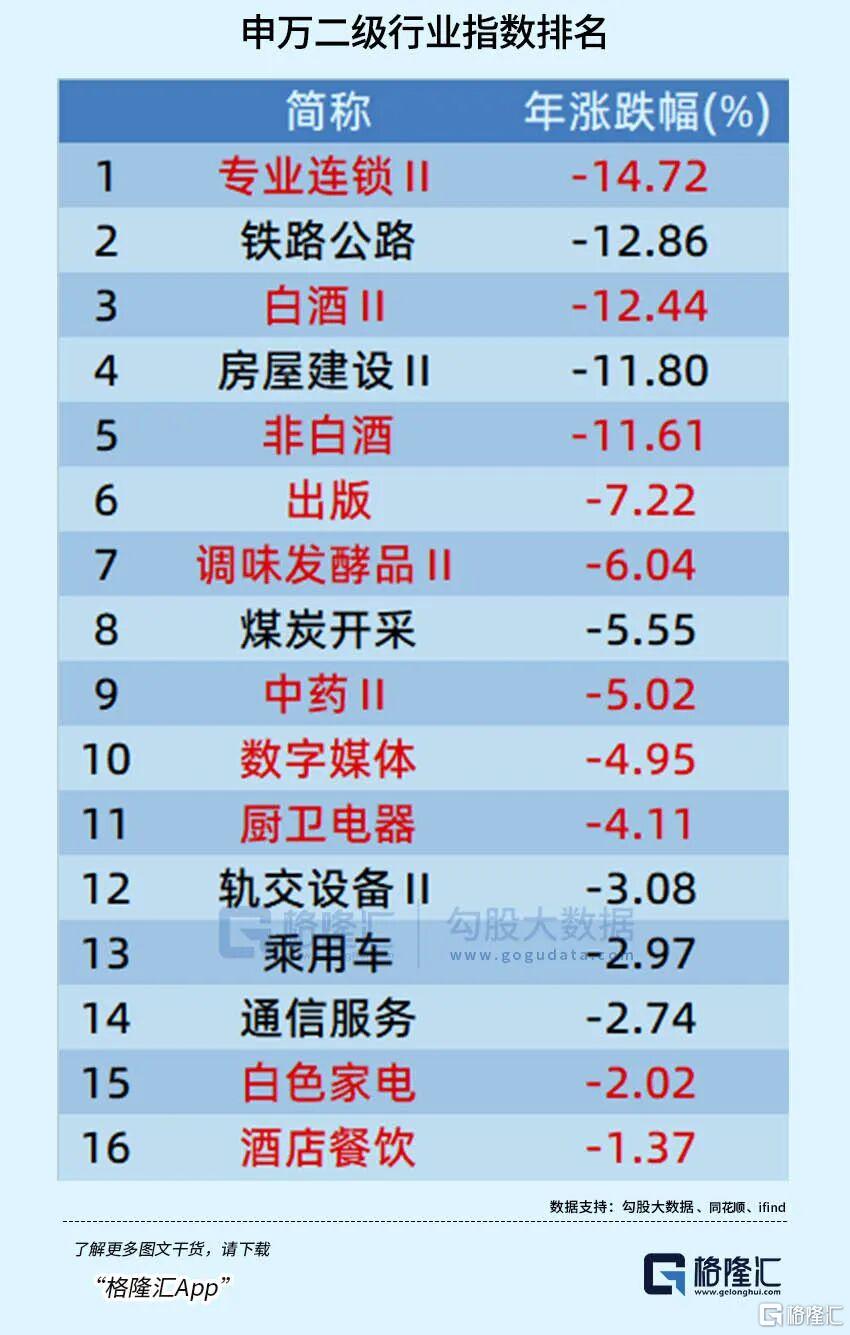
Core Viewpoint - The article discusses the significant downturn in various consumer sectors, particularly the liquor and retail industries, highlighting the challenges and potential opportunities for recovery amidst changing consumer behaviors and market dynamics [2][4][43]. Group 1: Liquor Industry - The liquor sector, especially the white liquor segment, has faced substantial declines, with the overall white liquor market down by 12.44% this year [9][15]. - Major brands like Wuliangye have reported significant drops in revenue and profit, with a 10.26% decline in revenue and a 13.72% drop in net profit for the first three quarters [17]. - The white liquor industry is experiencing a shift from a growth-driven model to one focused on consumer preferences, with a need for companies to adapt to changing consumption patterns [26][27]. Group 2: Retail Industry - The professional chain sector has seen a dramatic decline of 14.72%, with many traditional retail models struggling to survive [28][30]. - Companies like Renrenle have faced severe financial difficulties, leading to a significant reduction in store numbers and ultimately triggering delisting procedures [34][35]. - The shift towards online shopping and changing consumer preferences have forced traditional retailers to innovate or face extinction [36][39]. Group 3: Non-White Liquor Sector - The non-white liquor sector, including beer and wine, has also suffered, with a reported decline of 11.61% this year [40]. - Major players like Budweiser APAC have experienced significant sales drops, with a 9.5% revenue decrease and a 24.4% decline in net profit [46]. - The industry is witnessing a trend of cross-industry competition, with liquor companies diversifying into other beverage categories to adapt to market changes [51][56]. Group 4: Publishing Industry - The publishing sector has faced a 7.22% decline, with the overall market for printed books down by 10.40% [60]. - Despite the downturn, some publishing companies have managed to increase profits through cost control and operational efficiency, with a 14.65% rise in net profit for listed companies [61][62]. - The industry is undergoing significant transformation, moving from traditional sales models to more dynamic content management and IP development strategies [70][71]. Group 5: Seasoning Industry - The seasoning sector has seen a 6.04% decline, with companies like Qianhe Flavor struggling due to a drop in revenue and profit [74]. - The industry is facing challenges from both market saturation and changing consumer preferences, necessitating a shift in strategy for many companies [81]. Group 6: Traditional Chinese Medicine - The traditional Chinese medicine sector has experienced a 5.02% decline, with companies like Pian Zai Huang facing significant revenue and profit drops [86]. - The industry is under pressure from regulatory changes and increased competition, pushing companies to innovate and diversify their product offerings [91][92]. Group 7: Digital Media - The digital media sector has reported a 4.95% decline, with traditional advertising models struggling to adapt to new market realities [97][100]. - Companies like Mango TV have seen significant revenue drops, highlighting the challenges of maintaining profitability in a rapidly changing landscape [101][104]. Group 8: Kitchen and Bathroom Appliances - The kitchen and bathroom appliance sector has faced a 4.11% decline, with major players like Boss Electric experiencing revenue drops for the first time in years [112]. - The industry is grappling with reduced demand due to a slowdown in the real estate market, necessitating a shift towards innovation and international expansion [117][118]. Group 9: White Goods - The white goods sector has seen a 2.02% decline, with companies like Gree Electric facing significant challenges due to market saturation and increased competition [126][129]. - The industry is shifting towards a more rational consumer base that prioritizes product quality and brand reputation over traditional growth drivers [133]. Group 10: Hotel and Restaurant Industry - The hotel and restaurant sector has experienced a 1.37% decline, with many businesses struggling to convert increased tourism into profits [140][141]. - The industry is witnessing a shift towards more refined operational models, with companies focusing on member engagement and digital transformation to enhance profitability [142][143].




海通国际2026年1月金股
Haitong Securities International· 2025-12-26 06:30
Investment Focus - Alphabet (GOOGL US) is expected to maintain strong advertising revenue due to AI integration in search functionalities and a significant increase in TPU orders, projecting over 30% growth in cloud business for the year [1] - Alibaba (BABA US) anticipates a cloud business growth rate of 28%-30%, driven by strong demand in China and synergies from its food delivery services, with a projected MAU growth of 20-30% for Taobao [1] - NVIDIA (NVDA US) is expected to achieve strong revenue growth, with projections indicating potential revenue exceeding $500 billion, supported by significant demand for its products [1] - Tencent (700 HK) is recommended for its robust growth in gaming and advertising, with a target price of 700, and is expected to benefit from AI trends [3] - Tencent Music (TME US) is expected to maintain double-digit growth in subscription revenue, supported by its long-term partnerships with top domestic artists [3] - New Oxygen (SY US) is positioned for rapid expansion in the light medical beauty sector, with plans to increase self-operated stores significantly by 2025 [3] - Trip.com (TCOM US) is projected to benefit from the recovery of domestic leisure travel and inbound tourism, with a revenue growth forecast of 14% to 71.1 billion yuan [4] - Kuaishou (1024 HK) is expected to see significant revenue contributions from its advertising solutions, with a target price of 93 [4] - Futu (FUTU US) is recognized for its strong user base and compliance advantages, with a projected PE of 17x for 2026, indicating significant valuation potential [4][5] - AIA (1299 HK) is expected to see steady growth in new business value due to its expansion strategy in mainland China and demand for traditional savings products [5] - Howmet Aerospace (HWM US) is positioned for stable revenue growth due to its strong market position in gas turbine components and a long order backlog [10]
扩内需:食品饮料行业投资机会
2025-12-24 12:57
Summary of Key Points from the Conference Call Industry Overview - The food and beverage industry is experiencing systemic opportunities driven by policies aimed at expanding domestic demand and increasing residents' income levels, which are expected to enhance consumption capabilities [1][2] - The liquor industry is undergoing a deep adjustment, with expectations of entering an EPS killing phase by 2025, while high-end liquor brands like Moutai and Lao Jiao are recommended for investment [1][4] - The dairy industry has completed supply-demand adjustments, with anticipated increases in demand for milk powder and liquid milk due to fertility and income policies, highlighting companies like Yili and New Dairy as potential recovery opportunities [1][5] - The snack food sector is benefiting from the "lipstick effect," new channels, and health trends, with recommendations for companies such as Salted Fish, Wei Long, Wan Chen Food, and Qiaqia Food [1][6] - The beverage sector is seeing a clear trend towards health, with non-traditional channels gaining market share, making high-growth companies like Dongpeng Beverage noteworthy [1][7] Key Insights and Arguments - The central economic work conference in 2026 will prioritize expanding domestic demand, which is expected to lead to a series of policies stimulating consumption, positively impacting the food and beverage industry [2] - The food and beverage sector has faced significant changes in volume, price, and channel structure over the past six years, with varying performances across sub-sectors [3] - The liquor sector is expected to see marginal improvements in 2026, driven by policies aimed at boosting business and government consumption [4] - The dairy sector is projected to enter a recovery phase, with increased demand anticipated due to supportive policies [5] - The snack food market is expected to gradually recover, supported by rising incomes and new retail channels [6] Additional Important Content - Cost fluctuations are a significant factor affecting the performance of consumer goods companies, with some agricultural product costs declining, providing investment opportunities [9] - The planting area for sunflower seeds is expected to recover, leading to a projected 10% decrease in the cost of sunflower seeds, which will positively impact Qiaqia Food's gross margin [10][11] - The konjac market is facing supply-demand imbalances, with high prices expected to ease in 2026, alleviating cost pressures for companies like Wei Long and Salted Fish [12] - The sugar molasses market is currently at low prices, providing strong support for Angel Yeast's profitability [13] - Innovative companies are leveraging product and channel innovations to drive growth, with notable examples including Nongfu Spring and Uni-President [14] - Efficient supply chain management is crucial for companies, with Dongpeng Beverage demonstrating strong performance in this area [15] Future Outlook - Dongpeng Beverage is expected to achieve double-digit growth in 2026 through strategic measures and product innovations [16] - Wan Chen is enhancing store quality and accelerating store openings, which is expected to improve profitability in the snack food sector [17][18] - Hai Tian Flavoring has implemented efficiency improvements under new management, resulting in revenue and profit growth exceeding industry averages [19] - The restaurant industry is expected to see a mild recovery, with companies like Yihai International and Tianhe Flavoring showing potential for improvement [20][21] - In the liquor sector, companies like Yanghe and Budweiser are expected to benefit from product and channel improvements, leading to potential breakthroughs in performance [22][23][25] - Gan Yuan Food is focusing on expanding e-commerce and high-end membership stores, with a stable development outlook [26][27] - Overall, companies in the food and beverage sector are expected to experience gradual recovery and growth, making them worthy of investor attention [28]




“涨薪只能靠跳槽”,为什么新员工总比老员工工资高?
3 6 Ke· 2025-12-24 02:49
Core Viewpoint - The year 2025 is expected to be a tumultuous year for the food and beverage industry, primarily characterized by widespread leadership changes across numerous companies, which is a rare occurrence in the industry [1] Group 1: Leadership Changes - A significant number of traditional fast-moving consumer goods (FMCG) companies are undergoing leadership changes, including major players like Coca-Cola, Nestlé China, Unilever, Kraft Heinz, and others [1] - The widespread nature of these changes suggests a collective struggle within the industry, as many companies are facing challenges in sales performance and are seeking new directions through new leadership [4] Group 2: Employee Compensation and Job Market - There is a prevailing sentiment among employees in the FMCG sector that salary increases are unlikely, leading many to consider job changes as the only viable option for salary growth [2][3] - Employees have observed that new hires often receive significantly higher salaries than existing staff, creating a disparity that can lead to dissatisfaction among long-term employees [5][6] - The current environment has led to a situation where companies are more inclined to hire externally, often at higher salaries, rather than promoting from within, which can create tension and feelings of unfair treatment among existing employees [5][6] Group 3: Market Dynamics and Future Outlook - The leadership changes are seen as a response to the challenging sales environment, with companies hoping that new leaders can revitalize performance and restore confidence among stakeholders [4] - The expectation is that new leaders will be given a grace period of about one to one and a half years to stabilize the market before being held accountable for performance [3] - Despite the current difficulties, there is an underlying belief that these traditional companies have the potential for future growth, as they possess the resources and aspirations to navigate through turbulent times [3]

【时代风口】 智能消费改变了什么
Zheng Quan Shi Bao· 2025-12-22 18:03
Group 1 - The core idea of the articles is that smart consumption is transforming various aspects of life, industry, and social relationships, moving beyond mere convenience to drive significant changes in production methods and industry structures [1][2][3] - Smart consumption has led to the rise of customized products, with companies like Nike allowing consumers to design their own shoes, thus shifting from mass production to precision manufacturing [1] - The emergence of new professions such as smart home operation technicians and AI lifestyle consultants highlights the economic opportunities created by smart consumption [2] Group 2 - There is a need for "age-friendly" technology design to ensure that older adults can also benefit from smart consumption, which currently poses challenges for them due to operational barriers [3] - Market regulation is evolving in response to smart consumption, with cities like Shenzhen implementing guidelines to protect consumer data and privacy [3] - Smart consumption is not only a technological advancement but also a necessary outcome of economic development, promising to enhance efficiency and vitality in society [3]
习酒称今年稳住基本盘;奔富将降低中国渠道库存|观酒周报
2 1 Shi Ji Jing Ji Bao Dao· 2025-12-22 07:42
Industry Dynamics - Guizhou Xijiu held its 2026 national dealer conference, with over 800 representatives attending. The chairman stated that despite challenges, the company achieved unexpected breakthroughs and aims to strengthen its brand through a dual-brand strategy and marketing reform [2] - Wuliangye announced its 2026 goals focused on enhancing market share and brand value through a marketing strategy termed "one core, three reinforcements, and two goals" [3] - Water Jiufang appointed actor Tony Leung as its first brand ambassador, launching a high-end product line priced above 800 yuan [4] - Shanxi Fenjiu established an international trade company in Hainan with a registered capital of 30 million yuan, focusing on various alcohol-related businesses [5] Financial Agreements and Projections - Chongqing Beer reached a settlement with Chongqing Jiawei Beer, agreeing to pay 100 million yuan and establish a fixed procurement agreement, which is expected to enhance profits for 2025 by approximately 37.11 million yuan [6][7] - Guizhou Zhenjiu announced a temporary halt to recruitment in 15 counties to stabilize prices and ensure profits for its new product line, which has generated 350 million yuan in returns within 200 days [8] - 1919's founder became the largest shareholder of Yiyuan Wine Industry, indicating a new approach to capital markets [9] Market Trends - A report from Zhongjin Company predicts that the white liquor industry will see improvements in 2026, with demand recovery and inventory issues being resolved [20] - Jiu Xian Group's chairman forecasted a significant price drop for 99% of famous liquors in 2025, with average retail prices decreasing by 30% [19] New Product Launches - Yanghe launched zodiac-themed liquor products under three brands, continuing its tradition since 2015 [21] - Niulanshan introduced a new 36% alcohol content product aimed at younger consumers, priced at 78 yuan per bottle [22] - Carlsberg released a special edition for the Year of the Horse, incorporating advanced technology in its design [23]