
通富微电

Search documents
AI领域覆铜板(CCL)市场及企业情况
势银芯链· 2026-01-28 07:36
Core Viewpoint - The article discusses the growth and dynamics of the PCB (Printed Circuit Board) industry, particularly focusing on the demand for copper-clad laminates (CCL) driven by advancements in AI applications and the increasing need for high-speed, high-frequency materials [3][13]. Industry Overview - PCB is referred to as the "mother of electronic products," serving as a carrier for electrical connections and functional integration of electronic components. The demand for PCBs is influenced by the terminal market, showing a stable growth trend [3]. - The cost structure of PCBs reveals that copper-clad laminates account for approximately 27.30% of the total cost, making them a crucial substrate in PCB manufacturing [3]. Market Segmentation - CCL can be classified based on material and structure, with different categories suitable for various applications, including communication devices, consumer electronics, and automotive electronics [10]. - High-frequency and high-speed CCLs are emerging to meet the demands of AI applications, characterized by high signal transmission speeds (10-50 Gbps) and low loss [11]. Market Size and Growth - The global AI application CCL market is projected to reach approximately $2.4 billion by 2025, $5.8 billion by 2026, and $18.7 billion by 2027, with a compound annual growth rate (CAGR) of about 18% from 2024 to 2027. The high-speed CCL market is expected to grow at a CAGR of 40%, significantly outpacing the average growth rate of the CCL market [13]. Competitive Landscape - The global CCL production capacity is primarily concentrated in Asia, with Taiwanese and Japanese companies holding significant market shares. The high-end CCL market is dominated by Taiwanese and Japanese manufacturers, while mainland Chinese companies are expected to ramp up production starting in 2026 [13]. - Key players in the CCL industry include companies like Shengyi Technology, Nan Ya Plastics, and Panasonic, each with unique strengths and market positions [17]. Recent Developments - Shengyi Technology plans to invest 4.5 billion yuan in a high-performance CCL project by 2026 [18]. - Jinan Guojiji has approved a fundraising plan to raise 1.557 billion yuan for a high-grade CCL project and R&D center [18]. - Nan Ya Plastics intends to raise up to 900 million yuan for the development of high-frequency CCLs based on AI computing power [19]. - Huazheng New Materials has recently added a high-end production line, increasing its capacity to 14 million sheets per year [19].


AI服务器对存储需求呈现爆发式增长,集成电路ETF嘉实(562820)全面布局全产业链芯片龙头
Xin Lang Cai Jing· 2026-01-28 06:11
东海证券指出,受益于AI浪潮,国内相关A股标的预估2025全年业绩实现大幅增长。2026年全球AI服务 器出货量同比有望增长28%以上,拉动存储、CPU等相关芯片涨价。三星电子于2026Q1将NAND闪存的 供应价格上调100%以上,英特尔和AMD考虑将2026Q1服务器CPU均价调涨10%~15%。当前电子行业 需求持续复苏,供给有效出清,存储芯片价格上涨,我国国产化力度超预期。TrendForce预估2026年存 储器产业产值将同比增长134%达到5516亿美元。 数据显示,截至2025年12月31日,中证全指集成电路指数前十大权重股分别为寒武纪、中芯国际、海光 信息、兆易创新、澜起科技、豪威集团、紫光国微、长电科技、芯原股份、通富微电,前十大权重股合 计占比53.66%。 2026年1月28日盘中,半导体板块一度涨超3%,截至13:37,中证全指集成电路指数上涨0.68%,成分股 中微半导上涨17.61%,普冉股份上涨15.17%,燕东微上涨11.58%,北京君正上涨6.68%,力芯微上涨 6.27%。 集成电路ETF(562820)跟踪中证全指集成电路指数,是布局全产业链芯片龙头的便捷工具。 AI服务 ...
先进封装迎AI驱动黄金期,国产链加速突破赋能高集成未来
Sou Hu Cai Jing· 2026-01-28 04:05
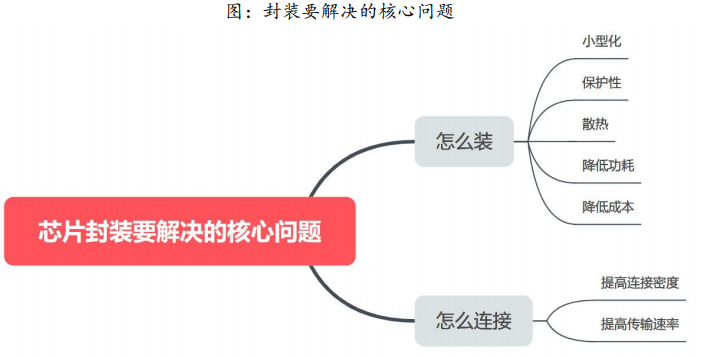
Core Insights - TSMC has raised its 2026 capital expenditure to $52-56 billion, with 10-20% allocated to advanced packaging, indicating a high growth cycle driven by AI chip demand [1] - The advanced packaging market is expected to grow at a CAGR of 8.9% from 2019 to 2029, increasing its share from 45.6% to 50.9%, surpassing traditional packaging [1] Industry Trends - Technological advancements focus on enhancing electrical performance, integration, thermal management, and cost reduction, with key enabling technologies including Bump, RDL, Wafer-level packaging, and TSV [3] - Current trends include 2.5D/3D packaging and Chiplet technology, which offer significant advantages in yield improvement, cost reduction, and compatibility across multiple processes [3] Market Dynamics - Advanced packaging addresses multiple bottlenecks in the post-Moore's Law era, such as alleviating the "memory wall" with 2.5D/3D integration of high bandwidth memory, breaking the "area wall" through multi-chip stacking, and optimizing power consumption and heat dissipation to tackle the "power wall" [5] - The global packaging revenue is dominated by Taiwan (43.7%), the USA (21%), and mainland China (20.2%), with mainland China's advanced packaging share at approximately 15.5% [7] Growth Projections - The advanced packaging market in mainland China is projected to grow from 51.4 billion yuan in 2024 to 100.6 billion yuan in 2029, with a CAGR of 14.4% [7] - The global advanced packaging market is expected to reach approximately $45 billion in 2024, accounting for 55% of the packaging market, and is projected to grow to $80 billion by 2030, with a CAGR of 9.4% from 2024 to 2030 [7] Company Developments - Changdian Technology has launched the XDFOI® chip integration process and has begun mass production [8] - Tongfu Microelectronics plans to expand production through a private placement, with a 55.7% increase in net profit for the first three quarters of 2025 [8] - Huada Semiconductor has acquired Huayi Microelectronics to expand its power device packaging and has established a subsidiary to enhance 2.5D/3D advanced packaging [8] - Yongxi Electronics is leveraging the FH-BSAP platform to meet diverse advanced packaging needs, with expected revenue of 4.2-4.6 billion yuan in 2025 [8]
HBM指数盘中涨2%,深科技涨7%
Mei Ri Jing Ji Xin Wen· 2026-01-28 02:13
Group 1 - The HBM index rose by 2% during intraday trading on January 28 [1] - Among the constituent stocks, Deep Technology surged by 7% [1] - Taiji Industry increased by 6%, while stocks like Tongfu Microelectronics, Guoxin Technology, and Yake Technology also experienced gains [1]




未知机构:1用玉米大豆模型把AI需求如何外溢到非AI芯片讲清楚-20260128
未知机构· 2026-01-28 02:00
Summary of Conference Call Transcript Industry Overview - The discussion revolves around the semiconductor industry, particularly the impact of AI demand on traditional chip production and supply dynamics [1][3]. Core Insights and Arguments 1. **Agricultural Analogy**: The author uses a "corn-soybean" model to explain how AI demand diverts resources from traditional chips (corn) to advanced chips (soybeans) like HBM and 3/4 nm processes [1][3]. 2. **Supply Shortage Evidence**: By 2026, three key indicators suggest a shortage of traditional chips: - **NAND**: Companies like Kioxia and SK Hynix report that their 2026 production capacity was sold out by January, with SSD spot prices increasing by 15-20% [2][6]. - **CPU**: Intel prioritizes 14/10 nm capacity for server CPUs, leading to a widening supply gap for PC CPUs, with Raptor Lake prices rising by 8-12% in January [2][6]. - **Packaging**: Major players like ASE and Tongfu report a 5-8% increase in lead frame and substrate prices due to rising costs of copper, gold, and BT resin, alongside tight 8-inch capacity [2][6]. 3. **Comparison of 2021 and 2026**: - **2021**: Supply constraints due to events like the Renesas fire and Texas freeze, with 8-inch utilization dropping to 75%. Demand surged due to pandemic-driven PC and electric vehicle sales [6]. - **2026**: Supply constraints persist, with AI demand causing negative capital expenditure for 8-inch lines for three consecutive years, and global capacity down 7% from 2021 levels. Demand remains weak, with mobile shipments expected to grow only 3% and automotive chip inventories at 2.2 months [6]. 4. **Potential Catalysts for Demand Recovery**: - **Macro Factors**: A global inventory replenishment cycle in the second half of 2026 could boost utilization rates from 85% to 95% [6]. - **Events**: A significant disruption at a major 8-inch wafer or packaging facility could lead to rapid price increases [6]. - **Policy Initiatives**: New government policies promoting domestic MCU and analog IC demand could significantly impact the market [6]. Additional Important Insights 1. **MCU Price Trends**: In January, 32-bit MCU prices showed a 5% increase for STMicroelectronics and a 7% increase for GigaDevice, indicating early signs of price recovery, although actual demand remains subdued [7]. 2. **Risk Factors**: If demand does not improve by Q2 2026, channel inventories may flood the market again, potentially driving prices back to 2022 lows [7]. 3. **Investment Strategy**: Recommended stocks include leading packaging firms (Changdian, Tongfu, Huada), specialized 8-inch wafer manufacturers (Huahong, China Resources Micro), and domestic MCU/analog design companies (GigaDevice, Silead, Systech) as a balanced investment approach [7].
建筑工程业:美光未来十年将在新加坡投资240亿美元,驱动洁净室市场扩容
GUOTAI HAITONG SECURITIES· 2026-01-28 01:18
Investment Rating - The industry investment rating is "Overweight" [8] Core Insights - Micron Technology plans to invest $24 billion in a new NAND factory in Singapore over the next ten years, with the facility expected to provide 700,000 square feet of cleanroom space and commence production in the second half of 2028. This investment is driven by the growing demand for NAND technology due to the rapid expansion of artificial intelligence and data center applications [2][3] - The World Semiconductor Trade Statistics (WSTS) forecasts that the global semiconductor market will grow by 26.3% in 2026, reaching $975 billion, with storage and logic ICs being the main growth drivers [5] - The cleanroom industry is experiencing expansion due to increased investments in high-tech industries, which are essential for its development. The demand for cleanroom engineering services is rising, leading to a concentration and scaling of the industry, with leading companies gaining stable market shares [5] Summary by Sections Micron Technology's Investment - Micron Technology is set to build a new NAND factory in Singapore, with an investment of $24 billion over the next decade. The groundbreaking ceremony took place on January 27, 2026, and the factory is expected to help meet the growing demand for NAND technology driven by AI and data centers [3] Semiconductor Market Forecast - WSTS predicts a 26.3% increase in the global semiconductor market size in 2026, reaching $975 billion. The growth is primarily driven by storage and logic ICs, which are expected to grow by 39.4% and 32.1%, respectively [5] Cleanroom Industry Dynamics - The cleanroom industry is benefiting from the growth in high-tech investments, leading to increased demand and market expansion. The characteristics of cleanroom projects, such as large investment scales and short implementation cycles, are driving industry consolidation and differentiation among companies [5]


狂飙1034.71%,国产半导体最大赢家现身
3 6 Ke· 2026-01-27 10:51
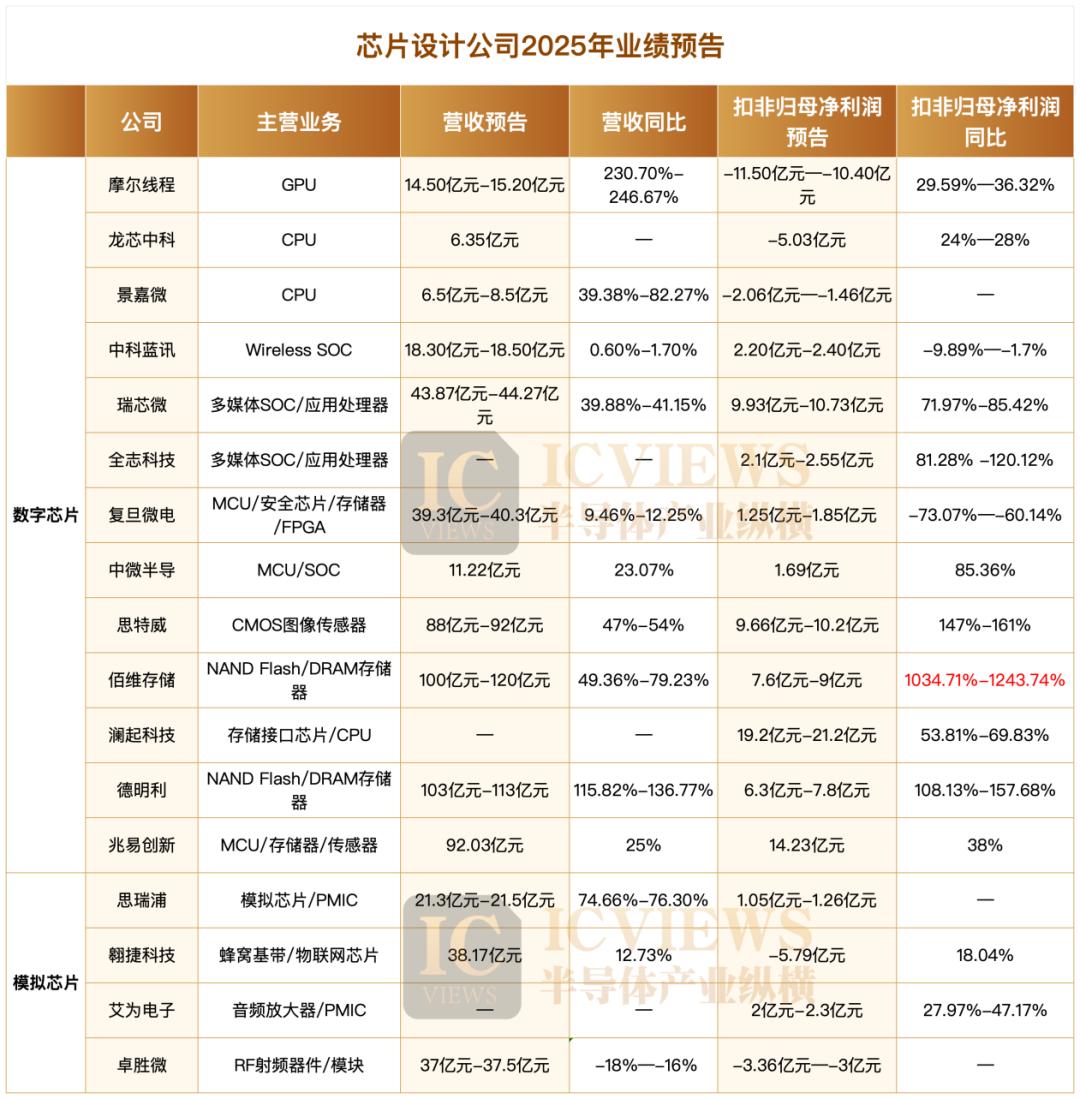
Core Insights - The semiconductor industry is experiencing significant performance differentiation as over 50 listed companies release their 2025 earnings forecasts, with some companies thriving while others struggle [1] IC Design - The IC design sector shows stark performance disparities, with digital chip companies experiencing both high revenue growth and losses, while the analog chip segment continues to see performance divergence [2] - Notable companies include: - Moer Technology: Expected revenue of 1.45 billion to 1.52 billion yuan, a growth of 230.70% to 246.67%, but a net loss of 1.04 billion to 1.15 billion yuan [3] - Longxin Zhongke: Expected revenue of 635 million yuan, with a net loss of approximately 449 million yuan [4] - Jingjia Micro: Revenue forecast of 650 million to 850 million yuan, with a net loss of 120 million to 180 million yuan [4] CPU and GPU Companies - Moer Technology's revenue is projected to grow significantly, with a continuous high growth trend despite ongoing losses, attributed to the rapid penetration of domestic GPUs in AI training and inference scenarios [5][6] - Longxin Zhongke and Jingjia Micro also show reduced losses, indicating a trend of narrowing losses in the sector [4][5] MCU, SoC, and CIS Companies - Companies in the MCU, SoC, and CIS segments are showing stable growth, with some achieving significant profit increases: - Zhongke Blue Communication: Expected revenue of 1.83 billion to 1.85 billion yuan, with a slight decline in net profit [7] - Ruixin Micro: Revenue forecast of 4.387 billion to 4.427 billion yuan, with net profit growth of 71.97% to 85.42% [7] - Allwinner Technology: Expected net profit growth of 50.53% to 76.92% [7] Storage Chip Companies - The storage chip industry is entering a "super cycle," with all companies reporting high growth, driven by rising DRAM and NAND prices and increased demand from AI servers: - Baiwei Storage: Expected revenue of 10 billion to 12 billion yuan, with net profit growth of 427.19% to 520.22% [10] - Demingli: Revenue forecast of 10.3 billion to 11.3 billion yuan, with net profit growth of 85.42% to 128.21% [11] - The storage market is experiencing a "super bull market," with prices expected to rise further in 2026 [11][12] Analog Chip Companies - The analog chip sector is witnessing a recovery, with some companies turning profitable: - Sirepu: Expected revenue of 2.13 billion to 2.15 billion yuan, with a return to profitability [13] - Awei Electronics: Expected net profit growth of 17.7% to 29.47% [13] - However, companies focused on consumer electronics are facing challenges due to market downturns [14] Semiconductor Equipment and Testing - The semiconductor equipment and testing sectors are benefiting from the AI computing revolution, with significant growth in earnings: - Chip equipment companies are seeing increased demand due to domestic wafer plant expansions [16] - Tongfu Microelectronics: Expected net profit of 1.1 billion to 1.35 billion yuan, with growth of 62.34% to 99.24% [17] - The storage chip industry is also experiencing a price increase, impacting the testing segment positively [17]

先进封装与测试专题报告:先进封装量价齐升,测试设备景气上行
Dongguan Securities· 2026-01-27 09:31
Group 1 - The report emphasizes that advanced packaging is crucial for enhancing chip performance and reliability, especially in the context of the AI wave driving demand for higher integration and performance in semiconductors [8][21][25] - The semiconductor packaging and testing industry in China is expected to grow significantly, with the market size projected to reach 438.98 billion yuan by 2029, reflecting a compound annual growth rate (CAGR) of 5.8% from 2024 to 2029 [28][29] - Advanced packaging is anticipated to account for 50% of the semiconductor packaging market by 2029, with a CAGR of 10.6%, outpacing traditional packaging growth [28][29] Group 2 - The report highlights the rise of independent third-party testing services in the semiconductor industry, driven by the increasing number of IC design companies and the growing demand for testing services [42][43] - The competitive landscape for wafer testing is relatively concentrated due to high technical and investment barriers, with fewer participants compared to finished chip testing [42][43] - The report notes that independent third-party testing firms often collaborate with integrated packaging and testing companies, outsourcing wafer testing while also competing in finished chip testing [42][43]


第一上海证券科技行业周报:英特尔财报证实 CPU 紧缺
First Shanghai Securities· 2026-01-27 07:45
Investment Rating - The report suggests a focus on companies in the advanced packaging industry and highlights potential investment opportunities in CPU manufacturers like AMD and Intel [3][4]. Core Insights - Intel's recent earnings report confirms a shortage of CPUs, with a revenue of $13.67 billion for Q4 2025, a year-on-year decline of 4.1% but a quarter-on-quarter increase of 3%. The client computing group (CCG) revenue was $8.19 billion, down 6.6% year-on-year, while the data center and AI (DCAI) segment saw a revenue increase of 8.9% to $4.74 billion [2]. - The report emphasizes the rising importance of CPU performance in the Agentic AI era, suggesting that CPU shortages could significantly enhance the profitability of related companies [3]. - The advanced packaging supply chain is experiencing increased demand due to AI investments, with companies like TSMC facing capacity constraints and price increases expected in the packaging sector [4]. - Domestic packaging companies are anticipated to benefit from strong overseas demand and a surge in local demand for advanced packaging processes in 2026 [4]. - The report highlights the emergence of domestic computing power solutions, with significant investments from major internet companies expected in 2026, indicating a growing market for domestic computing power [5][6]. Summary by Sections Intel's Financial Performance - Intel's Q4 2025 revenue was $13.67 billion, with a decline in CCG revenue and growth in DCAI revenue. The guidance for Q1 2026 is between $11.7 billion and $12.7 billion, lower than expected due to capacity constraints [2]. Advanced Packaging Industry - The advanced packaging sector is experiencing a boom, with companies like ASE and Amkor expected to raise prices by 5-20% due to high demand and limited supply [4]. Domestic Computing Power - The report identifies a strong opportunity for domestic computing power solutions, with significant investments from companies like ByteDance and Alibaba expected to drive demand in 2026 [6]. IC Substrate Supply Chain - The IC substrate supply chain is facing shortages due to limited supply of glass fiber, with domestic companies likely to benefit from price increases in the market [7]. Global Computing Power Demand - The report anticipates sustained high growth in computing power demand driven by AI applications, with companies like Google planning to double their computing power every six months [8]. Stock Recommendations - The report recommends several stocks, including domestic computing power companies like Cambricon and SMIC, as well as companies in the advanced packaging and IC substrate sectors [10].


通富微电控股股东3天套现8.4亿此前套现5亿 6年募60亿
Zhong Guo Jing Ji Wang· 2026-01-27 06:26
Core Viewpoint - The major shareholder of Tongfu Microelectronics, Huada Group, has reduced its stake in the company and decided to terminate its share reduction plan early after selling 15 million shares, which represents 0.99% of the company's total share capital, bringing its ownership down from 19.79% to 18.80% [1] Group 1: Shareholder Actions - Huada Group initiated its first share reduction on November 29, 2019, and has cumulatively reduced its holdings by 28.7 million shares, realizing approximately 507 million yuan [2] - The recent share reduction occurred between January 21 and January 23, 2026, with an average selling price of 56.04 yuan per share, resulting in a cash inflow of 841 million yuan [1] Group 2: Fundraising Activities - Tongfu Microelectronics plans to raise up to 4.4 billion yuan through a private placement of A-shares, with the funds intended for enhancing testing capacity in storage chips, automotive applications, and other emerging fields, as well as for working capital and repaying bank loans [2] - Over the past six years, Tongfu Microelectronics has raised a total of 5.965 billion yuan [5]