LVMH

Search documents
从黄仁勋培养子女之道说起
Xin Lang Cai Jing· 2025-12-29 19:18
盘和林 最近,黄仁勋的两个子女进入英伟达公司核心管理层。这标志着黄仁勋已开始将企业传承与战略布局深度绑定, 打破了硅谷"科技巨头子女不进家族企业"的潜规则。 黄仁勋一对子女都有酒水行业创业经历,都学习了管理,最终都进入了英伟达的关键部门担任管理职务。那么, 为什么黄仁勋要采取这种培养策略呢?个人认为原因如下: 其一,黄仁勋说到底是个具有东方观念的企业家。黄仁勋只是允许子女拥有一个"叛逆期",比如从事酒水行业, 在东方企业家的观念中,酒水业是最容易接触到方方面面人物的行业,从事它可以顺带让子女建立属于自己的社 交圈,时间其实一点没浪费。 其二,黄仁勋对英伟达的控制力其实不强。黄仁勋只有4%的英伟达股权,可以作为参考的,是丰田家族只拥有丰 田1%—2%的股权。结果就是,无论是黄仁勋,还是丰田章男,他们自己的感觉就是:自己其实是一个职业经理 人。相比于一股独大的老板,黄仁勋在子女任用上,心理压力显然更小。因为这并不是控制权的继承,而是企业 内部社会关系的继承。英伟达内部的社会关系是无价之宝。 总之,很多富人,在面对二代继承的时候很迷茫,他们总是想要将企业"塞给"下一代,但实际上并不成功,相关 案例层出不穷。在东亚各 ...


Investors Say Europe Is Cooked, But JP Morgan’s Euro ETF Is Destroying The S&P and Hot AI Stocks
Yahoo Finance· 2025-12-29 15:07
Core Insights - European equities, particularly quality blue chips, have outperformed U.S. benchmarks and AI-focused stocks in 2025, despite currency fluctuations and geopolitical tensions [1]. Group 1: ETF Overview - The JPMorgan BetaBuilders Europe ETF (BBEU) offers low-cost exposure to developed European large caps with a 0.09% expense ratio and $8.4 billion in assets [2]. - BBEU achieved a return of 36.9% year-to-date through late December 2025, significantly surpassing the S&P 500's 17.8% gain during the same period [3]. Group 2: Performance Drivers - The fund experienced $678.7 million in inflows during one week in October, leading to a 16.4% increase in outstanding units, indicating strong institutional interest despite lower retail investor sentiment [3][7]. - Key contributors to BBEU's performance include European defense contractors like Rheinmetall and BAE Systems, as well as luxury brands such as LVMH and Hermès, which have shown resilience amid economic challenges [6]. Group 3: Portfolio Composition - The ETF's holdings include major companies such as ASML Holding (3.3%), AstraZeneca (2.2%), Roche Holding (2.2%), HSBC Holdings (2.0%), and Nestlé (2.0%), representing leaders in semiconductors, pharmaceuticals, banking, and consumer staples [5]. - The portfolio also features companies like SAP, Siemens, and Airbus, further diversifying its exposure [6]. Group 4: Currency Impact - Currency fluctuations have a dual impact; European investors in U.S. stocks faced a 14% loss due to euro strength in 2025, while American investors in BBEU benefited from dollar weakness [8].

年终盘点之非美股市:降息+AI双buff加持,多国股指创纪录,明年还能继续牛吗?
智通财经网· 2025-12-29 06:59
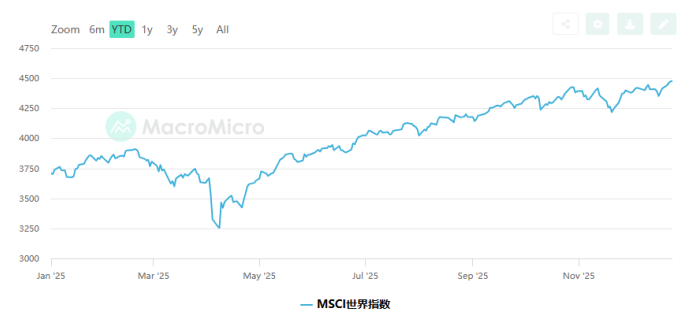
Group 1: Global Market Trends - In the context of global central banks initiating a "rate-cutting wave" and releasing ample liquidity, stock markets in multiple countries are expected to continue their upward momentum into 2025, demonstrating resilience amid macroeconomic and geopolitical shocks [1] - The MSCI global index has achieved a cumulative increase of over 20% this year, marking the third consecutive year of gains exceeding 15% [1] Group 2: Asian Market Dynamics - The AI boom has significantly boosted demand for semiconductors, with the MSCI Asia-Pacific index rising approximately 28% this year, marking the first time since 2020 that Asian stocks have outperformed US and European benchmarks in a single year [5][6] - Asia accounts for over 75% of global semiconductor manufacturing capacity, with Taiwan and South Korea leading in advanced process nodes, while China is rapidly expanding its mature process capacity [6] Group 3: Japanese and Korean Market Performance - The Nikkei 225 index has surpassed 50,000 points, with a year-to-date increase of 30%, driven primarily by technology stocks such as SoftBank Group and Advantest [7][9] - South Korea's KOSPI index has surged over 70% this year, with SK Hynix and Samsung Electronics leading the charge due to a supercycle in AI-driven memory chips [12] Group 4: European Market Insights - European stock markets have reached historical highs, supported by improved economic outlooks, lower inflation compared to the US, and significant fiscal stimulus from Germany [38][43] - The DAX index has shown resilience despite Germany's stagnant economic growth, bolstered by a massive fiscal stimulus plan aimed at infrastructure and defense spending [43][44] Group 5: North American Market Developments - Canada's TSX Composite Index has recorded a 30% increase this year, driven by strong performances in the financial, materials, and energy sectors [66][67] - Brazil and Mexico have also benefited from capital inflows due to their low valuation advantages, with both markets experiencing approximately 30% gains this year [74][75] Group 6: Future Outlook - Investors are optimistic about 2026, with expectations of continued stock market growth driven by corporate profit increases, reduced policy resistance, and AI investments [88][89] - Analysts predict that the AI-driven supercycle will lead to record capital expenditures and rapid profit expansion across various sectors, including defense and utilities [94][96]
Want To Be Rich? These 4 Industries Launched Billionaires’ Careers
Yahoo Finance· 2025-12-28 17:03
Core Insights - The analysis of the top 20 names on Forbes' 2025 Billionaires List reveals four industries that have generated significant wealth, highlighting the career paths of successful entrepreneurs and innovators [1] Technology and AI - Tech billionaires often began their careers as coders or engineers, demonstrating that technical skills can lead to the creation of global empires [2] - Elon Musk started coding at age 12, selling a video game for $500 [3] - Mark Zuckerberg launched Facebook from his Harvard dorm room after developing early chat applications [4] - Larry Ellison began as a software programmer at Ampex Corporation, where he created a CIA database that inspired the name of his company, Oracle [5] - Larry Page and Sergey Brin, as Ph.D. students at Stanford, transformed their research project into Google [6] - Steve Ballmer transitioned from an assistant brand manager at Procter & Gamble to becoming Microsoft's president and CEO [9] - Jensen Huang co-founded NVIDIA after working as a microchip designer at AMD and climbing the corporate ladder at LSI Logic [10] Luxury Brands - Founders in the luxury sector have successfully turned everyday purchases into billion-dollar businesses through brand loyalty [11] - Bernard Arnault, known as the "pope of fashion," initially worked for his father's real estate firm before investing in luxury goods, leading to his fortune [12] - The net worth of key figures includes: Bernard Arnault at $178 billion from LVMH [14], and Jensen Huang at $98.7 billion from NVIDIA [13]
—商社行业2026年度投资策略:消费复苏态势延续;把握景气及顺周期
Hua Yuan Zheng Quan· 2025-12-28 12:25
Group 1 - The report maintains a positive outlook on the retail and consumer services industry, highlighting a continued recovery in consumption and cyclical opportunities [1][2] - In 2025, the consumer services and retail sectors underperformed compared to the CSI 300 index, with the consumer services sector showing better performance than retail [11][16] - The jewelry retail sector experienced significant growth, primarily driven by rising gold prices, while the consumption of gold jewelry faced a decline [24][25] Group 2 - The report identifies two main investment directions for 2026: the continuation of consumption recovery, focusing on high-end sectors like duty-free and gaming, and the sustained high demand for emotional and self-rewarding consumption, particularly in jewelry and trendy products [68][71] - The restaurant industry showed a faster growth rate than overall retail, with a notable increase in the number of registered restaurants, indicating a cautious approach from new entrants [34][40] - The travel sector is recovering steadily, with strong demand during holidays and a positive trend in passenger numbers for civil aviation [45][51] Group 3 - The report emphasizes the importance of brand strength and product differentiation in the jewelry sector, as emotional value increasingly drives consumer choices [29][25] - The restaurant industry is expected to see a rise in chain operations and a focus on cost-effective consumption, with the overall market growth projected at 9.0% from 2020 to 2024 [37][40] - The report notes that the gaming sector remains robust, with Macau's gross gaming revenue showing a year-on-year increase, indicating a strong recovery in this segment [46][51]
Consumers proved to be resilient despite shortened holiday season: 5 New Digital's Michael Zakkour
Youtube· 2025-12-26 13:08
Core Insights - The holiday shopping season was notably shorter this year, with only 27 days between Thanksgiving and Christmas, yet consumer resilience was evident as spending continued despite the time constraints [2][3] - Value retailers, such as Walmart and dollar stores, performed well due to consumers having limited budgets and opting to spend in fewer places [3][6] - Electronics emerged as the top-selling category, with significant demand for gaming consoles, new phones, and laptops, contributing to a mini boom for retailers and tech companies [4] Retail Performance - Discount retailers saw substantial gains, with dollar stores and Walmart reporting increased sales, reflecting consumer behavior focused on budget-friendly options [6][14] - The K-shaped economy is highlighted, where affluent consumers continue to spend confidently while budget-minded individuals face economic challenges [7][12] - Luxury retailers experienced a mixed performance, with ultra-high-end products performing well, while mid-level luxury brands struggled due to inflation and decreased aspirational spending [8][9][11] Future Outlook - The retail economy is expected to remain strong in 2026, with consumers likely to continue spending, albeit with a focus on essentials and budget items [13][14] - There may be a "holiday hangover" as consumers reassess their financial situations post-holiday season, leading to potential shifts in spending behavior [13][16] - The macroeconomic environment shows low unemployment and healthy consumer balance sheets, but poor sentiment could impact future spending [15]


深度 | 美妆年度考题:开一家“对”的店
FBeauty未来迹· 2025-12-26 10:46
Core Insights - The beauty retail landscape in 2025 has undergone a strategic transformation, with traditional department stores closing approximately 20 beauty counters daily, resulting in a net reduction of over 5,000 points throughout the year. In contrast, more than 80 new stores have opened across various formats, indicating a shift in the essence of store openings from mere locations to interactive "experience generators" [1][4][20]. Group 1: Changes in Retail Strategy - The focus of foreign brands has shifted from establishing static brand landmarks to creating dynamic operational "experience laboratories" that engage consumers [5][8]. - The concept of "first stores" has evolved, with brands now competing not just for geographical presence but for the best resources to launch globally, making China a key market for premier brand assets and innovative products [8][10]. - The traditional department store channel has seen a significant efficiency optimization, with a beauty brand counter opening and closing ratio of only 0.6, reflecting a strategic shift towards deeper experiential value creation [20][43]. Group 2: Local Brand Strategies - Local brands have completed a strategic evolution, moving beyond imitation to establish distinct paths in fragrance, color cosmetics, and skincare, focusing on systematic brand space construction rather than scattered store openings [22][38]. - Three distinct paths for local fragrance brands have emerged: cultural deepening, matrix penetration, and business model integration, each targeting unique market segments and consumer experiences [24][31]. - Local brands are also exploring international markets, with brands like JUDUO and JOOCYEE opening their first overseas stores, indicating a systematic exploration of international growth [32][33]. Group 3: Innovative Retail Formats - Pop-up stores have evolved from marketing events to "high-end experience laboratories," offering flexible themes and deep technological integration, exemplified by Lancôme and SkinCeuticals [11][13]. - Some foreign brands are merging retail with lifestyle solutions, as seen with HARNN's "SPA + retail" concept, allowing customers to experience the brand's culture and services in a holistic manner [15][16]. - The integration of various business models is becoming standard, with brands like MARCH creating multi-functional spaces that combine fragrance with cultural and lifestyle elements [29][41]. Group 4: Market Dynamics and Future Trends - The role of cities in brand strategy has been redefined, with high-tier cities serving as core battlegrounds for brand recognition and narrative development, while lower-tier cities are seen as growth areas for brand expansion [40][41]. - The future of beauty retail is shifting from geographical competition to the creation of mental and experiential spaces, emphasizing the importance of opening the "right" store in strategically chosen locations [43][44].

140亿欧元爱马仕股份是怎么消失的?
3 6 Ke· 2025-12-26 08:02
Core Viewpoint - The legal battle involving Nicolas Picié, a fifth-generation heir of Hermès, against LVMH centers around the alleged loss of 6 million shares valued at €14 billion, which he claims were wrongfully taken by LVMH through his financial advisor [1][29]. Group 1: Background of Nicolas Picié - Nicolas Picié is one of the heirs of the Hermès family, with a background that diverges from traditional family roles, preferring a lifestyle away from family business responsibilities [3][5]. - He inherited approximately 5.7% of Hermès shares, which provided him with substantial dividend income, reportedly around €42 million in 2011 alone [6][7]. Group 2: The Allegations and Discovery - Picié discovered discrepancies in his wealth management when his gardener and financial advisor failed to transfer a sum of CHF 1 million, prompting an audit that revealed missing assets [8][12]. - His financial advisor, Frémond, was accused of mismanaging Picié's assets, including the alleged sale of his Hermès shares to LVMH without his knowledge [13][27]. Group 3: The LVMH Acquisition Strategy - LVMH's acquisition of Hermès shares began in 2001-2002, with a significant increase in holdings by 2010, reaching over 20% of the company [36][38]. - The acquisition strategy involved complex financial maneuvers, including equity swaps and covert purchases, which allowed LVMH to accumulate shares without triggering regulatory disclosures [39][46]. Group 4: Hermès Family Defense - In response to LVMH's aggressive acquisition, the Hermès family united to form a new entity, H51, aimed at consolidating shares and maintaining control over the company [52][55]. - Picié's lack of participation in the family defense efforts raised suspicions about his loyalty and intentions during the acquisition battle [56][57]. Group 5: Financial Performance of Hermès - Hermès reported a sales figure exceeding €15 billion in 2024, with impressive profit margins, including a net profit margin of 30%, significantly higher than competitors like LVMH [64][66]. - The brand's ability to maintain high resale values and limited production has solidified its status as a luxury market leader, with a unique business model focused on craftsmanship and scarcity [70][72][75].

2025年第51周:美妆行业周度市场观察
艾瑞咨询· 2025-12-26 00:05
Group 1: Industry Environment - The international college market has become a battleground for fashion and beauty brands, with Generation Z's annual beauty spending reaching $5 billion, and skincare usage starting as early as ages 11-13, showing a trend of gender convergence in consumption [3] - Brands are leveraging campus ambassadors, pop-up events, social media, and influencer collaborations to penetrate the college market, while health brands utilize clubs and TikTok to reach their target audience [3] - The strong purchasing power and loyalty of Generation Z make campus settings strategic for brands, necessitating innovative activities to capture attention [3] Group 2: Market Dynamics - Traditional chain pharmacies are accelerating their transformation by expanding into beauty and personal care categories to address industry challenges, with YST planning to add beauty and maternal products in 70% of its stores (nearly 8,000 locations) [5] - The beauty segment now accounts for nearly 60% of the health category in these pharmacies, as other chains like Shuyupingmin and Yifeng also enter the beauty market to cope with tightening medical insurance policies and declining foot traffic [5] - Cosmetic brands such as Winona and Kefu Mei are actively entering pharmacy channels to enhance brand value through professional credibility, although expanding OTC channels requires significant investment and faces challenges in product selection and private domain operations [5] Group 3: Major Brand Developments - Major beauty brands like L'Oréal and Estée Lauder have signed global ambassadors, enhancing their brand influence, while LVMH invests in the French niche fragrance brand BDK to support its international expansion [6] - The clean beauty sector is experiencing differentiation, with Korean brand Aromatica's stock surging while L'Oréal shuts down related brands [6] - Japanese high-end brand SUQQU is entering the Chinese market, targeting the premium segment [6] Group 4: Technological Innovations - Estée Lauder Group has launched a global innovation center for fragrance in Paris, integrating R&D and creative teams, utilizing AI to monitor trends, optimize formulas, and accelerate approval processes while respecting brand uniqueness [7] - AI assists perfumers in innovation by analyzing data and emotional preferences, with the launch of an AI fragrance consultant tool by Jo Malone in December, providing personalized fragrance recommendations [7] Group 5: Company Performance - Huaxi Biological has faced declining performance due to the diminishing market dividends of hyaluronic acid, with a 18.36% year-on-year revenue drop and a 30.29% decline in net profit for the first three quarters of 2024, resulting in a market value loss of 100 billion [8] - The company has adjusted welfare policies, reduced employee benefits, and cut staff, particularly in sales, while its skincare business has seen significant revenue declines and multiple sub-brands have been eliminated [8] - Increased competition and product homogenization in the hyaluronic acid market have pressured profits, prompting Huaxi Biological to explore new sectors like weight loss and invest in small nucleic acid drugs, although it faces fierce industry competition and consumer skepticism regarding ingredients [8] Group 6: Digital Transformation - Digitalization is increasingly important in retail for product management, marketing, and user experience, especially in a saturated market, necessitating innovative digital transformations to enhance efficiency [9] - Huamei's collaboration with Hanshu Technology has been recognized as an excellent digital innovation case, reshaping the beauty store shopping experience through a "warehouse-style display + artistic aesthetics" model [9] - The use of electronic price tags supports real-time information updates and enhances marketing conversion, demonstrating how digitalization can seamlessly integrate into brand identity and improve customer experience [9]

红杉中国买了“小脏鞋”,马云或套现离场
21世纪经济报道· 2025-12-23 07:45
Core Viewpoint - Sequoia China has finalized the acquisition of a controlling stake in Golden Goose, with Temasek and its subsidiary participating as minority shareholders, while the original shareholder Permira retains a minority stake. This investment aims to accelerate Golden Goose's global expansion [1][2]. Company Overview - Golden Goose, founded in 2000, is described as a global emerging fashion brand that blends luxury, lifestyle aesthetics, and sports style. The company is headquartered in Venice, Italy, and was co-founded by designers Alessandro Gallo and Francesca Rinaldo. Its signature product, the Super-Star sneaker, features a distinctive worn look and has gained popularity in the fashion community [3][4]. Financial Performance - In the latest fiscal quarter ending September 30, Golden Goose reported a net revenue increase of 13% year-over-year, reaching €517 million. The EMEA and APAC markets grew by 15%, while the Americas saw a 10% increase. Direct-to-consumer (DTC) net revenue rose by 21%, accounting for 79% of total revenue, driven by new store openings and double-digit same-store sales growth [5]. - Adjusted EBITDA for the first nine months increased by 7% to €173.6 million, with an EBITDA margin of 33.6% [5]. Strategic Initiatives - CEO Silvio Campara highlighted the brand's unique store expansion strategy, collaborations with influential ambassadors, and the launch of new sneaker models. The company has also established the Golden Goose Arena in Milan, which integrates sports, culture, and community [6]. - Golden Goose has attracted over 2 million members to its Dreamers community and operates 227 direct stores globally, reaching consumers through online and wholesale channels [6]. Market Context - The luxury goods market is experiencing fluctuations, with major brands like LVMH and Kering reporting declines in revenue. However, there are emerging opportunities, as seen with brands like Arc'teryx, which reported a 25.9% revenue increase in the first three quarters of the year [8][9]. - The market dynamics suggest that high-end consumers are shifting preferences, opting for brands like Arc'teryx and Golden Goose, which offer a better price-to-value ratio compared to traditional luxury brands [9]. Investment Outlook - Sequoia China's investment in Golden Goose reflects confidence in the growth potential of the consumer market, despite the challenges faced by the luxury sector. The partnership with Temasek, which has experience in the luxury market, may help address operational challenges [10].