东鹏饮料

Search documents
渠道布局与场景化精准触达 东鹏饮料构筑终端动销增长新引擎
Zheng Quan Shi Bao Wang· 2025-09-04 04:18
Core Insights - The fast-moving consumer goods (FMCG) industry is undergoing significant transformation, driven by diverse consumer demands and evolving channel dynamics [1] - Dongpeng Beverage has demonstrated strong growth, achieving a revenue of 10.737 billion yuan in the first half of 2025, a year-on-year increase of 36.37%, and a net profit of 2.375 billion yuan, up 37.22% [1] Group 1: Channel Development - Dongpeng Beverage has established a leading channel system with over 3,200 distributors, covering more than 4.2 million active retail points and reaching over 250 million unique consumers [2] - The company employs a dual-track approach of deep cultivation in mature markets and rapid expansion in emerging markets, with revenue in Guangdong growing by 20.61% and North China by 73.03% [2] - New channels such as dining, social e-commerce, and live streaming are being actively explored, alongside the deployment of smart vending machines to enhance product visibility in high-frequency consumption areas [2] Group 2: Digital Integration - Dongpeng Beverage integrates digital technology with channel management, creating a full-link digital closed loop that enhances operational quality and market expansion capabilities [3] - The use of real-time data reduces channel costs and improves targeting accuracy, supporting cross-regional and cross-category expansion [3] Group 3: Scene Marketing - Scene marketing strengthens the connection between the brand and various consumer scenarios, with Dongpeng Beverage identifying specific product anchors within a three-dimensional coordinate system of people, scenes, and products [4] - The company sponsors major esports and sports events, linking its functional beverages to the spirit of competition and athletic performance [4] - Revenue from Dongpeng's hydration product, "Dongpeng Water," reached 1.493 billion yuan in the first half of 2025, increasing its revenue share from 6.05% to 13.91% year-on-year [4] Group 4: Sales Conversion - Dongpeng Beverage has developed a comprehensive operational system that connects channel layout, scene penetration, and sales conversion [6] - The company enhances product availability through upgraded display strategies and digital marketing initiatives, driving consumer engagement and repeat purchases [7] - The focus on overseas expansion, particularly in Southeast Asia, leverages the company's established methodologies in channel development and scene penetration to tap into new growth opportunities [7]

上市公司中报勾勒消费升级新图景
Jin Rong Shi Bao· 2025-09-04 03:03
Group 1: Company Performance - Pianzaihuang Pharmaceutical Co., Ltd. reported revenue of 5.379 billion yuan and net profit of 1.442 billion yuan for the first half of 2025, reflecting the company's strong performance in the traditional Chinese medicine sector [1] - The company is expanding its product offerings to include functional health foods and daily chemical products, aligning with the rising demand for health and wellness products in China [1] - The overall performance of Pianzaihuang is indicative of the resilience and vitality of China's consumer market, which is shifting towards quality, personalization, greenness, and health [1] Group 2: Consumer Market Trends - The "old for new" policy has effectively stimulated growth in the consumer market, with 2.8 billion people applying for subsidies, leading to sales exceeding 1.6 trillion yuan [2] - The automotive sector saw a 6% increase in revenue for listed companies, with new energy vehicle sales rising nearly 30% [2] - The home appliance sector also experienced a 10% increase in net profit among listed companies, with Haier and Hisense leading in market share and sales growth [2] Group 3: Basic and New Consumption - Basic consumption categories such as dining, accommodation, and household services showed steady growth, with retail sales of consumer goods reaching 24.5458 trillion yuan, a 5% increase year-on-year [4] - Companies in the beverage and seasoning sectors reported significant growth, with East Peak Beverage's electrolyte drink revenue increasing by 214% [4] - New consumption trends, particularly in beauty and fashion, have led to substantial profit increases for companies in these sectors, with net profits rising by 26.12% and 42.91% respectively [4] Group 4: Tourism and Travel - Domestic tourism saw 3.285 billion trips in the first half of 2025, a 20.6% increase, with spending reaching 3.15 trillion yuan, up 15.2% [7] - Listed tourism companies reported a 58% increase in net profit, driven by innovative experiences and cultural tourism [7] - Airports such as Shanghai and Baiyun reported net profit increases of 28% and 71% respectively, reflecting the recovery in international travel [8]

量化大势研判:当成长只有预期在扩张
Minsheng Securities· 2025-09-03 09:32
Quantitative Models and Construction Methods Model Name: Quantitative Market Trend Analysis Framework - **Model Construction Idea**: The model aims to solve the systematic rotation problem of styles by conducting a bottom-up quantitative market trend analysis. It identifies the dominant asset characteristics that represent the future market's mainstream style through a comprehensive comparison of assets[1][5] - **Model Construction Process**: - The model considers five style stages based on the asset's industry lifecycle: external growth, quality growth, quality dividend, value dividend, and bankruptcy value[1][5] - The priority for asset comparison is based on the sequence: growth (g) > return on equity (ROE) > dividend (D)[1][5] - The model uses the spread of asset advantage differences to capture the trend changes of top assets, similar to factor timing[20] - **Model Evaluation**: The framework has shown good explanatory power for past A-share style rotations, achieving an annualized return of 27.25% since 2009[15] Model Backtesting Results - **Quantitative Market Trend Analysis Framework**: - 2009: Asset Comparison Strategy 133%, Wind All A 82%, Excess Return 51%[18] - 2010: Asset Comparison Strategy 7%, Wind All A -7%, Excess Return 14%[18] - 2011: Asset Comparison Strategy -33%, Wind All A -22%, Excess Return -11%[18] - 2012: Asset Comparison Strategy 5%, Wind All A 5%, Excess Return 0%[18] - 2013: Asset Comparison Strategy 41%, Wind All A 5%, Excess Return 36%[18] - 2014: Asset Comparison Strategy 48%, Wind All A 52%, Excess Return -4%[18] - 2015: Asset Comparison Strategy 55%, Wind All A 38%, Excess Return 16%[18] - 2016: Asset Comparison Strategy -14%, Wind All A -13%, Excess Return -1%[18] - 2017: Asset Comparison Strategy 32%, Wind All A 5%, Excess Return 27%[18] - 2018: Asset Comparison Strategy -21%, Wind All A -28%, Excess Return 7%[18] - 2019: Asset Comparison Strategy 41%, Wind All A 33%, Excess Return 8%[18] - 2020: Asset Comparison Strategy 69%, Wind All A 26%, Excess Return 44%[18] - 2021: Asset Comparison Strategy 47%, Wind All A 9%, Excess Return 38%[18] - 2022: Asset Comparison Strategy 44%, Wind All A -19%, Excess Return 62%[18] - 2023: Asset Comparison Strategy 5%, Wind All A -5%, Excess Return 10%[18] - 2024: Asset Comparison Strategy 62%, Wind All A 10%, Excess Return 52%[18] - 2025 (Aug): Asset Comparison Strategy 27%, Wind All A 23%, Excess Return 4%[18] Quantitative Factors and Construction Methods Factor Name: Expected Growth (gf) - **Factor Construction Idea**: The factor focuses on the highest analyst forecasted growth rates, regardless of the cycle stage[6] - **Factor Construction Process**: - The factor is constructed by selecting industries with the highest expected growth rates as forecasted by analysts[6] - The spread of expected growth advantage differences (Δgf) is used to capture the trend changes in top assets[20] - **Factor Evaluation**: The factor has shown significant excess returns since 2019, with notable performance in 2014-2015[34] Factor Name: Actual Growth (g) - **Factor Construction Idea**: The factor focuses on industries with the highest actual growth rates, particularly during transition and growth periods[6] - **Factor Construction Process**: - The factor is constructed by selecting industries with the highest actual growth rates (Δg)[6] - The spread of actual growth advantage differences (Δg) is used to capture the trend changes in top assets[24] - **Factor Evaluation**: The factor has shown significant excess returns in growth-dominant environments[36] Factor Name: Profitability (ROE) - **Factor Construction Idea**: The factor focuses on industries with high ROE and low valuation under the PB-ROE framework, concentrated in mature periods[6] - **Factor Construction Process**: - The factor is constructed by selecting industries with high ROE and low PB-ROE residuals[6] - The spread of ROE advantage differences is used to capture the trend changes in top assets[26] - **Factor Evaluation**: The factor has shown significant excess returns from 2016 to 2020, with weaker performance since 2021[39] Factor Name: Quality Dividend (DP+ROE) - **Factor Construction Idea**: The factor focuses on industries with the highest DP+ROE scores, concentrated in mature periods[6] - **Factor Construction Process**: - The factor is constructed by selecting industries with the highest DP+ROE scores[6] - The spread of DP+ROE advantage differences is used to capture the trend changes in top assets[42] - **Factor Evaluation**: The factor has shown significant excess returns in 2016, 2017, and 2023[43] Factor Name: Value Dividend (DP+BP) - **Factor Construction Idea**: The factor focuses on industries with the highest DP+BP scores, concentrated in mature periods[6] - **Factor Construction Process**: - The factor is constructed by selecting industries with the highest DP+BP scores[6] - The spread of DP+BP advantage differences is used to capture the trend changes in top assets[45] - **Factor Evaluation**: The factor has shown significant excess returns in 2009, 2017, and 2021-2023[46] Factor Name: Bankruptcy Value (PB+SIZE) - **Factor Construction Idea**: The factor focuses on industries with the lowest PB+SIZE scores, concentrated in stagnation and recession periods[6] - **Factor Construction Process**: - The factor is constructed by selecting industries with the lowest PB+SIZE scores[6] - The spread of PB+SIZE advantage differences is used to capture the trend changes in top assets[48] - **Factor Evaluation**: The factor has shown significant excess returns in 2015-2016 and 2021-2023[49] Factor Backtesting Results - **Expected Growth (gf)**: - Cable: 12 stocks, largest weight stock Zhongtian Technology, average market cap 21.791 billion yuan, 3-month performance 49.62%[34] - Cement: 19 stocks, largest weight stock Conch Cement, average market cap 17.929 billion yuan, 3-month performance 12.71%[34] - Glass Fiber: 6 stocks, largest weight stock China Jushi, average market cap 26.657 billion yuan, 3-month performance 63.67%[34] - Rare Earth and Magnetic Materials: 17 stocks, largest weight stock Northern Rare Earth, average market cap 31.018 billion yuan, 3-month performance 98.77%[34] - White Goods III: 10 stocks, largest weight stock Midea Group, average market cap 113.675 billion yuan, 3-month performance -1.21%[34] - **Actual Growth (g)**: - Integrated Circuits: 104 stocks, largest weight stock Cambricon-U, average market cap 45.058 billion yuan, 3-month performance 42.93%[37] - PCB: 38 stocks, largest weight stock Shenghong Technology, average market cap 27.163 billion yuan, 3-month performance 112.10%[37] - Tungsten: 4 stocks, largest weight stock Xiamen Tungsten, average market cap 30.523 billion yuan, 3-month performance 69.26%[37] - Lithium Battery Equipment: 12 stocks, largest weight stock Lead Intelligent, average market cap 11.731 billion yuan, 3-month performance 60.15%[37] - Weapons and Equipment III: 12 stocks, largest weight stock Great Wall Military Industry, average market cap 21.307 billion yuan, 3-month performance 80.22%[37] - **Profitability (ROE)**: - Beer: 7 stocks, largest weight stock Tsingtao Brewery, average market cap 26.758 billion yuan, 3-month performance -3.94%[39] - Liquor: 20 stocks, largest weight stock Kweichow Moutai, average market cap 162.722 billion yuan, 3-month performance 4.12%[39] - Non-dairy Beverages: 7 stocks, largest weight stock Eastroc Beverage, average market cap 32.754 billion yuan, 3-month performance -4.45%[39] - Network Connection and Tower Setup: 19 stocks, largest weight stock Zhongji Xuchuang, average market cap 64.299 billion yuan, 3-month performance 202.29%[39] - Building Decoration III: 28 stocks, largest weight stock Gold Mantis, average market cap 3.436 billion yuan, 3-month performance 4.42%[39] - **Quality Dividend (DP+ROE)**: - Automotive Motor Control: 15
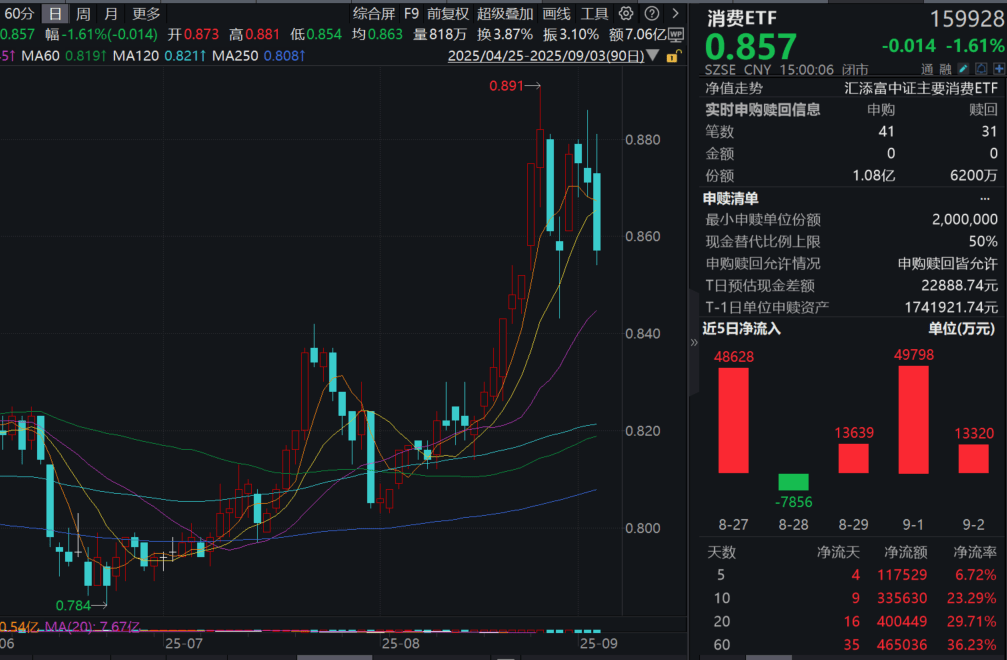
科技为矛,消费为盾!消费ETF(159928)跌1.6%连续第3日回调,全天净申购4600万份!机构:中报后新消费重拾上涨,白酒有望走出底部!
Sou Hu Cai Jing· 2025-09-03 09:29
Market Overview - The A-share market showed a mixed performance with the Shanghai Composite Index declining by 1.16% and the Consumer ETF (159928) falling by 1.61%, with a total trading volume exceeding 700 million yuan [1] - The Consumer ETF has seen a net subscription of 46 million units, indicating a strong inflow of funds, with a cumulative "capital absorption" exceeding 1.1 billion yuan over the past ten days [1] Consumption Policies - Shaoxing, Zhejiang Province announced a tiered subsidy for hotel banquets based on the number of tables and total expenditure, as part of its upcoming "2025 Shaoxing Consumption Promotion Policy" [3] - The policy focuses on three areas: integration of culture, commerce, and tourism; expansion of new consumption scenarios; and distribution of consumption vouchers, comprising 15 specific measures [3] Long-term Investment Trends - Long-term funds are adopting a high-dividend strategy, with a focus on technology as a growth driver and consumer sectors as a defensive shield [6] - There is a notable shift in fund allocation, with increased investments in technology sectors such as TMT and military-related ETFs, while also showing renewed interest in low-position domestic consumer goods [6] Consumer Sector Insights - The white liquor sector is currently in a bottoming phase, with companies actively adjusting their product channels, presenting potential bottom-fishing opportunities [7] - The consumer landscape is evolving with new demands for emotional and personalized products, particularly in categories like trendy toys and beauty products, which are experiencing significant growth [8][11] Service Consumption Growth - Service consumption is projected to account for 46.1% of household spending by 2024, contributing 63% to overall consumption growth, indicating a shift towards a more significant role in defining lifestyles and emotional connections [14] ETF Composition - The Consumer ETF (159928) has a strong resilience to economic cycles, with the top ten constituent stocks accounting for over 68% of its weight, including leading liquor brands and major consumer goods companies [17][18]

复盘106家食品企业半年报:70家公司业绩下滑,蒙牛液奶缩水40亿,农夫逆袭净赚76亿
3 6 Ke· 2025-09-03 08:50
Overall Industry Performance - In the first half of 2025, 70 out of 106 companies reported varying degrees of performance decline, with 57 experiencing revenue drops and 48 facing net profit declines, indicating a trend of prioritizing profit preservation over revenue growth [1][2] - The consumer market remains weak, leading to supply-demand imbalances, intense competition, and price wars [1] Dairy Industry - The dairy sector is significantly impacted, with 25 out of 33 listed companies reporting performance declines, primarily due to falling liquid milk sales [1][3] - Major players like Yili and Mengniu saw substantial revenue drops in their liquid milk segments, with Yili's liquid milk revenue decreasing by 7.61 billion yuan and Mengniu's by 40.48 billion yuan [3][4] - Conversely, the milk powder segment shows signs of structural recovery, with some companies reporting revenue growth due to market consolidation and subsidy policies [3][5] Snack Industry - Snack companies are largely struggling, with brands like Liuyinpuzi and Laiyifen reporting losses, while others like Qiaqia and Three Squirrels experienced significant profit declines [1][2] - The challenges stem from channel transformations and rising costs, particularly in raw materials, leading to increased customer acquisition costs [1] Beverage Industry - The beverage sector shows mixed results, with companies like Nongfu Spring and Dongpeng achieving record net profits, while others like China Resources Beverage faced revenue declines [9][10] - Nongfu Spring's tea beverage segment surpassed 10 billion yuan in revenue for the first time, indicating strong market performance [9] Seasoned Food Industry - The seasoning industry is experiencing increasing differentiation, with leading companies like Haitian maintaining stable growth while others like Zhongju Gaoxin face significant declines [7][8] - Many companies are adjusting their channel strategies in response to market saturation, with a focus on international expansion [8] Convenience Food Industry - The convenience food sector shows slight recovery among leading companies, with Shuanghui Development reporting a revenue increase of 2.97% [13] - Notably, Guoquan Foods achieved remarkable growth, with revenue and net profit increasing significantly [14] Overall Conclusion - The food industry is facing a challenging environment with more companies reporting declines than gains, but there are still structural growth opportunities for those willing to adapt and innovate [14]
2025年1-7月中国饮料产量为11101.1万吨 累计增长3%
Chan Ye Xin Xi Wang· 2025-09-03 05:18
Industry Overview - The beverage production in China is projected to reach 17.97 million tons by July 2025, reflecting a year-on-year growth of 4.7% [1] - From January to July 2025, the cumulative beverage production in China is expected to be 111.01 million tons, with a cumulative growth of 3% [1] Companies Mentioned - Listed companies in the beverage sector include Yangyuan Beverage (603156), Chengde Lolo (000848), Dongpeng Beverage (605499), and Junyao Health (605388) [1] Research Report - The insights are derived from the "2025-2031 China Beverage Industry Market Operation Pattern and Future Prospects Analysis Report" published by Zhiyan Consulting [1][2]


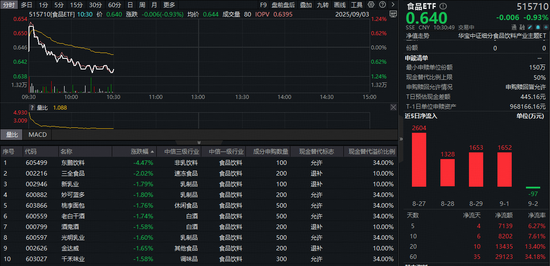
绍兴宴席补贴新政出炉!吃喝板块冲高回落,食品ETF(515710)近20日吸金超1.3亿元!
Xin Lang Ji Jin· 2025-09-03 02:53
Group 1 - The food and beverage sector experienced a pullback on September 3, with the Food ETF (515710) opening high but declining, down 0.93% at the time of reporting [1][2] - Major stocks in the sector, including Dongpeng Beverage, Sanquan Food, and several liquor brands, saw significant declines, with Dongpeng Beverage dropping over 4% and Sanquan Food down over 2% [1][2] - The Food ETF has seen substantial net inflows recently, with over 70 million yuan in net subscriptions over the past five trading days and more than 130 million yuan over the last 20 days [2] Group 2 - A new consumption promotion policy was announced in Shaoxing, Zhejiang, which includes subsidies for dining events, potentially boosting demand in the food and beverage sector [3] - The current valuation of the food and beverage sector is considered low, with the Food ETF's underlying index PE ratio at 21.25, indicating a favorable time for investment [3] - Despite a weak performance in the liquor sector, some companies are actively adjusting their product channels, suggesting potential bottom-fishing opportunities [4] Group 3 - The liquor sector is viewed as having good investment value, with ongoing policy support reinforcing expectations for economic recovery, although there are still concerns about the pace of recovery [5] - The Food ETF (515710) tracks the China Securities Index for the food and beverage industry, with a significant portion of its holdings in high-end liquor stocks and other beverage segments [6]


饮料制造板块盘初冲高,会稽山涨停创新高
Xin Lang Cai Jing· 2025-09-03 01:36
Group 1 - The beverage manufacturing sector experienced a strong initial surge, with Kuaijishan reaching a new high and hitting the daily limit [1] - Other companies such as Guyue Longshan, Jinfeng Wine Industry, Pinwo Food, Huanlejia, and Dongpeng Beverage also saw increases [1]

华创证券食饮2025年中报总结:白酒加速出清 大众呈现亮点
智通财经网· 2025-09-02 22:55
Group 1 - The beverage sector shows better performance, with leading companies demonstrating significant advantages. The sector's revenue and profit increased by 5.4% and 14.4% year-on-year in Q2 2025, respectively [1][3] - The soft drink segment, particularly brands like Nongfu Spring and Dongpeng, is experiencing strong momentum, with bottled water market share recovering and functional beverages continuing to benefit from market trends [1][4] - Traditional leaders in the beer and dairy industries, such as China Resources Beer, Yili, and Angel Yeast, are seeing improvements in return on equity (ROE) as they adapt to market conditions [1][3] Group 2 - The white wine sector is under pressure, with Q2 2025 revenue and net profit declining by 5.0% and 7.5% year-on-year, respectively. Excluding Moutai, the declines are more pronounced at 13.0% and 21.4% [2][3] - High-end and mid-range wines are experiencing a drop in gross margins, with high-end wine margins decreasing by 0.2 percentage points, while base and expansion-type mid-range wines saw declines of 1.7 and 5.4 percentage points, respectively [3] - Cash flow in the white wine sector decreased by 3.2% in Q2 2025, indicating a tightening of liquidity as companies focus on easing channel pressures [3]
食品饮料及新消费行业跟踪报告:茶饮上半年业绩亮眼,泡泡玛特新品成爆款
Shanghai Aijian Securities· 2025-09-02 06:34
Investment Rating - The food and beverage industry is rated as "stronger than the market" [1] Core Views - The food and beverage industry index increased by 2.13% in the week of August 25-29, outperforming the Shanghai Composite Index, which rose by 0.84% [9] - The industry is currently at a historical low valuation, with a PE-TTM of 22.51x, corresponding to the 17th percentile over the past 15 years [16] - The liquor sector is expected to see a weak recovery in demand as policy pressures ease, with leading companies like Kweichow Moutai and Wuliangye showing strong dividend potential [6] Summary by Sections Weekly Performance - The food and beverage industry outperformed the market with a 2.13% increase, ranking 7th among 31 sub-industries [9] - The snack sector saw the highest increase at 10.20%, followed by dairy products at 2.67% and liquor at 2.14% [12] Liquor Sector - Wuliangye launched a new 29° product aimed at attracting younger consumers, reflecting a trend towards modernizing the liquor market [26] - The price of Feitian Moutai has decreased, with current prices at 1820 RMB for original and 1795 RMB for scattered [25] Tea Beverage Sector - Mixue Group reported a revenue of 14.88 billion RMB in the first half of 2025, a 39.3% year-on-year increase, with a net profit of 2.72 billion RMB, up 44.1% [32] - The number of Mixue stores reached 53,014, a 22.7% increase year-on-year, with a significant expansion in mainland China [33] New Consumption - Pop Mart's new mini LABUBU product saw over 1 million units sold within minutes of its launch, indicating strong consumer demand and improved production capacity [38] - The company has significantly increased its production capacity to 30 million units in August, ten times that of the previous year [38] Cost Indicators - Prices for sugar and glass have slightly decreased, which may positively impact the cost structure of the food and beverage industry [39]