
美的集团

Search documents
近期消费系列重要政策解读专题电话会议
2025-12-22 01:45
近期消费系列重要政策解读专题电话会议 20251221 摘要 扩大内需是应对挑战的关键,措施包括提高中等收入群体就业、社保和 收入,以及完善职业技能教育体系。供给端则注重质量与效率,创新消 费业态与模式,服务消费成为新增长点。 消费行业负贝塔效应减弱,CPI 数据转正,餐饮和社会零售数据改善。 政策预期商品消费向服务消费倾斜,市场期待业绩估值双重弹性,2026 年或是业绩兑现窗口期。 海南自贸港封关遵循一线放开、二线管住、岛内自由原则。免税商品种 类大幅增加,离岛免税新政包括即购即提、新增国产品类及扩展适用人 群,利好中免公司。 中免公司销售数据持续改善,12 月封关首日销售额同比增长超 90%, 得益于旅游宣传和消费券发放。尽管毛利率较低,但连续增长的数据对 业绩有积极作用,值得关注。 家电板块受益于刺激消费政策,包括延续国补和以旧换新,并可能扩大 规模。政策推动绿色智能家电转型,提升能效标准,优化产业环境,利 好美的集团、海尔智家等企业。 Q&A 康养经济与服务消费成为经济新增长点,企业通过 IP 打造附加值,跨行 业融合。泰迪威尼授权业务表现出色,今年实收已达 10 亿元,预计明 年继续保持增长。 生猪 ...





扩大内需战略解读与推荐
2025-12-22 01:45
Summary of Key Points from Conference Call Records Industry Overview - The focus is on the **expansion of domestic demand** as a long-term structural reform strategy to address challenges such as declining demographic dividends and globalization pressures. The shift is from supply-driven to demand-driven, emphasizing the need to supplement both upstream R&D and downstream consumption [1][2][3]. Core Insights and Arguments - **Increase in Resident Income**: A critical factor for expanding domestic demand. Policies like trade-in subsidies may have a short-term effect but can lead to over-reliance on such measures. The emphasis should be on increasing wage and asset income through fiscal reforms to achieve broad-based benefits [1][6]. - **Consumer Trends**: By 2026, service consumption, high-end consumption, and emerging self-reward consumption are expected to perform well. Policies may favor sectors like tourism and dining, while a declining real estate market could enhance purchasing power for younger consumers [1][9]. - **Investment Focus**: Effective investments are anticipated in water conservancy, energy, municipal infrastructure, and core technology sectors such as AI, biomedicine, and quantum communication. The green transition is expected to unlock consumption potential in areas like eco-tourism and energy-efficient appliances [1][11]. Industry-Specific Insights Home Appliance Sector - The home appliance industry is projected to experience a downturn in the second half of 2025 due to trade-in policies, but a recovery is expected in early 2026 as subsidies are renewed, leading to a replenishment cycle [1][12][13]. - **Sales Data**: By November 2025, air conditioner sales grew by approximately 2%, while refrigerator sales declined by about 1%. The overall industry saw a decline in the latter half of the year, particularly in Q4, where air conditioner sales dropped over 20% [12][13]. Fiscal Policy and Consumer Behavior - The fiscal reform is expected to shift focus from incremental taxation to more comprehensive measures, such as property and capital gains taxes, which will gradually influence overall household income and consumption [7][8]. - The effectiveness of subsidies is questioned, as they may lead to a crowding-out effect on autonomous consumption. For instance, a 300 billion yuan subsidy led to a 2.7 trillion yuan increase in retail sales, but the non-subsidy portion contributed negatively [6]. Investment Recommendations - **Home Appliances**: Companies like Midea, Haier, TCL, and Hisense are recommended for their strong domestic and international performance. The expectation is that these companies will benefit from the renewed subsidy policies in 2026 [15]. - **New Consumption Trends**: Focus on emerging brands in personal care and health products, as well as established brands with significant market barriers, such as Mao Geping and Shanghai Jahwa [18]. - **Health and Wellness Sector**: Companies like Xianle Health and Ximai Foods are highlighted for their growth potential in the health and wellness market, driven by the aging population and increasing health awareness [19][21]. Additional Insights - **Transportation Sector**: The aviation industry is expected to benefit directly from increased demand, while the shipping industry will see indirect benefits from heightened domestic trade activities [28]. - **Agricultural Sector**: Recommendations include focusing on the pet industry and functional ingredients, with companies like Zhongchong and Bailong Chuangyuan showing strong growth potential [31]. Conclusion - The overall sentiment is optimistic regarding the expansion of domestic demand, with significant investment opportunities across various sectors, particularly in health, home appliances, and new consumption trends. The emphasis on increasing resident income and effective fiscal reforms will be crucial in driving this growth [26][27].
大消费景气展望:基数与大促后增速放缓,期待明年政策发力
2025-12-22 01:45
Summary of Conference Call Records Industry Overview - **Consumer Sector Outlook**: The consumer sector is expected to face challenges in the first half of 2026 due to the tapering of the trade-in policy, which may lead to a slowdown in durable goods consumption. However, service consumption is showing strong internal momentum, with growth expected in sectors like elderly care and home services, which may receive more policy support [1][4][5]. Key Points and Arguments - **Consumer Data Trends**: In November 2025, retail sales growth fell to 1.3%, the lowest of the year, primarily due to the early Double Eleven promotions, the impact of the trade-in policy, and weakened consumer confidence due to falling housing prices [2][3]. - **Trade-in Policy Impact**: The decline in the trade-in policy is anticipated to negatively affect consumer spending in early 2026, particularly in durable goods like home appliances and automobiles, which are expected to see continued low growth [3][21]. - **Service Consumption Growth**: Service retail growth has increased from 4.9% at the beginning of the year to 5.4%, with significant contributions from education and dining sectors [4]. - **Investment Recommendations**: Focus on the AI industry and emerging sectors like pet economy and trendy toys. Real estate is expected to recover by 2026-2027, benefiting related industries [1][6][7]. Important but Overlooked Content - **High-End Consumption and Travel Chain**: The service sector in 2026 will focus on high-end consumption and travel, with recommendations for companies in the duty-free, hotel, aviation, and dining sectors, such as China Duty Free Group and hotel chains like Jin Jiang and Huazhu [7]. - **Overseas Expansion Opportunities**: Companies like Anker Innovations and Huakai 100 are recommended for their potential in overseas markets, despite current low stock prices [9][10]. - **Alcohol and Beverage Sector**: The alcohol sector is currently in a low season, but some brands are seeing price recovery due to channel control measures. The soft drink market is also expected to show potential growth despite current sales being slow [11][12][13]. - **Food and Beverage Trends**: The snack sector is seeing positive demand ahead of the Spring Festival, with health-oriented products like konjac and oats showing significant growth. Companies like Wancheng and Yanjinpuzi are highlighted for investment [12]. - **Investment in New Consumption Areas**: The new consumption sector is showing upward trends, particularly in the vaping and AI glasses markets, with companies like Smoore and Kangnai Optical recommended for their growth potential [16]. Conclusion - The consumer sector is navigating a complex landscape with both challenges and opportunities. The focus on service consumption, emerging sectors, and strategic investments in high-potential companies will be crucial for navigating the anticipated economic conditions in 2026.
2025年中国除湿机行业政策、发展历程、产业链、发展规模、市场集中度、重点企业及发展趋势研判:随着应用场景的不断拓展,需求不断增加,增长潜力强劲[图]
Chan Ye Xin Xi Wang· 2025-12-22 01:16
Core Viewpoint - The dehumidifier market in China is experiencing significant growth due to increasing awareness of indoor environmental quality, technological advancements, and expanding applications in various sectors such as biomedicine, data centers, and new energy battery production [1][6]. Industry Definition and Classification - Dehumidifiers, also known as moisture removers, consist of components such as compressors, heat exchangers, air duct systems, water tanks, controllers, and casings [2][4]. - They can be categorized based on usage scenarios (household, commercial, industrial), dehumidification methods (refrigeration, wheel, solution), and functionalities (standard, cooling, temperature control, multifunctional) [3][4]. Market Demand and Supply - In 2024, China's dehumidifier production is projected to reach 12.95 million units, with a demand of 1.83 million units and a market size of 2.566 billion yuan; by 2025, production is expected to be 12.09 million units, demand 1.75 million units, and market size 2.407 billion yuan [6][8]. - The household dehumidifier segment dominates the market, accounting for approximately 63.91% in 2024, with commercial and industrial dehumidifiers making up 18.36% and 17.73%, respectively [8]. Industry Development Environment - The Chinese government has implemented various policies to encourage the development of the dehumidifier industry, including measures to promote green and intelligent home appliance consumption [4][5]. Industry Chain - The upstream of the dehumidifier industry includes key raw materials and components such as compressors, fans, heat exchangers, water tanks, and controllers, while the midstream involves manufacturing, and the downstream applications span households, commercial, and industrial sectors [10][11]. Competitive Landscape - The domestic dehumidifier market features a mix of major home appliance companies (e.g., Midea, Gree, Haier) and specialized brands (e.g., Deye, Oujing) [14][15]. - The market is characterized by a "domestic-led + imported high-end coexistence" structure, with domestic brands focusing on mid-to-high-end markets and imported brands targeting high-end segments [14][15]. Key Companies - Deye Technology Co., Ltd. is a leading player in the dehumidifier market, focusing on innovation and high-end industrial dehumidifiers, with a projected total cost of 635 million yuan for its products in 2024 [12][17]. - Oulun Electric Co., Ltd. has established a comprehensive product system covering household, commercial, and industrial dehumidifiers, with dehumidifier revenue accounting for approximately 55.15% of its total revenue in 2024 [19]. Industry Trends - The dehumidifier industry is moving towards smart, energy-efficient, and environmentally friendly solutions, with a focus on enhancing user experience and expanding market demand [20][21]. - There is a trend towards customized products for specific scenarios and the integration of multiple functions, such as dehumidification combined with air purification and temperature control [21][22]. - The industry is expected to see increased concentration, with leading companies leveraging technology and scale to maintain competitive advantages, while niche players may find opportunities in specialized markets [22][23].




废旧家电家具的回收、处置体系日益完善
Xin Hua Wang· 2025-12-22 01:08
Core Insights - The article highlights the growing attention on the recycling and disposal of old household appliances and furniture, driven by the ongoing "trade-in" policy for consumer goods, which is enhancing the recycling system and promoting resource circulation in various regions of China [1] Group 1: Recycling Network Expansion - The establishment of more recycling points is evident, with over 120 collection points for old furniture in Guangzhou, allowing residents to either drop off items or schedule pickups through online platforms [2] - In Guangxi, cities like Wuzhou and Liuzhou have over 700 recycling points each, while Wuhan has built 2,320 standardized community recycling points by the end of 2024 [2] - Hangzhou has implemented a plan to set up one recycling point for every 1,000 households in urban areas and one for every 2,000 households in rural areas, resulting in 2,676 recycling points and 48 sorting centers by the end of 2024 [2] Group 2: Diverse Recycling Models - The integration of "Internet+" recycling models into daily life is notable, with platforms like "Sui Recycling" facilitating easy scheduling for old furniture pickups, having collected over 4,600 pieces of furniture and over 5,000 orders for appliances by November [3] - Companies are adopting "reverse recycling" models, with Haier establishing a nationwide appliance recycling network and recycling factories to create a complete appliance recycling system [3] - The introduction of cash or shopping card compensation for second-hand products at IKEA's circular market in Nanning reflects a growing trend in consumer engagement with recycling initiatives [4] Group 3: Standardization in Recycling and Disposal - Companies like Shunde Xinhai Resource Utilization Co., Ltd. are implementing traceable processing for old appliances, with a capacity to handle 2.6 million units and approximately 100,000 tons annually [5][6] - Regulatory measures are being strengthened to ensure the standardized disposal of old appliances, with a reported 20% year-on-year increase in the number of compliant appliances dismantled in 2024 [6] - Partnerships between companies and certified dismantling enterprises, such as Midea Group's collaboration, have led to the recovery and compliant dismantling of 4.6 million appliances by 2024 [6]
机构扎堆调研的大消费+内需升级潜力股出炉,融资客重点埋伏
Zheng Quan Shi Bao Wang· 2025-12-22 00:13
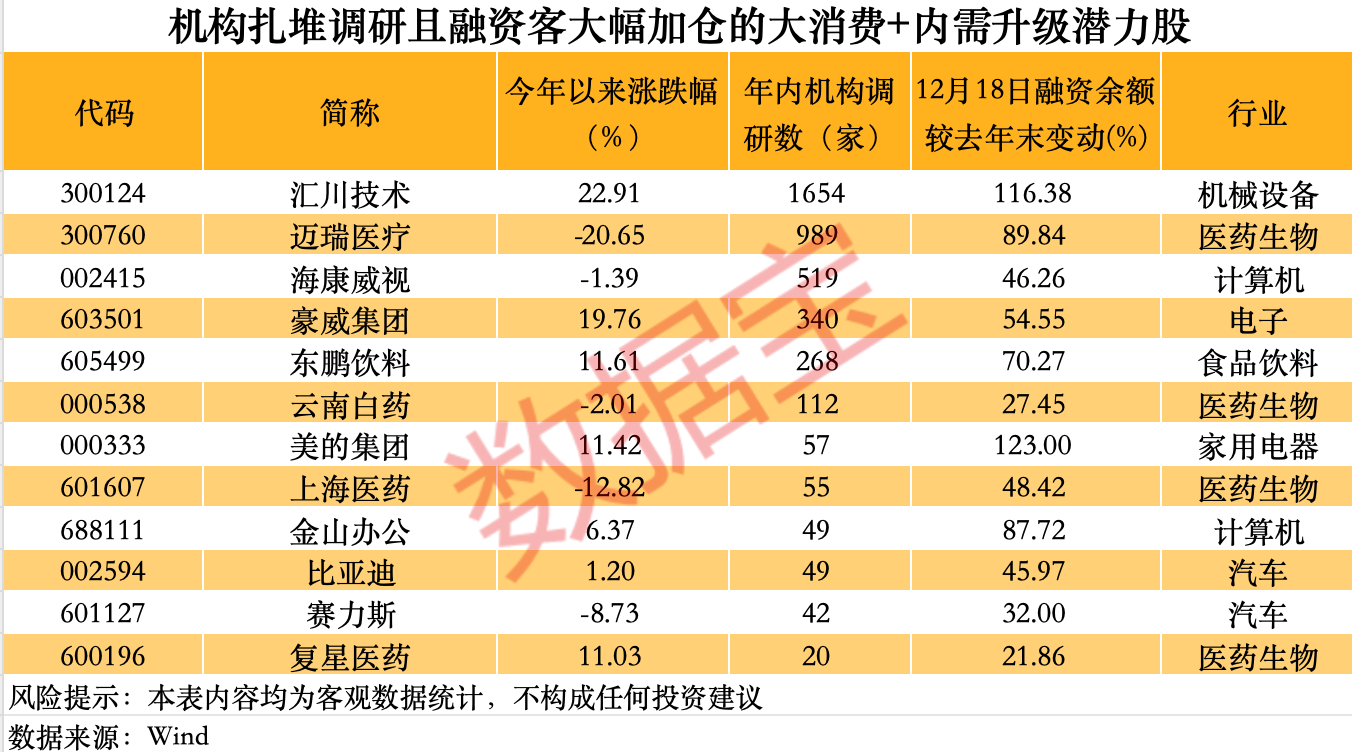
Core Viewpoint - The article highlights the recent measures taken by various regions to boost consumer spending ahead of the traditional consumption peak season, leading to a rebound in the large consumer sector in the capital market [1] Group 1: Market Performance - The large consumer index rose by 1.33% on December 19, significantly outperforming the Shanghai Composite Index [1] - Sub-sectors such as dairy, retail, and beverage manufacturing saw substantial increases, with Kweichow Moutai, a representative of large consumption, achieving a cumulative increase of 2.36% since December 10 [1] Group 2: Financing and Investment Trends - As of December 18, the total financing balance for the 87 constituent stocks of the large consumer index approached 320 billion yuan, representing an increase of over 45% compared to the end of last year, with over 70% of the financing targets seeing increased investment [1] - Notable stocks such as Rongchang Biologics, Sanhua Intelligent Control, and Sunshine Power experienced financing balance increases exceeding 100% [1] Group 3: Institutional Research and Stock Performance - There are 12 stocks with a financing balance increase of no less than 20%, having received research from 20 or more institutions this year, and with a year-to-date increase of less than 25% [1] - The leading companies in terms of institutional research are Huichuan Technology, Mindray Medical, and Hikvision, with the number of institutional research counts being 1654, 989, and 519 respectively [2]



企稳反弹,有望迎双位数增长!机构扎堆调研的大消费+内需升级潜力股出炉,融资客重点埋伏
Zheng Quan Shi Bao· 2025-12-21 23:40
Group 1 - The core viewpoint of the articles highlights the recovery and growth potential of the consumer sector, driven by policy support and increasing consumer demand during the traditional consumption peak season [1][5][6] - The consumer sector index showed signs of stabilization and rebound, with a 1.33% increase on December 19, outperforming the Shanghai Composite Index [2] - The consumer market is expected to see double-digit growth over the next two years, with retail sales projected to rise from 39.1 trillion yuan in 2020 to 48.3 trillion yuan by 2024, reflecting an average annual growth rate of 5.5% [5][6] Group 2 - The consumer sector is currently experiencing a valuation adjustment, with the consumer index's latest price-to-earnings ratio at 23.29, significantly below the 10-year average of 28.56 [6] - Institutional predictions indicate that the net profit growth for the consumer sector index constituents is expected to exceed 14% in 2026 and 2027, with a projected total net profit of nearly 460 billion yuan for 2025 [6] - A total of 87 stocks in the consumer sector have seen an average increase of over 28% this year, with significant contributions from the electronics and biopharmaceutical sectors [8] Group 3 - Notable stocks such as 汇川技术 (Inovance Technology) and 迈瑞医疗 (Mindray) have received substantial institutional attention, with the former seeing a 22.91% increase in stock price and over 1,600 institutional surveys this year [9][11] - The financing balance for the consumer sector stocks has increased by over 45% compared to the end of last year, with more than 70% of the stocks receiving additional financing [8][11] - Companies like 东鹏饮料 (Eastroc Beverage) are expanding their product lines and exploring overseas markets, indicating a strategic focus on growth and market penetration [10]

高校科技成果转化的“通关攻略”
Xin Lang Cai Jing· 2025-12-21 20:41
Core Insights - The 2025 Higher Education Technology Achievement Fair in Guangzhou attracted over 600 universities and collected more than 3,000 technology achievements and over 260 student entrepreneurship projects, emphasizing the importance of universities in driving technological innovation and commercialization [1] - The Chinese government has issued several policies to enhance patent conversion and utilization, indicating a shift from a management-focused to a service-oriented research system in universities [2] - Universities are increasingly restructuring their research management to improve collaboration and efficiency in technology transfer, as seen in institutions like Tongji University and Anhui University of Technology [2] Group 1: Policy and Institutional Changes - The Ministry of Education emphasizes the role of universities as key players in basic research and technological breakthroughs, aligning with national policies to promote innovation [1] - Recent reforms in research management at universities aim to break down barriers and enhance the entire chain from basic research to technology commercialization [2] - The establishment of specialized technology transfer offices, such as at Tsinghua University, has proven effective in increasing technology commercialization success [3] Group 2: Talent Development and Innovation - Universities are focusing on cultivating entrepreneurial talent capable of bridging the gap between scientific research and market needs, with initiatives like the "Innovation and Entrepreneurship Postdoctoral Program" at Hong Kong Polytechnic University [7] - Institutions like Beihang University and Guangdong University of Technology are implementing comprehensive support systems for student entrepreneurship, leading to successful startups [6] - The emphasis on practical applications of research is evident in the projects showcased at the 2025 Fair, highlighting the potential of student-led innovations [6] Group 3: Collaboration and Ecosystem Building - The integration of Hong Kong and Macau universities into the innovation ecosystem enhances international collaboration and industrial integration, as demonstrated by their participation in the 2025 Fair [10] - The establishment of regional technology transfer centers and collaborative agreements among universities aims to create a more dynamic innovation ecosystem [9] - The 2025 Fair facilitated significant transactions, with 1,361 deals and a total transaction value of 7.244 billion yuan, showcasing the effectiveness of such collaborative efforts [9] Group 4: Role of Technology Managers - Technology managers are crucial in facilitating the transfer of scientific achievements to the market, acting as intermediaries between researchers and industry [8] - Their role includes evaluating patents, designing market strategies, and assisting in the establishment of startups, significantly lowering the barriers for scientists entering the commercial space [7] - The development of a robust technology manager workforce is highlighted as essential for enhancing the conversion of research outcomes into economic value [8]
于不确定中寻路——读《寻路集》
Shang Hai Zheng Quan Bao· 2025-12-21 18:17
Core Insights - The book "Seeking a Path" by Professor Zhou Qiren reflects on the current critical phase of development, emphasizing the need for exploration and repositioning in both global dynamics and corporate growth paths [4] - The author advocates for a methodology that focuses on asking the right questions rather than merely recalling answers, especially in a world filled with uncertainties [5] Group 1: Global Economic Landscape - The book discusses the profound restructuring of the global economic landscape, where industries and enterprises face dual pressures of upgrading and competition [6] - It highlights the shift from traditional nation-state perspectives to market network-based observations, emphasizing the importance of connectivity and radiation capabilities in economic networks [6] - Chinese companies like Shenzhou International and Midea Group have proactively integrated into global networks, transitioning from "Made in China" to "Regionally Supplying Regions" strategies [7] Group 2: Manufacturing Evolution - The transition of Chinese manufacturing from "product export" to "capability going global" is framed as a necessary leap for sustainable long-term development [8] - The book outlines the growth stages of manufacturing in emerging economies, emphasizing the need for innovation and unique product offerings as opposed to mere cost competition [9] - Companies are encouraged to focus on quality and uniqueness to break free from the constraints of cost competition, with examples of successful innovations from various firms [9] Group 3: Institutional Environment - The author stresses that reducing institutional costs and clearly defining rights are foundational for economic growth, moving beyond micro-level discussions to deeper institutional analyses [10] - Local reforms aimed at redefining rights and enhancing resource allocation efficiency are documented, showcasing the importance of property rights in unlocking economic potential [10][11] - The book suggests that improving the social security system and breaking down labor mobility barriers are essential for optimizing human resource allocation [11] Group 4: Entrepreneurial Spirit - The narrative emphasizes the importance of entrepreneurial spirit in navigating uncertainties, where the ability to assess trends and allocate resources becomes crucial for survival and growth [12][13] - The author posits that the success of enterprises ultimately hinges on their internal capabilities rather than external macroeconomic conditions [13] - The book encourages a focus on actionable strategies rather than passive responses to external challenges, highlighting the resilience of market entities [14]

家电周报:iRobot破产重组,追觅科技实控人收购嘉美包装-20251221
Shenwan Hongyuan Securities· 2025-12-21 13:15
Investment Rating - The report maintains a positive outlook on the home appliance sector, indicating that the sector has outperformed the CSI 300 index, with a 0.2% increase in the home appliance index compared to a 0.3% decrease in the CSI 300 index [4][5]. Core Insights - The home appliance sector is experiencing a mixed performance, with leading companies like Zhejiang Meida, Aojiahua, and Biyi Co. showing significant gains, while companies like Lek Electric and Huaxiang Co. are facing declines [4][7]. - The acquisition of Jiamei Packaging by the actual controller of Chasing Technology for 2.282 billion yuan is a notable industry development, with commitments for stable profit growth [10]. - iRobot, a leading global brand in robotic vacuum cleaners, has filed for bankruptcy protection and is expected to be acquired by Shenzhen Shanjun Company, highlighting competitive pressures from Chinese firms [11]. - November sales data for major appliances show significant declines in both volume and revenue, with air conditioners, refrigerators, and washing machines all experiencing substantial drops [35][37][40]. Summary by Sections Industry Performance - The home appliance sector has outperformed the broader market, with a 0.2% increase in the sector index against a 0.3% decline in the CSI 300 index [4][5]. - Key companies leading the gains include Zhejiang Meida (up 12.2%), Aojiahua (up 8.1%), and Biyi Co. (up 4.1%), while Lek Electric (-10.9%), Huaxiang Co. (-4.7%), and Sanhua Intelligent Control (-3.5%) faced declines [4][7]. Industry Dynamics - Jiamei Packaging was acquired for 2.282 billion yuan, with commitments for a minimum net profit of 1.2 billion yuan from 2026 to 2030 [10]. - iRobot's bankruptcy highlights the competitive landscape, with its revenue of $146 million in Q3 2025 and a loss of $22 million, alongside a cash reserve of only $25 million [11]. Sales Data Observations - November data shows a significant decline in sales for major appliances: air conditioners down 47.4% in volume and 55.7% in revenue, refrigerators down 44.6% in volume and 51.7% in revenue, and washing machines down 42.0% in volume and 50.0% in revenue [35][37][40]. - The average prices for air conditioners, refrigerators, and washing machines have also decreased, indicating a challenging market environment [35][37][40].