
腾讯

Search documents
月之暗面将完成新一轮融资,引入海外投资机构
雷峰网· 2025-10-25 07:08
Core Insights - The article discusses the recent funding activities and market dynamics of AI startups, particularly focusing on the company "月之暗面" (Moon's Dark Side) and its competitive landscape within the AI industry [2][3]. Group 1: Funding and Valuation - 月之暗面 recently completed a new funding round amounting to several hundred million dollars, with new overseas investors participating [2]. - The company was founded in 2023 and has garnered significant attention, completing multiple funding rounds within two years, with notable investors including Sequoia Capital and Alibaba [2]. - In its previous funding round a year ago, 月之暗面 was valued at over $3.3 billion [2]. Group 2: Market Trends and Competition - The AI investment landscape has cooled down over the past year, prompting investors to reassess valuations of AI startups [3]. - Despite the cooling market, 月之暗面 launched its new Kimi K2 model in July, which received positive feedback, outperforming competitors like GPT-5 in benchmark tests [3]. - Another company, MiniMax, which was also part of the "AI Six Dragons," secured approximately $300 million in funding recently, raising its valuation to over $4 billion (around 30 billion RMB) [3].

阿里京东入局,雷鸟、夸克推新,AI智能眼镜双11抢风头
Nan Fang Du Shi Bao· 2025-10-25 05:05
Core Insights - The AI smart glasses market is experiencing a surge in product launches, with major companies like Alibaba, Thunderbird, and JD Technology entering the space, indicating a shift towards integrated hardware and ecosystem competition [1][6]. Group 1: Product Launches - Alibaba launched its first self-developed Quark AI glasses on October 24, featuring deep integration with services like Amap navigation and Alipay [1]. - Thunderbird introduced its fourth-generation pocket TV, the Thunderbird Air 4 AR glasses, on October 23, with a focus on enhanced display and audio quality [1][2]. - JD Technology partnered with Rokid to release the world's first smart glasses shopping application, set to debut in November [8]. Group 2: Technological Advancements - The Thunderbird Air 4 glasses utilize advanced display technology from Pixelworks, offering double brightness and higher color output [2]. - The audio experience has been significantly improved with four speakers and collaboration with Bang & Olufsen, reducing sound loss by 80% [4]. - AI features in the Thunderbird Air 4 include AI HDR conversion and AI 3D video transformation, enhancing user experience [4]. Group 3: Market Trends - IDC forecasts that global smart glasses shipments will reach 4.065 million units by mid-2025, reflecting a 64.2% year-on-year growth [6]. - The market is expected to evolve from hardware competition to a more comprehensive competition involving hardware, ecosystems, and channels [6]. Group 4: Ecosystem Development - Alibaba's Quark AI glasses are designed to work within a broader ecosystem, integrating various services for enhanced functionality [6]. - Thunderbird is building a content ecosystem in collaboration with major companies like Tencent and Ant Group, emphasizing the importance of ecosystem in AR glasses [8].



重磅会议提振“科技自立自强”预期,半导体设备ETF(159516)涨超2.5%
Mei Ri Jing Ji Xin Wen· 2025-10-24 19:03
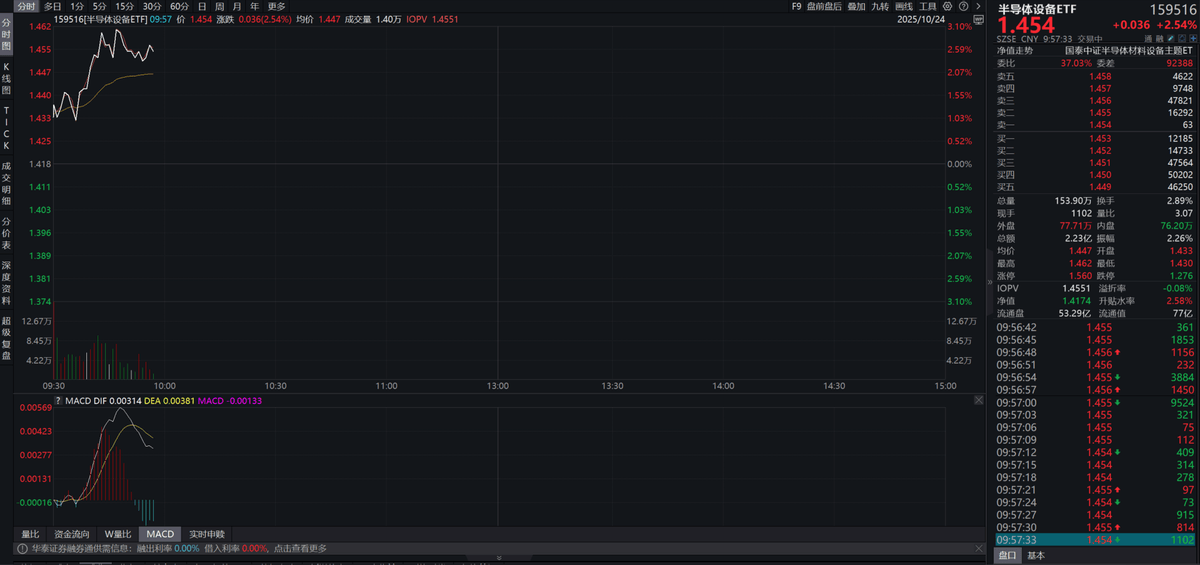
Group 1 - The core message emphasizes the significant improvement in "technological self-reliance and strength," indicating an increased importance of technology in the current context [2][4] - The semiconductor equipment ETF (159516) has seen a rebound, rising over 2.5% on October 24, with a year-to-date share growth exceeding 200%, currently reaching over 7.5 billion yuan, making it the largest in its category [1][6] - The focus on "domestic substitution and self-control" is reinforced, highlighting the need for China to enhance its technological capabilities amidst global competition and supply chain constraints [2][4] Group 2 - Major cloud service providers (CSPs) are significantly increasing capital expenditures, with North American CSPs planning to exceed 370 billion USD in capital spending for the 2025 fiscal year, a 40% increase year-on-year [3] - Domestic cloud companies, including ByteDance, Alibaba, Tencent, and Baidu, are expected to invest over 450 billion yuan in AI computing power by 2025, accelerating the industrialization of domestic supernode computing clusters [3] - The semiconductor industry is experiencing strong growth momentum, driven by increased demand for AI computing power and supply constraints in upstream components [3][4]
Unity中国发布“团结引擎1.7.3版本”
Zhong Zheng Wang· 2025-10-24 13:44
Core Insights - The 10th Unite Developer Conference was held in Shanghai, showcasing Unity China's latest achievements in localization and technology [1] - Unity China launched the "Unity Engine 1.7.3" version and partnered with Tencent to introduce the AI Graph intelligent creation platform [1] Group 1: Event Highlights - The conference featured seven specialized sessions and over 60 technical presentations, attracting thousands of developers [1] - Since its inception in 2012, the Unite Developer Conference has become a key platform for Chinese developers to learn about cutting-edge technology and share innovative practices [1] Group 2: Product Developments - The newly released Unity Engine 1.7.3 includes comprehensive upgrades in core rendering, cross-platform deployment, and AI integration [1] - The AI Graph platform allows developers to leverage powerful AI generation capabilities directly within the engine, significantly enhancing production efficiency and reducing development costs [1] Group 3: Company Commitments - Unity China's CEO made three commitments: to flexibly embrace the Chinese market, deeply integrate AI capabilities, and create a truly cross-platform engine [1] - Unity aims to be not just a technology provider but also a partner in realizing dreams and co-building the market [1] Group 4: Industry Impact - Unity China has been driving real-time 3D technology innovation in gaming and automotive sectors, contributing to the development of China's smart cockpit ecosystem [2]
高盛大幅上调阿里资本开支预期至4600亿元:推理需求爆炸性增长,AI效率提高驱动更强收入
硬AI· 2025-10-24 12:40
Core Viewpoint - Goldman Sachs predicts that Alibaba's capital expenditure will reach 460 billion yuan in the next few years, significantly higher than the company's previous target of 380 billion yuan, driven by the surge in AI inference demand [2][3]. Group 1: Capital Expenditure and AI Demand - The explosive growth in demand for AI will continue to drive capital expenditure (Capex) for cloud service providers in China [3][6]. - Goldman Sachs has raised its forecast for capital expenditure among leading Chinese cloud companies, expecting Alibaba's total capital expenditure from fiscal years 2026 to 2028 to reach 460 billion yuan [3][4]. - Despite improvements in technological efficiency, the demand for AI is growing exponentially, leading to continued expansion in capital expenditure [6][8]. Group 2: Strategic Differentiation Among Giants - Alibaba focuses on the enterprise-level AI market, leveraging its unique full-stack AI capabilities, while ByteDance is concentrating on consumer-level applications [3][8]. - Alibaba has launched new AI services, such as the Quark AI chatbot, to compete directly with ByteDance's "Doubao" and Tencent's "Yuanbao" [8]. - ByteDance's "Doubao" chatbot leads the consumer market in daily token consumption, indicating its commitment to exploring consumer-facing AI applications [8]. Group 3: Multi-modal Models and Commercialization - Chinese multi-modal models are gaining traction in the global market, with competitive advantages in open-source, low pricing, and high speed [10]. - Alibaba's Qwen model is being utilized by global companies, such as Airbnb, for customer service, showcasing the international recognition of Chinese open-source AI models [10]. - The commercialization of consumer-level AI applications in China is evolving, with both Alibaba and ByteDance integrating e-commerce functionalities into their AI offerings [10].

AI编程迎全球大厂密集布局 对话亚马逊云科技Jeff Barr:未来个体开发者或将能撑起10亿美元估值
Mei Ri Jing Ji Xin Wen· 2025-10-24 12:18
Core Insights - The AI coding sector is rapidly gaining momentum globally, with significant investments and innovations leading the charge in commercialization [1][7] - Major players like Anthropic have achieved remarkable valuations, indicating a strong market interest and potential for growth in AI-driven development tools [1][2] - The transformation in software development is characterized by a shift from traditional coding to more collaborative and efficient methods, enabled by AI technologies [2][3] Investment Landscape - Anthropic's recent funding round raised $13 billion, tripling its valuation to $183 billion in just six months, highlighting the lucrative nature of the AI coding market [1] - Chinese tech giants such as Alibaba, Tencent, and ByteDance are actively launching independent IDE products, indicating a competitive domestic landscape [1][4] - The influx of capital into AI coding is creating a "nationwide pursuit of AI programming," with startups quickly securing funding through niche solutions [3][5] Technological Evolution - AI tools are not merely replacing existing technologies but enhancing their value, allowing developers to focus on higher-level tasks such as requirement analysis and solution design [2][3] - The emergence of Vibe Coding allows non-technical individuals to create application prototypes, showcasing the democratization of software development [2] - The core demands for flexibility, security, and scalability remain unchanged, even as AI applications evolve [3][5] Industry Challenges - Despite the advancements, challenges such as low payment capacity and intellectual property protection in China persist, hindering the full potential of AI coding [4] - The industry is witnessing a shift in developer roles, where interpersonal communication skills are becoming increasingly important alongside technical expertise [6][7] - The traditional software industry is being disrupted as companies opt for in-house development over purchasing commercial software, forcing a transformation in business models [5][6] Future Outlook - The combination of cloud and AI technologies is expected to empower individual developers, leading to a more dynamic and competitive environment in the next decade [7] - The industry anticipates that those who can overcome technical barriers and address business pain points will emerge as leaders in the AI coding space [7]

高盛大幅上调阿里资本开支预期至4600亿元:推理需求爆炸性增长,AI效率提高驱动更强收入
Hua Er Jie Jian Wen· 2025-10-24 09:25
Core Insights - Goldman Sachs believes that explosive demand growth will continue to drive capital expenditures (Capex) for cloud service providers, with Chinese internet giants increasingly differentiating their AI strategies [1][2] - Alibaba is betting on the enterprise AI cloud market with its full-stack capabilities, while ByteDance is focusing on consumer applications [1] - Goldman Sachs raised its capital expenditure forecast for leading Chinese cloud providers, predicting Alibaba's total Capex for FY2026-2028 to reach 460 billion RMB, up from a previous target of 380 billion RMB [1] Group 1: Capital Expenditure and AI Demand - Goldman Sachs predicts that capital expenditures for Chinese cloud service providers will grow by 50% year-on-year by Q3 2025, driven by strong AI inference demand [2] - The report highlights that AI inference demand and token consumption are growing exponentially, with ByteDance's daily token consumption surpassing 30 trillion in September, doubling since April-May [2] Group 2: Strategic Differentiation of Giants - Alibaba is focusing on the enterprise AI market, leveraging its unique full-stack AI capabilities, and has launched the Quark AI chatbot to compete with ByteDance's Doubao and Tencent's Yuanbao [3] - ByteDance is emphasizing consumer-facing AI applications, with Doubao leading the To-C market and integrating e-commerce services within its chat platform [3] Group 3: Global Market and Commercialization - Chinese multimodal models are gaining traction in the global market, with Tencent's model ranking high in competitive benchmarks [4] - Alibaba's Qwen model is being utilized by global companies like Airbnb for customer service, indicating the recognition of Chinese open-source AI models [5] - The commercialization of To-C applications in China is evolving, with both Doubao and Alibaba's Quark integrating e-commerce functionalities [5] Group 4: Valuation and Market Outlook - Goldman Sachs asserts that there is currently no AI bubble, with expectations that the AI capital expenditure boom in the U.S. will continue until 2026 [5] - The projected P/E ratios for Tencent and Alibaba in 2026 are 21x and 23x, respectively, which are considered not excessive compared to global peers like Google and Amazon [5]
港股收评:恒指涨0.74%,半导体飙升,有色金属活跃
Ge Long Hui· 2025-10-24 08:48
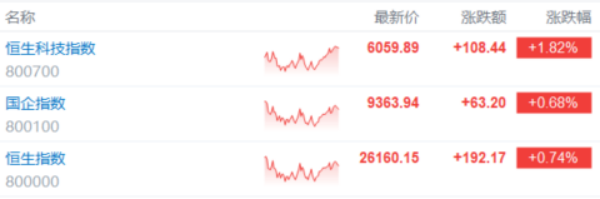
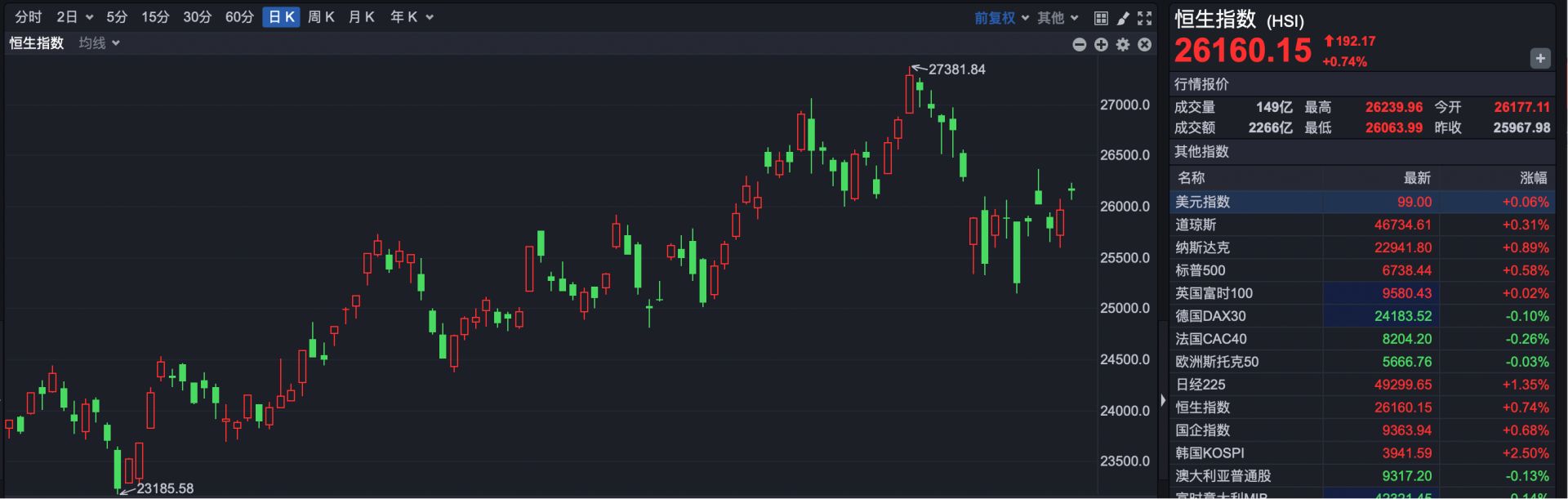
Market Overview - On October 24, Hong Kong's three major indices collectively rose, with the Hang Seng Tech Index leading with a gain of 1.82%, while the Hang Seng Index increased by 0.74%, recovering the 26,000-point mark, and the State-Owned Enterprises Index rose by 0.68% [1][2] - Large technology stocks generally saw increases, with Alibaba and Kuaishou rising over 2%, and Baidu and NetEase up over 1% [1][2] Sector Performance - Semiconductor stocks performed notably well, with Hua Hong Semiconductor surging nearly 14% [1][4] - Military stocks were active, with significant gains in Chinese brokerage stocks in the afternoon session [1] - Precious metals and non-ferrous metals sectors saw collective gains, while water utilities, nuclear power, new consumption concept stocks, domestic real estate, gas, and coal sectors mostly underperformed [1] Company News - Alibaba launched its first self-developed Quark AI glasses on October 24, featuring dual flagship chips from Qualcomm and Hengxuan [3] - The Central Committee of the Communist Party of China emphasized the importance of technological modernization to support China's development during a press conference on October 24 [5] Individual Stock Movements - Hua Hong Semiconductor led the semiconductor sector with a 13.73% increase, followed by ASMPT and Center International with gains of 8.11% and 8.04%, respectively [4][6] - Military-related stocks like AVIC and Aerospace Holdings also saw increases, with AVIC rising over 4% [8] - The non-ferrous metals sector was active, with Jiangxi Copper and Luoyang Molybdenum both rising over 6% [10] Investment Trends - Southbound funds recorded a net inflow of 3.414 billion HKD, indicating strong interest in Hong Kong stocks [18] - Analysts from Guotai Junan Securities believe that if market concerns are alleviated, Hong Kong tech stocks will benefit from current industry trends, particularly with the potential return of foreign capital due to anticipated interest rate cuts by the Federal Reserve [20]
港股速报 | 港股两连涨 半导体板块集体大涨
Mei Ri Jing Ji Xin Wen· 2025-10-24 08:40
Market Overview - The Hong Kong stock market rebounded for the second consecutive day, with the Hang Seng Index closing at 26,166.03 points, up 198.05 points, a gain of 0.74% [1] - The Hang Seng Tech Index closed at 6,059.89 points, increasing by 108.44 points, a rise of 1.82% [2] Sector Performance - The semiconductor sector saw significant gains, with Huahong Semiconductor (01347.HK) rising over 13%, SMIC (00981.HK) and ASMPT (00522.HK) up over 8%, and InnoCare Pharma (02577.HK) and Fudan University (01385.HK) increasing over 5% [3] - The Apple-related stocks performed well, with Weishi Jiajie (00856.HK) rising over 6% as Apple plans to launch an AI glasses product by the end of 2026 [6] Policy and Industry Insights - The "14th Five-Year Plan" emphasizes enhancing technological self-reliance and innovation, which is expected to drive growth in domestic semiconductor manufacturing and related sectors [5] - Morgan Stanley predicts a "super cycle" for the storage chip industry driven by the AI boom, with strong policy support for domestic storage chip development [5] Investment Trends - Southbound funds net bought over 3.4 billion HKD in Hong Kong stocks by the end of the trading day [8] - Goldman Sachs highlighted Tencent's unique advantage in AI technology and raised its target price, while also indicating that Alibaba's stock price dip presents a buying opportunity [9] Future Outlook - Analysts from various institutions believe AI remains a clear main theme in the Hong Kong market, with the internet sector expected to continue benefiting [10] - The technology sector is currently viewed as historically undervalued, with expectations for significant growth driven by advancements in AI and increased capital expenditure [10]
乐普医疗转型医美背后:业绩连降、商誉高悬与跨界风险
Xin Lang Zheng Quan· 2025-10-24 07:10
Core Viewpoint - Lepu Medical's recent partnership with Meituan to promote its medical beauty brands "Yueyayan" and "Flora" is seen as a significant transformation effort amid ongoing performance pressures, but the path to success in the increasingly competitive medical beauty market is fraught with challenges [1][6]. Group 1: Financial Performance - Lepu Medical has experienced a continuous decline in performance, with a 23.52% year-on-year drop in revenue and an 80.37% decrease in net profit for 2024, marking the worst results in its 16-year history [2]. - The company recorded a goodwill and other asset impairment loss of 251 million yuan in 2024, with goodwill still amounting to 3.62 billion yuan, representing 14.35% of total assets as of mid-2025, indicating ongoing impairment risks [2]. Group 2: Market Competition - The medical beauty market is highly competitive, with Lepu Medical entering a saturated field where price wars are emerging, exemplified by New Oxygen's introduction of a 2,999 yuan "affordable童颜针" [3]. - Lepu Medical's recent launch of its self-developed polylactic acid facial filler (童颜针) positions it as the seventh product in this category in China, but the company faces significant challenges as a latecomer in a market dominated by established players [3]. Group 3: Diversification and Resource Allocation - In addition to medical beauty, Lepu Medical is diversifying into structural heart disease, GLP-1 innovative drugs, brain-computer interfaces, and artificial intelligence, reflecting its commitment to innovation [4]. - Despite a research and development expenditure of 1.249 billion yuan in 2024, the allocation across multiple emerging fields has resulted in insufficient investment in each area, leading to a strategic shift towards medical beauty amid tightening cash flow [4]. Group 4: Capital Structure Concerns - Lepu Medical, known for its aggressive acquisition strategy, has completed 54 investments and acquisitions from 2008 to 2021, resulting in high goodwill and asset impairment risks [5]. - As of mid-2025, the company's cash reserves have fallen to 3.6 billion yuan, while accounts receivable have risen to 2.05 billion yuan, significantly exceeding industry warning levels, indicating potential liquidity issues [5].
