陕西煤业

Search documents
新材料与投资品产业链点评:“反内卷”政策下,能源及材料投资机会梳理-20250706
Shenwan Hongyuan Securities· 2025-07-06 13:50
2025 年 07 月 06 日 "反内卷"政策下,能源及材料投 资机会梳理 看好 ——新材料与投资品产业链点评 本期投资提示: 行 业 研 究 / 行 业 点 评 证券分析师 宋涛 A0230516070001 songtao@swsresearch.com 陆灏川 A0230520080001 luhc@swsresearch.com 马天一 A0230525040004 maty@swsresearch.com 任杰 A0230522070003 renjie@swsresearch.com 郭中伟 A0230524120004 guozw@swsresearch.com 陈松涛 A0230523090002 chenst@swsresearch.com 刘子栋 A0230523110002 liuzd@swsresearch.com 严天鹏 A0230524090004 yantp@swsresearch.com 联系人 赵文琪 (8621)23297818× zhaowq@swsresearch.com 本研究报告仅通过邮件提供给 中庚基金 使用。1 券 研 究 报 告 请务必仔细阅读正文之后的各项 ...
煤炭开采行业周报:高温来袭,对煤炭市场影响如何?-20250706
Guohai Securities· 2025-07-06 12:31
Investment Rating - The coal mining industry is rated as "Recommended" [7] Core Views - The coal supply-demand relationship continues to optimize under high-temperature conditions, with port coal prices rising and inventory decreasing [4][72] - The production side shows a tightening trend, with a decrease in capacity utilization in Shanxi and a reduction in transportation volumes [4][72] - The demand side is supported by power plants replenishing inventory in anticipation of increased consumption due to high temperatures [4][72] Summary by Sections 1. Thermal Coal - Port coal prices increased to 623 RMB/ton, up 3 RMB/ton week-on-week [4][72] - Inventory at northern ports decreased by 797,000 tons week-on-week [30] - Daily consumption at coastal power plants rose by 80,000 tons week-on-week [24][72] 2. Coking Coal - Supply of coking coal has improved, with capacity utilization rising by 1.04 percentage points [5][41] - Coking coal prices at ports remained stable, with the average price at 1,230 RMB/ton [42] - Coking coal inventories at production enterprises decreased by 586,200 tons week-on-week [47] 3. Coke - Coking enterprises are experiencing a decline in production rates due to rising costs from coking coal prices [50] - The average profit per ton of coke is approximately -46 RMB, indicating a decrease in profitability [54] - Steel mills are replenishing raw material inventories, leading to a reduction in coke inventories [62] 4. Anthracite - Anthracite prices remained stable, with the price at 820 RMB/ton [68] - Demand from non-electric sectors remains weak, with procurement primarily focused on long-term contracts [68] 5. Key Companies and Profit Forecasts - Key companies to focus on include China Shenhua, Shaanxi Coal, and Yanzhou Coal, all rated as "Buy" [8] - The report highlights the strong cash flow and asset quality of leading coal companies, emphasizing their investment value [7][8]



如何看待“反内卷”对煤炭的影响?
Changjiang Securities· 2025-07-06 09:11
Investment Rating - The report maintains a "Positive" investment rating for the coal industry [10]. Core Insights - The current profitability of the coal industry is better than that before the supply-side reform in 2016, but coking coal profitability is lower than thermal coal, indicating a stronger necessity for reform [7][8]. - The "anti-involution" measures in the coal industry are expected to primarily involve production limits and capacity exits, which could raise the price baseline in a favorable demand environment. However, the current demand pressure is greater than in 2016 [6][7]. - Short-term price elasticity may be limited due to high inventory and suppressed demand, but unexpected demand improvements could lead to price rebounds [6][7]. Summary by Sections Market Performance - The coal index (Yangtze) increased by 1.67%, outperforming the CSI 300 index by 0.13 percentage points, ranking 11th out of 32 industries [21]. - As of July 4, the market price for Qinhuangdao thermal coal was 623 RMB/ton, a weekly increase of 3 RMB/ton [21]. Thermal Coal Analysis - Daily coal consumption in 25 provinces reached 573.3 million tons, a week-on-week increase of 3.3% [22]. - The inventory of power plants was 125.22 million tons, with a usable days count of 21.8 days, a decrease of 0.4 days week-on-week [22]. Coking Coal Analysis - The price for main coking coal at Jingtang Port was stable at 1230 RMB/ton as of July 4 [21]. - Coking coal inventory increased by 0.55% week-on-week, indicating a need to monitor supply recovery and seasonal demand [22][53]. Investment Recommendations - Recommended stocks include long-term stable profit leaders such as China Coal Energy, China Shenhua Energy, and Shaanxi Coal and Chemical Industry [8]. - Growth-oriented companies include Electric Power Investment and New Hope Liuhe, while flexible growth stocks include Yanzhou Coal Mining and Huayang Co [8].

高温催动日耗抬升,去库深化煤价走强
Xinda Securities· 2025-07-06 08:31
Investment Rating - The investment rating for the coal mining industry is "Positive" [2] Core Viewpoints - The current phase is seen as the beginning of a new upward cycle in the coal economy, with a resonance between fundamentals and policies, making it an opportune time to accumulate coal sector investments [10][11] - The underlying investment logic of coal capacity shortages remains unchanged, with a short-term supply-demand balance and a long-term gap still present [10] - The trend of coal prices establishing a bottom and moving to a new platform is expected to continue, with high profitability, cash flow, return on equity (ROE), and dividends from quality coal companies [10][11] - The coal sector is viewed as undervalued, with overall valuation expected to improve, supported by high premiums in the primary mining rights market and a public fund allocation that is currently underweight in coal [10][11] Summary by Sections Coal Price Tracking - As of July 5, the market price for Qinhuangdao port thermal coal (Q5500) is 616 CNY/ton, a week-on-week increase of 2 CNY/ton [28] - The price for thermal coal from Shaanxi Yulin (Q6000) is 600 CNY/ton, up 5.0 CNY/ton week-on-week [28] - The international thermal coal price at Newcastle (NEWC5500) is 64.8 USD/ton, down 0.3 USD/ton week-on-week [28] Supply and Demand Tracking - The capacity utilization rate for sample thermal coal mines is 94%, an increase of 1.1 percentage points week-on-week [46] - The capacity utilization rate for sample coking coal mines is 83.82%, an increase of 1.3 percentage points week-on-week [46] - Coastal provinces' daily coal consumption increased by 18.80 thousand tons/day (+9.90%) while inland provinces' daily consumption decreased by 0.60 thousand tons/day (-0.16%) [47] Investment Recommendations - Focus on stable and robust performance companies such as China Shenhua, Shaanxi Coal, and China Coal Energy [11] - Consider companies with significant rebound potential like Yanzhou Coal, Electric Power Energy, and Guanghui Energy [11] - Pay attention to high-quality metallurgical coal companies such as Huabei Mining and Pingmei Shenma [11]


大能源行业2025年第27周周报:夏季或高温少雨,煤炭去库有望延续-20250706
Hua Yuan Zheng Quan· 2025-07-06 08:18
Investment Rating - The investment rating for the coal industry is "Positive" (maintained) [4] Core Viewpoints - The report anticipates high electricity coal demand due to less rainfall and higher temperatures in summer 2025, leading to a continued reduction in coal inventory [4] - The average temperature in major coastal cities from July 1 to July 5, 2025, was 30.2°C, which is 2.7°C higher year-on-year, indicating a significant increase in electricity consumption [4][30] - The report suggests that the coal supply-demand balance has begun to rebalance, with coal prices at historical lows, and recommends focusing on companies with high long-term contract coal ratios [4] Summary by Sections Section 1: Coal Demand and Supply - The report highlights that summer 2025 is expected to see high electricity coal demand due to elevated temperatures and reduced rainfall, particularly in the Yangtze River basin [4][19] - The average temperature for the first half of 2025 was slightly higher than in 2024, with significant increases noted in central and eastern China [8][19] - The report predicts that the reduction in coal inventory will exceed expectations due to weak hydropower output from reduced rainfall [4][30] Section 2: Investment Recommendations - The report recommends focusing on leading coal companies such as China Coal Energy and China Shenhua Energy, which have a high proportion of long-term contracts and flexible pricing [4] - It also suggests paying attention to Shaanxi Coal and Yanzhou Coal Mining [4] Section 3: Temperature and Rainfall Analysis - The report indicates that the first half of 2025 experienced slightly less rainfall compared to the previous year, with most regions showing normal or reduced precipitation levels [13][19] - The forecast for summer 2025 suggests a significant overlap of high-temperature and low-rainfall areas, particularly in southern China, which may exacerbate drought conditions [19][27] Section 4: Inventory Trends - The report notes that coal inventory at ports has been continuously decreasing, driven by high daily consumption at power plants during the summer peak [4][30] - The report emphasizes that the ongoing high temperatures and increased electricity demand will support the trend of coal inventory reduction [4][30]
《世界能源统计年鉴2025》煤炭相关梳理-20250706
GOLDEN SUN SECURITIES· 2025-07-06 03:06
Investment Rating - The report maintains a "Buy" rating for key coal companies including China Qinfa, China Coal Energy, and AnYuan Coal Industry [3][6]. Core Insights - The global coal production is expected to reach a historical high of 924.2 million tons in 2024, with a year-on-year growth of 0.9%. The Asia-Pacific region continues to expand production, with India and Indonesia increasing output by 7% and 8% respectively [7]. - Global coal demand is projected to grow to 165.06 exajoules (EJ) in 2024, reflecting a year-on-year increase of 1%. However, demand in Europe is declining rapidly, with a decrease of 7% [7]. - The report highlights the stability of coal prices, with Newcastle port coal prices at $110.85 per ton, up 4.35 dollars per ton (+4.08%) from the previous week [34]. Summary by Sections Coal Mining - The report indicates that coal prices at European ARA ports have risen to $107.25 per ton, an increase of 3.90 dollars per ton (+3.77%) [34]. - The report emphasizes the importance of monitoring coal production and demand trends, particularly in the Asia-Pacific region, which is driving growth [7]. Investment Recommendations - Key recommended stocks include China Coal Energy, China Shenhua, and the turnaround story of China Qinfa. Other notable mentions are Shaanxi Coal and Energy, and Yancoal Energy, which show potential for growth [3][6]. - The report also suggests keeping an eye on AnYuan Coal Industry, which is undergoing significant changes in its shareholder structure and asset swaps [3]. Market Trends - The report notes that global coal trade volume is expected to reach 35.99 EJ in 2024, marking a year-on-year increase of 1.3%. Indonesia remains the largest coal exporter, accounting for 29.8% of total exports [7]. - The report provides a detailed analysis of coal price movements, indicating a stable trend in shipping coal prices [30].

煤炭开采行业周报(2025.6.30~2025.7.6):“反内卷”叠加旺季来临,煤价板块底部或已出现-20250705
EBSCN· 2025-07-05 14:58
2025 年 7 月 5 日 行业研究 "反内卷"叠加旺季来临,煤价板块底部或已出现 ——煤炭开采行业周报(2025.6.30~2025.7.6) 要点 "反内卷"叠加旺季来临,煤价板块底部或已出现。(1)7 月 1 日,中共中央 总书记、国家主席、中央军委主席、中央财经委员会主任习近平主持召开中央 财经委员会第六次会议,会议提出,要依法依规治理企业低价无序竞争,引导 企业提升产品品质,推动落后产能有序退出;(2)本周 28 个主要城市平均气 温为 30.56 ℃,已进入季节性高温区间,夏季用煤旺季已经来临;(3)在基本 面、事件共同驱动下,近期焦煤期货价格、煤炭板块均止跌回升。 本周港口煤价小幅反弹,海外天然气价格回落。(1)本周(6.30-7.4)秦皇岛 港口动力煤平仓价(5500 大卡周度平均值)为 621 元/吨,环比+5 元/吨 (+0.88%);(2)陕西榆林动力混煤坑口价格(5800 大卡)周度平均值为 475 元/吨,环比+1 元/吨(+0.21%);(3)澳大利亚纽卡斯尔港动力煤 FOB 价格 (5500 大卡周度平均值)为 65 美元/吨,环比-1.89%;(4)欧洲天然气期货 结算价(D ...
信用利差再度压缩,二永债表现强势
Xinda Securities· 2025-07-05 14:57
Report Industry Investment Rating Not provided in the given content. Report's Core View - Credit bonds return to strength, with yields of 3Y and above varieties generally declining by around 5BP. Interest rates of interest rate bonds fluctuate and decline, and credit spreads mostly decline except for some high-grade short-duration varieties [2][5]. - Credit spreads of urban investment bonds decline across the board, with spreads of each variety decreasing by about 4BP [2][9]. - Most credit spreads of industrial bonds decline, while those of mixed-ownership real estate bonds slightly increase [2][18]. - Yields of secondary and perpetual bonds decline across the board, and their overall performance is stronger than that of ordinary credit bonds [2][23]. - Excess spreads of industrial perpetual bonds are generally stable, while those of 3Y urban investment perpetual bonds decline [2][25]. Summary by Directory 1. Credit bonds return to strength, with yields of 3Y and above varieties generally declining by around 5BP - Interest rate bond yields fluctuate and decline. The yields of 1Y, 3Y, 5Y, and 7Y Guokai bonds decline by 3BP, 2BP, 1BP, and 4BP respectively, and the 10Y yield remains flat [2][5]. - Credit bond yields return to a downward trend. Yields of 3Y and above varieties generally decline by around 5BP, and credit spreads mostly decline except for some high-grade short-duration varieties [2][5]. - Rating spreads and term spreads mostly remain flat or decline [5]. 2. Credit spreads of urban investment bonds decline across the board - Credit spreads of external rating AAA, AA+, and AA platforms all decline by about 4BP. Spreads of most AAA-level platforms decline by 3 - 4BP, AA+ by 3 - 5BP, and AA by 3 - 6BP [2][9]. - By administrative level, credit spreads of provincial, municipal, and district-level platforms all decline by 4BP [2][16]. 3. Most credit spreads of industrial bonds decline, while those of mixed-ownership real estate bonds slightly increase - Credit spreads of central and local state-owned real estate bonds decline by 4BP, those of mixed-ownership real estate bonds increase by 2BP, and those of private real estate bonds increase by 13BP [2][18]. - Credit spreads of coal bonds at all levels decline by 3BP, those of AAA and AA+ steel bonds decline by 3BP and 4BP respectively, and those of chemical bonds at all levels decline by 4 - 5BP [2][18]. 4. Yields of secondary and perpetual bonds decline across the board, and their overall performance is stronger than that of ordinary credit bonds - Yields of secondary and perpetual bonds follow the decline of certificate of deposit rates. Spreads of medium and short-term high-grade varieties compress significantly [2][23]. - Specifically, the yield of 1Y AAA- secondary capital bonds declines by 9BP, and the spread compresses by 6BP. Yields of other grades decline by 8BP, and spreads compress by 4 - 5BP [23]. 5. Excess spreads of industrial perpetual bonds are generally stable, while those of 3Y urban investment perpetual bonds decline - The excess spread of industrial AAA3Y perpetual bonds increases by 0.01BP to 3.82BP, and that of AAA5Y remains flat at 8.51BP [2][25]. - The excess spread of urban investment AAA3Y perpetual bonds declines by 2.38BP to 3.76BP, and that of AAA5Y increases by 0.10BP to 9.91BP [25]. 6. Credit Spread Database Compilation Instructions - Market-wide credit spreads, commercial bank secondary and perpetual spreads, and credit spreads of urban investment/industrial perpetual bonds are calculated based on ChinaBond medium and short-term notes and ChinaBond perpetual bonds data [27]. - Credit spreads of industrial and urban investment individual bonds are calculated by subtracting the yield of the same-term government bond from the medium-term valuation of the individual bond, and then the arithmetic average method is used to calculate the credit spreads of the industry or regional urban investment [31]. - Samples of medium-term notes and public corporate bonds are selected for industrial and urban investment bonds, and guaranteed bonds and perpetual bonds are excluded [31].
煤炭:用电负荷创新高,煤价反弹持续
Huafu Securities· 2025-07-05 13:54
Investment Rating - The report suggests an increase in allocation to coal-related stocks due to the rebound in coal prices and the overall health of coal companies' balance sheets [5][6]. Core Views - The price of thermal coal is approaching 600 RMB, leading to negative feedback on the supply side. The report notes a continued decrease in coal imports as of May, with global coal shipment volumes to China at 4.85 million tons, a year-on-year decrease of 23.7% [5]. - The coal industry is undergoing a transformation driven by energy security and policy changes, indicating that coal may still be in a golden era. The supply of coal is expected to remain rigid due to strict capacity controls and increasing extraction difficulties [5]. - The report emphasizes that while macroeconomic conditions may temporarily affect coal demand, the rigid supply and rising costs will support coal prices, which are expected to maintain a volatile pattern [5]. Summary by Sections Thermal Coal - As of July 4, 2025, the Qinhuangdao 5500K thermal coal price is 623 RMB/ton, with a week-on-week increase of 0.5% and a year-on-year decrease of 25.8% [3][30]. - The average daily production of thermal coal from 462 sample mines is 5.661 million tons, reflecting a week-on-week increase of 1.2% [45]. - The inventory index for thermal coal is at 194.3, showing a year-on-year decline [3][49]. Coking Coal - The price of coking coal at the Jing Tang Port remains at 1230 RMB/ton, unchanged week-on-week, with a year-on-year decrease of 41.7% [4][83]. - The average daily production of coking coal from 523 sample mines is 739,000 tons, with a week-on-week increase of 0.15% [82]. - The inventory of coking coal at independent coking plants is 716,500 tons, reflecting a week-on-week increase of 5.57% [82]. Investment Opportunities - The report identifies several investment opportunities in the coal sector, including companies with strong resource endowments and stable operating performance, such as China Shenhua, Shaanxi Coal, and China Coal Energy [6]. - Companies benefiting from coal-electricity integration and those with production growth potential are also highlighted as attractive investment targets [6].
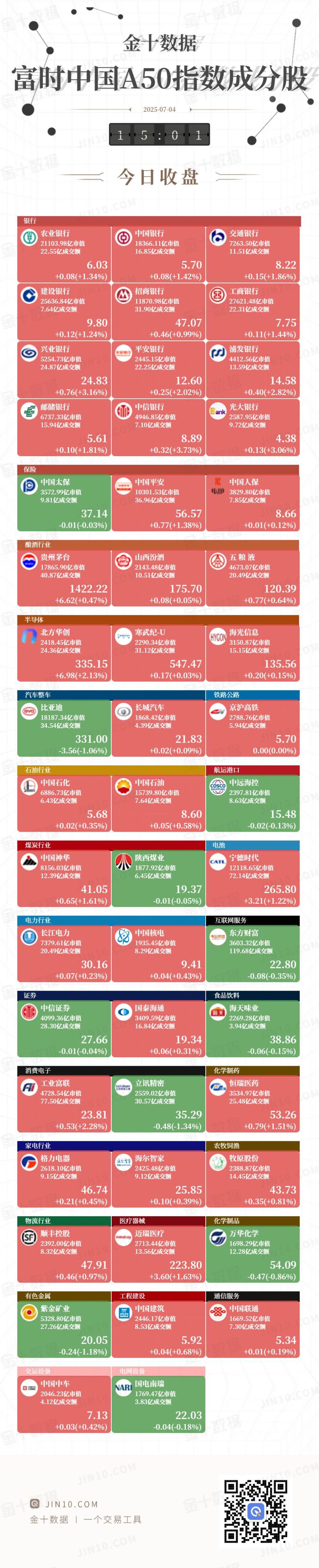
金十图示:2025年07月04日(周五)富时中国A50指数成分股今日收盘行情一览:银行、白酒、半导体、物流等板块走高,有色金属、化学制药等走弱,比亚迪跌超1%
news flash· 2025-07-04 07:04
Market Overview - The FTSE China A50 Index components showed a mixed performance with banking, liquor, semiconductor, and logistics sectors rising, while non-ferrous metals and chemical pharmaceuticals sectors weakened [1] - BYD's stock price fell over 1% [1] Sector Performance Banking Sector - Major banks like China Pacific Insurance, Ping An Insurance, and China Life Insurance reported market capitalizations of 382.98 billion, 357.30 billion, and 1,030.15 billion respectively, with trading volumes of 9.81 million, 36.96 million, and 7.85 million [3] Liquor Industry - Key players such as Kweichow Moutai, Shanxi Fenjiu, and Wuliangye had market capitalizations of 1,786.59 billion, 214.35 billion, and 467.31 billion respectively, with trading volumes of 40.87 million, 10.51 million, and 20.49 million [3] Semiconductor Sector - Companies like Northern Huachuang, Cambricon Technologies, and Haiguang Information had market capitalizations of 241.84 billion, 229.03 billion, and 315.09 billion respectively, with trading volumes of 24.36 million, 31.12 million, and 15.15 million [3] Automotive Sector - BYD, Great Wall Motors, and Beijing-Shanghai High-Speed Railway had market capitalizations of 1,818.73 billion, 186.84 billion, and 278.88 billion respectively, with trading volumes of 34.54 million, 4.39 million, and 5.94 million [3] Oil Industry - China Petroleum, Sinopec, and COSCO Shipping had market capitalizations of 239.78 billion, 688.67 billion, and 1,573.98 billion respectively, with trading volumes of 8.63 million, 6.43 million, and 7.64 million [3] Coal Industry - Major companies like China Shenhua and Shaanxi Coal and Chemical Industry had market capitalizations of 187.79 billion and 815.60 billion respectively, with trading volumes of 12.39 million and 6.45 million [3] Power Industry - Key players such as Yangtze Power and China Nuclear Power had market capitalizations of 360.33 billion and 737.96 billion respectively, with trading volumes of 20.49 million and 8.29 million [4] Food and Beverage Sector - Companies like Citic Securities, Guotai Junan, and Haitian Flavoring had market capitalizations of 409.94 billion, 340.96 billion, and 226.93 billion respectively, with trading volumes of 28.30 million, 3.94 million, and 16.84 million [4] Consumer Electronics - Industrial Fulian, Luxshare Precision, and Gree Electric Appliances had market capitalizations of 472.85 billion, 255.90 billion, and 242.55 billion respectively, with trading volumes of 30.57 million, 77.50 million, and 25.48 million [4] Chemical Products - Companies like Wanhua Chemical and SF Holding had market capitalizations of 239.20 billion and 271.34 billion respectively, with trading volumes of 12.28 million and 8.32 million [4] Construction and Engineering - China State Construction and Zijin Mining had market capitalizations of 532.88 billion and 166.95 billion respectively, with trading volumes of 27.26 million and 8.53 million [4]