
九号公司

Search documents
方正证券:创新驱动价格增长 电动两轮车行业头部盈利能力提升
Zhi Tong Cai Jing· 2025-04-01 01:39
Market Size - The electric two-wheeler industry is expected to experience double-digit growth in sales in 2025, with an average price increase of approximately 3% due to national subsidies [1] - Historical trends show rapid growth from 2005 to 2013, a decline from 2014 to 2019, and a recovery from 2019 to 2023, driven by increasing ownership and the introduction of the new national standard in 2019 [1] - The 2025 national subsidy policy for trade-ins is anticipated to further stimulate demand, especially in provinces with room for increased subsidy levels compared to Zhejiang, Jiangsu, and Hubei [1] Competitive Landscape - The industry is becoming increasingly concentrated, with leading brands benefiting from product definition and technological innovation [2] - Yadea has significantly increased its market share by correctly identifying consumer demand for mid-to-high-end products and expanding its sales network [2] - The first tier of brands includes Jike, Niu, and Ninebot, while the second tier includes Aima and Yadea, and the third tier includes Luyuan and New Day [2] Profitability - The industry is expected to raise prices and improve profit margins in response to the new national standard and new models, benefiting all companies [3] - Yadea and Aima, with high market shares, are likely to see greater performance improvements from enhancing profitability rather than merely increasing market size [3] - The industry is focusing on product upgrades to boost gross margins in the short term, while long-term profitability will be enhanced through channel reforms [3]

中证全指休闲设备与用品指数报3414.80点,前十大权重包含浙江自然等
Jin Rong Jie· 2025-03-31 08:26
Group 1 - The Shanghai Composite Index decreased by 0.46%, while the CSI All-Share Leisure Equipment and Supplies Index reported at 3414.80 points [1] - The CSI All-Share Leisure Equipment and Supplies Index has increased by 6.08% in the past month, 10.78% in the past three months, and 15.73% year-to-date [1] - The index is categorized into 11 primary industries, 35 secondary industries, over 90 tertiary industries, and more than 200 quaternary industries, with a base date of December 31, 2004, set at 1000.0 points [1] Group 2 - The top ten weights in the CSI All-Share Leisure Equipment and Supplies Index are: Nine Company (19.5%), Aofei Entertainment (14.79%), Zhonglu Co. (6.31%), Gaole Co. (5.12%), Huali Technology (4.75%), Yingpais (4.53%), Shifeng Culture (4.47%), Chuangyuan Co. (4.29%), Zhejiang Nature (4.28%), and Xinlong Health (4.15%) [1] - The market segments of the CSI All-Share Leisure Equipment and Supplies Index show that the Shenzhen Stock Exchange accounts for 59.62%, while the Shanghai Stock Exchange accounts for 40.38% [1] Group 3 - The sample of the CSI All-Share Leisure Equipment and Supplies Index consists entirely of leisure equipment and supplies [2] - The index sample is adjusted every six months, with adjustments implemented on the next trading day following the second Friday of June and December each year [2] - Temporary adjustments to the index sample will occur if there are special events affecting the industry classification of sample companies, and companies that are delisted will be removed from the index sample [2]

潍柴动力:发动机利润强劲增长,派息率再创新高,维持买入-20250328
BOCOM International· 2025-03-28 12:28
Investment Rating - The report maintains a "Buy" rating for Weichai Power (2338 HK) with a target price raised to HKD 20.50, indicating a potential upside of 31.4% from the current price of HKD 15.60 [1][6][8]. Core Insights - Weichai Power's engine profits have shown strong growth, with a record high dividend payout ratio of 55%. The company is expected to achieve a revenue growth of 0.8% in 2024, reaching RMB 215.7 billion, driven by improved gross margins and a net profit increase of 26.5% to RMB 11.4 billion [2][6]. - The report highlights several catalysts for growth, including new subsidies to boost heavy truck demand, strong growth in data center engines, and robust demand for natural gas heavy trucks [6][10]. Financial Overview - Revenue projections for Weichai Power are as follows: - 2023: RMB 213.96 billion - 2024: RMB 215.69 billion (0.8% YoY growth) - 2025E: RMB 237.92 billion (10.3% YoY growth) - 2026E: RMB 254.83 billion (7.1% YoY growth) - 2027E: RMB 269.35 billion (5.7% YoY growth) [3][10]. - Net profit forecasts are: - 2023: RMB 9.01 billion - 2024: RMB 11.40 billion (26.5% YoY growth) - 2025E: RMB 14.64 billion (28.4% YoY growth) - 2026E: RMB 16.19 billion (10.6% YoY growth) - 2027E: RMB 17.77 billion (9.8% YoY growth) [3][10]. - The report notes a significant improvement in gross margin, which is expected to reach 22.4% in 2024, up from 21.1% in 2023 [11]. Market Position and Performance - Weichai Power's market share in the domestic heavy truck engine market is 38.7%, with a strong performance in high-end markets such as data centers, where sales of M-series engines grew by 148% [6][10]. - The company has maintained a stable market share despite a 5% decline in overall commercial vehicle demand in the domestic market [6][10]. Valuation Metrics - The report provides the following valuation metrics: - Price-to-Earnings (P/E) ratio for 2025E is projected at 11.5x, with a corresponding dividend yield of 6.6% [6][10]. - The book value per share is expected to be RMB 8.73 in 2025E, with a price-to-book (P/B) ratio of 2.4x [3][10].
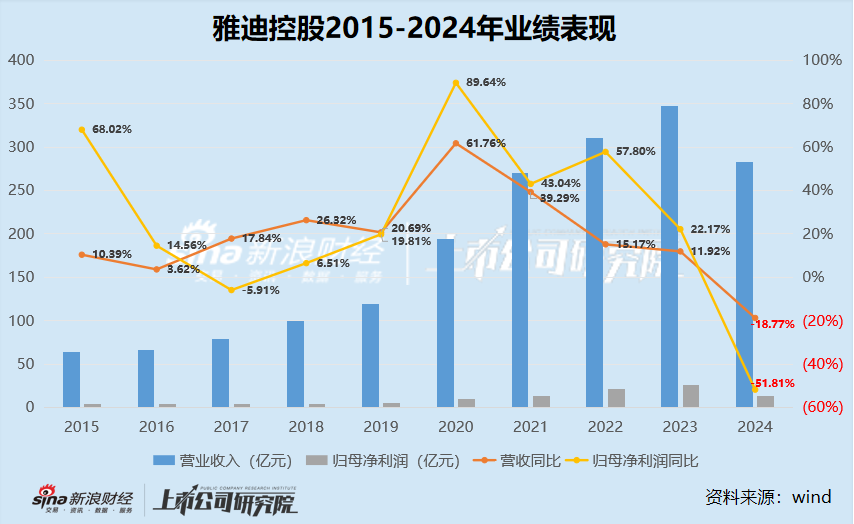
雅迪控股交出“史上最差”答卷:营收下滑18.8%、净利润”腰斩“51.8% 量价齐跌降价却少卖350万台电动车
Xin Lang Zheng Quan· 2025-03-28 02:44
Core Viewpoint - Yadea Holdings has reported a significant decline in both revenue and net profit for 2024, marking one of the worst performances in its history, with revenue down 18.8% to 28.236 billion yuan and net profit halved by 51.8% to 1.272 billion yuan [1][2][4] Group 1: Financial Performance - Yadea's revenue for 2024 was 28.236 billion yuan, a decrease of 18.8% year-on-year, while net profit fell to 1.272 billion yuan, a drop of 51.8% compared to the previous year [1][2] - The company's performance in 2024 is described as the worst since its listing, with both revenue and net profit showing negative growth for the first time since 2016 [1][2] - The gross profit margin for Yadea reached a five-year low, with margins decreasing from 18.08% in 2022 to 15.19% in 2024, indicating increased cost pressures despite reduced sales [4][5] Group 2: Market Dynamics - The overall market for electric two-wheelers in China saw a total sales volume of 49.5 million units in 2024, down 11.6% year-on-year, reflecting a saturated market with diminishing new demand [2][4] - Yadea's sales volume dropped to 13.0205 million units in 2024, a decrease of 350,000 units from 2023, with electric bicycle sales falling by approximately 21.4% [7][8] - The competitive landscape has intensified, with rivals like Aima Technology and Ninebot gaining market share, while Yadea struggles to maintain its position [1][4] Group 3: Strategic Responses - Yadea has implemented a price reduction strategy to clear existing inventory, with electric bicycles' average selling price dropping from 1,380 yuan in 2023 to 1,347 yuan in 2024 [6][7] - Despite these efforts, the company still faced a 20% decline in sales volume, indicating that price cuts alone were insufficient to stimulate demand [6][7] - Inventory levels remained high at 1.279 billion yuan by the end of 2024, an increase of 33.91% from the previous year, suggesting challenges in inventory management [9]


财报解读:2024年净利润砍半,雅迪的救命稻草在哪?
3 6 Ke· 2025-03-25 12:06
Core Viewpoint - The electric two-wheeler industry in China is undergoing significant changes in 2024, with a notable decline in both sales and prices, driven by the implementation of new national standards and a wave of product replacements [1][3]. Group 1: Financial Performance - Yadea Holdings reported a revenue of approximately 28.236 billion RMB in 2024, a decrease of 18.8% compared to 2023 [4]. - The company's net profit was halved, reflecting broader industry challenges and individual company struggles [3][4]. - Sales of electric scooters fell by 20.7% to 3.931 million units, while electric bicycles saw a 21.4% decline to 9.089 million units [4]. Group 2: Market Dynamics - The domestic electric two-wheeler market is saturated, with over 420 million units in circulation, leading to a shift in demand from new purchases to replacements [6]. - Increased competition from rivals like Aima Technology and Ninebot has intensified market pressures, with Ninebot's net profit soaring by 167.82% in the first half of 2024 [6][7]. - Yadea's gross margin decreased from 16.9% to 15.2% due to aggressive pricing strategies and rising raw material costs [6]. Group 3: Strategic Challenges - Yadea's reliance on government subsidies is becoming unsustainable as new regulations and international standards tighten [6][7]. - The company faces challenges in maintaining its market leadership as competitors rapidly expand and capture market share [7][9]. - Yadea is investing in research and development, planning to launch its first sodium-ion battery-powered electric bicycle in January 2025, aiming to reduce dependence on lead-acid batteries and mitigate lithium battery cost fluctuations [10][11]. Group 4: Global Expansion and Innovation - Yadea is accelerating its global expansion, particularly in Southeast Asia, with factories in Indonesia and Vietnam and flagship stores in Thailand [9]. - The company aims to adapt its products to local market needs rather than simply replicating its low-cost domestic strategy [11]. - Yadea's battery and charger revenue reached 4.065 billion RMB in the first half of 2024, down 9.62% year-on-year, indicating a need to diversify into B2B markets and energy services [13]. Group 5: Future Outlook - The transition from a focus on scale and price competition to value creation is essential for Yadea's survival and evolution in the changing market landscape [13]. - The company's ability to innovate in battery technology and expand internationally will be crucial in determining its future competitiveness [10][13].

小牛电动2024年再亏1.93亿:“以价换量”后毛利率下滑、缩减研发但营销费用高企 门店数量仍远少于同行
Xin Lang Zheng Quan· 2025-03-25 10:02
近日,小牛电动发布了2024年财报,昔日的"行业鲶鱼"在连续多年业绩掉头向下之后,终于迎来了 一定回暖。 但实际上,如果结合近几年小牛电动以及对比同行的业绩表现来看,当下的小牛电动的确不容乐 观。与2024年的高增长所对比的是公司连续两年的营收缩水,而公司在2022年由盈转亏后至今仍未走出 亏损泥淖,已经连续3年亏损。对比2021年小牛电动"巅峰"时期的业绩表现来看,2021年实现营收37.05 亿元,同期净利润2.26亿元,而3年后小牛电动如今的业绩表现显然已远不如前。 更何况,在小牛电动跌落神坛极力自救的过程中,也已经被同行远远甩下。两轮电动车赛道的雅 迪、爱玛、九号在过去几年中基本均保持了收入的增长与盈利,尽管有个别季度的调整,但整体业绩表 现稳中有升。其中特别是当年与小牛电动一同出圈的九号公司,已经连续3年实现超百亿营收,销售净 利率也在持续增长。而对比之下,小牛电动的业绩规模与盈利能力、成长能力均较为逊色。 高端化背后:平均单价持续降价、毛利率下滑、缩减研发但营销费用高企 尽管小牛电动在2024年业绩有所回暖,但相比之前年度以及公司曾经的预期,仍存在不小的差距。 2023年公司CEO李彦曾表示,公司 ...

迎接高低切机遇暨提振消费专项行动方案解读
2025-03-18 01:38
Summary of Key Points from the Conference Call Industry Overview - The conference call primarily discusses the **consumer goods industry** and its various segments, including retail, real estate, food and beverage, home appliances, and new consumption trends. Core Insights and Arguments - **Retail Performance**: In January-February, the total retail sales of consumer goods increased by 4% year-on-year, with significant growth in communication products (26.2%), cultural and office furniture (21.8%), and essential goods like grain and oil (11.5%) [2][3] - **Real Estate Impact**: Real estate sales fell by 2.6%, but the decline has narrowed significantly, indicating a stabilization in the market. This stabilization has positively influenced consumer confidence and spending [3][4] - **Government Initiatives**: The government is actively promoting consumption through measures such as increasing residents' income, reducing living expenses, and implementing a "trade-in" policy for durable goods. A special action plan has been introduced to boost consumer expectations [5] - **Emerging Technologies**: The integration of new technologies with traditional industries, such as AI in healthcare and industrial internet platforms in consumption, is highlighted as a new investment theme [7][8] - **Food and Beverage Sector**: The sector is expected to benefit from policy support and has a focus on cyclical segments like high-end liquor and beer. The overall valuation remains attractive, with recommendations for leading brands [9][10] - **Home Appliance Sector**: The home appliance industry saw a 10.9% year-on-year growth in January-February, with expectations for continued demand due to government subsidies and seasonal sales [24][25] - **Consumer Trends**: The call emphasizes the importance of online retail growth, with a 5% increase in online retail sales. Categories like toys and IP products are gaining popularity [20] - **Service Consumption**: There is significant potential for growth in service consumption on internet platforms, with low current penetration rates indicating room for expansion [21] Additional Important Insights - **Investment Recommendations**: Specific companies are recommended based on their growth potential and market positioning, including high-dividend yielding companies in the home appliance sector and leading brands in the food and beverage industry [25][30] - **Market Dynamics**: The call notes a shift in market sentiment towards domestic demand-driven sectors due to external uncertainties affecting exports [6] - **Consumer Confidence**: The stabilization of the real estate market and government policies are expected to enhance consumer confidence, which is crucial for sustained consumption growth [3][5] This summary encapsulates the key points discussed in the conference call, providing a comprehensive overview of the current state and future outlook of the consumer goods industry.
家电在2025有哪些新逻辑和新机会?
2025-03-16 15:50
Summary of Key Points from Conference Call Industry Overview - The conference call primarily discusses the **home appliance industry** in China, focusing on investment opportunities and market dynamics for 2025 [2][4][7]. Core Insights and Arguments - **Economic Growth and Consumer Spending**: In 2024, China achieved a GDP growth target of 5%, largely driven by a 7.1% increase in export growth. However, domestic consumption is expected to play a more critical role in achieving the 2025 GDP growth target of 5% due to increasing export pressures [2][3]. - **Government Support for Consumption**: The government has increased fiscal spending, with a significant rise in the comprehensive fiscal index by 8.62% year-on-year, which is expected to boost household income and stimulate consumption, particularly in the home appliance sector [2][4]. - **Subsidy Policies**: The "trade-in" subsidy policy has been expanded from 150 billion yuan in 2024 to 300 billion yuan in 2025, directly stimulating demand in the home appliance market [4][11]. - **Investment Opportunities**: The home appliance sector is seen as having multiple investment opportunities due to policy support, strong domestic demand, and the potential for technological innovation [2][4][7]. Market Dynamics - **Sales Growth**: The home appliance industry has shown significant growth in domestic sales, with online and offline channels maintaining double-digit growth rates. For instance, air conditioning sales grew by 20%, and kitchen appliances saw over 40% growth in offline sales [7][10]. - **Consumer Trends**: There is a notable shift towards durable consumer goods, with strong demand in lower-tier markets. The retail sales growth in these markets has reached 11% [7][10]. - **AI Integration**: The application of AI technology in home appliances is enhancing user experience and profitability, with companies like Xiaomi and Haier leading in smart home ecosystem development [2][15][17]. Financial Metrics - **Free Cash Flow Improvement**: The consumer sector has seen a reduction in capital expenditure, leading to improved free cash flow, which is attractive to foreign investors. The consumer sector's valuation is at historical lows, suggesting potential for upward movement [5][8][20]. - **Dividend Policies**: Companies are increasing dividend payouts as free cash flow improves, with Haier raising its payout ratio from 40% to 50% [21][22]. Emerging Trends - **New Consumption Areas**: The rise of service robots and AI integration in consumer products is creating new market opportunities. For example, the penetration rate of robotic vacuum cleaners is expected to increase significantly due to government subsidies [23]. - **Market Segmentation**: Different categories of home appliances are performing variably, with kitchen appliances and small appliances showing stronger growth compared to traditional white goods [13][19]. Risks and Challenges - **Export Challenges**: The home appliance sector faces challenges from declining export growth, with a forecasted export growth rate of around 2% for 2025 [3][10]. - **Market Volatility**: The overall market is experiencing a slowdown in growth rates, which is a normal phenomenon given the size of the Chinese economy. Investors are advised to focus on long-term stable growth rather than short-term spikes [19][20]. Conclusion - The home appliance industry in China is poised for growth in 2025, driven by government support, technological advancements, and changing consumer preferences. Investors are encouraged to identify quality stocks within this sector, particularly those benefiting from subsidy policies and innovative product offerings [4][7][19].
家用电器25W11周观点:电动自行车以旧换新成效显著,1-2月扫地机数据靓丽-2025-03-16
Huafu Securities· 2025-03-16 13:09
Investment Rating - The industry rating is "Outperform the Market" [8][70]. Core Insights - The electric bicycle trade-in program has shown significant results, with 1.664 million units sold by March 11, 2025, surpassing the total for 2024 by 120.4% [3][11]. - The online sales of robotic vacuum cleaners in January-February 2025 reached 1.916 billion yuan, a year-on-year increase of 72%, with sales volume of 587,500 units, up 58% year-on-year [3][13]. Summary by Sections Electric Bicycle Trade-in Program - The trade-in program has resulted in 1.664 million electric bicycles being sold, with a total subsidy of 1 billion yuan, averaging 600 yuan per person, leading to new car sales of 4.51 billion yuan [3][11]. - The number of participating stores increased to 47,000, with an average sales boost of 96,000 yuan per store [11][12]. Robotic Vacuum Cleaner Sales - The online sales of robotic vacuum cleaners showed a strong performance, with a total sales amount of 1.916 billion yuan and an average price of 3,261 yuan, reflecting a 9% year-on-year increase [3][13]. - Leading brands like Ecovacs and Roborock saw significant increases in their market shares, with Ecovacs achieving a 27% market share and Roborock reaching 25% [13]. Investment Recommendations - The report suggests focusing on major home appliance companies benefiting from the trade-in program, including Midea Group, Haier Smart Home, Gree Electric, and TCL Electronics [5][17]. - The pet industry is highlighted as a resilient sector, with recommendations to consider companies like Guibao Pet and Zhongchong Co [5][17]. - The report anticipates a recovery in demand for small appliances and branded apparel in 2026, suggesting attention to leading brands in these categories [5][17]. Market Performance - The home appliance sector saw an overall increase of 1.7% this week, with specific segments like white goods and kitchen appliances performing particularly well [4][21]. - Raw material prices for copper and aluminum increased by 0.98% and 0.74% respectively compared to the previous week [4][21].
汽车行业月报:2月乘用车销量同比增26%,以旧换新政策+车企促销推动车市回暖-2025-03-12
BOCOM International· 2025-03-12 02:02
交银国际研究 行业更新 2025 年 3 月 11 日 行业评级 领先 2 月乘用车销量同比增 26%,以旧换新政策+车企促销推动车市回暖 估值概要 | 公司名称 | 股票代码 | 评级 | 目标价 | 收盘价 | | -----每股盈利----- | ----市盈率---- | | | ----市账率---- 股息率 | | | --- | --- | --- | --- | --- | --- | --- | --- | --- | --- | --- | --- | | | | | | | FY25E | | | FY26E FY25E FY26E FY25E FY26E | | | FY25E | | | | | | (当地货币) (当地货币) (报表货币) (报表货币) | | | (倍) | (倍) | (倍) | (倍) | (%) | | 比亚迪股份 | 1211 HK | 买入 | 379.22 | 350.20 | 23.261 | 28.629 | 14.1 | 11.4 | 3.11 | 2.42 | 0.1 | | 理想汽车 | 2015 HK | 买入 | 120.34 | 113 ...


