
腾讯控股

Search documents
跌9.39%VS买636亿!南向资金节前逆势扫货|中环观察
2 1 Shi Ji Jing Ji Bao Dao· 2026-02-12 09:28
Core Viewpoint - The Hong Kong stock market is experiencing a significant influx of southbound capital despite recent declines in the Hang Seng Index and Hang Seng Tech Index, indicating a potential investment opportunity as valuations reach attractive levels [1][2]. Group 1: Market Performance and Capital Inflow - From January 29 to February 6, the Hang Seng Index fell by 4.55%, while the Hang Seng Tech Index dropped by 9.39%, yet southbound capital net bought HKD 636.64 billion during this period [1]. - On February 5, a record single-day net purchase of HKD 249.77 billion was noted, the highest since August 2025 [1]. - The increase in southbound capital is attributed to the perceived undervaluation of Hong Kong stocks, which have adjusted from 28,000 points to 26,200 points [1][2]. Group 2: Investment Strategies and Preferences - Southbound capital is focusing on two main types of stocks: technology leaders that are scarce in the A-share market and high-dividend stocks that offer better yields than their A-share counterparts [2][3]. - In 2025, the banking sector saw a net inflow of nearly HKD 210 billion, while tech giants Alibaba and Meituan attracted over HKD 250 billion combined, highlighting a preference for high-growth and dividend-paying stocks [2]. Group 3: Future Market Outlook - Analysts predict that the Hong Kong market has room for valuation recovery, with expectations of a slow bull market supported by increased southbound capital inflow and foreign investment [7][8]. - DBS Bank has raised its 12-month target for the Hang Seng Index to 30,000 points, while HSBC anticipates a target of 31,000 points by the end of 2026, driven by strong earnings growth and structural opportunities [8]. - Investment strategies for 2026 emphasize sectors such as technology, consumer goods, and essential retail, while cautioning against potential risks from geopolitical tensions and inflation [9].


12日港股低开低走 恒指跌0.86% 科指跌1.65%
Xin Hua Cai Jing· 2026-02-12 09:24
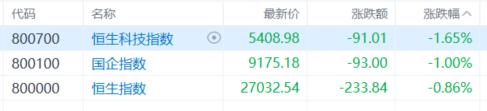
Market Overview - The Hong Kong stock market experienced a decline, with the Hang Seng Index falling by 0.86% to 27,032.54 points, the Hang Seng Tech Index down by 1.65% to 5,408.98 points, and the National Enterprises Index decreasing by 1.00% to 9,175.18 points [1] - The Hang Seng Index opened lower at 27,210.56 points, fluctuated downwards, and closed down by 233.84 points, with a total trading volume exceeding 238.7 billion HKD [1] - The net inflow for the southbound trading (Hong Kong Stock Connect) was over 4.5 billion HKD [1] Sector Performance - Most sectors saw declines, with notable exceptions in metals, chips, high-speed rail infrastructure, and wind power, which experienced gains [1] - Sectors such as oil and gas, banking, brokerage, and coal showed mixed performance, while new consumption, gold, commercial aerospace, biomedicine, new energy vehicles, technology, and real estate mostly declined [1] Individual Stock Movements - Xiaomi Group decreased by 1.56%, while Zijin Mining increased by 3.45% [1] - SenseTime rose by 6.77%, and Ctrip Group fell by 3.90% [1] - WuXi Biologics dropped by 0.14%, Pop Mart fell by 1.10%, and SMIC decreased by 0.29% [1] - Notable gainers included Zhizhen Technology with a rise of 28.68%, and Longi Green Energy up by 5.56% [1] - China Construction Bank fell by 0.86%, while CATL increased by 4.14%, and Dongfang Electric surged by 12.38% [1] - Yao Cai Securities Financial dropped by 4.15%, and China Petroleum gained 0.85% [1] Top Traded Stocks - Tencent Holdings fell by 2.28% with a trading volume exceeding 21.2 billion HKD [2] - Alibaba decreased by 0.94% with a trading volume over 8.9 billion HKD [2] - Meituan dropped by 4.50% with a trading volume of 7.7 billion HKD [2]
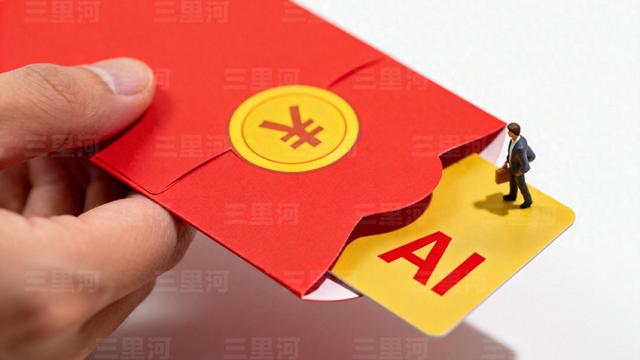
45亿春节红包雨,能否筑起巨头AI护城河?
Xin Lang Cai Jing· 2026-02-12 09:13
Core Insights - The recent surge in milk tea orders is attributed to the AI red envelope competition initiated by major internet companies, with Alibaba's AI application Qianwen launching a 3 billion yuan milk tea giveaway that garnered over 10 million orders in just 9 hours [2] - The total amount invested by tech giants like Tencent, Alibaba, Baidu, and ByteDance in AI red envelopes has reached 4.5 billion yuan, indicating a fierce competition as they aim to cultivate user habits of turning to AI for assistance [2][4] Group 1: Market Dynamics - The historical context shows that red envelopes have previously transformed the payment market, with WeChat's "shake" feature in 2014 significantly increasing its user share [4] - The current competition is not just about payment but focuses on AI, aiming to establish a habit among users to seek AI assistance for various needs [4] - The competition has led to tensions between platforms, as evidenced by WeChat blocking certain red envelope commands, highlighting the intense rivalry among these tech giants [4] Group 2: Strategic Focus - Chinese companies are differentiating themselves by targeting high-frequency life scenarios such as dining, socializing, and entertainment, leveraging the vast market potential [5] - The government's push for AI application prevalence, with a target of over 70% by 2027, supports this strategic focus on integrating AI into everyday life [5] - The rapid growth in generative AI users, reaching 602 million by the end of 2025, reflects the critical phase of AI entering large-scale application [5][6] Group 3: Competitive Landscape - The 4.5 billion yuan red envelope initiative serves as a reflection of the practical path for AI in China, emphasizing the importance of building an ecological moat from scenarios to users [6] - Success in this competitive landscape hinges on establishing user loyalty, scenario stickiness, and practical technology, which are essential for creating a robust platform ecosystem [6] - The initial excitement will eventually give way to the real challenges of sustaining market presence and achieving commercial viability [7]


谁用腾讯会议谈恋爱啊
半佛仙人· 2026-02-12 09:12
Core Viewpoint - The article emphasizes the role of Tencent Meeting as a vital tool for maintaining intimacy and trust in long-distance relationships, transforming the way couples interact despite physical separation [2][10]. Group 1: Emotional Value - Tencent Meeting provides a formal atmosphere that enhances emotional connection, allowing couples to treat their interactions with seriousness and dedication [2][3]. - The platform's features, such as screen sharing, enable couples to engage in activities together, creating a sense of presence despite being physically apart [5][6]. Group 2: Communication Quality - The article highlights that meaningful conversations require dedicated time, which Tencent Meeting facilitates by minimizing distractions and allowing for deep discussions [8][10]. - The platform's ability to create a focused environment enhances the quality of communication, making it more conducive to heartfelt exchanges [8][10]. Group 3: Trust Building - Trust issues in long-distance relationships often stem from a lack of frequent, meaningful interactions; Tencent Meeting serves as a substitute for high-frequency reunions [10][12]. - By scheduling meetings, couples signal their commitment and seriousness, which helps alleviate doubts and fosters trust [10][12]. Group 4: Overcoming Distance - The article discusses how Tencent Meeting can mitigate feelings of distance by providing a virtual space where couples can share experiences and emotions in real-time [6][14]. - Features like real-time transcription and meeting minutes enhance communication by allowing couples to revisit important discussions and feelings [12][14]. Group 5: Practical Applications - Tencent Meeting is portrayed as a tool that can help couples navigate the complexities of long-distance relationships, especially during challenging times like family gatherings [14][17]. - The platform's functionalities, such as shared tasks and reminders, can help couples maintain their connection and manage their relationship effectively [15][17].

1月黑猫投诉综合电商领域红黑榜:淘宝贵金属交易乱象频发,消费者维权困难
Xin Lang Cai Jing· 2026-02-12 09:06
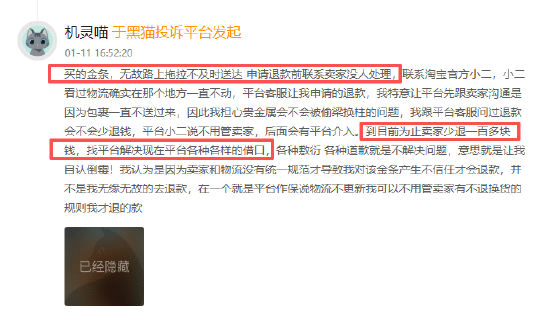
黑猫投诉 【下载黑猫投诉客户端】发布1月企业投诉处理红黑榜单,数据均来源于黑猫投诉平台,反映 了企业在黑猫投诉平台的投诉处理解决情况。 截至2026年1月底,黑猫投诉平台累计收到消费者有效投诉近3274万件,1月有效投诉近79万件。 为了更加精准、及时地展现不同细分消费领域企业在黑猫平台的客诉处理情况,红黑榜单除了按行业划 分,还会根据近期热点消费事件设置"最受关注领域榜单",为消费者提供更有价值的消费参考。 关键词:淘宝贵金属交易乱象频发,消费者维权困难 一月份贵金属交易市场持续火爆,有大量消费者选择购入实体金条/银条,或将自己之前购入的金饰卖 出,有消费者向黑猫投诉反馈,自己下单后出现物流停滞/拖延不发货等情况,由于目前金价较高,担 心运输过程中被调包,故申请退款,但申请平台介入后获得的退款莫名被扣除一部分。还有消费者表示 自己购入的金饰在回收时被鉴定为假,寻求售后时却因为下单时间过去太久不能获得有效处理,还有的 商家早已关店跑路。 黑猫投诉1月行业红黑榜单 共享服务 黑榜:光宇科斯特换电、智慧笑联、云马科技、哈啰、小电科技、咻电、悦快闪充、悟空快充、南瓜 侠、来电 红榜:怪兽充电、街电、松果电单车、倍电 ...
寒假助力家长守护上网安全,腾讯多场景升级未成年人网络保护
Huan Qiu Wang· 2026-02-12 09:03
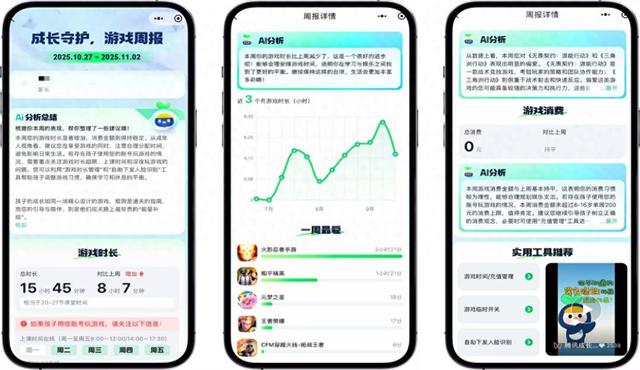
来源:环球网 腾讯游戏成长守护 视频场景中,电视是10岁以下儿童重要的数字媒体,腾讯视频电视端在行业内率先推出"三级管控"模 式,将内容的选择权交给家长和孩子。在默认模式、中度管控、强管控三种不同模式下,家长可根据孩 子的年龄和实际情况,灵活配置时长管理、宝贝片单、黑名单、少儿锁等多元功能,调整管理的方式和 强度,针对性选择适合孩子观看的内容。时长管控上,家长既能设定每日观看总时长,也能精准划定禁 看时段,针对寒假亲子观影等特殊场景,还支持临时调整时长限制,在严格管控与亲子互动之间找到平 衡。在内容管理上,家长可以将自己精心挑选的视频,加入宝贝片段,供孩子观看,寓教于乐;也可以 【环球网互娱综合报道】寒假之际,孩子们居家上网时间大幅增加。如何防范网络沉迷、误触不良内 容?不少家长发现,腾讯旗下游戏、视频、社交等多个产品强化未成年人网络保护功能,"技术管控 +网络素养提升"双管齐下,让数字产品做到"家长放心、孩子喜欢",成为寒假家长保护未成年人触网 的"好帮手"。 通过黑名单机制,根据自身判断筛选内容,避免孩子观看。同时,平台会优先推荐科普、国学等内容, 让孩子在娱乐中收获知识,实现"边看边学"的成长价值。 三 ...
港股收盘 | 恒指收跌0.86% 科网股拖累大市走低 大模型“双雄”齐创新高
Zhi Tong Cai Jing· 2026-02-12 08:50
Market Overview - The Hong Kong stock market declined today, influenced by technology stocks, with the Hang Seng Index stopping its three-day rise and barely holding above the 27,000 mark. The index closed down 0.86% or 233.84 points at 27,032.54, with a total turnover of HKD 238.7 billion. The Hang Seng China Enterprises Index fell 1% to 9,175.18, and the Hang Seng Tech Index dropped 1.65% to 5,408.98 [1] Blue Chip Performance - Zijin Mining (601899) (02899) led blue-chip gains, rising 3.45% to HKD 45.02 with a turnover of HKD 4.993 billion, contributing 14.47 points to the Hang Seng Index. Citigroup raised its target price for Zijin's A-shares and H-shares by over 30% due to increased gold and lithium price forecasts and higher gold sales. The target price for Zijin's H-shares was raised from HKD 39 to HKD 51.8, a 32.8% increase [2] - Other notable blue-chip movements included WuXi AppTec (603259) (02359) up 2.91% to HKD 127.5, contributing 2.69 points; Sun Hung Kai Properties (00016) up 2.85% to HKD 133.5, contributing 8.63 points; while Budweiser APAC (01876) fell 5.21% to HKD 7.83, dragging down the index by 1.42 points [2] Sector Highlights - Technology stocks dragged the market lower, with Tencent down over 2% and Alibaba nearly 1%. However, several major companies launched new models, with Zhizhu's flagship model GLM-5 seeing a price increase and its stock rising over 40% to a new high. MINIMAX also rose over 14% [3] - The chip sector saw significant gains, with domestic GPU leader Tianzuo Zhixin and storage chip leader Zhaoyi Innovation both rising over 20%. Optical communication concepts rebounded, with Yangtze Optical Fibre (601869) benefiting from rising fiber prices, increasing over 12% [4] Notable Stock Movements - Zhongyuan Shipping (600026) (01138) surged 8.61% to HKD 17.6, driven by heightened shipping rates due to geopolitical tensions and increased demand for oil transportation [8] - China National Heavy Duty Truck (000951) (03808) reached a new high, rising 5.58% to HKD 42.38, with January heavy truck exports exceeding 16,000 units, marking a historical high [9] - Rebio Biotech (06938) also performed well, increasing 5.26% to HKD 74.05 after announcing a global exclusive licensing agreement with Madrigal Pharmaceuticals for innovative siRNA therapies [9] Company-Specific News - Budweiser APAC reported a revenue of USD 5.764 billion for the year ending December 31, 2025, a decrease of 7.7% year-on-year, with net profit attributable to shareholders down 32.6% to USD 489 million. The company also reported a loss of USD 105 million in the last quarter, compared to a loss of USD 16 million in the same period last year [10]

港股收评:三大指数低迷!餐饮股走弱,电力设备逆势发力
Ge Long Hui· 2026-02-12 08:48
Market Overview - The Hong Kong stock market experienced a decline, with the Hang Seng Index halting a three-day rally, closing at 27,032.54, down 0.86% [1][2] - The Hang Seng Tech Index fell by 1.65%, while the Hang Seng China Enterprises Index dropped by 1% [1][2] Sector Performance Technology Sector - Major tech stocks saw significant declines, with Meituan and NetEase both dropping over 4%, and Baidu and Tencent falling more than 2% [2][4] - Other tech companies like Kuaishou, Xiaomi, JD.com, and Alibaba also reported losses [2][4] Financial Sector - Financial stocks, including banks, Chinese brokerage firms, and insurance companies, mostly declined, adding pressure to the market [2] Consumer Sector - The restaurant sector faced downturns, with Jiumaojiu falling over 5% and Haidilao dropping more than 3% [6] - The overall consumer demand in the restaurant industry is stabilizing, with expectations for improvement in 2026 [6] Entertainment Sector - The film and entertainment sector was weak, with Emperor Culture Industries dropping nearly 6% [7] Energy Sector - The power equipment sector showed strength, with Harbin Electric rising over 13% [9] - The oil sector was active, with China Petroleum and Sinopec both gaining over 2% [14] Heavy Machinery Sector - Heavy machinery stocks continued to rise, with China National Heavy Duty Truck Group and Sany International both increasing over 5% [12] Semiconductor Sector - Semiconductor stocks saw gains, with Tensun Zhixin and Zhaoyi Innovation both rising over 20% [10] Notable Stocks - Dipo Technology surged by 8.34%, reaching a market value of 29.707 billion HKD [16] - The stock has increased 2.46 times since its IPO price of 26.66 HKD [21]


胜率78%!持股过节?
格隆汇APP· 2026-02-12 08:47
Core Viewpoint - The article discusses the investment strategies of "holding stocks during the festival" versus "holding cash during the festival," highlighting the significance of the Spring Festival on market dynamics and investor behavior [1]. Group 1: Market Trends and Performance - Historical data shows that the average return of the entire A-share market in the 10 trading days after the Spring Festival is 3.3%, while the average decline in the 10 trading days before is -1.3%, indicating a stronger post-festival performance [16][17]. - The trading volume in the A-share market has decreased to around 2.2 trillion yuan, with financing funds experiencing a net outflow for three consecutive weeks, consistent with the seasonal "calendar effect" before the Spring Festival [4][24]. - The market has shown a rebound this week, driven by AI catalysts, suggesting a prelude to the Spring Festival market dynamics [3][15]. Group 2: Investor Behavior and Sentiment - Investors tend to lock in profits and reduce positions before the long holiday due to cash withdrawal demands and uncertainties in overseas markets, leading to decreased trading volumes and increased market volatility [5][6]. - The sentiment among institutions remains optimistic regarding the post-festival market, as the recent adjustments present significant recovery opportunities [18][19]. - The recent adjustments have released some risks, and global assets, including Bitcoin and U.S. stocks, have shown signs of stabilization, indicating a gradual recovery in global risk appetite [12]. Group 3: Sector Performance and Opportunities - The recent adjustments in the market have led to a quick rotation among sectors, with notable performances in light communication, computing power chains, commercial aerospace, and cultural media [15]. - The AI sector has been a significant driver of market performance, with the recent launch of ByteDance's AI video generation model, Seedance 2.0, creating a surge in the media sector [30][36]. - The article emphasizes the potential for resource-based sectors, such as non-ferrous metals and chemicals, to recover significantly due to supply-demand fundamentals [43]. Group 4: Future Outlook - The upcoming macroeconomic data releases from both China and the U.S. are expected to provide insights into the improvement of the domestic economy and calibrate monetary policy expectations [19]. - The article suggests that the "Spring Rally" may continue into February and March, supported by ample liquidity and policy catalysts, encouraging investors to participate in the market [29][41].

港股收盘(02.12) | 恒指收跌0.86% 科网股拖累大市走低 大模型“双雄”齐创新高
智通财经网· 2026-02-12 08:45
Market Overview - The Hong Kong stock market declined today, influenced by technology stocks, with the Hang Seng Index closing down 0.86% at 27,032.54 points, marking the end of a three-day rally [1] - The Hang Seng Technology Index fell 1.65% to 5,408.98 points, indicating a weak performance in the tech sector [1] Blue-Chip Stocks Performance - Zijin Mining (02899) led blue-chip gains, rising 3.45% to HKD 45.02, contributing 14.47 points to the Hang Seng Index, following a target price increase by Citigroup of over 30% for both A-shares and H-shares [2] - WuXi AppTec (02359) and Sun Hung Kai Properties (00016) also saw gains of 2.91% and 2.85%, respectively, while Budweiser APAC (01876) and Trip.com Group (09961) faced declines of 5.21% and 3.9% [2] Sector Highlights - The technology sector faced pressure, with Tencent and Alibaba dropping over 2% and nearly 1%, respectively [3][6] - The AI model sector saw significant gains, with Zhizhu (02513) rising 28.68% and MINIMAX-WP (00100) increasing over 14% [3] - The chip sector experienced a notable rise, with Tianzhi Zhixin (09903) and Zhaoyi Innovation (03986) surging over 20% [4] Notable Company Developments - Zhizhu confirmed the launch of its new model GLM-5, which has seen a price increase of at least 30% for subscription packages, while existing subscribers will maintain their current rates [4] - Micron Technology's stock rose significantly in the U.S. market, with a target price increase to USD 450 by Morgan Stanley, reflecting strong demand driven by AI applications [5] Emerging Trends - The gas turbine sector is gaining traction due to a surge in electricity demand in North America, with companies like Harbin Electric (01133) and Dongfang Electric (01072) seeing substantial stock increases [6] - The North American electricity shortage is expected to create investment opportunities across various technologies, including gas turbines and energy storage [6] Company-Specific News - Budweiser APAC reported a revenue decline of 7.7% to USD 5.764 billion for the year ending December 31, 2025, with a significant drop in net profit by 32.6% [9] - China National Heavy Duty Truck (03808) achieved record high exports of over 16,000 heavy trucks in January, marking a 22.5% year-on-year increase in total vehicle sales for 2025 [8]