
华为

Search documents
镁合金材料专家交流
2026-01-22 02:43
Summary of Magnesium Alloy Application in Automotive Industry Industry Overview - The automotive industry is actively researching the application of magnesium alloys, driven by lower prices compared to aluminum alloys and abundant domestic magnesium resources in China. Key research areas include the three electric systems, electric drive systems, and body structural components, with significant increases in magnesium alloy usage expected in future vehicles [1][2][15]. Key Points and Arguments - **Price Comparison**: Magnesium alloy prices are currently around 35-36 RMB per kilogram, comparable to aluminum alloys. However, magnesium alloys offer a significant weight reduction of approximately 25% [1][8][25]. - **Usage in Electric Drive Systems**: Research on magnesium alloys in the three electric systems has progressed to the point of vehicle testing and is entering mass production phases. By 2026, it is expected that models equipped with magnesium alloy components will achieve monthly sales of over 10,000 units [1][4]. - **Supplier Landscape**: Key suppliers of magnesium alloy materials include Xinyuan Zhuomei, Jiarui Metal, and BYD Fudi Power. Major automotive manufacturers like SAIC, Xpeng, BYD, and Huawei are collaborating with Xinyuan on electric drive shell projects [1][10][5]. - **Future Projections**: The goal is to increase magnesium alloy usage per vehicle to 40 kg, with a long-term target of 100 kg. Some models may achieve 30-40 kg of magnesium alloy usage by 2026 [1][17]. - **Regulatory Environment**: National energy consumption requirements are pushing for lightweight materials in new energy vehicles, which is driving the strategic push for magnesium alloy applications to replace traditional steel and aluminum [1][15][16]. Additional Important Insights - **Market Demand**: China holds approximately 70-80% of the world's magnesium resources, which is expected to stabilize magnesium prices in the future. The demand for magnesium alloys, particularly in electric drive shells, is significant, and new entrants may find opportunities in this market [3][26][22]. - **Challenges in Adoption**: While magnesium alloys have been used in high-end vehicles, their adoption has been cautious due to historical price volatility. However, the current trend indicates a shift towards broader application as prices stabilize [2][30]. - **Potential Applications**: Beyond electric drive systems, magnesium alloys are being explored for use in body structural components such as door inner panels and tailgates, which could further increase overall magnesium usage in vehicles [12][31]. - **Export Considerations**: Currently, there are no plans to export vehicles using magnesium alloy components until they have been thoroughly tested in the domestic market [29]. This summary encapsulates the key discussions and insights from the conference regarding the application of magnesium alloys in the automotive industry, highlighting the strategic importance of these materials in future vehicle design and production.

3D打印与商业航天
2026-01-22 02:43
Summary of 3D Printing and Commercial Aerospace Conference Call Industry Overview - **Industry**: 3D Printing in Commercial Aerospace - **Key Companies**: Platinum and Huazhu are leading domestic metal 3D printing service providers in China, with significant market presence compared to foreign competitors like Germany's EOS and Nikon [2][15] Core Insights and Arguments - **Application of 3D Printing**: Widely used in manufacturing metal parts for rocket engines and satellites, addressing issues of long processing cycles, low precision, and complex structures [1][3] - **Material Costs**: Prices for commonly used materials have significantly decreased, with steel powder at 50-60 RMB/kg, aluminum alloy at 30-40 RMB/kg, and titanium alloy reduced to 200-300 RMB/kg, promoting wider application [1][5] - **Market Demand**: The commercial aerospace sector is projected to require 6,000 to 8,000 metal 3D printers annually, potentially exceeding 10,000 units when considering satellite manufacturing needs [8][11] - **Current Equipment**: The most mature 3D printing equipment is the 350 model, priced between 2.6 million to 3 million RMB, with future demand focusing on 350 and 450 models [9][10] Additional Important Content - **Production Efficiency**: 3D printing can optimize internal structures, reduce manual labor, and significantly improve yield rates, with about 80-90% of core rocket components now manufacturable via this technology [4][5] - **Emerging Markets**: The fastest-growing applications for 3D printing are in the electric vehicle and consumer electronics sectors, with major companies like Apple, Huawei, and Xiaomi adopting the technology for core components [13][14] - **Competitive Landscape**: Domestic companies are gaining ground against international firms due to more efficient and market-responsive development models, with a notable gap widening between local and foreign manufacturers [2][15] - **Future Trends**: The 3D printing industry is expected to see continued advancements in large-scale and support-free printing technologies, with Chinese companies rapidly catching up to international leaders [17][18] - **Material Market Dynamics**: Metal materials are anticipated to see the most significant growth in demand, outpacing plastics, resins, and nylon, which are primarily used for smaller applications [19] This summary encapsulates the key points discussed in the conference call regarding the advancements and market dynamics of 3D printing technology in the commercial aerospace sector.

CPU-AI推理用量提升-涨价或是必然
2026-01-22 02:43
Deepseek 通过条件记忆和 n-gram 模块优化模型性能,并将 n-gram 嵌入表储存在 CPU DRAM 中,提升数据查询效率,凸显 CPU 在推理过 程中的价值。 在 AGI 时代,CPU 作用日益关键。英伟达通过 Grace CPU 与 NVLink C2C 技术提高数据搬运速度,并扩大 GPU 显存,采用超级芯片封装技 术紧密结合 CPU 与 GPU,提升计算效率。 算力需求增加和技术迭代推动 CPU 出货量和价格双增。中科曙光和华为 分别推出 STELLAR X64 超级点和 384 超级点,采用海光 X86 架构授 权及 HASL 总线互联协议,满足 AGI 需求。 英伟达为解决 AI 训练瓶颈,推出 Grace CPU,通过 NVLink C2C 技术 将数据搬运速度提高到 900 Gbps,扩大 GPU 显存容量,并采用超级 芯片封装技术提高系统效率。 国内企业积极应对 AI 算力需求,中科曙光发布 STELLAR X64 超级点, 采用海光 X86 架构授权和 HASL 总线互联协议。华为推出 384 超级点, 实现高效硬件协同。 Q&A 近年来,CPU 在 AI 推理时代的重要性 ...
汽车赛道“最靓的仔”,新能源商用车来到转型关键期
Zheng Quan Shi Bao Wang· 2026-01-22 02:39
Core Viewpoint - The new energy commercial vehicle market in China is expected to experience significant growth in 2025, with sales projected to reach 954,000 units, representing a year-on-year increase of 65.5%, indicating a shift from policy-driven to market-driven growth in the industry [1][2]. Market Penetration - The penetration rate of new energy commercial vehicles has consistently exceeded 30% for four consecutive months, marking a new phase of large-scale application [1][2]. - In 2025, domestic sales of new energy commercial vehicles are expected to reach 871,000 units, a year-on-year increase of 63.7%, accounting for 26.9% of total commercial vehicle sales [2][3]. Sales and Orders - The cumulative sales of new energy heavy trucks in 2025 are projected to reach 231,100 units, a substantial increase of 182% year-on-year, with December alone achieving a record monthly sales of 45,300 units [3]. - Significant orders have been reported, including a strategic cooperation agreement between China National Heavy Duty Truck Group and Bashu Logistics for 1,000 heavy trucks, with the first batch of 200 units to be delivered [4]. Future Market Potential - The overall commercial vehicle market in China is expected to reach 4.25 million units in 2026, with a projected penetration rate for new energy vehicles exceeding 35% [5]. - By 2030, the penetration rate for new energy heavy trucks is anticipated to surpass 50%, with a market size exceeding 450,000 units [5]. Transition to Market-Driven Growth - The industry is moving away from reliance on subsidies, with customers increasingly focusing on product performance and total lifecycle costs [6]. - The decline in battery prices and the adoption of vehicle-to-grid models are making new energy commercial vehicles more affordable [7]. Technological Advancements - The energy density of power batteries has improved, allowing for enhanced range without increasing vehicle weight, with battery capacities primarily in the 400 kWh to 600 kWh range [7]. - The introduction of ultra-fast charging solutions and extensive charging networks is addressing user pain points and facilitating the large-scale deployment of new energy commercial vehicles [8]. Competitive Landscape - The competition in the commercial vehicle sector is evolving, with a focus on smart technology that can deliver economic benefits and reduce marginal costs [9]. - Major manufacturers are investing in intelligent vehicle technologies, with several companies launching models equipped with advanced driver-assistance systems [9]. International Expansion - Overseas markets are viewed as critical growth areas, with companies like Foton aiming for 200,000 units in overseas sales by 2026, and China National Heavy Duty Truck Group targeting 300,000 units by 2030 [11]. - The penetration rate of new energy heavy trucks in international markets remains low, presenting opportunities for early movers [11]. Ecosystem Development - The competition in the commercial vehicle industry is shifting from product-centric to a comprehensive ecosystem approach, focusing on long-term value creation for customers [11].



DeepSeek新模型曝光;AI产业链业绩兑现丨新鲜早科技
2 1 Shi Ji Jing Ji Bao Dao· 2026-01-22 02:30
Group 1: Technology Developments - DeepSeek has updated its GitHub repository, revealing a new model architecture "MODEL1," which is expected to be more efficient and suitable for edge devices compared to its predecessor DeepSeek-V3.2 [2] - Longji Technology announced significant progress in Co-packaged Optics (CPO) technology, with successful customer sample deliveries and testing, addressing the growing demand for high-bandwidth, low-latency optical interconnects [11] - Shanghai Yiyou Intelligent Control Technology has launched its first automated production line for robot joints in Zhangjiang, aiming to meet the increasing demand and reduce costs for humanoid robots [10] Group 2: Financial Performance and Projections - Moole Technology expects a net loss of 950 million to 1.06 billion yuan for 2025, despite launching a leading GPU product and experiencing revenue growth due to the AI industry's expansion [17] - Demingli anticipates a net profit of 650 million to 800 million yuan for 2025, representing a year-on-year increase of 85.42% to 128.21%, driven by advancements in storage solutions and AI demand [18] - Tianfu Communication projects a net profit of 1.881 billion to 2.150 billion yuan for 2025, reflecting a growth of 40% to 60% due to the accelerating AI industry and global data center construction [19] Group 3: Regulatory and Market Responses - The European Union plans to phase out "high-risk suppliers" in critical sectors, interpreted as targeting Chinese tech firms like Huawei, which has expressed concerns over the fairness of such regulations [2] - Pinduoduo was fined 100,000 yuan for failing to report tax information as required, highlighting regulatory scrutiny on internet platform companies [4] - Zhiyu Technology announced a temporary limit on the sale of its GLM Coding Plan due to high demand and resource constraints, reducing daily sales to 20% of current levels [3]

欧盟拟强制淘汰“高风险供应商”设备 华为回应
2 1 Shi Ji Jing Ji Bao Dao· 2026-01-22 02:26
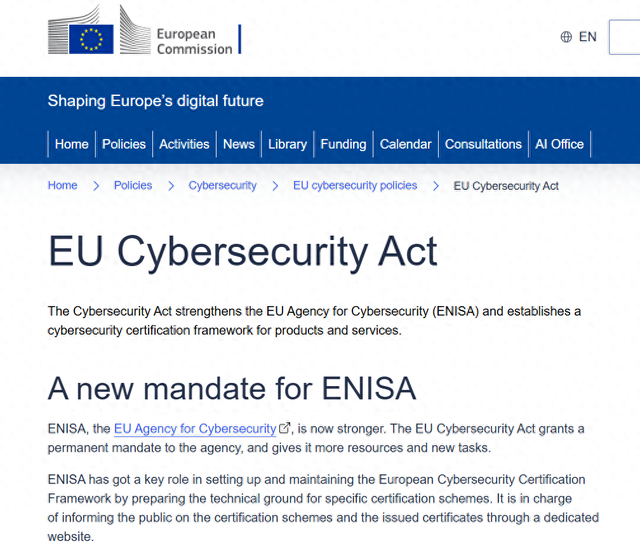
21世纪经济报道记者倪雨晴 1月21日,环球网援引媒体报道称,欧盟委员会于当地时间1月20日公布《欧盟网络安全法》修订草案,计划在包括5G通信、半导体、电力系 统、自动驾驶、医疗设备等18个关键领域,逐步淘汰所谓"高风险供应商"的组件和设备。 根据欧盟委员会披露的信息,此次修订的一个核心变化在于,将此前作为自愿性指南的"供应链工具箱",正式纳入具有法律约束力的强制执行 框架,并把涉及的行业范围扩大了。 2020年,欧盟曾推出5G安全"工具箱",主要针对5G网络设备,对所谓"高风险供应商"采取限制措施。但由于设备替换成本高昂、执行弹性较 大,相关措施在不少成员国推进缓慢。此次修法,正是试图通过统一立法,强化规则执行力。 而草案显示,新措施适用于欧盟认定的18个关键行业,除电信网络外,还涵盖探测设备、联网和自动驾驶车辆、电力供应和储能系统、供水系 统、无人机和反无人机系统等基础设施领域,以及云服务、医疗设备、监控设备、航天服务和半导体等核心科技领域。 相较此前仅聚焦5G网络,监管范围明显向"泛数字基础设施"和核心科技产业延伸。尽管草案全文未直接点名任何国家或企业,但在行业和舆 论层面,其政策指向被普遍解读为针对中 ...

乐道汽车推出鸿蒙版App,正式版直接登陆华为应用市场
Feng Huang Wang· 2026-01-22 01:58
通过查询发现,蔚来三品牌仅差firefly萤火虫App暂未上线鸿蒙端,蔚来、乐道汽车App均已上线。 凤凰网科技讯 1月22日,蔚来高级副总裁兼乐道汽车总裁沈斐昨日发文宣布,乐道汽车鸿蒙版App已上 线,并表示:"大家的各种需求都收到,一个一个来。" 值得一提的是,乐道汽车App直接上架了华为应用市场App Gallery,可直接安装使用。应用详情页显 示,乐道汽车App上线时间在2026年1月20日,同时在1月21日还进行了小版本更新。目前乐道汽车App 已支持乐道社区、在线购车、加电无忧、乐道惊喜、福利活动等功能。 ...
出行观丨欧盟正在打一场保护主义下的产业升级算盘
Guan Cha Zhe Wang· 2026-01-22 01:47
Core Viewpoint - The European Commission has introduced a comprehensive cybersecurity legislative proposal, deemed the "strictest ever," mandating EU member states to remove Huawei and ZTE from their mobile networks within three years of the law's enactment, indicating a shift from recommendations to mandatory actions in telecommunications security [1][4]. Group 1: Legislative Impact - The new proposal extends beyond telecommunications, potentially restricting companies from 18 sensitive sectors, including connected vehicles, power and water supply systems, cloud computing, medical devices, drones, aerospace, and semiconductors, if a country is deemed a cybersecurity threat [4]. - Huawei has responded to the proposal, arguing that it violates fundamental legal principles of fairness and non-discrimination by targeting non-EU suppliers based on country of origin rather than factual evidence and technical standards [4]. Group 2: Industry Implications - The legislative changes could significantly impact the automotive sector, particularly in the context of smart connected vehicles, as the freedom of choice in technology solutions may be replaced by security reviews, potentially barring Chinese companies from participating in critical components [5][7]. - The proposal could lead to systemic marginalization of Chinese technology standards in Europe, affecting the supply chain structure and increasing costs for European manufacturers who may have to opt for less mature and more expensive alternatives [7][11]. Group 3: Economic Considerations - The estimated cost of fully excluding Chinese equipment from 5G construction in Europe could reach approximately €550 billion (about ¥4.48 trillion), with the overall cost of transforming the telecommunications network projected at €2 trillion (about ¥16 trillion) [14][16]. - The financial burden of these changes may ultimately be passed on to consumers, raising product prices and complicating the market landscape for European companies [14][19]. Group 4: Strategic Objectives - The EU's move appears to be a strategic choice aimed at reshaping its technological landscape and reducing dependency on Chinese technology, pushing for local development of software and algorithms [11][13]. - This approach may lead to increased R&D costs for multinational companies, as they will need to maintain dual technology stacks to comply with different regulatory environments, further complicating the market dynamics [14][18].
小米国内激活量超苹果 卢伟冰:竞争极其焦灼
Xin Lang Cai Jing· 2026-01-22 01:23
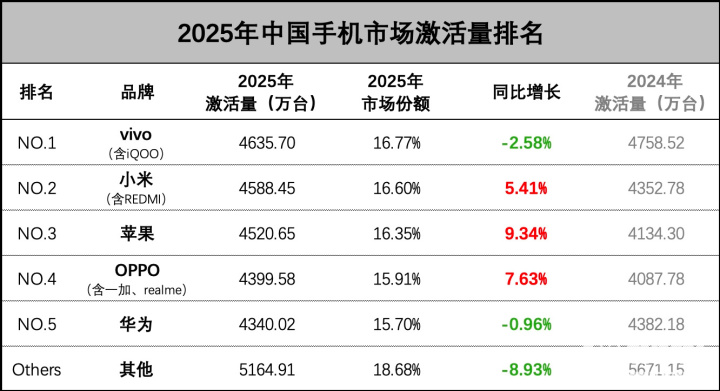
Core Insights - The top three smartphone brands in China by activation volume in 2025 are vivo, Xiaomi, and Apple, with vivo maintaining the first position despite a slight decline in activation volume [1][5] - Xiaomi surpassed Apple to claim the second position, largely due to the success of the Xiaomi 17 series, which includes models with activation volumes exceeding one million [2][6] - The activation volume gap between the top five brands is minimal, with less than 3 million units separating vivo from Huawei, indicating a highly competitive market where a single popular model can significantly influence brand rankings [1][5] Brand Performance Summary - **Vivo**: Ranked first with an activation volume of 4,635.70 thousand units, a market share of 16.77%, and a year-on-year decline of 2.58% from 4,758.52 thousand units in 2024 [2][6] - **Xiaomi**: Ranked second with an activation volume of 4,588.45 thousand units, a market share of 16.60%, and a year-on-year growth of 5.41% from 4,352.78 thousand units in 2024 [2][6] - **Apple**: Ranked third with an activation volume of 4,520.65 thousand units, a market share of 16.35%, and a year-on-year growth of 9.34% from 4,134.30 thousand units in 2024 [2][6] - **OPPO**: Ranked fourth with an activation volume of 4,399.58 thousand units, a market share of 15.91%, and a year-on-year growth of 7.63% from 4,087.78 thousand units in 2024 [2][6] - **Huawei**: Ranked fifth with an activation volume of 4,340.02 thousand units, a market share of 15.70%, and a year-on-year decline of 0.96% from 4,382.18 thousand units in 2024 [2][6] - **Others**: The remaining brands collectively accounted for 5,164.91 thousand units, with a market share of 18.68% and a year-on-year decline of 8.93% from 5,671.15 thousand units in 2024 [2][6] Market Dynamics - The competition among the top brands is extremely tight, with minor differences in activation volumes leading to significant shifts in rankings [5][9] - The timing of new product launches, such as the Huawei Mate 80 series, can greatly impact market standings, suggesting that strategic release schedules are crucial for maintaining competitive positions [5][8] - Xiaomi's Lu Weibing emphasized the intense competition in the Chinese market, indicating that the leading positions are very fragile and require continuous effort to maintain [9]


财信证券晨会纪要-20260122
Caixin Securities· 2026-01-22 00:53
晨会纪要(R3) 晨会纪要 2026 年 01 月 22 日 | 市场数据 | | | | --- | --- | --- | | 指数名称 | 收盘 | 涨跌% | | 上证指数 | 4116.94 | 0.08 | | 深证成指 | 14255.12 | 0.70 | | 创业板指 | 3295.52 | 0.54 | | 科创 50 | 1535.39 | 3.53 | | 北证 50 | 1519.75 | 0.14 | | 沪深 300 | 4723.07 | 0.09 | 一、财信研究观点 【债券研究】债券市场综述 二、重要财经资讯 【财经要闻】市场监管总局发布 2025 年综合整治"内卷式"竞争十大典 型案例 【财经要闻】财政部发布《关于全面推行财政电子票据跨省报销工作的 通知》 上证指数-沪深 300 走势图 -5% 5% 15% 25% 35% 2025-01 2025-04 2025-07 2025-10 上证指数 沪深300 | 黄红卫 | 分析师 | | --- | --- | | 执业证书编号:S0530519010001 | | | huanghongwei@hnchasing.c ...