
石头科技

Search documents
家电周报:三大白电 2 月排产数据发布,民爆光电公告收购预案-20260131
Shenwan Hongyuan Securities· 2026-01-31 12:12
Investment Rating - The report indicates a cautious outlook for the home appliance sector, with a recommendation to focus on leading companies that exhibit low valuations, high dividends, and stable growth potential [5][10]. Core Insights - The home appliance sector underperformed compared to the Shanghai and Shenzhen 300 Index, with a decline of 2.4% in the appliance index while the broader index rose by 1.1% [5][6]. - Major companies like Opple Lighting, Boss Electric, and Midea Group showed positive performance, while companies like Ecovacs, Lek Electric, and Huaxiang suffered significant declines [5][8]. - Production data for major appliances in February 2026 revealed substantial year-on-year declines, with air conditioner production down 31.6%, refrigerators down 17%, and washing machines down 3.2% [10][11]. - The report highlights three main investment themes: 1. **Dividend Play**: Leading white and black appliance companies are characterized by low valuations and high dividend yields, providing a safety margin and growth potential [5]. 2. **Technology Transition**: Key component manufacturers are diversifying into emerging tech sectors such as robotics and semiconductor cooling, indicating a shift in business strategy [5]. 3. **Export Opportunities**: Major appliance firms are well-positioned in global markets, with production bases in various regions to mitigate trade risks and capitalize on demand in emerging markets [5]. Industry Dynamics - The report notes a significant drop in production for major appliances in February 2026, with air conditioners at 11.49 million units, refrigerators at 6 million units, and washing machines at 6.3 million units, all showing declines compared to the previous year [10]. - The report also mentions a planned acquisition by Minexplosion Optoelectronics, which aims to purchase a 49% stake in Xiamen Maida and a 51% stake in cash, with a total consideration not exceeding 250 million yuan [11]. Data Observations - Sales data for cleaning appliances in December 2025 showed an increase in volume but a decrease in revenue and average price, with robotic vacuum sales up 29.11% but revenue down 2.14% [34]. - Personal care products like hair dryers saw a decline in sales volume and revenue, while electric shaver sales revenue increased despite a drop in volume [40][41]. Macro Economic Environment - As of January 30, 2026, the USD to RMB exchange rate showed a decrease of 0.87% since the beginning of the year, indicating potential impacts on import costs for raw materials [47]. Company Announcements - Ecovacs announced a bond buyback option, with no investors opting for the buyback during the specified period, indicating confidence in the company's stock performance [63]. - Other companies like Aojiahua and Foshan Lighting provided profit forecasts indicating significant declines in net profits for 2025, reflecting broader industry challenges [60][64].





三大白电2月排产数据发布,民爆光电公告收购预案
Shenwan Hongyuan Securities· 2026-01-31 09:49
Investment Rating - The report maintains a positive outlook on the home appliance sector, particularly recommending leading companies in the white and black goods categories due to their low valuations, high dividends, and stable growth potential [5][11]. Core Insights - The home appliance sector underperformed compared to the Shanghai and Shenzhen 300 Index, with a decline of 2.4% in the home appliance index while the broader index rose by 1.1% [5][6]. - Production data for major home appliances in February 2026 shows significant year-on-year declines: air conditioners down 31.6%, refrigerators down 17%, and washing machines down 3.2% [11][12]. - The report highlights the resilience of leading companies in the face of international trade fluctuations and emphasizes the growth potential in emerging markets [5][11]. Summary by Sections Industry Performance - The home appliance sector index decreased by 2.4%, while the Shanghai and Shenzhen 300 Index increased by 1.1% [5][6]. - Key companies such as Opple Lighting, Boss Electric, and Midea Group showed gains, while companies like Ecovacs and Lek Electric faced significant declines [5][8]. Production Data - February 2026 production figures indicate a total of 11.49 million air conditioners produced, a 31.6% decrease from the previous year; 6 million refrigerators, down 17%; and 6.3 million washing machines, down 3.2% [11][12]. Company Developments - Minexplosion Optoelectronics announced plans to acquire a 49% stake in Xiamen Maida and a cash purchase of 51% stake in Xiamen Precision, with a total cash consideration not exceeding 250 million yuan [12]. Market Trends - The report notes a year-on-year increase in sales of cleaning appliances, with robotic vacuum sales up 29.11% in December 2025, although sales revenue decreased by 2.14% [35][40]. - Personal care products showed mixed results, with hairdryer sales down 26.36% but electric shaver sales revenue up by 1.78% [42][45]. Investment Opportunities - The report identifies three main investment themes: 1. Leading white and black goods companies with low valuations and high dividends [5]. 2. Core component manufacturers expanding into new technology sectors [5]. 3. Companies like Ecovacs and Roborock benefiting from strong demand for cleaning appliances [5][11]. Economic Environment - As of January 30, 2026, the USD to RMB exchange rate has decreased by 0.87% since the beginning of the year [50][51]. - Retail sales in December 2025 showed a slight increase of 0.86% year-on-year, while disposable income for urban residents rose by 4.27% [52][53]. Regulatory Developments - Shenzhen's three-year action plan aims to enhance the consumption environment, promoting smart home products and digital consumption [73][75]. - The plan encourages the integration of artificial intelligence in home appliances and aims to boost home renovation and smart home adoption [75][76].
小家电板块1月30日跌1.22%,鸿智科技领跌,主力资金净流出1.23亿元
Zheng Xing Xing Ye Ri Bao· 2026-01-30 08:54
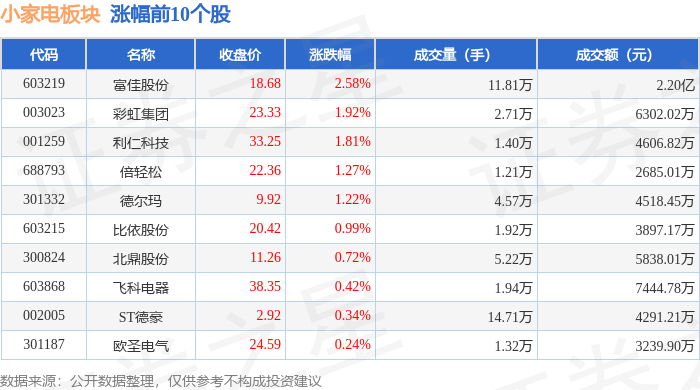
Group 1 - The small home appliance sector experienced a decline of 1.22% on January 30, with Hongzhi Technology leading the drop [1] - The Shanghai Composite Index closed at 4117.95, down 0.96%, while the Shenzhen Component Index closed at 14205.89, down 0.66% [1] - Notable gainers in the small appliance sector included Fujia Co., which rose by 2.58% to a closing price of 18.68, and Rainbow Group, which increased by 1.92% to 23.33 [1] Group 2 - The small home appliance sector saw a net outflow of 123 million yuan from main funds, while retail investors contributed a net inflow of 105 million yuan [2] - Key stocks with significant fund flows included Feike Shiqi, which had a main fund net inflow of 8.34 million yuan, and Delmar, which saw a net inflow of 6.38 million yuan [3] - Conversely, Hongzhi Technology experienced a main fund net inflow of 739,500 yuan, but also had a significant retail net inflow of 610,200 yuan [3]


当前时点如何看消费顺周期
2026-01-30 03:12
当前时点如何看消费顺周期?20260129 摘要 房地产市场:预计 2027 年接近底部,短期一线城市二手房成交量回升, 价格跌幅收窄,政策稳定预期,显示边际向好信号。关注未来超常规政 策如房贷结构性工具、公积金降息及城市更新货币化安置。 货币政策与流动性:央行维持低利率,定期存款到期或转向理财及权益 市场,活期存款增加,资金更易流入资本市场。地产板块持仓比例仅 0.4%,刷新历史新低,估值修复迅速。 财政政策与消费:财政支出倾斜社保民生等领域,多地发放消费券支撑 春节消费,1 月政府债同比多增,表明财政前置发力。2026 年一季度经 济量价预计整体提升。 通胀预期:春节临近及季节性因素致蔬菜、水果、白酒价格上涨,国际 金属价格上行推动 PPI 向 CPI 传导,预计 2026 年 CPI 中枢高于去年。 白酒板块持仓降至新低,有望迎来反弹。 消费品市场:大众品复苏节奏超前于白酒,连锁业态维持高景气,规模 效应提升利润率。调味品板块库存消化完毕,进入发货周期,餐饮供应 链复苏,经销商备货积极。 Q&A 当前如何看待消费顺周期的表现? 当前消费顺周期的表现主要受到几个因素的影响。首先,从地产层面来看,我 们总结 ...
10城覆盖、4小时送达!天猫联手50家电品牌开启“闪购时代”
Sou Hu Cai Jing· 2026-01-29 17:24
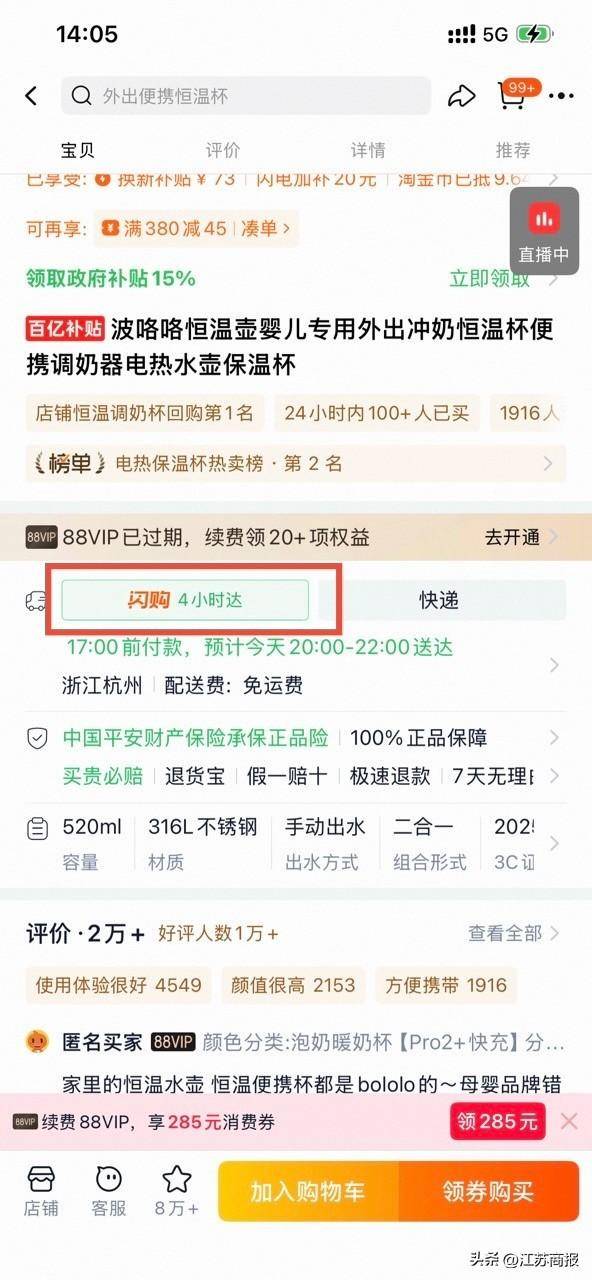
Group 1 - The Tmall New Year Festival offers significant discounts on home appliances, with official reductions starting at 8.8% and additional coupons available, allowing prices to drop to as low as 50% after combining various promotions [1] - Major home appliance brands such as Philips, Joyoung, Gree, Midea, Hisense, Siemens, and others are participating in the Tmall event, providing fast delivery services [1] - The "4-hour delivery" service is now available in ten major cities, including Shanghai, Guangzhou, and Beijing, enhancing consumer convenience and satisfaction [4] Group 2 - The integration of Tmall brands into Taobao Flash Sale reflects a growing trend in instant retail, with approximately 3,500 Tmall brands connecting their offline stores to the service [5] - The collaboration has resulted in a significant increase in consumer orders, with daily orders for instant retail on Tmall seeing a 198% month-over-month growth compared to September [5] - The fast delivery service has led to a notable increase in sales for participating brands, with some products experiencing over a 30% rise in sales due to improved logistics and delivery efficiency [4]

整个社会都在喊没钱了,为什么这些公司反而年赚百亿?
创业家· 2026-01-29 10:34
Core Viewpoint - The article emphasizes that despite the prevailing narrative of economic hardship, certain industries are thriving and generating significant profits, particularly in the context of Japan's "lost 30 years" and the evolving consumer behavior in China [3][4]. Group 1: Economic Shifts and Opportunities - The concept of a "low-desire society" does not equate to a lack of opportunities, as consumer demand is shifting towards different sectors [4]. - The article identifies eight key industries that are capitalizing on changing consumer preferences, highlighting that demand migration presents substantial business opportunities [5]. Group 2: Key Industries and Trends - **Second-Hand Economy**: The second-hand luxury market in Japan, exemplified by companies like Daikokuya, has seen a significant revenue increase. In China, platforms like Hongbulin and Panghu are experiencing similar growth [6][7]. - **Pet Economy**: With declining birth rates, spending on pets is rising, as seen with brands like Inaba in Japan and Guobao in China, indicating a robust market for pet products and services [12][13][14]. - **Adult Care**: The adult diaper market in Japan has surpassed $10 billion, showcasing the potential of the aging population as a lucrative economic segment [17][18]. - **Health Food and Beverages**: The rise in health consciousness has led to increased demand for products like sugar-free tea and functional beverages in both Japan and China [21]. - **Beauty and Aesthetics**: The beauty industry continues to thrive, with products like collagen supplements and home beauty devices gaining popularity, indicating a strong consumer focus on personal care [23][24][26]. - **Outdoor Recreation**: Companies in the outdoor equipment sector, such as Snow Peak in Japan, are profiting from the growing interest in outdoor activities, reflecting a shift in consumer spending priorities [29][31]. - **Convenience Economy**: The demand for convenience products, such as frozen foods and smart home appliances, is increasing as younger generations seek to save time in their daily routines [39][40]. - **Leisure and Experience Economy**: Consumers are willing to spend on experiences and small pleasures, indicating a dual trend of frugality and indulgence in spending [36][44].

小家电板块1月29日跌0.07%,鸿智科技领跌,主力资金净流出6188.49万元
Zheng Xing Xing Ye Ri Bao· 2026-01-29 09:03
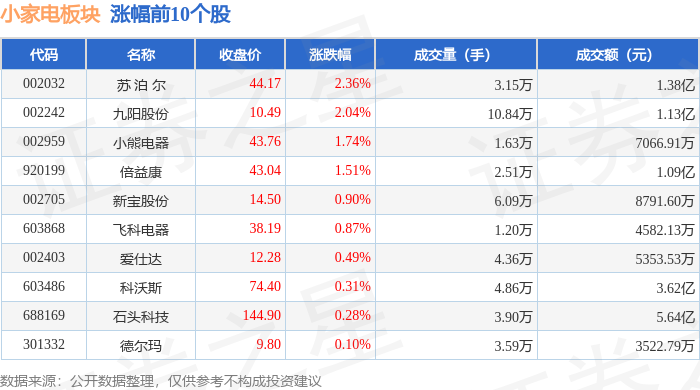
Group 1 - The small home appliance sector experienced a slight decline of 0.07% on January 29, with Hongzhi Technology leading the drop [1] - The Shanghai Composite Index closed at 4157.98, up 0.16%, while the Shenzhen Component Index closed at 14300.08, down 0.3% [1] - Notable gainers in the small home appliance sector included Supor, which rose by 2.36% to a closing price of 44.17, and Joyoung, which increased by 2.04% to 10.49 [1] Group 2 - The small home appliance sector saw a net outflow of 61.88 million yuan from institutional investors, while retail investors contributed a net inflow of 68.63 million yuan [2] - Key stocks with significant movements included Chicken Smart Technology, which fell by 6.06% to 18.61, and Lek Electric, which decreased by 4.71% to 32.55 [2] - The trading volume for the small home appliance sector was highlighted, with Supor achieving a transaction amount of 138 million yuan and Joyoung at 113 million yuan [1][2] Group 3 - In terms of capital flow, Fuhua shares saw a net inflow of 15.51 million yuan from institutional investors, while Supor experienced a net outflow of 13.78 million yuan [3] - The data indicates that retail investors were more active, with a net inflow of 6.86 million yuan across various stocks in the sector [2][3] - The overall market sentiment reflected a mixed performance, with some stocks like Supor and Joyoung attracting retail interest despite the overall sector decline [1][3]
中国定位专家顾均辉解析徕芬拓展困局:心智占位才是破局关键
Sou Hu Wang· 2026-01-29 08:09
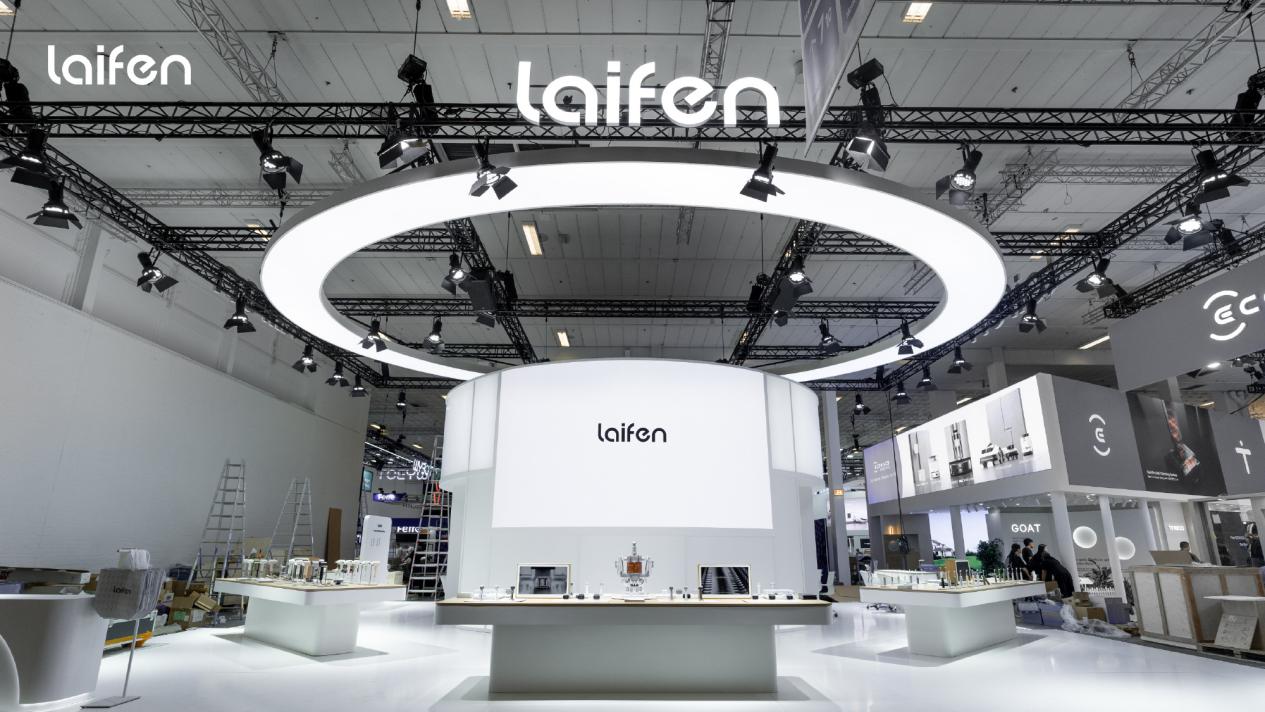
Core Insights - The domestic personal care appliance brand, Lefan Technology, is facing challenges due to obstacles in new category expansion and significant losses in its electric toothbrush business, raising industry concerns [1] - Lefan previously achieved rapid sales growth from 150 million yuan in 2021 to approximately 4.1 billion yuan in 2024 through its "high-speed hair dryer" but now struggles with a "substitute" label and a lack of diverse growth drivers [1] Strategic Positioning Issues - Strategic positioning expert Gu Junhui identifies that Lefan's current predicament stems from a deviation in strategic positioning; after initially entering the market as a "big brand substitute," it failed to build an independent brand identity, leading to limited growth [2] - The "substitute" positioning is a double-edged sword, providing short-term gains but posing long-term risks, as consumer choice is primarily driven by cost rather than brand value recognition [3][5] Market Competition and Risks - Lefan's brand recognition is heavily reliant on the leading brand, Dyson, and faces severe challenges as competitors like Mijia and Feike introduce low-cost high-speed hair dryers, threatening Lefan's market position [5] - The brand's attempts to extend into electric toothbrushes and shavers have not met expectations, indicating confusion in consumer perception and a lack of competitive differentiation in these new categories [6][7] Recommendations for Strategic Recovery - Gu Junhui suggests that Lefan should focus on solidifying its core category and upgrading its brand perception, moving away from the "Dyson substitute" label by enhancing core technology and establishing a trustworthy brand image [11] - Any new category expansion should adhere to the principle of mental synergy, ensuring that new products are closely related to the brand's established core recognition to avoid dilution [11] - The brand should concentrate on deepening its presence in the high-speed hair dryer market and related categories, aiming to become a leading brand in a specific niche rather than spreading resources too thin across multiple competitive markets [11][13]
押注AI与半导体等重点产业,珠三角多地市强化发展新动能
第一财经· 2026-01-29 05:41
Core Viewpoint - The article discusses the specific measures taken by various cities in the Pearl River Delta region to promote technological innovation and industrial upgrading, with a focus on artificial intelligence, robotics, and semiconductors as key areas of development [3]. Summary by Sections Focus on Core Industries - Guangzhou has included artificial intelligence and low-altitude economy in its "12218" modernization industrial system, planning to enhance the business environment and optimize resource allocation [5][6]. - The city aims to establish a unique artificial intelligence industrial ecosystem and develop significant platforms for low-altitude economy, including the construction of various manufacturing bases [6]. Industrial Development Plans - Dongguan is focusing on technology-driven industries, particularly artificial intelligence and robotics, while also emphasizing quality and brand development to enhance its manufacturing competitiveness [7]. - Huizhou plans to establish an artificial intelligence and robotics bureau and leverage its strengths in hardware manufacturing, with notable companies already leading in various sectors [7][8]. Collaborative Efforts - Shenzhen, Dongguan, and Huizhou are seeking collaboration in the field of artificial intelligence, with Shenzhen's mayor highlighting the establishment of a national AI application pilot base [8]. - Dongguan aims to connect high-end resources from Hong Kong and the Greater Bay Area to foster innovation and technological advancements [8]. Achievements in Technological Innovation - Shenzhen has reported significant growth in its industrial output, with strategic emerging industries like semiconductors and AI showing double-digit growth [11]. - Huizhou's "2+1" industrial layout has led to substantial achievements in petrochemical and electronic information sectors, with both industries exceeding trillion-yuan scales [11][12]. Future Industry Development - Zhuhai is focusing on emerging industries and plans to accelerate the development of AI and robotics, with a goal of achieving over 20% growth in these sectors by 2025 [12].

特斯拉Optimus机器人产能持续扩大,机器人ETF嘉实(159526)聚焦机器人产业发展机遇
Xin Lang Cai Jing· 2026-01-29 02:56
Group 1 - The core viewpoint of the news highlights the strong performance of the robotics sector, with the China Securities Robotics Index rising by 1.19% and key stocks like iFlytek increasing by 10% [1] - Tesla announced the launch of its third-generation humanoid robot, Optimus, aimed at mass production, with plans to replace production lines in its Fremont factory to achieve an annual output of one million robots [1] - Domestic developments include a strategic partnership between Zhongqing Robotics and Chuanxuezhe to initiate a humanoid astronaut exploration program, utilizing Zhongqing's PM01 intelligent agent [1] Group 2 - As of December 31, 2025, the top ten weighted stocks in the China Securities Robotics Index include iFlytek, Huichuan Technology, and others, accounting for 52.83% of the index [2] - The Jia Shi Robotics ETF closely tracks the China Securities Robotics Index, focusing on system solution providers, digital workshops, automation equipment manufacturers, and other robotics-related entities [2] - Investors without stock accounts can access the robotics industry through the Jia Shi Robotics ETF linked fund, providing opportunities for investment in the sector [3]

