
青岛啤酒

Search documents
百威喜力鏖战中国:啤酒生意,要重做一遍
2 1 Shi Ji Jing Ji Bao Dao· 2025-12-05 12:22
Core Insights - The Chinese beer market is undergoing significant changes, with local brands showing resilience and growth while international brands face challenges [2][3][5] - The industry is shifting from a focus on high-end products to a more diverse range of offerings, including lower-priced options and innovative flavors [31][37][38] Industry Overview - The beer industry in China has entered a phase of stock competition, with production levels at about 70% of their peak [3] - The latest statistics show a 1% year-on-year decline in beer production in October, with cumulative production growth for the first ten months at 0% [3] Brand Performance - Domestic brands like Tsingtao, Yanjing, and Zhujiang have reported growth in revenue, profit, and sales, while international brands like Budweiser and Carlsberg are experiencing declines [3][11] - Budweiser's performance in China has been disappointing, with a projected decline in revenue, profit, and sales for three consecutive years [11][12] Market Dynamics - The shift in consumer preferences has led to a decline in the night-time economy, affecting high-end brands that previously thrived in this channel [5][24] - Heineken has successfully leveraged local partnerships to expand its market presence, achieving significant sales growth in recent years [13][25] Strategic Initiatives - Budweiser is attempting to adapt by focusing on lower-priced products and expanding its presence in non-drinking channels [31][33] - Heineken's strategy includes entering various retail channels and enhancing its marketing efforts to resonate with local consumers [28][29] Consumer Trends - Chinese consumers are increasingly open to innovative beer flavors, with tea-infused beers gaining popularity [37][38] - The market is seeing a shift towards non-alcoholic and low-alcohol products, although these remain niche compared to traditional beer consumption [37][38]






西安推动“唐诗之都”建设 开拓千亿级文化经济新赛道
Zhong Guo Jing Ji Wang· 2025-12-05 06:41
Core Perspective - Xi'an is leveraging its rich cultural heritage, particularly its association with Tang poetry, to create a new economic growth engine worth hundreds of billions, aiming to establish an international-level Tang poetry cultural brand by 2025 [1][5]. Group 1: Cultural Resources and Initiatives - Xi'an possesses unique cultural resources with over 20,000 poems related to the city from the "Complete Tang Poems," including works by famous poets like Li Bai and Du Fu [2]. - The city has launched 26 specific tasks to promote the active transmission of Tang poetry culture, transforming it from mere historical documentation to living heritage [2]. - Major attractions like the Big Wild Goose Pagoda and the Tang Paradise are enhancing visitor experiences through immersive installations and sculptures that celebrate Tang poetry [2]. Group 2: Technological Integration and Consumer Experience - Digital technology is revitalizing tourism by transforming poetry consumption from passive observation to immersive participation, exemplified by the Qujiang Flying Theater, which offers a unique visual experience of Tang poetry [3]. - Nighttime economy initiatives, such as interactive poetry performances and themed products, are creating a comprehensive immersive experience that integrates cultural elements into consumer goods [4]. Group 3: Policy Framework and Development Strategy - Xi'an's government is implementing a systematic policy framework to build a Tang poetry IP ecosystem, with a three-year plan that includes cultural heritage protection, tourism integration, and brand development [5]. - The city plans to host the "Chang'an Lantern Festival" earlier in 2026, incorporating modern technology to create immersive experiences centered around Tang poetry [6]. Group 4: Economic Impact and Growth Projections - By the end of 2024, Xi'an's cultural and related industries are projected to achieve revenues of 81.29 billion yuan, marking a 2.6% year-on-year growth, laying a solid foundation for a cultural industry worth over 100 billion yuan [2]. - The city aims to enhance its cultural confidence and innovation-driven growth, contributing to the modernization and industrialization of traditional culture [6].
CBA新赛季增设潜力赛,开放15个招商品类
Zhong Guo Jing Ying Bao· 2025-12-02 08:04
Group 1 - The CBA League's 31st season will commence on December 12, with the regular season reduced from 46 to 42 rounds, aligning game rules more closely with FIBA standards [1][2] - A new "CBA Potential Match" will be introduced, allowing more young players to gain exposure and playing time, which is seen as beneficial for player development [2][3] - The trend towards youth is evident, with 62 out of 339 registered domestic players being first-time registrants, and 197 players born in the 2000s, making up 58% of the total [3][4] Group 2 - The core player mobility is increasing, with notable players like Zhao Rui and Zhang Zhenlin involved in trades, enhancing the quality of transactions [4] - The number of sponsors has decreased from 16 to 14, with some companies exiting and new ones entering, indicating a shift in sponsorship dynamics [4][5] - The league is opening 15 categories for club sponsorship rights, aiming to enhance commercial potential and brand value for clubs [5][6] Group 3 - Several teams have undergone name changes due to sponsorship updates, reflecting the ongoing trend of brand partnerships in the league [6][7] - Alcohol companies are prominent sponsors, with five teams in the CBA and three in the WCBA being sponsored by liquor brands, highlighting the marketing strategy of leveraging sports for brand recognition [6][7] - The future of sports marketing is expected to evolve towards deeper engagement and interaction, moving beyond simple sponsorships to more integrated marketing strategies [7]

中国必选消费品11月需求报告:所有品类增速均放缓
Haitong Securities International· 2025-12-01 11:31
Investment Rating - The investment rating for the essential consumer goods sector is "Outperform" for multiple companies including Kweichow Moutai, Wuliangye, and Yili [1] Core Insights - In November 2025, four out of eight monitored essential consumer sectors showed positive growth, while four experienced negative growth, with the growth sectors being condiments, frozen foods, soft drinks, and catering services [29] - The overall growth rates across all sectors have slowed compared to the previous month, attributed to macroeconomic conditions, structural industry challenges, and seasonal factors [29] Subsector Summaries Mid-to-High-End and Above Baijiu - Revenue for the mid-to-high-end and premium baijiu sector in November was RMB 24 billion, down 13.0% year-on-year, with cumulative revenue from January to November at RMB 349.2 billion, a decline of 6.2% [30] - The market is experiencing simultaneous declines in both volume and price, with a conservative consumer spending trend [30] Mass-Market and Below Baijiu - Revenue for the mass-market and lower-tier baijiu industry reached RMB 18.9 billion in November, marking a 3.3% year-on-year decline, with cumulative revenue from January to November totaling RMB 180.9 billion, down 8.5% [30] - The production of baijiu in October was 276,000 kiloliters, down 18.3% year-on-year, indicating a challenging market environment [30] Beer - The domestic beer industry generated revenue of RMB 9.9 billion in November, a 2.0% year-on-year decline, with cumulative revenue from January to November at RMB 162.6 billion, representing a 0.2% year-on-year increase [31] - Seasonal demand has decreased due to a nationwide temperature drop, leading to subdued overall demand [31] Condiments - The condiments sector reported revenue of RMB 418 billion in November, a year-on-year increase of 0.8%, with cumulative revenue from January to November at RMB 4,129 billion, up 1.3% [18] Frozen Foods - The frozen foods sector achieved revenue of RMB 81.6 billion in November, a year-on-year increase of 4.0%, with cumulative revenue from January to November at RMB 964 billion, up 2.2% [22] Soft Drinks - Revenue for the soft drinks sector was RMB 388 billion in November, a year-on-year increase of 2.1%, with cumulative revenue from January to November at RMB 6,583 billion, up 4.1% [24] Catering - The catering industry reported revenue of RMB 130.4 billion in November, a year-on-year increase of 0.3%, with cumulative revenue from January to November at RMB 1,607 billion, down 0.7% [26]




食品饮料行业周报:茅台股东会传递务实信号,月度金股推荐泸州老窖-20251130
Shenwan Hongyuan Securities· 2025-11-30 11:41
Group 1: Core Insights - The report indicates that the food and beverage sector is entering a strategic allocation period, particularly for high-quality companies, as the market is expected to reach a predictable bottom in the near future [2][6][8] - Key recommendations for the liquor sector include Luzhou Laojiao, Shanxi Fenjiu, Guizhou Moutai, and Wuliangye, while for consumer goods, the focus is on Yili, Qingdao Beer, Anjui Food, Qianhe Flavor Industry, Tianwei Food, and New Dairy [2][6][8] Group 2: Market Performance - The food and beverage sector saw a slight increase of 0.07% last week, with the liquor segment declining by 0.73%, underperforming the Shanghai Composite Index by 1.33 percentage points [5] - Moutai's bottle price is reported at 1570 RMB, down 80 RMB week-on-week, while the box price is 1580 RMB, down 85 RMB [7][30] Group 3: Industry Trends - The report highlights that the high-end liquor prices are declining, indicating a search for balance between volume and price in the market [6][7] - For the consumer goods sector, the core observation for 2026 is the Consumer Price Index (CPI), which is expected to improve gradually, leading to potential recovery for companies with pricing power [8][31] Group 4: Valuation Metrics - As of November 28, 2025, the food and beverage sector has a dynamic PE of 20.59x, with a premium rate of 28%, while the liquor sector has a dynamic PE of 19.35x, with a premium rate of 20% [31]


非白酒板块11月28日跌0.01%,青岛啤酒领跌,主力资金净流出1.21亿元
Zheng Xing Xing Ye Ri Bao· 2025-11-28 09:08
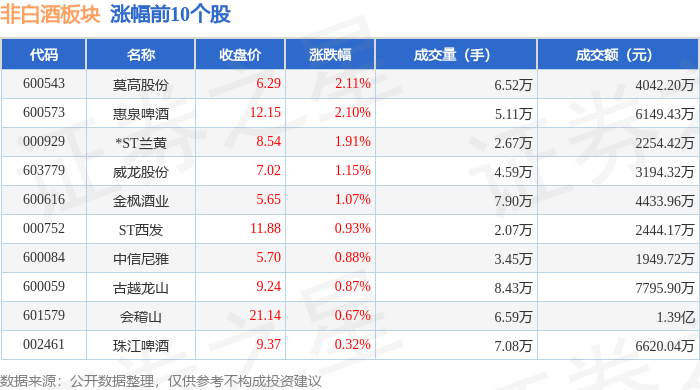
Core Viewpoint - The non-baijiu sector experienced a slight decline of 0.01% on November 28, with Qingdao Beer leading the drop, while the overall market indices showed positive movements [1] Market Performance - The Shanghai Composite Index closed at 3888.6, up 0.34% - The Shenzhen Component Index closed at 12984.08, up 0.85% [1] Non-Baijiu Sector Stock Performance - Notable gainers in the non-baijiu sector included: - Mogao Co., Ltd. (600543) with a closing price of 6.29, up 2.11% - Huichuan Beer (600573) at 12.15, up 2.10% - ST Lanhua (000929) at 8.54, up 1.91% - Weilang Co., Ltd. (603779) at 7.02, up 1.15% - Jinfeng Wine Industry (600616) at 5.65, up 1.07% [1] Capital Flow Analysis - The non-baijiu sector saw a net outflow of 121 million yuan from institutional investors - Retail investors contributed a net inflow of 78.65 million yuan, while speculative funds saw a net inflow of 42.59 million yuan [1]


食品饮料行业双周报(2025、11、14-2025、11、27):白酒筑底,关注结构性机会-20251128
Dongguan Securities· 2025-11-28 08:14
Investment Rating - The report maintains an "Overweight" rating for the food and beverage industry, indicating an expectation that the industry index will outperform the market index by more than 10% over the next six months [2][47]. Core Viewpoints - The white liquor sector is bottoming out, with a focus on structural opportunities. The report anticipates continued pressure on sales in the white liquor market through Q4 of this year and Q1 of next year, with a potential recovery in Q2 of next year due to a low base effect. The report suggests monitoring high-end liquor brands like Kweichow Moutai and other regional brands for investment opportunities [2][44]. - The report highlights a mixed performance across various segments within the food and beverage industry, with certain sectors like snacks and soft drinks showing potential growth driven by key products and channel contributions [2][44]. Summary by Sections 1. Market Review - The SW food and beverage industry index decreased by 2.97% from November 14 to November 27, 2025, outperforming the CSI 300 index by approximately 1.00 percentage points [9][11]. - Most sub-sectors underperformed the CSI 300 index during the same period, with the dairy sector showing the smallest decline of 0.11% [11][12]. - Approximately 6% of stocks in the industry recorded positive returns, with notable gainers including Hai Xin Food (+11.34%) and Nan Qiao Food (+7.86%) [13][14]. - The industry valuation is currently below the five-year average, with a PE ratio of approximately 21.3 times, compared to the historical average of 32 times [15]. 2. Key Industry Data Tracking 2.1 White Liquor Sector - The report notes a decline in the prices of premium liquor brands, with the price of Feitian Moutai at 1590 RMB per bottle, down 50 RMB from the previous period [17]. 2.2 Seasoning Sector - Prices for soybean meal increased, while white sugar and glass prices decreased. The price of white sugar fell to 5470 RMB per ton, a decrease of 290 RMB [22]. 2.3 Beer Sector - The average price of barley decreased to 2195 RMB per ton, while the price of aluminum ingots increased slightly [27]. 2.4 Dairy Sector - The average price of fresh milk remained stable at 3.03 RMB per kilogram [34]. 2.5 Meat Products Sector - The average wholesale price of pork decreased to 18.07 RMB per kilogram, reflecting a year-on-year decline of 22.88% [36]. 3. Industry News - The report mentions a 4.1% year-on-year growth in retail sales of tobacco and alcohol for October 2025, indicating a positive trend in consumer spending [39]. - The report also highlights a 16.1% increase in beer exports for the first ten months of 2025, suggesting a growing international demand [40]. 4. Company Announcements - Yili Group announced a shareholder return plan for 2025-2027, committing to a cash dividend of no less than 75% of the net profit attributable to shareholders [43]. 5. Weekly Industry Perspective - The report emphasizes the importance of monitoring economic recovery and distributor confidence in the white liquor sector, while also suggesting investment in high-quality brands and sectors benefiting from policy support [44][45].


【2025美好生活高峰论坛】华创证券食品饮料首席分析师欧阳予:解码新消费浪潮下的食品饮料行业变革与机遇
Sou Hu Cai Jing· 2025-11-28 07:11
Group 1 - The forum focused on high-quality and upgraded consumption in the Chinese market, aiming for a healthier and more sustainable future [2] - The chief analyst from Huachuang Securities provided insights into the evolution of the Chinese consumer market and structural opportunities in the food and beverage industry [3][8] - New consumption trends are reshaping market dynamics, with a focus on personalized and emotional consumption, as seen in the rise of trendy toys and pet-related products [8] Group 2 - The food and beverage industry is experiencing three major trends: the rise of functional foods driven by economic development and aging population, diversification in alcoholic beverages, and the standardization of restaurant supply chains [10][11] - Functional foods are becoming increasingly popular, with innovations in product forms such as functional gummies and drinks, indicating a growing market for health-oriented products [10] - The alcoholic beverage market is shifting towards lighter drinks, with whiskey and yellow wine gaining traction, reflecting changing consumer preferences [10][11] Group 3 - The evolution of the Chinese consumer goods market over the past 40 years can be divided into four stages, highlighting the transition from basic consumption to quality demands and the current era of personalized and functional consumption [9] - The restaurant industry is undergoing a transformation, with a focus on chain standardization and the survival of efficient restaurant chains following a period of volatility [11] - The insights shared at the forum indicate that the food and beverage industry is on the brink of a golden development period, driven by continuous consumption upgrades and industry innovations [11]
安永:预计港股全年超百股上市|首席资讯日报
首席商业评论· 2025-11-28 04:08
2.市场监管总局召开2025年第五次企业公平竞争座谈会 11月27日,市场监管总局召开2025年第五次企业公平竞争座谈会,围绕"促进公平竞争,优化营商环境"主 题,与三星、宝马、强生、拜耳、正大、宝洁、宜家等外资企业深入交流,听取意见建议。 1.安永:预计港股全年超百股上市,融资额2800亿港元 11月27日,安永发布2025年《中国内地和香港IPO市场回顾及展望》报告。报告指出,A股和香港市场全年 IPO数量和筹资额占全球总量的16%和33%。其中,A股市场整体稳中有进,港交所融资额位居全球交易所 榜首,预计全年港股上市新股数量超百只,融资额2800亿港元。报告显示,大型IPO项目上市成为推动港股 崛起的关键因素,其中来自A股的"A+H"及"A拆H"企业贡献突出,全年预计超过20家A股公司在港首发上 市,合计募资超过1700亿港元。 点评:港股IPO回暖,融资寒冬现暖流。 6.马云公益基金会捐赠3000万港元驰援香港 香港大埔突发火灾,许多家庭突遭变故痛失亲人令人心痛,马云公益基金会将紧急捐赠3000万港元,向受 灾家庭和个人提供经济援助,向冒着生命危险英勇救火的消防员和应急人员,及其家庭提供帮助。 7.证 ...
青岛啤酒拟使用最高100亿元认购理财 维珍妮上半财年盈利同比翻倍
Xin Lang Cai Jing· 2025-11-27 12:40
Performance Summary - Virginie (02199.HK) reported revenue of HKD 3.84 billion for the six months ending September 30, 2025, a decrease of 3.45% year-on-year; net profit increased by 114.25% to HKD 145 million [1] - Huagang United (01001.HK) achieved revenue of HKD 1.023 billion, up 3.34% year-on-year; profit decreased by 3.64% to HKD 52.9 million [1] - Disen Creation (00113.HK) reported revenue of HKD 973 million, a year-on-year increase of 1.2%; net profit rose by 14.02% to HKD 150 million [1] - Sanhe Construction Group (03822.HK) generated revenue of HKD 470 million from customer contracts, a 20.8% increase year-on-year; net profit surged by 1364.7% to HKD 47.41 million [1] - Bojun Education (01758.HK) reported revenue of HKD 379 million for the year ending August 31, 2025, a decrease of 11.9%; losses increased by 227.6% to HKD 130 million [1] - Jiahua Holdings (00064.HK) reported revenue of HKD 172 million, down 21.01% year-on-year; profit increased by 57.59% to HKD 49.51 million [2] - Tiande Real Estate (00266.HK) reported revenue of HKD 152 million, a decrease of 2.5%; losses narrowed by 72.9% to HKD 75.43 million [3] - Kairun International Hotel (00105.HK) reported revenue of HKD 148 million, down 2.34%; losses decreased by 69.77% to HKD 148 million [4] - Safe Warehouse (00237.HK) reported revenue of HKD 84.1 million, down 9.97%; the company recorded a loss of HKD 17.56 million, shifting from profit to loss [4] Company News - Xinchen Power (01148.HK) established a strategic alliance with Sichuan Hongpeng Aerospace Equipment Intelligent Manufacturing in the field of aviation piston engines [5] - Qingdao Beer Co., Ltd. (00168.HK) plans to engage in wealth management investment activities with a maximum single-day balance of RMB 10 billion over the next 12 months [5] - Junshi Biosciences (01877.HK) plans to use up to RMB 2.4 billion of temporarily idle raised funds for cash management [5] - China Anshun Energy (02399.HK) signed a memorandum of understanding with Guo Heng for further investment and participation in energy-related projects [6] - Yanzhou Coal Mining (01171.HK) subsidiary plans to acquire 100% equity of a high-end support company for HKD 345 million [7] - Beijing Qingniao Huanyu (08095.HK) intends to invest approximately HKD 130 million to acquire the remaining 30% equity of Shanghai Shengjin Venture Capital Co., Ltd., focusing on new materials, energy conservation, and high-end equipment manufacturing [7] Financing and Buyback Activities - China Smart Technology (00464.HK) completed the issuance of a total of 11.7 million shares, raising approximately HKD 10.3 million [8] - Tencent Holdings (00700.HK) repurchased 1.036 million shares for HKD 636 million, with repurchase prices ranging from HKD 609 to HKD 620 [9] - China Petroleum & Chemical Corporation (00386.HK) repurchased 9.01 million shares for HKD 40.2765 million, with repurchase prices between HKD 4.42 and HKD 4.52 [10] - China Feihe (06186.HK) repurchased 4 million shares for HKD 16.6763 million, with repurchase prices ranging from HKD 4.12 to HKD 4.23 [10]
