吉利汽车

Search documents
昆仑芯以“保密形式”赴港IPO 百度持股价值或超200亿美元
Zheng Quan Ri Bao Wang· 2026-01-04 13:46
事实上,昆仑芯并非横空出世的新玩家。其前身百度智能芯片及架构部自2011年起布局AI芯片,2021年4月份完成首轮融 资并独立运营,首轮估值即达130亿元。截至2025年7月份,公司已完成7轮融资,最新一轮D轮募资2.83亿美元,投后估值攀升 至29.7亿美元(约合210亿元人民币)。四年多时间,估值增长61.5%。 本报记者 袁传玺 2026年1月2日,百度集团股份有限公司(以下简称"百度")发布公告显示,百度旗下AI芯片子公司——昆仑芯(北京)科 技股份有限公司(以下简称"昆仑芯")已于2026年1月1日透过其联席保荐人以保密形式向香港联交所提交上市申请表格(A1表 格),申请批准昆仑芯于香港联交所主板上市及买卖。 "当前正是AI芯片行业的战略窗口期。"广州艾媒数聚信息咨询股份有限公司CEO张毅对《证券日报》记者表示,全球大模 型军备竞赛催生了对高性能、高能效AI算力的刚性需求,而政策端对硬科技企业的持续支持,也为昆仑芯这样的核心基础设施 企业提供了绝佳的上市时机。 受IPO消息刺激,百度港股股价于1月2日大涨9.35%,收报143.8港元/股,总市值达3955亿港元。 抢占AI芯片战略窗口期 尽管市场早 ...
2026年汽车以旧换新政策发布
Dong Zheng Qi Huo· 2026-01-04 13:43
1. Report Industry Investment Rating No information provided in the given content. 2. Core Viewpoints of the Report - China's new energy vehicle market penetration has rapidly increased in the past few years, exceeding 50% in 2025. In 2025, the domestic market shifted to "anti - involution", and exports gradually became a new growth point [3][122]. - Considering the overseas market trade environment, trade protectionism in Europe and the United States is severe, while countries along the Belt and Road and the Middle East have good development prospects. Regarding the development of the overseas new energy vehicle market itself, the development space of new energy vehicles in non - US regions is generally optimistic [3][122]. - In terms of the competition pattern, the market share of self - owned brands continues to expand. Enterprises with strong product capabilities, smooth overseas expansion, and high supply stability will be the core beneficiaries [3][122]. 3. Summary According to Relevant Catalogs 3.1 Financial Market Tracking - The report shows the one - week price changes of related sectors and listed companies, including the closing prices and one - week price change percentages of many vehicle manufacturers and power battery and material companies [12][15]. 3.2产业链数据跟踪 3.2.1 China New Energy Vehicle Market Tracking - **Sales and Exports**: Information on China's new energy vehicle sales, penetration rate, domestic sales, and exports is presented through relevant charts [16][18][20]. - **Inventory Changes**: Charts show the monthly new additions of new energy passenger vehicle channel inventory and manufacturer inventory [25][26]. - **Delivery Volume of Chinese New Energy Vehicle Enterprises**: The monthly delivery volumes of many new energy vehicle companies such as Leapmotor, Li Auto, XPeng, and NIO are presented [29][30][35]. 3.2.2 Global and Overseas New Energy Vehicle Market Tracking - **Global Market**: Charts show global new energy vehicle sales, penetration rate, and sales of EV and PHV [40][41][43]. - **European Market**: Information on European new energy vehicle sales, penetration rate, and sales of EV and PHV in countries like the UK, Germany, and France is presented [45][46][51]. - **North American Market**: Charts show North American new energy vehicle sales, penetration rate, and sales of EV and PHV [59][60][62]. - **Other Regions**: Information on new energy vehicle sales, penetration rate, and sales of EV and PHV in regions like Japan, South Korea, and Thailand is presented [63][64][67]. 3.2.3 Power Battery Industry Chain - Information on power battery loading volume (by material), export volume (by material), weekly average price of battery cells, and costs of cell materials is presented. It also includes data on the operating rates and prices of various battery materials such as ternary materials, phosphoric acid iron lithium, and negative electrode materials [79][81][84]. 3.2.4 Other Upstream Raw Materials - The daily prices of rubber, glass, steel, and aluminum are presented [100][101][102]. 3.3 Hot News Summaries 3.3.1 Industry Dynamics: China - In 2026, the implementation details of the car trade - in subsidy were introduced. The subsidy method changed from fixed - amount subsidy to subsidy based on the proportion of the new car's selling price, with the subsidy cap remaining unchanged [107]. - Four departments including the Ministry of Industry and Information Technology jointly issued the "Implementation Plan for the Digital Transformation of the Automobile Industry", proposing two - stage development goals and six key tasks [109]. - According to the Passenger Car Association, from December 1 - 28, the new energy retail sales increased by 5% year - on - year, and the cumulative retail sales since this year increased by 18% year - on - year [110]. 3.3.2 Enterprise Dynamics - BYD's sales in December 2025 were 420,398 vehicles. In 2025, its annual sales of pure - electric vehicles exceeded Tesla's for the first time, ranking first globally [112]. - Geely Auto's sales in December 2025 were 236,817 vehicles. It announced a sales target of 3.45 million vehicles in 2026 [113][115]. - Chery Group's sales in December 2025 were 244,928 vehicles. In 2026, it aims to have a sales growth rate 10 - 20 percentage points higher than the industry average [116][118]. - Xiaomi Auto's delivery volume in December 2025 exceeded 50,000 vehicles, and its delivery target in 2026 is 550,000 vehicles. It also plans to launch four new models in 2026 [119]. 3.4 Industry Views - From December 1 - 28, 2025, the retail growth rate of the domestic passenger car market was - 17%, and the new energy growth rate was + 5%. As of December 28, 2025, the cumulative annual growth rates were 4% and 18% respectively. Self - owned brands such as BYD and Geely remained strong, and exports became a new growth point [120]. - The US new energy vehicle market declined in November 2025, while the European and other regions showed growth. Overall, the development space of new energy vehicles in non - US regions is optimistic [121]. 3.5 Investment Suggestions - China's new energy vehicle market penetration rate has rapidly increased, and exports have become a new growth point. Non - US regions have good development prospects, and self - owned brands with certain advantages will be the core beneficiaries [122].

汽车行业周报:2026年汽车以旧换新国补延续,比亚迪超越特斯拉成为纯电汽车全球销冠-20260104
KAIYUAN SECURITIES· 2026-01-04 13:43
Investment Rating - The industry investment rating is "Positive" (maintained) [1] Core Views - The automotive sector is expected to experience a bottom recovery due to the implementation of the vehicle trade-in policy in 2026, with BYD surpassing Tesla to become the global sales champion for pure electric vehicles [5][16] - The domestic automotive market saw significant sales growth in 2025, with BYD leading with 4.6 million units sold, a 8% increase year-on-year [5][16] - The report highlights the competitive landscape, with new energy vehicle sales driving market growth, particularly for companies like BYD and NIO [5][16] Industry News - In 2025, BYD sold 4,602,436 vehicles, maintaining its position as the top seller, while new entrants like Leap Motor and Xiaomi also showed strong sales growth [5][13] - Tesla's 2025 delivery data revealed nearly 1.64 million vehicles delivered, with a 8.6% decrease compared to the previous year [14][16] - NIO has expanded its battery swap network, aiming to build 1,000 new battery swap stations by 2026 [15] - The lithium battery industry is experiencing price increases, with demand for energy storage batteries remaining high [18] - The 2026 vehicle trade-in policy will adjust subsidies based on vehicle price, with a maximum subsidy of 20,000 yuan [19] Market Performance - The automotive sector outperformed the market with a 1.49% increase, ranking fifth among A-share industries [6][28] - The passenger vehicle index saw a decline of 1.20%, while the automotive parts index increased by 3.63% [6][28] - The report indicates a decrease in PE ratios for passenger and commercial vehicle sectors, while the automotive parts sector saw a 12% increase in PE ratios [10][12] Investment Recommendations - For passenger vehicles, the report recommends companies like JAC Motors and Seres, with beneficiaries including Geely [7] - In the automotive parts sector, companies such as Desay SV and Zhejiang Xiantong are recommended, with beneficiaries including Weichai Power and Huayu Automotive [7]
比亚迪首次全年反超特斯拉,全球纯电王座易主
3 6 Ke· 2026-01-04 12:54
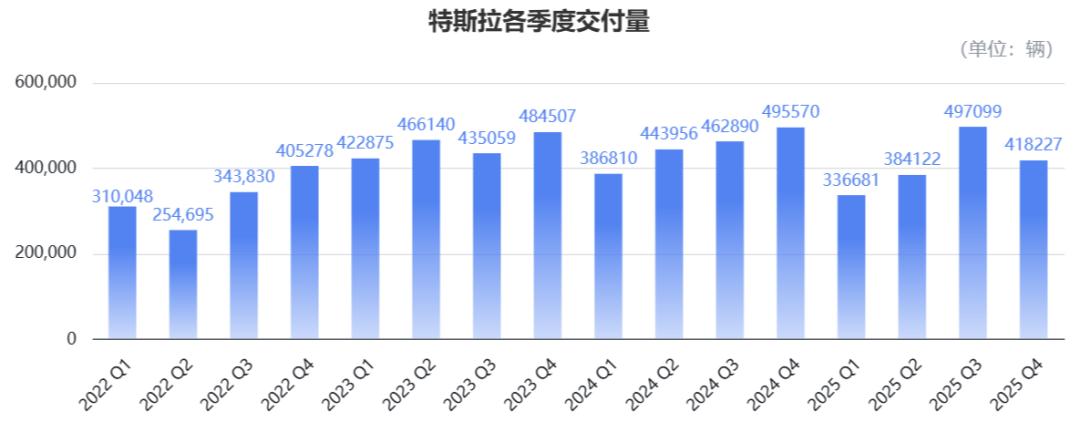
Core Insights - The global electric vehicle sales leader has shifted from Tesla to BYD, marking a significant change in the market dynamics [1][2][12] - Tesla's sales in 2025 declined, with a total of 1.655 million vehicles sold, a 9% year-over-year decrease, while BYD's sales reached 2.257 million, a 27.9% increase [7][12] Group 1: Tesla's Performance - In Q4 2025, Tesla delivered 418,227 vehicles, a 16% decline year-over-year, with Model 3/Y accounting for 406,585 units [2][5] - The decline in Tesla's sales was anticipated due to the expiration of U.S. tax incentives, leading to a surge in Q3 deliveries [5][10] - Tesla's total sales for 2025 were 1.655 million vehicles, down from 1.8086 million in 2023, marking a second consecutive year of decline [7][10] Group 2: BYD's Growth - BYD's total sales for 2025 reached 4.6 million vehicles, a 7.73% increase, with pure electric vehicle sales at 2.257 million, representing a 27.9% increase [12][24] - BYD's overseas sales surged by 145%, contributing to 22.8% of total sales [24] - This marks the first time BYD has topped the global sales chart for pure electric vehicles, surpassing Tesla's 1.636 million units [12][13] Group 3: Market Dynamics and Competitors - The competition in the electric vehicle market is intensifying, with Chinese automakers gaining significant market share [16][42] - Other notable performers include Xpeng, which saw a 125.9% increase in sales, and Li Auto, which faced an 18.8% decline [20][35] - The overall landscape indicates a shift towards a more diversified and competitive market, moving away from Tesla's previous dominance [42]


汽车事件点评:以旧换新政策落地,看好2026Q1乘用车需求修复
Guohai Securities· 2026-01-04 12:25
Investment Rating - The industry investment rating is "Recommended" (maintained) [1] Core Insights - The implementation of the new national subsidy policy for vehicle replacement is expected to boost passenger car demand in Q1 2026 [2][6] - The report indicates that the adjustment of subsidies from fixed amounts to percentage-based will likely enhance the proportion of mid-to-high-end passenger cars [6][7] - The continuation of subsidies for scrapping old commercial vehicles is expected to stabilize market confidence and potentially exceed expectations for heavy truck demand in 2026 [7] Summary by Sections Industry Performance - The automotive sector showed a performance increase of 5.7% over the last month, a decrease of 3.2% over the last three months, and a significant increase of 24.2% over the last year [3] Policy Impact - The new subsidy policy for 2026 includes support for scrapping and replacing vehicles, with specific subsidies for purchasing new energy vehicles and fuel-efficient cars [6] - The maximum subsidy for purchasing new energy vehicles is 12% of the vehicle price (up to 20,000 yuan), while for fuel-efficient cars, it is 10% (up to 15,000 yuan) [6] Market Outlook - The report suggests that the automotive industry will continue to see opportunities in high-end self-owned brands and the acceleration of smart technology integration [7] - Recommended companies include Jianghuai Automobile, Great Wall Motors, Geely, BYD, BAIC Blue Valley, and SAIC Group [7] - The report also highlights potential growth in the heavy truck sector, with expected sales of over 86,000 units in 2026 [7]
全球棋盘上的中国车:不只卖车,更要“造局”
3 6 Ke· 2026-01-04 11:54
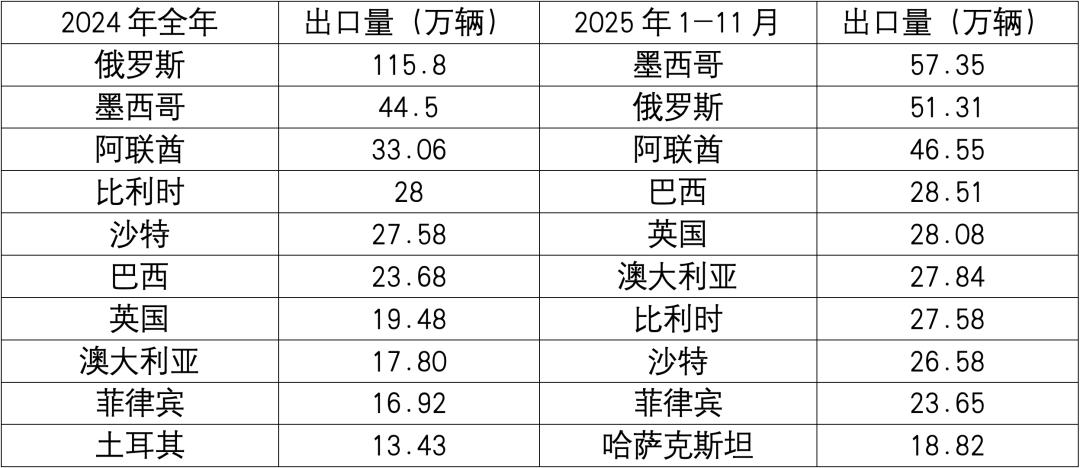
Core Insights - In 2025, China's automobile exports demonstrated resilience and vitality amidst challenges, with total exports reaching 7.33 million units from January to November, a year-on-year increase of 25%, and an expectation to exceed 8 million units for the entire year [1] Group 1: Market Dynamics - The Russian market, previously the largest for Chinese automobile exports, saw a dramatic decline, with exports dropping to 513,000 units from January to November 2025, a 50% year-on-year decrease, causing it to fall to the second position [2][3] - In contrast, the European market experienced significant growth, with Chinese brand car sales in Europe reaching 78,358 units in November 2025, a 108% increase year-on-year, resulting in a market share of 7.4% [3] - Mexico emerged as the largest single market for Chinese automobile exports, with 573,500 units exported, while the UAE ranked third with 465,500 units [4] Group 2: Structural Changes in Exports - The export structure is shifting, with a notable increase in the export of new energy vehicles (NEVs), which reached 3.01 million units from January to November 2025, a 62% increase year-on-year, and plug-in hybrid electric vehicles (PHEVs) accounting for 13% of total exports, up 8 percentage points [6] - The growth of PHEVs is attributed to their suitability for diverse markets, particularly in regions where charging infrastructure is still developing [6] Group 3: Localization and Ecosystem Development - Chinese automakers are transitioning from merely exporting vehicles to establishing local manufacturing and supply chains, with companies like BYD investing in local production facilities in Europe and Southeast Asia [9][10] - The number of Chinese automotive parts companies in Thailand has surged from approximately 48 in 2017 to 165 by March 2025, indicating a growing industrial cluster [9] Group 4: Challenges Ahead - Despite strong export figures, Chinese automakers face significant challenges in brand recognition and service networks in established markets like Europe, where consumer preference remains heavily skewed towards local brands [11][12] - In Southeast Asia, entrenched Japanese brands dominate the market, making it difficult for Chinese brands to gain a foothold despite rapid growth in electric vehicle sales [12][14] - The reliance on imported components for local production in markets like Thailand poses risks to customer satisfaction and operational efficiency [14]
过会≠过关、被BYD卷价格更卷账期的维通利应对毛利率下滑已采取措施
Xin Lang Cai Jing· 2026-01-04 11:30
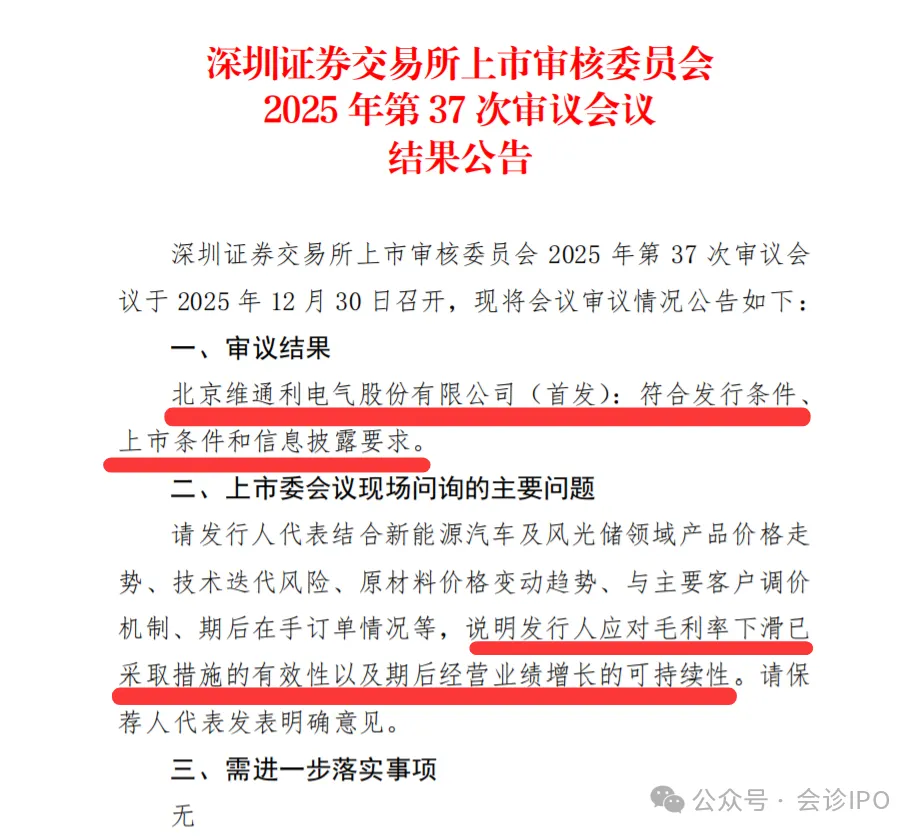
Core Viewpoint - The company, Beijing Weitongli Electric Co., Ltd., is facing significant challenges despite being recognized as a leader in the domestic electric connection industry. Key issues include declining gross margins, negative cash flow, and increasing accounts receivable, raising concerns about the sustainability of its growth and operational performance [3][35]. Group 1: Financial Performance and Cash Flow - The company reported a negative operating cash flow of -43.3688 million yuan in the first half of 2025, contrasting sharply with a net profit of 139 million yuan during the same period [4][35]. - The ratio of cash received from sales to operating income has declined from 0.84 in 2022 to 0.70 in 2024, indicating worsening cash flow management [4][35]. - The net cash flow from operating activities decreased from 163 million yuan in 2023 to 103 million yuan in 2024, ultimately turning negative in the first half of 2025 [4][35]. Group 2: Accounts Receivable and Collection Issues - As of the end of 2024, the company's accounts receivable reached 948 million yuan, accounting for 42.04% of its revenue, with a growth rate of 61.35%, significantly outpacing the revenue growth of 40.72% [38][39]. - The accounts receivable turnover rate is 2.92 times per year, below the industry average of 3.31 times, indicating slower collection of payments compared to peers [39]. - The company acknowledges that its customers in the new energy vehicle sector primarily use six-month bank acceptance bills or digital accounts receivable certificates for payments, extending the actual cash collection period [41][39]. Group 3: Product Pricing and Profitability - The company's most profitable product, the synchronous decomposer, has seen its average selling price plummet from 49.70 yuan per unit in 2022 to 17.93 yuan per unit in the first half of 2025, a decline of over 60% [44][43]. - The gross margin for the synchronous decomposer has decreased from 61.14% to 50.69% during the same period, reflecting increased pricing pressure [44][43]. - The gross margin for electric connection products in the new energy vehicle sector has also narrowed, dropping from 15.24% in 2022 to 12.05% in the first half of 2025 [45][44]. Group 4: Internal Control and Governance Issues - The company has faced seven administrative penalties from May 2023 to October 2025, raising concerns about its internal control systems [47][46]. - Issues have been identified regarding the timely recovery and proper storage of customer delivery and logistics receipts, leading to significant revenue losses [48][49]. Group 5: Ownership Structure and Related Party Transactions - The company's ownership structure is highly concentrated, with the actual controller, Huang Haoyun, directly and indirectly controlling 68.33% of the voting rights, and family members controlling a total of 85.51% [50][51]. - The fairness and necessity of related party transactions are under scrutiny, as the company has procured external processing services from a related entity, Tongda Yongli, amounting to 128 million yuan from 2022 to the first half of 2025 [52][51]. Group 6: Legal Risks and Intellectual Property Issues - The company is currently involved in two lawsuits concerning trade secret infringement, which could adversely affect its operations if unfavorable judgments are rendered [53][54]. - The company has acknowledged that adverse rulings could negatively impact its financial performance [56][55]. Group 7: Research and Development Concerns - The company obtained high-tech enterprise status in October 2024, but the proportion of R&D personnel has consistently been below 10%, raising questions about the sustainability of this qualification [58][59]. - The company holds 181 authorized patents, with only 18 being invention patents, indicating a need for increased investment in R&D [59][58].
我们该怎样记住2025年的中国汽车?
Xin Lang Cai Jing· 2026-01-04 11:30
Core Insights - The Chinese automotive industry has undergone a significant transition in 2025, moving towards the popularization of electrification and the acceptance of safety and responsibility in intelligent driving, while the focus has shifted from expansion to efficiency, governance, and organizational capability [2][69]. Group 1: Industry Competition and Regulation - The Chinese automotive sector has seen a comprehensive intervention from the government to restore competitive order, addressing issues like price wars and production consistency [4][70]. - The intervention marks a shift from merely addressing price control to tackling the root cause of competition, which is the high degree of product and capability homogeneity among companies [6][73]. - The need for differentiation in competition is emphasized, suggesting that true market differentiation must be established to eliminate the cycle of homogeneous competition [9][75]. Group 2: State-Owned Enterprise Reform - The establishment of a new state-owned enterprise, Changan Automobile, marks a significant reform in the state-owned automotive sector, indicating a shift from scale and form to mechanisms and efficiency [10][14]. - The reform aims to enhance the capabilities of state-owned enterprises, focusing on creating irreplaceable advantages in key areas [12][14]. - The changes in state-owned enterprises reflect a broader trend towards efficiency and capability building in the face of new industry challenges [15][64]. Group 3: Intelligent Driving and Safety - The rapid adoption of intelligent driving technologies has led to a shift in focus from technical capabilities to safety and responsibility, with companies facing increased scrutiny over their marketing practices [16][18]. - A significant traffic accident in March 2025 highlighted the urgent need for clear definitions of responsibility and safety standards in intelligent driving [18][21]. - Companies like Geely are taking proactive steps to enhance safety standards, indicating a broader industry trend towards building safety as a core competency [21][23]. Group 4: Globalization and Market Dynamics - The Chinese automotive industry is increasingly viewed as a key player in global market dynamics, with companies recognizing the need for localized manufacturing and long-term partnerships abroad [44][46]. - The shift from merely exporting products to establishing a presence in foreign markets reflects a deeper understanding of the complexities of global trade [44][46]. - The evolving landscape of international relations, particularly between China and the West, is reshaping how Chinese automotive companies approach global expansion [43][48]. Group 5: Capital Market Engagement - The surge of Chinese automotive companies seeking IPOs in Hong Kong indicates a strategic reassessment of capital and risk in light of global market changes [56][58]. - The focus on stable cash flow and clear profit models is becoming essential as the industry transitions into a phase of stock competition and technological differentiation [56][58]. - The choice of Hong Kong for IPOs reflects a desire for regulatory stability and alignment with global standards, enhancing transparency and governance [58][61]. Group 6: Industry Consolidation and Efficiency - A trend of strategic consolidation is emerging, with companies prioritizing resource concentration and efficiency over brand proliferation [66][66]. - Major global automakers are also reducing operations and focusing on core competencies, indicating a broader industry recognition that scale alone may not ensure safety in a volatile market [66][66]. - The end of the expansion phase in the automotive industry signals the beginning of a more competitive environment that tests endurance, efficiency, and organizational capabilities [66][66].



盘点自主五强的2025,哪家增长最有含金量?
Xin Lang Cai Jing· 2026-01-04 11:29
尖子生就要比学赶超! 编辑:梅梅 回顾2025年,自主五强销量均有增长。 比亚迪460万辆,吉利302万辆,长安超290万辆,奇瑞280万辆,长城132万辆——哪家的增长最有含金量? 比亚迪继续稳坐NO.1宝座,拿下三冠王:中国汽车市场车企销量冠军、中国汽车市场品牌销量冠军、全球新能源车市场销量冠军。值得关注的是,比亚 迪2025年海外出口已超百万台,同比增长145%,直追"出口一哥"奇瑞。2025年,奇瑞出口销量为134.4万辆。 超额完成2025全年任务后,吉利已放出2026年目标:全年销量冲击345万辆,新能源目标为222万辆。过去两年,吉利集团都在年中宣布上调销量目标—— 有理由相信,345万辆只是吉利2026的保底? 作为自主五强中的唯一央企,长安汽车2025销量创九年新高,总销量超290万辆,同比增长8.5%,连续6年实现同比正增长。长城汽车整体销量虽不及前 面四强,但132万辆仍创下历史新高。 头部的较量,犹如尖子生的"比学赶超",没一个孬的! 2026年,你觉得自主五强中,哪家更有后劲呢? 尖子生就要比学赶超! 编辑:梅梅 回顾2025年,自主五强销量均有增长。 比亚迪460万辆,吉利302万 ...

CES 2026前瞻:英伟达或重塑物理AI,中美韩机器人齐“秀肌肉”
美股研究社· 2026-01-04 11:22
Core Viewpoint - The 2026 Consumer Electronics Show (CES) is anticipated to showcase significant advancements in technology, particularly in AI, robotics, and consumer electronics, with a focus on cost reduction and efficiency improvements [7][10]. Group 1: Chip Industry Strategies - NVIDIA is shifting its focus away from traditional consumer graphics cards, emphasizing "Physical AI" to extend AI computing capabilities into robotics and industrial applications, with potential delays in the RTX 50 Super series due to high GDDR7 memory prices [8][14]. - AMD is adopting a steady upgrade strategy, planning to launch the Ryzen 9000 series for desktops and Ryzen AI 400 series for mobile devices, targeting workstation users with advanced features [14]. - Intel is set to release the Core Ultra Series 3, which includes approximately 14 SKUs, with the flagship model featuring 16 cores and a maximum frequency of 5.1GHz, aiming to regain market confidence in its advanced manufacturing capabilities [14]. Group 2: Robotics and AI Developments - 2026 is seen as a pivotal year for humanoid robots, with a focus on practical applications and real-world testing [10]. - The competition among countries in robotics is intensifying, with China focusing on cost control and mass production, while the U.S. showcases technological benchmarks through companies like Boston Dynamics [15]. - South Korea is forming alliances to enhance its robotics capabilities, exemplified by the "K-Humanoid" alliance led by Rainbow Robotics, showcasing industrial-grade humanoid robots [15]. Group 3: XR and Consumer Electronics - The XR market is currently in a digestion phase following the release of Apple Vision Pro, with CES 2026 expected to mark the beginning of a counterattack from the Android camp [12]. - Samsung is debuting the Galaxy XR glasses, which integrate advanced AI features and aim to compete with Apple's ecosystem [16]. - Chinese companies are leading the trend of lightweight AI glasses, with products like the Quark AI Glasses S1 and Rokid Glasses focusing on practical applications such as real-time translation and AR navigation [16]. Group 4: Automotive Industry Innovations - The automotive sector is transitioning from "software-defined" to "AI-defined," with a competitive arms race in chip technology [13][21]. - Companies like Geely and Great Wall are showcasing innovations in vehicle architecture, while BMW is presenting its iX3 based on the Neue Klasse architecture, integrating advanced technologies [21]. Group 5: Display and Hardware Innovations - Lenovo is introducing innovative hardware solutions, including AI-driven automatic rotating screens and rollable laptops, addressing the balance between large displays and portability [22]. - Display technology advancements are highlighted by TCL and Hisense, focusing on Mini-LED technology and AI image processing capabilities to enhance picture quality [22].