安踏

Search documents
可隆、迪桑特牵手国家队:安踏的“新奥运牌”怎么打?
Hua Er Jie Jian Wen· 2025-10-21 10:17
Core Insights - Anta is strategically shifting its top-tier sports resources towards a multi-brand matrix, enhancing its brand recognition and professional capabilities through sports sponsorships [1][3]. Sponsorship Developments - Anta's KOLON brand has officially partnered with the National Climbing Team, marking its first collaboration with a national sports resource in China [2][3]. - Descente has taken over the sponsorship rights for the Chinese Triathlon National Team, replacing the previous partner 361° [2][3]. - These sponsorships indicate Anta's focus on leveraging sports partnerships to strengthen its sub-brands and enhance their market positioning [3][6]. Olympic Marketing Strategy - Anta has successfully utilized Olympic marketing and national team sponsorships as core strategies since partnering with the Chinese Olympic Committee in 2009 [4]. - The brand's influence peaked during the 2022 Beijing Winter Olympics, where it provided professional sports equipment for the Chinese sports delegation [4][6]. Revenue Growth and Market Changes - Over a 16-year sponsorship period, Anta's annual revenue grew from less than 6 billion to over 70 billion [5]. - However, the external environment has changed, with Li Ning set to replace Anta as the top sportswear partner for the Chinese Olympic Committee starting in early 2025 [6]. Focus on Niche Sports - Anta is intensifying its focus on niche sports by signing sponsorships in archery, three-on-three basketball, swimming, and continental cycling teams, alongside traditional sports [6][10]. - The National Climbing Team and Triathlon Team sponsorships allow Anta to tap into growing sports with increasing public interest [7][10]. Brand Performance - In the first half of the year, revenues from "all other brands," including KOLON and Descente, grew by 53.7% to 10.678 billion [12]. - KOLON is the fastest-growing brand, with a growth rate close to 80% [13]. Strategic Positioning of Sub-brands - KOLON is positioned between professional and trendy, appealing to consumers seeking functionality and urban style [15]. - Descente focuses on high-end training, skiing, and triathlon, with a strong emphasis on specialized equipment for complex sports [18]. Market Expansion and Retail Strategy - KOLON has opened its first flagship store in Chengdu and is expanding into other cities, while Descente is penetrating southern markets and diversifying its product offerings [20]. - The goal is to create a compelling brand narrative that resonates with consumers and supports sustained growth [20][21].
2025年第41周:服装行业周度市场观察
艾瑞咨询· 2025-10-21 00:06
Market Overview - The recent surge in international gold prices has led to a price increase among various gold brands, with some brands like Chow Sang Sang raising their gold jewelry prices to 1100 yuan per gram, and others like Laopuhuang increasing prices by up to 15% [3][4] - Major fast fashion brands such as Gap, Zara, and H&M are entering the beauty industry due to sluggish clothing sales, with LVMH and other fashion brands also expanding their beauty lines [5] - The Chinese sportswear market is witnessing intensified competition among major players like Anta and Li Ning, with Anta leading in revenue and profit, while Li Ning focuses on brand rejuvenation and Olympic sponsorship [6] Industry Environment - The rise of Laopuhuang has prompted other brands like Baolan and Junpei to adopt high-end strategies, launching products priced above 10,000 yuan, despite the price hikes not dampening consumer enthusiasm [3][4] - The beauty sector's performance remains uncertain, as many luxury brands are experiencing declines in beauty sales, leading to a preference for licensing rather than acquisitions [5] - Anta's revenue reached 38.5 billion yuan in the first half of the year, 1.4 times that of its competitors combined, while Li Ning is focusing on Olympic-related marketing to enhance its brand image [6] Retail Trends - H&M has reopened its largest flagship store in China, covering nearly 3,000 square meters, as part of a strategy to enhance brand presence amid a reduction in the number of stores [7] - The Milan Fashion Week saw the opening of 15 new international brand stores, reinforcing Milan's status as a fashion capital [8] Emerging Brands - New brands in the sneaker market are gaining traction by emphasizing innovative design and functionality, with EMPTYBEHAVIOR being a notable example [9] - The high-end down jacket market is evolving with the introduction of a "six-dimensional standard" to enhance product quality and consumer satisfaction [10] Golf Market - Several overseas golf brands are accelerating their entry into the Chinese market, targeting younger consumers through trendy collaborations and social media marketing [11][12] - Malbon Golf is establishing a presence in China, focusing on lifestyle branding and community engagement to attract a diverse audience [16][19] Competitive Landscape - UR has emerged as a leading fast fashion brand in China, aiming for global expansion with a target of opening 200 overseas stores in five years [13] - Bosideng is innovating in the down jacket sector by integrating technology and fashion, launching a three-in-one jacket designed for varying temperatures [14] - FILA is strengthening its position in the tennis market by renewing sponsorships and targeting the growing Chinese tennis audience [15] Challenges in Established Brands - Lululemon is facing declining sales and profitability, with a significant drop in stock price, attributed to over-expansion and a shift in consumer preferences [21]


八马茶业开启招股:最高募资4.5亿港元,10月28日上市,IDG与七匹狼是股东
3 6 Ke· 2025-10-20 13:06
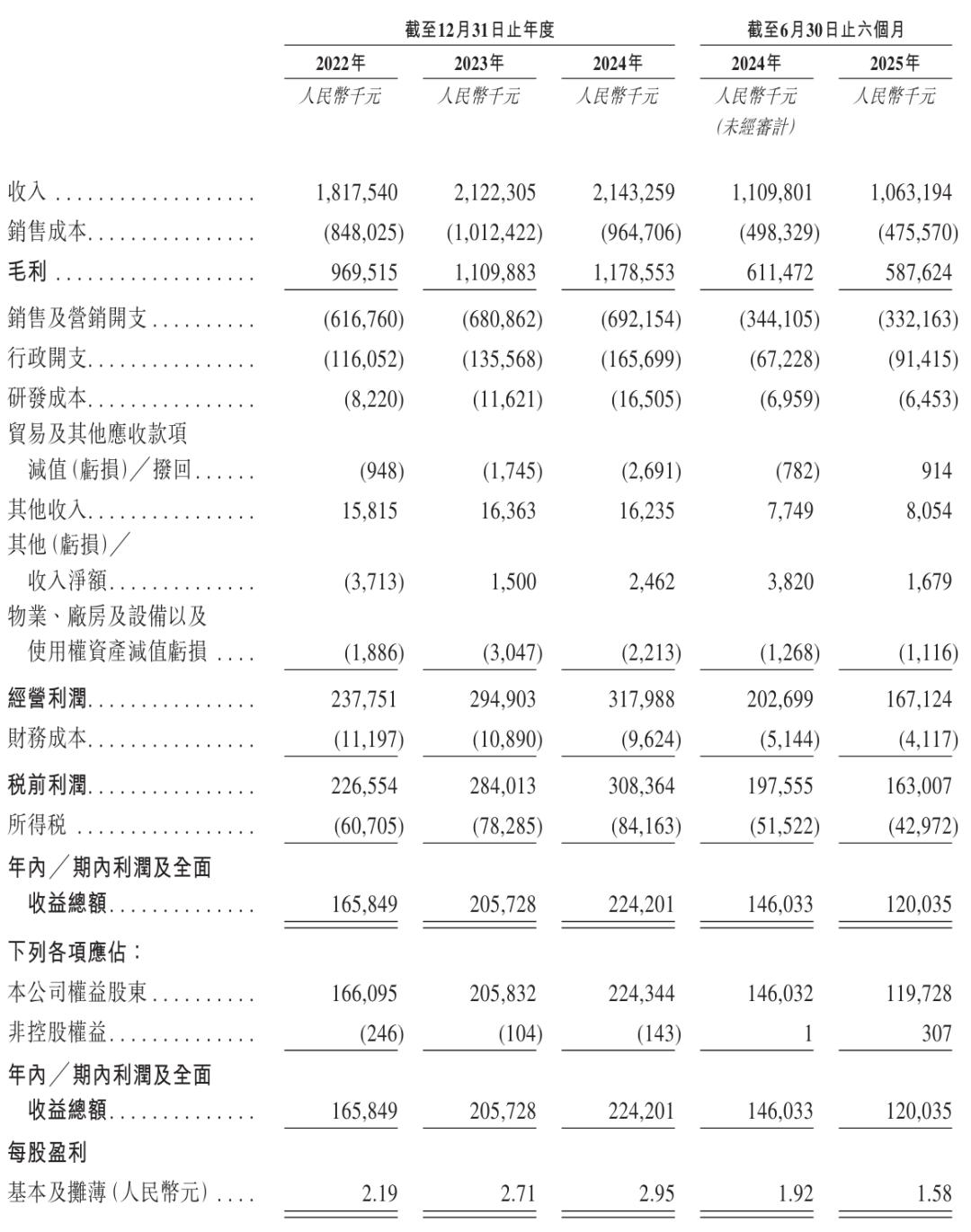
Core Viewpoint - Baima Tea Industry is preparing for its IPO on the Hong Kong Stock Exchange, aiming to raise up to HKD 450 million by offering 9 million shares at a price range of HKD 45 to 50 per share [1][2]. Financial Performance - For the first half of 2025, Baima Tea reported revenue of RMB 1.063 billion, a decrease of 4.2% from RMB 1.111 billion in the same period last year. Gross profit was RMB 587.6 million, down 3.8% from RMB 611.2 million, with a gross margin of 55.2% compared to 55.5% in the previous year [4][5]. - The company’s operating profit for the first half of 2025 was RMB 167.1 million, a decline of 17.73% from RMB 200 million year-on-year. Net profit for the same period was RMB 120 million, down 17.8% from RMB 146 million [5]. Business Overview - Baima Tea is a national chain brand engaged in the research, design, standard output, and retail of various tea products, including Oolong, black, red, green, and white teas, as well as tea utensils and food products [3]. - The number of offline stores increased from 2,613 as of January 1, 2022, to 3,585 by June 30, 2025, with franchise stores growing from 2,203 to 3,341 during the same period [3]. Historical Context - Baima Tea previously submitted IPO applications twice to the A-share market, both of which were terminated. The company shifted its focus to the Hong Kong Stock Exchange in January 2025 [2]. Shareholding Structure - The company has a strong family influence, with the controlling shareholders being members of the Wang family, who collectively hold 55.90% of the voting rights. Wang Wenbin directly holds 25.38% of the shares, while Wang Wenli holds 20.38% [11][13]. - Other significant shareholders include IDG Capital and several funds associated with Qipilang, holding 6.87% and 3% respectively [15][19]. Market Position - Baima Tea is positioned within a network of affluent families in the Quanzhou region, with connections to major brands such as Anta and Qipilang, enhancing its market presence and potential for growth [20][22].

烟花秀余波未平:始祖鸟大中华区总经理离职,双十一跌出前二十
Guan Cha Zhe Wang· 2025-10-20 09:33
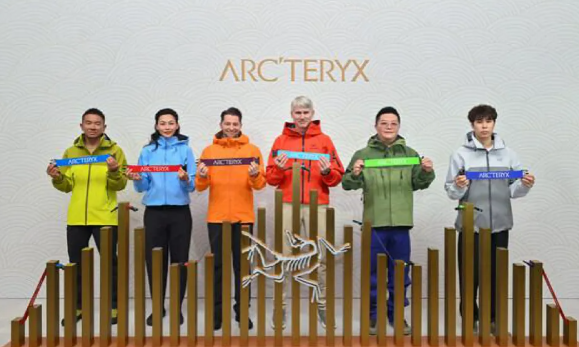
Core Viewpoint - The management change at Arc'teryx, following the fireworks event controversy, reflects the company's response to the situation and its ongoing challenges in the Chinese market [1][7]. Group 1: Management Changes - Ivan She, the General Manager of Arc'teryx Greater China, has left the company, with Jeffery Ma temporarily taking over his responsibilities [1][4]. - Ivan She previously held senior roles at Anta and was involved in the brand's retail operations before becoming the General Manager [2]. - Jeffery Ma, who joined Amer Sports in July, brings extensive experience from various companies in the sports industry and will report directly to the global CEO of Arc'teryx during this transition [4][7]. Group 2: Market Performance and Challenges - Arc'teryx's parent company, Amer Sports, reported a 23% revenue growth in the technical functional apparel segment for Q2, amounting to $509 million, which is a decline from the 28% growth in Q1 [7]. - The revenue growth rates for the Greater China and Asia-Pacific regions have also slowed, with Q2 growth at 42% and 45%, respectively, compared to 43% and 49% in Q1 [7]. - The outdoor industry in China is experiencing significant growth, with participation expected to exceed 400 million by the end of 2024, and the market size projected to reach 418 billion by 2029 [8]. Group 3: Competitive Landscape - Numerous international outdoor brands are rapidly expanding in China, posing direct competition to Arc'teryx, including the recent entry of Norrøna and the expansion of Haglöfs by Li Ning [10][12]. - Local brands like Camel and Kailas are also gaining traction, with Kailas specifically targeting Arc'teryx in its marketing and product positioning [14]. - The domestic professional outdoor apparel market is projected to grow from 27 billion in 2019 to 57.3 billion by 2024, with a compound annual growth rate of 19.1% [16]. Group 4: Brand Marketing and Strategy - The fireworks event was part of Arc'teryx's "Upward to Beauty" series, aimed at enhancing brand visibility through high-profile collaborations [17][20]. - Despite significant marketing investments, Arc'teryx's performance in the Tmall Double 11 sales event was disappointing, as it fell out of the top ten brands, indicating potential issues in brand positioning [21][22].
纺织服装行业周报:特步、361度发布Q3运营数据,运动板块仍有韧性-20251019
Shenwan Hongyuan Securities· 2025-10-19 08:43
Investment Rating - The report maintains a "Buy" rating for the textile and apparel industry, highlighting the resilience of the sportswear segment and the potential for growth in domestic demand [22][27]. Core Insights - The textile and apparel sector outperformed the market, with the SW textile and apparel index declining by 0.3%, outperforming the SW All A index by 3.3 percentage points from October 13 to October 17 [3]. - Recent industry data indicates a 2.9% year-on-year increase in retail sales for clothing, shoes, and textiles, totaling 940 billion yuan from January to August [10]. - The report emphasizes the significance of overseas production capacity and the upcoming third-quarter performance reports from various companies, suggesting that firms like Yanjiang and Nuobang may benefit from industry opportunities [8][10]. Summary by Sections Textile Sector - The textile export value for September was $12 billion, reflecting a year-on-year increase of 6.4%, while the overall textile and apparel export value for the first nine months was $221.69 billion, down 0.3% year-on-year [11][46]. - The report notes that the U.S. tariff policies are causing a divergence in production locations, favoring companies with established overseas capabilities [8][11]. Apparel Sector - The third-quarter operational data from Xtep and 361 Degrees shows resilience in the sportswear segment, with 361 Degrees reporting a 10% increase in offline sales for its main brand and children's line [9][24]. - The report recommends focusing on Bosideng due to favorable conditions for winter clothing sales, extended sales windows due to the delayed Spring Festival, and a high dividend yield [9][10]. Key Company Performance - 361 Degrees reported a 10% year-on-year increase in offline sales and a 20% increase in e-commerce sales for Q3 2025, demonstrating strong operational resilience [17][24]. - Xtep's main brand saw low single-digit growth in Q3, with online sales outperforming offline sales, particularly in children's and outdoor products [24][25]. Market Trends - The report highlights a mild recovery in domestic demand, with retail sales for clothing and textiles showing positive growth trends [10][39]. - The competitive landscape is shifting, with companies that can adapt to changing consumer preferences and optimize their supply chains expected to perform better [8][10].
共潮生 · 香帅年度财富展望2025(演讲全文)
Di Yi Cai Jing Zi Xun· 2025-10-19 03:15
Core Insights - The article emphasizes that 2025 marks a turning point in global financial and industrial landscapes, with new patterns emerging in capital flows and market structures [3][4]. Group 1: Capital Flows and Market Trends - Significant changes in capital flows have been observed, with gold prices surging by 43% from early 2025 to September, leading to increased demand for gold-related products [10][12]. - The article notes that various asset classes have experienced substantial gains, including silver (up 55%) and Bitcoin (up 18%), while European stock markets have rebounded significantly, with Germany up 28% and Italy up 40% [12][13]. - The A-share market's 15% increase is considered moderate compared to global trends, highlighting a divergence in performance across different markets [14]. - A notable decline in the US dollar index, dropping over 10%, has been linked to a shift in global capital dynamics, with investors seeking alternatives to the dollar [15][17]. Group 2: Geopolitical Influences - The article discusses how geopolitical events, particularly the announcement of tariffs by former President Trump, have prompted a reevaluation of the dollar's role in global finance, leading to a flight of capital from dollar-denominated assets [17][20]. - The concept of "island chain configuration" is introduced, indicating a shift from a centralized dollar-based system to a more fragmented approach where investors seek alternative anchors for their capital [25][26]. Group 3: Industry Developments - In the pharmaceutical sector, China's innovation in drug licensing has seen a dramatic increase, with a record-breaking $60.5 billion deal for a Chinese cancer drug, reflecting a significant shift in the global competitiveness of Chinese pharmaceuticals [60][62]. - The article highlights the rise of China's innovative drug sector, with a notable increase in the percentage of new drugs approved globally, indicating a shift in market perception [62][64]. Group 4: Emerging Companies and Technologies - The emergence of new Chinese companies in various sectors, such as AI and gaming, is noted, with examples like DeepSeek and successful gaming titles reshaping market expectations [66][70]. - The article emphasizes the importance of "emergent" companies that are redefining their industries, showcasing a shift from traditional manufacturing to high-value innovation [102][104]. Group 5: Global Positioning and Market Strategy - The article discusses the significance of "going global" for Chinese companies, with a focus on the increasing importance of overseas markets for revenue and growth [108][110]. - The "outbound premium" is highlighted, indicating that companies with significant international operations tend to perform better in the stock market, reflecting a strategic shift towards global integration [110][115].

共潮生 · 香帅年度财富展望2025(演讲全文)
第一财经· 2025-10-19 02:52
Group 1 - The article emphasizes that 2025 is a pivotal year, marking a shift in global financial flows and market dynamics, with new coordinates emerging in investment strategies [3] - There is a notable increase in demand for gold, with prices rising by 43% from early 2025 to September, indicating a shift in investor sentiment towards alternative assets [6][15] - The article highlights a significant trend of capital moving away from the US dollar, with various global markets experiencing substantial gains, such as the German stock market rising by 28% and the Italian market by 40% [6][7] Group 2 - The concept of "island chain configuration" is introduced, suggesting that global financial flows are becoming decentralized, with investors seeking alternatives to the US dollar [14][15] - The article discusses the geopolitical implications of investment decisions, emphasizing the need for a political risk filter in asset evaluation [15][22] - The narrative-driven nature of capital markets is highlighted, where market movements are increasingly influenced by stories and perceptions rather than just fundamentals [18][20] Group 3 - The article notes a significant transformation in China's pharmaceutical industry, with a record-breaking $60.5 billion deal for licensing a Chinese cancer drug, showcasing China's growing innovation capabilities [32] - It points out that China's share of global innovative drug approvals has increased significantly, indicating a shift in the global pharmaceutical landscape [32][33] - The article discusses the emergence of "DeepSeek moments" in various industries, where previously underestimated sectors suddenly gain prominence and reshape market expectations [33][35] Group 4 - The article illustrates the evolution of China's manufacturing capabilities through the lens of container contents over the years, showing a shift from low-value goods to high-tech products [40][41] - It emphasizes the importance of precision manufacturing in maintaining competitive advantages in global supply chains, with companies like Luxshare Precision exemplifying this trend [46][58] - The article discusses the necessity for Chinese companies to transition from merely exporting products to establishing production capabilities abroad, thereby enhancing their global positioning [71][75]

服饰行业周度市场观察-20251018
Ai Rui Zi Xun· 2025-10-18 09:27
Investment Rating - The report does not explicitly provide an investment rating for the apparel industry Core Insights - The apparel industry is experiencing significant shifts with brands adapting to market changes and consumer preferences, particularly in high-end segments and the beauty sector Industry Trends - Recent price increases among traditional gold brands, driven by rising international gold prices, have led to a surge in demand for high-end products, with some brands seeing price hikes of up to 15% [4] - Major fast fashion brands like Gap, Zara, and H&M are entering the beauty market due to sluggish clothing sales, with previous expansions by luxury brands like LVMH indicating a trend towards diversification [4] - The competition among major Chinese sportswear brands, including Anta and Li Ning, is intensifying as they leverage Olympic sponsorships and brand repositioning to capture market share [6] - The trend of flagship store openings among apparel brands aims to enhance brand presence and consumer experience, despite challenges such as high costs and market saturation [6] - The high-end down jacket market is evolving with a focus on technology and fashion, driven by consumer demand for premium products [10] - Golf brands are targeting younger consumers in China, shifting from traditional business models to more lifestyle-oriented approaches [10] Top Brand News - UR has emerged as a leading fast fashion brand in China, aiming for global expansion with a target of opening 200 overseas stores in five years [12] - Bosideng is innovating in the down jacket segment by integrating technology and fashion, launching a versatile jacket designed for varying temperatures [12] - FILA is strengthening its position in the tennis market by renewing sponsorships and targeting the growing Chinese tennis audience [12] - Malbon Golf is entering the Chinese market with a focus on youth culture and lifestyle, planning to open flagship stores and engage in community activities [15] - The competition in the luxury retail market is intensifying, with SKP facing challenges from Nanjing Deji Plaza, which has recently surpassed SKP in sales [15] - lululemon is facing declining sales and profitability, drawing comparisons to the decline of Victoria's Secret due to shifting consumer preferences [16]
激战中国市场:耐克销售下滑 阿迪达斯“高调”进击丨运动变局
2 1 Shi Ji Jing Ji Bao Dao· 2025-10-17 13:14
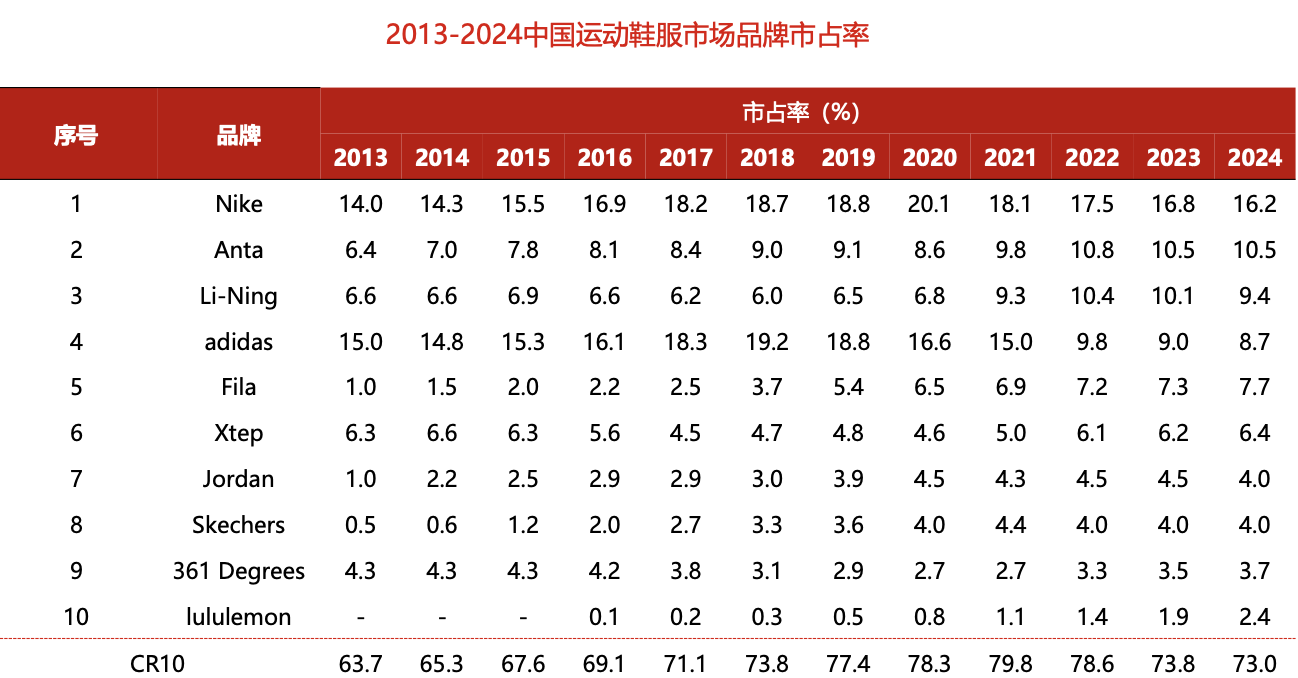
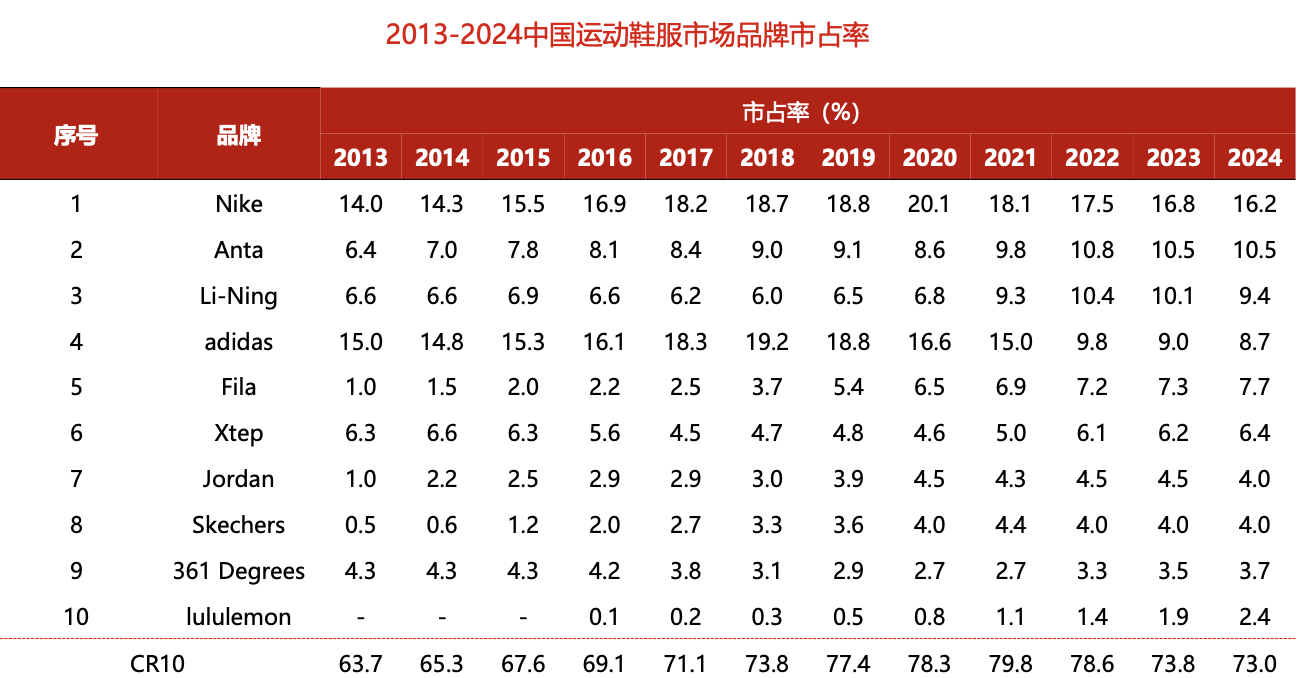
Core Insights - The global sports footwear and apparel industry is largely defined by the competition between Nike and Adidas, with a historical context of dominance by German, American, and Japanese brands before Nike's rise in the 1980s [1] - In the Chinese market, Nike and Adidas have faced increasing competition from domestic brands like Anta and Li-Ning since 2017, leading to a decline in Adidas's market share [1][10] - Adidas is actively working to regain its position in the Chinese market, showing a notable increase in revenue and market strategies [10][12] Market Dynamics - Nike's market share in China has decreased from 18.1% in 2021 to 16.2% in 2024, while Adidas's share has dropped from 15% to 8.7% in the same period [14] - Anta's market share increased from 9.8% to 10.5%, and Li-Ning's share rose slightly from 9.3% to 9.4% [14] - The competitive landscape is intensifying, with domestic brands gaining traction and impacting the pricing power of established international brands [6][22] Financial Performance - Nike's revenue in Greater China fell by 10% to $1.512 billion (approximately 10.775 billion RMB) for the latest fiscal quarter, with a decline in both direct and wholesale channels [4][5] - Adidas reported a 2.2% increase in revenue to €5.952 billion (approximately 49.625 billion RMB) in Q2, with a significant contribution from the Greater China region, which saw an 11% increase [10][11] - The operating profit margin for Adidas in China reached 22.7%, surpassing its margins in Europe and North America [11] Strategic Initiatives - Adidas's CEO, Bjorn Gulden, has been actively engaging with the Chinese market, emphasizing the importance of local production and design [12][14] - Nike is also increasing its investment in China, focusing on enhancing its retail experience and product offerings to regain market share [17][20] - Both companies are facing pressure from the rise of domestic brands, which are improving product quality and competitive pricing [8][22]


激战中国市场:耐克销售下滑,阿迪达斯“高调”进击丨运动变局
2 1 Shi Ji Jing Ji Bao Dao· 2025-10-17 12:46
Core Insights - The competition between Nike and Adidas has defined the global sports footwear and apparel industry, with both brands historically dominating the market [1][2][3] Market Dynamics - Nike surpassed Adidas in North America in 1980, achieving a market share of 50%, while Adidas struggled due to a lag in the sports fashion trend [2] - Adidas began to recover in the 1990s by focusing on sports fashion and launched the Originals retro series in 1996, maintaining over 20% growth since 1994 [2] - In China, the competition has intensified since 2017, with domestic brands like Anta and Li Ning rapidly gaining market share, leading to a decline in Adidas's position [3][4] Financial Performance - As of the latest fiscal quarter ending August 31, 2025, Nike's revenue in Greater China fell by 10% year-on-year to $1.512 billion (approximately 10.775 billion RMB), with declines across various channels [7] - Adidas reported a 2.2% year-on-year revenue increase to €5.952 billion (approximately 49.625 billion RMB) in Q2, with Greater China being a significant growth driver, showing an 11% increase to €798 million (approximately 6.653 billion RMB) [12] Competitive Landscape - The domestic sports market is under pressure, with brands like Peak reporting significant losses and implementing salary cuts [9] - The rise of domestic brands has eroded Nike's pricing power, as they offer high-quality products at competitive prices [10] Strategic Moves - Adidas's CEO, Bjorn Gulden, has made multiple visits to China, indicating a strategic focus on the market, which is crucial for the brand's recovery [13][14] - Nike is also increasing its investment in China, planning to enhance its retail experience and product offerings to regain market share [17][20] Market Share Trends - Adidas's market share in China has dropped from 15% in 2021 to 8.7% in 2024, while Nike's share decreased from 18.1% to 16.2% [14] - Anta and Li Ning have increased their market shares, with Anta rising from 9.8% to 10.5% and Li Ning from 9.3% to 9.4% [14] Leadership Changes - Nike has appointed Dong Wei as the new chairperson and CEO for Greater China, emphasizing the importance of the Chinese market for its overall strategy [20][21]