
小米汽车

Search documents
当“蔚小理”跌出头部:2026车企淘汰赛全面加速
首席商业评论· 2026-01-01 04:42
Core Viewpoint - The Chinese automotive market is undergoing a significant transformation, with a shift from traditional fuel vehicles to electric vehicles (EVs), leading to a competitive landscape focused on profitability and safety in the face of potential negative growth in 2026 [2][5][20]. Group 1: Market Transformation - The penetration rate of new energy vehicles in China rose from 5.4% in 2020 to 53.6% by November 2025, indicating a rapid transition compared to Europe [3]. - The automotive industry's value metrics have shifted from traditional components to new standards such as range, smart cabin experience, and assisted driving capabilities [3]. - By 2025, the market dynamics have changed, with new energy vehicles becoming the dominant force, moving from trendsetters to market leaders [3]. Group 2: Competitive Landscape - In 2025, the focus for automotive companies will shift from competing between new energy and fuel vehicles to finding ways to remain profitable in a low-margin environment [5][20]. - The market is witnessing a significant increase in market share for domestic brands, with projections indicating that domestic brands will exceed 65% market share [8]. - The sales performance of new entrants like Xiaomi has been inconsistent, highlighting the challenges of maintaining consumer trust amid safety concerns [10]. Group 3: Safety and Technology - The automotive industry is experiencing a profound value return, with safety becoming a critical factor rather than a cost option [12]. - By 2025, many vehicles are equipped with L2-level smart driving features, and advancements in battery technology have led to significant improvements in range and charging speed [12][14]. - New regulations are set to enforce stricter safety standards for electric vehicle batteries, emphasizing the importance of safety in the competitive landscape [16][18]. Group 4: Future Outlook - The automotive market is expected to face a potential decline in growth, with forecasts suggesting a 1% to 3% increase or a possible 2% negative growth in 2026 [20][21]. - Policy changes, such as the reduction of tax incentives for new energy vehicles, may impact sales growth, particularly in the price-sensitive segment [21][23]. - Companies are encouraged to explore global markets and innovate in technology to create new value, with a focus on L3-level autonomous driving and smart vehicle integration [25][28].



头部做大、腰部塌陷,但中国车市仍难迎寡头时代
Xin Lang Cai Jing· 2025-12-31 10:11
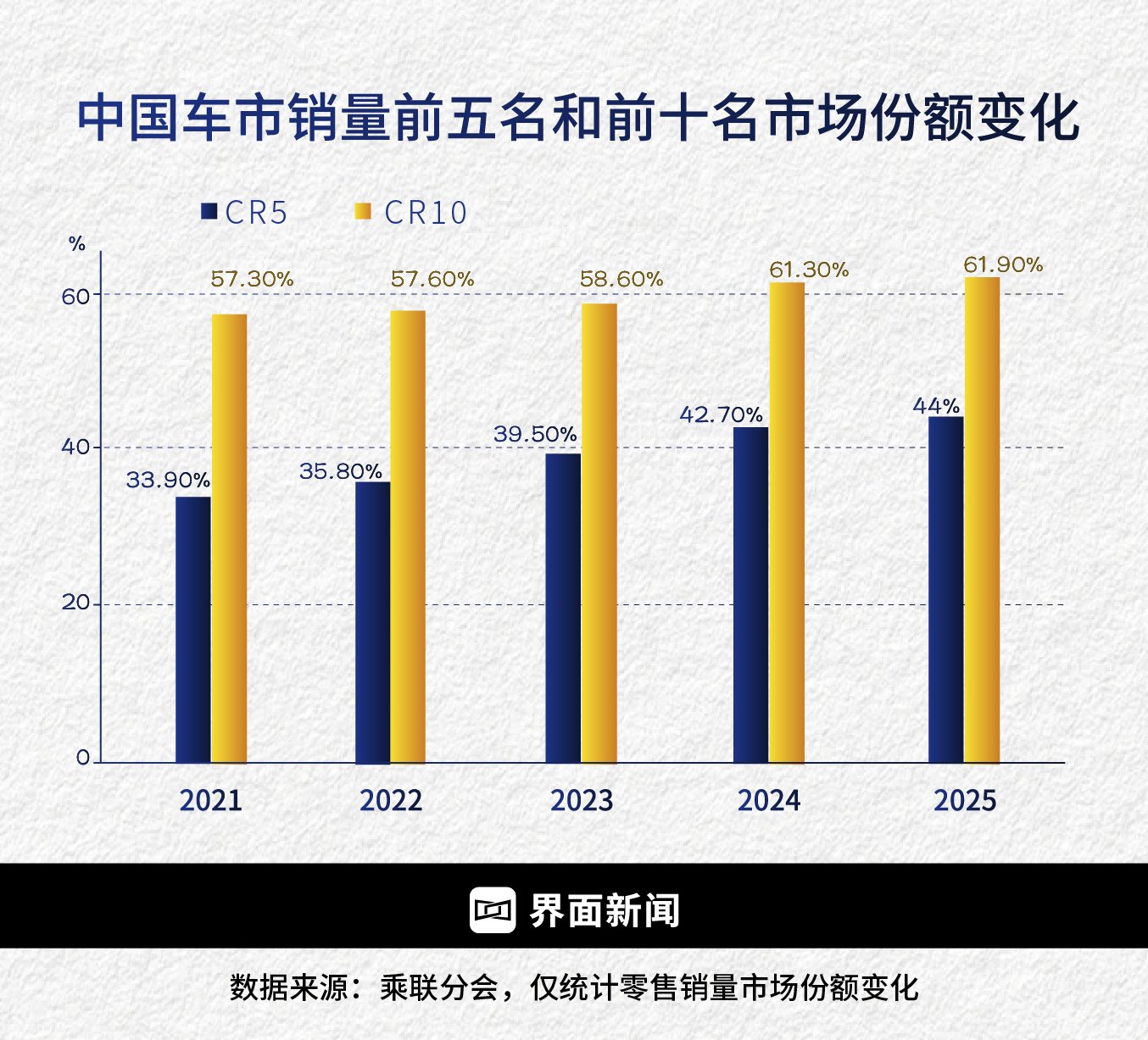
Group 1 - The Chinese passenger car market is undergoing a significant structural transformation, with overall growth slowing and market concentration increasing, leading to a clear advantage for leading companies in terms of sales and resources, while traditional mid-tier brands face severe survival pressures [1] - The market share of the top five automotive companies increased from 33.9% in 2021 to 44% by 2025, while the top ten's market share rose from 57.3% to 61.9%, indicating a shift from multi-brand competition to dominance by a few enterprises [1] - Geely Auto Group has shown the most significant market share growth among leading companies, increasing by approximately 3.5 percentage points compared to 2024, driven by the sales growth of new energy vehicles supported by government subsidies [3] Group 2 - BYD's market share has slightly declined this year but remains close to 15%, attributed to its vertically integrated supply chain that maintains product price advantages and a strong product offensive that ensures the launch of popular models across different market segments [4] - The strategy of using a shared platform for multiple models allows companies to reduce trial and error costs while maximizing market returns, enhancing the marginal returns on R&D investments [4] - Leading automotive companies are strengthening their scale advantages and cost efficiency through internal integration, as the focus shifts from technological leadership to cost competition in a market characterized by product homogeneity and slow technological iteration [7] Group 3 - The rapid collapse of mid-tier companies is evident, particularly in the second-tier joint venture brands, with significant sales declines reported for Dongfeng Nissan and GAC Honda from 2022 to 2024 [8] - New car-making forces like Li Auto, NIO, XPeng, and others are filling the gap left by traditional mid-tier brands, with their sales surpassing those of GAC Honda and Dongfeng Honda, entering the top 20 in annual sales rankings [8] - For mid-tier enterprises to survive, joint venture brands must develop products tailored to the Chinese market rather than simply importing overseas models, while new car-making forces need to achieve profitability and build operational capabilities to support large-scale production [9] Group 4 - The ongoing consolidation efforts among major automotive companies, such as the proposed merger between Changan and Dongfeng, highlight the complexities and challenges of achieving clear leadership in the market due to administrative disparities and high integration difficulties [10] - The current market dynamics suggest that while some foreign brands may exit, the overall number of participants may not significantly decrease, and the competition remains complex and ongoing [10] - The impressive sales figures of leading companies may be viewed as short-term responses to capital market pressures rather than indicators of long-term stability and profitability [10] Group 5 - The absolute dominance of leading companies, the elimination of mid-tier players, and the clearing out of lower-tier brands indicate that the market structure is still maturing, with the final outcome of the competitive landscape in the Chinese automotive market still unfolding [14]
12款新车展望2026:中国汽车市场开启“耐力赛” | 界面预言家⑧
Xin Lang Cai Jing· 2025-12-31 09:15
Group 1 - The automotive market is transitioning from a high-intensity "sprint" to a "marathon" mode by 2026, with electric vehicle (EV) growth slowing and consumers becoming more cautious about value and reliability [1] - Consumers are increasingly embracing hybrid and plug-in hybrid vehicles as a "bridge solution" to reduce range anxiety and stabilize purchasing decisions [1] - The supply side is experiencing compressed model development cycles, with a shift towards rapid iteration similar to the Chinese model, making "annual updates" and "mid-cycle facelifts" essential [1] Group 2 - The focus for 2026 is shifting towards addressing "problems" rather than just introducing "new cars," including questions about brand coherence and the ability to maintain consumer trust [2] - The success of the SU7 indicates that a clear product positioning and ongoing conversation can mitigate the disadvantages of late market entry, but the YU9 faces a crowded high-end SUV segment [3][7] Group 3 - The YU9 is expected to target the family flagship market with a three-row layout and reduced range anxiety, but it must adapt its sporty narrative to emphasize comfort and long-distance experience [7] - The Z model from Tengshi aims to rebrand the company by packaging its technological capabilities into a more appealing product narrative, enhancing its market presence [35] Group 4 - The iX3 from BMW is positioned to address how joint venture electric vehicles can differentiate themselves in the Chinese market, focusing on comfort and local adaptations while retaining driving characteristics [47][49] - The second-generation Roadster from Tesla, delayed for nearly nine years, needs to redefine its narrative to maintain its market allure amidst increasing competition in the high-performance electric vehicle segment [51][54] Group 5 - The introduction of large GT and convertible models by Genesis is seen as a brand investment rather than a sales strategy, aiming to elevate brand perception and value in the luxury market [56][59]



【新能源周报】新能源汽车行业信息周报(2025年12月22日-12月28日)
乘联分会· 2025-12-30 08:39
Industry Information - The 2025 Globalization and Sustainable Development Forum for the automotive industry released three key industry consensus points, emphasizing the integration of electric intelligence with ESG responsibilities, the importance of safety and user value in smart vehicles, and the necessity of sustainable development as a core requirement for the automotive industry [7] - Wuhan's 14th Five-Year Plan suggests accelerating the development of emerging industries such as embodied intelligence, high-end chips, quantum technology, and brain-computer interfaces [8] - As of November 2025, the total number of electric vehicle charging infrastructure in China reached 19.322 million, a year-on-year increase of 52.0%, with public charging facilities accounting for 4.625 million [9][10] - The total investment for the EVE Energy headquarters and Jin Yuan Robot AI Center project is approximately 1 billion yuan, focusing on sodium battery products and AI robotics [12] - Guangzhou aims to create a trillion-level smart connected new energy vehicle industry cluster as part of its 14th Five-Year Plan [13] - The "Shenzhen-Hong Kong Automotive Fast Pass Plan" has been officially implemented, streamlining the import process for electric vehicles [14] - The National Energy Administration is promoting the construction of charging piles in rural areas to support the growth of electric vehicles [15] - Huawei's ADS MAX 4.1 upgrade significantly enhances the experience in urban congestion scenarios [16] - The first batch of L3-level autonomous driving vehicle special license plates has been issued in Beijing, marking a milestone in the commercialization of autonomous vehicles [16] - By 2026, over 10,000 charging guns will be built in highway service areas across the country [16] - The National Energy Administration reported a 60.2% year-on-year increase in electricity consumption for charging and swapping services in November 2025 [18] - The first automotive intelligent chassis testing report was released, with BYD's Yangwang U7, NIO ES8, and Zhijie R7 recognized as benchmark models [20] - Hunan's electric vehicle exports exceeded 10 billion yuan for the first time, with a year-on-year growth of 105.3% [22] - Guangzhou's new energy vehicle production increased by 22.6% in the first 11 months of 2025 [22] - A total investment of 7.47 billion yuan was signed at the Ningde lithium battery new energy industry promotion conference, with an expected annual output value of 12.14 billion yuan [27] - The annual export of new energy vehicles from the Xiangyang Comprehensive Bonded Zone exceeded 10,000 units for the first time, marking a 350% year-on-year increase [27] - Inner Mongolia's Chifeng City has built 3,453 charging piles during the 14th Five-Year Plan period [29] Policy Information - The Guizhou Qiannan Prefecture government issued a plan for high-quality energy industry development from 2025 to 2027, focusing on expanding charging infrastructure [30] - The Henan Sanmenxia government released a plan for the construction of charging facilities in residential areas [31] - The Jiangsu province is adjusting its electric vehicle charging fee subsidy policy for 2026 [32] - The National Development and Reform Commission emphasized the need to regulate competition in the new energy vehicle, lithium battery, and photovoltaic industries to avoid "involution" [23][24]




超23亿索赔,用心做好每一块电池的欣旺达被起诉
Xin Lang Cai Jing· 2025-12-29 13:39
Core Viewpoint - The lawsuit against XWANDA by Weirui Electric Vehicle Technology highlights significant quality issues with battery cells supplied by XWANDA, leading to a claim of 2.314 billion RMB, which poses a substantial risk to the company's financial health [21][4][26]. Group 1: Lawsuit Details - XWANDA's subsidiary, XWANDA Power Technology, is being sued by Weirui Electric Vehicle Technology for a breach of contract, claiming severe quality issues with battery cells supplied from June 2021 to December 2023 [21][4]. - The lawsuit involves claims for direct economic losses, appraisal fees, attorney fees, and litigation costs, with the Ningbo Intermediate People's Court officially accepting the case [4][5]. - This lawsuit signifies a deeper internal conflict within the supply chain of major automotive manufacturers, rather than a typical customer-supplier dispute [5][24]. Group 2: Financial Implications - The claim amount of 2.314 billion RMB is significantly higher than XWANDA's net profit of 1.47 billion RMB for the entire year of 2024 and 1.41 billion RMB for the first three quarters of 2025 [26][7]. - If XWANDA loses the case and is required to pay the full amount, it could have a severe impact on the company's financial status, although the final effects will depend on the court's ruling and auditor assessments [26][6]. Group 3: Company Overview and Market Position - XWANDA has established a strong market presence, focusing on square aluminum shell battery technology and expanding into cylindrical batteries, covering various electric vehicle segments [27][8]. - The company's market share in the power battery sector has increased to 3.25%, ranking sixth in the industry, showcasing robust growth [28][9]. - XWANDA has formed partnerships with major automotive brands, including NIO, Xpeng, and Li Auto, and has secured a battery supply project for Xiaomi's third vehicle model [30][12]. Group 4: Strategic Challenges - The ongoing lawsuit not only affects the relationship between XWANDA and Weirui but also raises alarms across the entire industry supply chain [32][14]. - As XWANDA seeks to expand its market share and potentially list in Hong Kong, the resolution of this lawsuit will be crucial for its future growth and capital market ambitions [32][14]. - Following the announcement of the lawsuit, XWANDA's stock experienced a significant drop of nearly 16%, reaching a four-month low [32][14].

零跑逆袭 小鹏翻身 小米跨界 2025年谁更得意?
Xi Niu Cai Jing· 2025-12-29 09:29
Core Insights - The competition among new car manufacturers in 2025 is more intense than expected, with some brands falling behind, others exiting the market, and some making strong comebacks or debuting successfully [2] Group 1: Leap Automotive - Leap Automotive is considered the "dark horse" of 2025, achieving a remarkable turnaround by completing its annual sales target of 500,000 vehicles ahead of schedule, with a cumulative delivery of 536,132 vehicles from January to November, achieving a completion rate of 107.23% [3] - The company's success is attributed to its extreme cost control, with a self-research and self-manufacturing rate of 65% for core components, allowing it to maintain a healthy gross margin of 14%-15% while offering competitive pricing [3] - Leap Automotive has diversified its product matrix, covering various market segments with four product series, thus avoiding reliance on a single bestseller and catering to different consumer needs [4] Group 2: Xpeng Motors - Xpeng Motors has made a significant comeback, achieving a cumulative sales of 197,200 vehicles in the first half of 2025, surpassing its total sales for 2024, and completing its annual sales target ahead of schedule with 355,000 deliveries in the first ten months [5] - The company reported a revenue of 20.38 billion yuan in Q3 2025, a year-on-year increase of 101.8%, with a gross margin of 20.1% and a reduced loss of 380 million yuan, indicating a path towards profitability [5] - Xpeng's strategy of "technology downscaling and price reduction" has made advanced driving technologies standard in the 150,000 yuan market, contributing to its sales success [6] Group 3: Xiaomi Automotive - Xiaomi Automotive has made a significant impact in the automotive industry, achieving a record of 500,000 vehicles produced in just 19 months and capturing a 1.7% global market share in Q3 2025 [7] - The company delivered over 40,000 vehicles in November 2025, ranking among the top three in new car sales and achieving a revenue of 28.3 billion yuan in Q3, a 197.9% increase year-on-year, with a gross margin of 25.5% [7] - Xiaomi's marketing strategy, led by CEO Lei Jun, has created a strong emotional connection with consumers, although the company has faced criticism over safety incidents and production strategies that have led to customer dissatisfaction [8][9] Group 4: Industry Trends - The performance of Leap Automotive, Xpeng Motors, and Xiaomi Automotive in 2025 highlights the importance of core technology, profitability, and user trust in achieving strong market performance as the novelty of new entrants fades [9] - The differentiation among new car manufacturers is expected to intensify in 2026, raising questions about whether these three companies can maintain their market positions or if new competitors will emerge to challenge them [9]

汽车行业周报:“十五五”汽车持重,智能豪华定义新方向-20251229
Guoyuan Securities· 2025-12-29 09:14
Investment Rating - The report maintains a "Recommended" investment rating for the automotive industry [6] Core Insights - The automotive industry is experiencing a decline in sales due to tightening subsidies, but the annual cumulative sales remain within a reasonable range. Retail sales of passenger cars from December 1-21 reached 1.3 million units, a year-on-year decrease of 19%, but a month-on-month increase of 5%. Cumulative retail sales for the year stand at 22.783 million units, a year-on-year increase of 4% [2][20] - The penetration rate of new energy vehicles in the passenger car market reached 60.6% during the same period, with cumulative retail sales of 12.26 million units for the year, reflecting an 18% year-on-year growth [2][20] - Regional "14th Five-Year" plans emphasize the importance of the automotive industry, particularly in promoting smart and connected vehicles, with significant investments expected in key areas like Beijing, Shanghai, and Shenzhen [3][30][31] - Leading automotive companies are focusing on smart vehicle strategies, with domestic luxury car brands beginning to define their identities in the market [4][36] Summary by Sections Weekly Market Review - The automotive sector saw a 2.74% increase in the week of December 20-26, outperforming the Shanghai and Shenzhen 300 index by 0.79 percentage points [13] - The automotive parts sector had the highest increase at 4.25%, while the passenger car sector saw a 3.39% rise [15] Data Tracking - Retail and wholesale sales data for passenger cars indicate a mixed performance, with retail sales declining year-on-year but showing month-on-month growth [20] - New energy vehicle sales also reflect a similar trend, with a year-on-year increase in retail sales but a decline in wholesale figures [20] Industry News - The report highlights significant developments in the automotive industry, including organizational changes at Li Auto and the launch of new smart vehicle models by various manufacturers [25][36] - The implementation of the "Shenzhen-Hong Kong Automotive Fast Pass Plan" aims to streamline the export process for new energy vehicles, significantly reducing time and costs [29] Investment Recommendations - The report suggests focusing on the definitions of the automotive industry in various regional "14th Five-Year" plans and the upward trend in autonomous luxury vehicles [5]
【深度分析】2025年11月份全国新能源市场深度分析报告
乘联分会· 2025-12-26 08:36
Overall Market - The total market for passenger vehicles in China includes both traditional internal combustion engine (ICE) vehicles and new energy vehicles (NEV), which comprise battery electric vehicles (BEV) and plug-in hybrid electric vehicles (PHEV) [4][5] - In November 2025, the total production of NEVs reached 1,756,587 units, while ICE vehicles produced were 1,349,384 units, leading to a total market production of 3,105,971 units [6][7] - Year-to-date (YTD) data for January to November 2025 shows NEV production increased by 6.3%, while ICE vehicle production decreased by 4.0% compared to the same period in 2024 [6][8] Market Segmentation - The market is segmented into various categories including sedans, MPVs, and SUVs, with NEVs showing a significant growth trend in all segments [25][26] - In November 2025, NEV sales in the sedan category were 593,948 units, while ICE sedans sold were 413,429 units, indicating a strong preference for NEVs in the sedan market [26] Export Market - The export of NEVs has shown substantial growth, with a total of 2,149,769 units exported in November 2025, reflecting a 243.3% increase compared to the previous year [16][21] - The NEV export penetration rate reached 41.7% in the first eleven months of 2025, up from 27.1% in 2024, indicating a growing international demand for Chinese NEVs [18][20] Manufacturer Performance - BYD remains the leading manufacturer in the NEV market, with a wholesale volume of 474,921 units in November 2025, despite a year-on-year decline of 5.8% [22][23] - Other notable manufacturers include Geely and Chery, with Geely achieving a 53.4% increase in wholesale volume, indicating strong competitive performance in the NEV segment [22][23] Price Positioning - The market is categorized into price segments, with vehicles priced below 100,000 yuan showing a significant share in the NEV market, reflecting consumer preferences for affordable electric options [4][5] - The price segmentation also indicates a growing trend towards higher-priced NEVs, as consumers are increasingly willing to invest in premium electric vehicles [4][5]
智驾险仍徘徊“兜底服务”阶段
Jing Ji Wang· 2025-12-26 02:02
Core Viewpoint - The evolution of intelligent driving technology is leading to a revolution in transportation, with the recent approval of China's first L3-level vehicle licenses marking a significant step towards the commercialization of L3-level autonomous driving [1] Group 1: Intelligent Driving Technology and Market Developments - The L3-level "conditional automation" mode introduces "human-machine transfer" of driving responsibility, shifting focus to system reliability, algorithm decision-making, and sensor performance [1] - The emergence of "intelligent driving insurance" products in the market is primarily a safety net provided by automakers or intelligent driving solution suppliers, rather than genuine insurance products [2][3] - Companies like Xiaopeng Motors have launched intelligent driving insurance plans, with costs around 239 yuan per year, which require customers to purchase additional insurance from partnered companies [2] Group 2: Insurance Industry's Role and Challenges - Insurance companies play a crucial role in the design and risk control of these insurance products, but most current "intelligent driving insurance" offerings are essentially value-added services rather than independent insurance products [3] - The lack of access to critical driving data held by automakers complicates the ability of insurance companies to develop genuine intelligent driving insurance products [5] - The complexity of liability in "human-machine co-driving" scenarios presents challenges for insurance companies, as existing traffic safety regulations are based on human drivers [5] Group 3: Future Directions and Regulatory Environment - To realize intelligent driving insurance, collaboration across various sectors is necessary, including regulatory frameworks, data governance, and industry cooperation [6] - Policies encouraging the insurance industry to adapt to the impacts of intelligent driving are being developed, with a focus on evolving risk assessment and pricing models [6][7] - Experts emphasize the need for clear definitions and regulations regarding intelligent driving insurance to avoid overlaps with existing insurance products and ensure data transparency [7]
“人机共驾”再次进阶 智驾险仍徘徊“兜底服务”阶段
Zhong Guo Zheng Quan Bao· 2025-12-26 02:01
Core Insights - The evolution of intelligent driving technology is leading to a revolution in transportation, with the recent approval of China's first L3-level vehicle licenses marking a significant step towards the commercialization of L3-level autonomous driving [1] - The L3-level "conditional automation" introduces a shift in driving responsibility from human to machine, raising concerns about system reliability, algorithm decision-making, and sensor performance [1] - The emergence of "intelligent driving insurance" products has been noted, but these are primarily safety nets provided by automakers rather than true insurance products [1][2] Group 1: Intelligent Driving Insurance Landscape - Since 2025, there has been a notable increase in insurance products related to assisted and intelligent driving, with companies like Xiaopeng Motors offering "intelligent driving insurance" for an annual fee of 239 yuan [2] - Many of these insurance products require customers to first purchase traditional insurance before accessing additional coverage for intelligent driving scenarios, indicating a trend towards bundled services [2][3] - Current "intelligent driving insurance" products are largely backed by automakers rather than traditional insurance companies, often serving as value-added services rather than independent insurance offerings [3] Group 2: Challenges in Insurance Development - The lack of access to critical driving data held by automakers poses a significant challenge for insurance companies in developing true intelligent driving insurance products [5] - The complexity of responsibility in "human-machine co-driving" scenarios complicates the establishment of clear liability standards, as traditional insurance models are based on human drivers [5][6] - The need for high-quality, standardized data for accurate risk assessment is emphasized, with current data being monopolized by automakers, making it difficult for insurers to evaluate risks effectively [4][5] Group 3: Regulatory and Collaborative Efforts - There is a call for collaborative efforts among insurers, automakers, and technology companies to create a new ecosystem that addresses regulatory frameworks, data governance, and industry cooperation [6][7] - Recent policy signals indicate a push for the insurance industry to adapt to the impacts of intelligent driving, with a focus on evolving risk assessment and pricing models [6][7] - Experts suggest the establishment of a national data-sharing platform and the need for regulatory frameworks to clarify liability in intelligent driving scenarios [6][7]