安踏

Search documents
激战中国市场:耐克销售下滑,阿迪达斯“高调”进击
2 1 Shi Ji Jing Ji Bao Dao· 2025-10-17 12:42
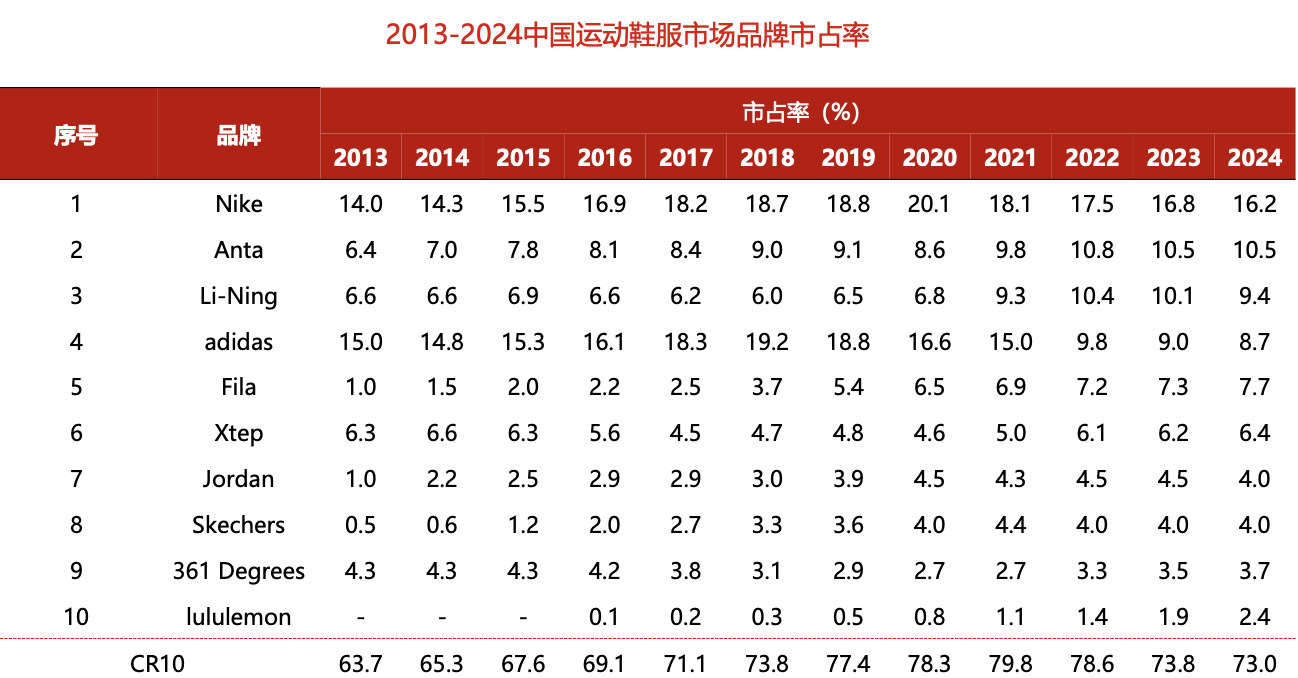
Core Insights - The global sports footwear and apparel industry is largely characterized by the competition between Nike and Adidas, with a historical context of dominance by German, American, and Japanese brands before Nike's rise in the 1980s [1][2]. Market Dynamics - Nike surpassed Adidas in North America in 1980, achieving a market share of 50%, while Adidas struggled due to a lag in the sports fashion trend [2]. - Since 2017, domestic brands like Anta and Li-Ning have rapidly gained market share in China, leading to a significant decline in Adidas's position, which fell below Nike, Anta, and Li-Ning by 2024 [3][4]. Performance Metrics - In the Chinese market, Nike's market share decreased from 18.1% in 2021 to 16.2% in 2024, while Adidas's share dropped from 15% to 8.7% during the same period [12]. - As of the latest fiscal quarter, Nike's revenue in Greater China fell by 10% to $1.512 billion (approximately 10.775 billion RMB), with a notable decline in both direct and wholesale channels [7]. Competitive Strategies - Adidas reported a 2.2% increase in revenue to €5.952 billion (approximately 49.625 billion RMB) in Q2, with Greater China being a key growth driver, showing an 11% increase to €798 million (approximately 6.653 billion RMB) [11]. - Adidas's operating profit margin in China reached 22.7%, surpassing that of Europe and North America, indicating a strong performance in the region [11]. Brand Positioning - Domestic brands are increasingly competitive, with claims that they have closed the product gap with Nike, focusing on high-quality products at competitive prices [9]. - Nike is responding to market pressures by enhancing its investment in China, including the transformation of retail spaces into sports experience centers and optimizing product offerings [15][18]. Leadership Changes - Nike appointed Dong Wei as the new chairperson and CEO for Greater China, emphasizing the importance of the Chinese market in its recovery strategy [18][19].


天猫“双11”预售首小时35个品牌成交破亿元
Zhong Guo Ji Jin Bao· 2025-10-16 07:34
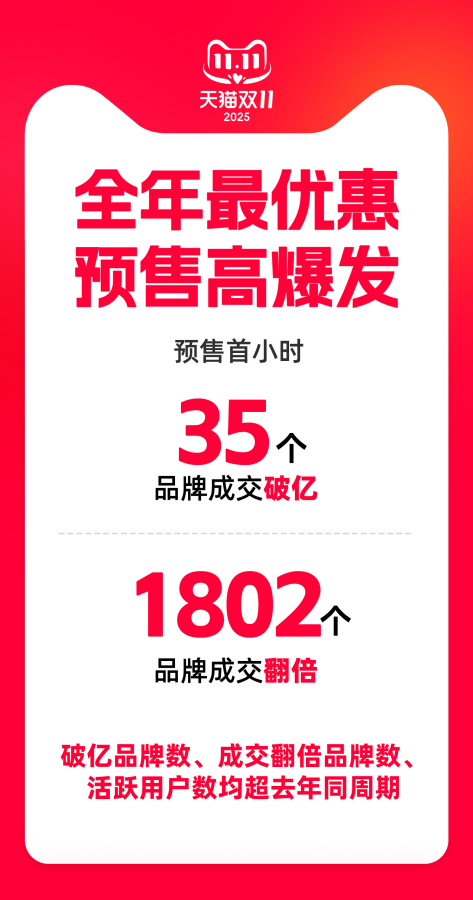
Core Insights - The 2025 Tmall "Double 11" pre-sale event commenced on October 15, with 35 brands achieving over 100 million yuan in sales within the first hour, surpassing last year's performance [1][3] - This year, platforms are focusing on simplifying discount rules and providing direct subsidies to consumers, rather than emphasizing absolute low prices, to enhance shopping experiences and accelerate purchase decisions [1][8] Sales Performance - In the first hour of the pre-sale, 1,802 brands saw sales double year-on-year, with the number of brands exceeding 100 million yuan and active user numbers also surpassing last year [3] - Notable brands that entered the "billion yuan club" include Fila, Proya, SK-II, and Nike [3] - The beauty category showed rapid growth, with several brands breaking the 100 million yuan mark within minutes of the pre-sale start [5] Live Streaming and Consumer Engagement - The number of users placing deposits through Taobao Live saw double-digit growth, with the number of live streaming rooms exceeding last year's figures [6] - Key live streaming hosts like Li Jiaqi experienced over 45% growth in visitor numbers during the first hour [6] Category Performance - Categories such as beauty, maternal and infant products, fashion, and food performed exceptionally well, with some categories seeing growth rates close to 80% [6] - The first day of Taobao Flash Sales recorded over 200% growth in night snack orders across 270 cities, with supermarket and convenience store orders increasing by 670% [6] AI Integration in E-commerce - This year's "Double 11" event features a significant integration of AI technology to enhance operational efficiency and user experience across platforms [8][9] - Platforms are offering free access to AI tools for merchants, covering various aspects of the e-commerce process, including content generation and customer service [9]




破亿!
Zhong Guo Ji Jin Bao· 2025-10-16 07:28
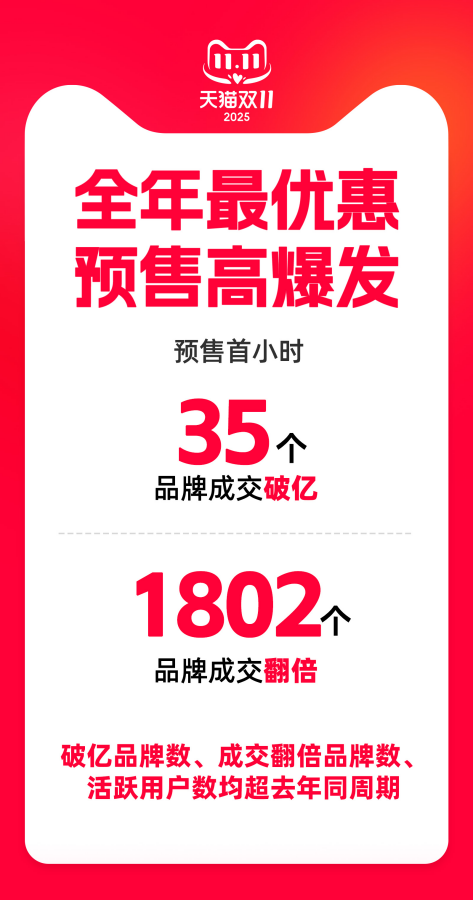
Core Insights - The 2025 Tmall "Double 11" pre-sale event commenced on October 15, with 35 brands achieving over 100 million yuan in sales within the first hour, surpassing last year's performance [1][2] - The focus of this year's promotions shifted from "absolute low prices" to simplifying discount rules and directly subsidizing consumers, enhancing shopping experiences and accelerating purchase decisions [1][6] Sales Performance - In the first hour of the pre-sale, 1,802 brands saw their sales double year-on-year, with the number of brands exceeding 100 million yuan also increasing compared to last year [2] - Notable brands that entered the "billion yuan club" include Fila, Proya, SK-II, Adidas, and Nike [2] - The beauty category experienced rapid growth, with several brands breaking the 100 million yuan mark within minutes of the pre-sale start [4] Live Streaming and Consumer Engagement - The number of users placing deposits through Taobao Live saw double-digit growth, with the number of live streaming rooms exceeding last year's figures [5] - Key categories such as beauty, maternity, fashion, and food showed significant performance, with some categories experiencing growth of nearly 80% [5] Collaboration and New Variables - Tmall and Taobao Flash Sale collaborated closely, with 37,000 brands and 400,000 brand stores participating, covering various sectors including electronics and beauty [5] - Brands utilizing the flash sale service reported a year-on-year sales increase of over 290% on the first day of pre-sale [5] AI Integration in E-commerce - This year's "Double 11" event saw platforms leveraging AI technology to enhance services for merchants and consumers, improving operational efficiency and user experience [6][7] - AI tools were made freely available to merchants, covering the entire store operation process, including graphic design, product launches, live streaming, and customer service [7] - The industry is transitioning from a "traffic-driven" model to an "intelligent-driven" model, with significant improvements in content generation, smart recommendations, and logistics management due to AI advancements [7]

年入20亿,传承289年的泉州茶业家族终圆梦,通过港交所上市聆讯
Sou Hu Cai Jing· 2025-10-15 13:56
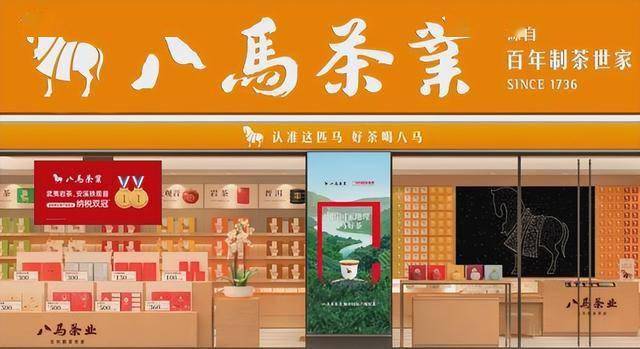
Core Insights - Eight Horse Tea has finally moved closer to its IPO after a decade of attempts, with the Hong Kong Stock Exchange announcing its hearing on October 12 [1] - The company, founded by the Wang family, has transformed into a modern enterprise with annual revenues exceeding 2 billion yuan, focusing on popular tea varieties like Tieguanyin and black tea [1] Group 1: Business Model and Performance - As of June 2025, Eight Horse Tea operates 3,585 stores nationwide, with 3,341 being franchise stores, accounting for 93% of the total [4] - Franchisees contributed 1.09 billion yuan in sales in 2024, making up half of the total revenue, while direct stores' sales dropped to 354 million yuan, representing only 16.5% [4] - The franchise model has enabled rapid market penetration, particularly in lower-tier regions, leveraging local resources to reduce expansion costs [6] Group 2: Challenges and Risks - The extensive franchise model has led to management challenges, including quality control issues, as evidenced by complaints and lawsuits related to product expiration due to improper storage [8] - The Wang family's intricate "billion-dollar in-law network" consolidates 55.9% of voting rights, raising concerns about potential conflicts of interest in decision-making [8][10] Group 3: Brand Strategy and Digitalization - Eight Horse Tea is attempting brand rejuvenation with new product lines targeting younger consumers, such as "Xinjihao" for high-end Pu'er tea and "Wanshanhong" for cold brew fruit tea [12][14] - The company's online sales have increased from 567 million yuan in 2022 to 838 million yuan, accounting for nearly 40% of total sales, indicating a growing trend among younger consumers to purchase tea online [14] - Post-IPO, Eight Horse plans to expand production facilities, open more direct stores, and enhance digital capabilities to address quality control issues [16] Group 4: Future Outlook - With an annual profit of approximately 224 million yuan, Eight Horse Tea is poised for its IPO, but it must balance franchise and direct store operations, maintain quality control, and engage younger consumers effectively to ensure long-term success [17]
中年男人的“爱马仕”,三个字
虎嗅APP· 2025-10-13 14:14
Core Viewpoint - The article discusses the booming marathon industry in China, highlighting the increasing participation and the evolving nature of marathon events, which have transformed into a complex ecosystem involving significant financial investment and social dynamics [3][4][6]. Industry Growth - The number of marathon events in China has surged, with 749 events planned for 2024, attracting a total of 704.86 million participants, averaging about 9,400 participants per event. This is a dramatic increase from 1828 events in 2019 and 134 in 2015, marking a growth of over 12 times in just five years [8][12]. - The participation numbers have also escalated from 1.5 million in 2015 to 7.12 million in 2024, indicating a growing interest in long-distance running [8]. Registration and Participation - Most popular marathons now require a pre-registration and lottery system, with extremely low acceptance rates. For instance, the Shanghai Marathon had a registration of 356,589 with a 7.2% chance of winning a spot, which can drop to around 3% when considering all factors [12][17]. - There are alternative ways to secure a spot, such as purchasing charity entries, which can cost significantly more than regular registration fees. For example, the 2024 Beijing Marathon offered charity spots for 2,000 RMB, while the 2025 Shanghai Marathon's charity spots were priced at 5,000 RMB each [17][18]. Equipment and Training - The marathon industry has led to a surge in demand for specialized running gear, with brands like Li Ning and Hoka becoming popular among participants. The article notes that the average marathon runner is typically aged between 30 to 39, a demographic that holds a significant portion of China's wealth [23][27]. - Training services have also emerged, with personal trainers charging between 400 to 800 RMB per hour, and specialized pacing services (referred to as "private hares") costing anywhere from 1,000 to 10,000 RMB depending on the desired performance outcome [29][30]. Social Dynamics - The marathon has evolved into a form of social currency, with participation and associated costs reflecting one's social status. The article suggests that marathons have become a new luxury experience for middle-class individuals, akin to owning high-end brands [20][21]. - The emotional and psychological aspects of running are emphasized, with many participants viewing marathons as a means to regain a sense of control and accomplishment in their lives, especially as they face the challenges of middle age [45][49][53].

坦博尔IPO前,突击分红2.9亿元
中国基金报· 2025-10-13 10:18
Core Viewpoint - The article discusses the upcoming IPO of the domestic outdoor brand Tamboor, highlighting its impressive revenue growth and recent financial maneuvers, including a significant pre-IPO dividend distribution of 290 million yuan [2][20]. Revenue Growth - Tamboor has demonstrated remarkable revenue growth, increasing from 732 million yuan in 2022 to 1.302 billion yuan in 2024, representing a compound annual growth rate of over 33%. In the first half of 2025, revenue reached 658 million yuan, marking an 85% year-on-year increase [5][12]. - The Chinese professional outdoor apparel market is rapidly expanding, with market size projected to grow from 688 billion yuan in 2019 to 1.319 trillion yuan in 2024, and expected to exceed 2.87 trillion yuan by 2029 [7]. Profitability Challenges - Despite strong revenue growth, Tamboor's net profit has shown significant volatility. Net profit was 85.77 million yuan in 2022, peaked at 139.24 million yuan in 2023, but fell to 107.31 million yuan in 2024, a year-on-year decline of 23%. In the first half of 2025, net profit was 35.94 million yuan [9][10]. - The net profit margins have also been under pressure, with net profit margins of 11.7%, 13.6%, 8.2%, and 5.5% for the years 2022, 2023, 2024, and the first half of 2025, respectively [9][10]. Channel Transformation - Tamboor has actively pursued channel transformation, with online channel revenue increasing from 226 million yuan in 2022 to 626 million yuan in 2024, accounting for 48.1% of total revenue by 2024. In the first half of 2025, online revenue surpassed offline for the first time [12][13]. - However, the rapid growth of online channels has led to increased marketing expenses, with sales and distribution expenses reaching 508 million yuan in 2024, accounting for 39% of revenue, an increase of nearly 12 percentage points from 2022 [12]. Inventory Issues - As of June 30, 2025, Tamboor's inventory value surged to 931 million yuan, a 262% increase from the end of 2023, and further rose to 1.103 billion yuan by the end of August 2025. The inventory turnover days increased significantly from 242 days in 2023 to 485 days in the first half of 2025, indicating a slowdown in inventory movement [14][15]. Pre-IPO Dividend Distribution - Prior to its IPO, Tamboor distributed a substantial dividend of 290 million yuan to shareholders, which is over eight times the 35 million yuan distributed in 2022. This distribution resulted in a decrease in the company's net assets from 741.5 million yuan at the end of 2024 to 487.5 million yuan by June 30, 2025 [20]. - The family controlling Tamboor, led by founder Wang Yongping, received a significant portion of this dividend, raising concerns about the company's liquidity and the necessity for IPO fundraising to support future growth initiatives [18][20].

保卫财富 科技赋能新消费 | 泰兰尼斯要做儿童跑鞋中的SUV
Jing Ji Guan Cha Wang· 2025-10-10 07:53
Core Insights - The article discusses the strategic shift of the company 泰兰尼斯 from focusing solely on infant shoes to introducing a new product line, the "稳跑鞋" (Stable Running Shoes), aimed at older children, thereby expanding its market presence and product offerings [2][3]. Product Strategy - The company is positioning the "稳跑鞋" as a versatile shoe suitable for various activities, akin to an SUV in the children's footwear market, rather than specializing in a single sport [3][4]. - The founder, 丁飞, emphasizes the importance of understanding niche consumer needs through direct engagement rather than relying solely on traditional market research [3][4]. Product Development - The "稳跑鞋" features advanced materials, including a half-sole protective carbon plate and high-performance rubber, designed to provide support and safety for children during physical activities [4][5]. - The shoe is priced around 1500 yuan, placing it in the premium segment of the market, which reflects the high production costs associated with its advanced materials and technology [5][6]. Market Positioning - The company does not view established sports brands like Nike and Adidas as direct competitors, but rather aims to deepen its engagement with existing customers as they transition from infant to older children's products [7][8]. - Initial market feedback indicates a positive reception of the "稳跑鞋," with many customers reportedly making multiple purchases within a short period since its launch [7][8]. Customer Engagement - The company has implemented a "晒单机制" (feedback mechanism) to capture customer insights and improve product offerings based on direct consumer feedback [8].

耐克CEO称扭亏为盈初现曙光,但中国市场“跌跌不休”仍是痛点
Xi Niu Cai Jing· 2025-10-10 04:23
Core Insights - Nike is on a mixed recovery path, with CEO Elliott Hill indicating initial progress in the company's turnaround plan, but cautioning that restoring profit growth will take time [2] - In Q1 of FY2026, Nike reported revenue of $11.72 billion, exceeding market expectations, driven by a recovery in the North American market and a rebound in wholesale channels [2] - However, the Greater China market, Nike's second-largest, saw a significant revenue decline of 21% in Q4 of FY2025 and a 13% drop for the entire fiscal year, equating to a loss of approximately 7 billion RMB [2] Market Challenges - Nike faces intense competition in China from local brands like Anta and emerging brands such as On, which are capturing market share with competitive products and pricing [3] - The company is also engaged in aggressive price wars, exemplified by its "more than 50% off" slogan during the recent 618 shopping festival, which, while boosting sales, has negatively impacted profit margins, with the latest fiscal quarter's gross margin shrinking to 42.2% [3] Strategic Initiatives - To address these challenges, Nike has appointed veteran Dong Wei as Chairman and CEO of Greater China and Global CEO of the ACG outdoor brand, aiming to enhance local decision-making and deepen market engagement [3] - The company is advancing its "Win Now" strategy, centered on a return to sports, and is promoting its professional sports image through exclusive sponsorships, such as the Chongli 168 Super Trail Race [3] - The success of Nike's turnaround plan will be tested in the critical Chinese market, where reversing the current trend is essential for overall recovery [3]

新力量NewForce总第4879期
First Shanghai Securities· 2025-10-09 12:05
Market Performance - Bitcoin recorded a strong start in Q4, achieving a historical high of $126,199 with a weekly increase of approximately 10%[6] - The recent surge in the BSC chain's Chinese Meme coins led to a market capitalization exceeding $150 million within three days[6] Meme Coin Trends - The "Binance Life" token, inspired by popular internet memes, launched at approximately $0.001 and peaked above $0.5[6] - The involvement of Binance's founders significantly boosted the market, with CZ's social media engagement driving substantial price increases[6] Regulatory Environment - The U.S. government shutdown delayed the release of key employment data, with ADP reporting a decrease of 32,000 jobs in September, far below the expected increase of 50,000[6] - The SEC has postponed decisions on Bitcoin ETF applications, potentially integrating them into a new "general listing standard" framework[6] ETF Inflows - Bitcoin spot ETFs attracted $3.24 billion in net inflows last week, marking the second-best weekly performance on record[9] - Ethereum ETFs also saw significant inflows, contributing to a total of $1.645 billion over the same period[12] Investment Strategy - The current market is in a healthy technical correction phase, presenting opportunities for investors to reposition[13] - Key support levels for Bitcoin are identified between $120,000-$122,000, and for Ethereum between $4,400-$4,500, viewed as good entry points for accumulation[13]

当老人鞋巨头,卖起有机食品
3 6 Ke· 2025-10-09 01:00
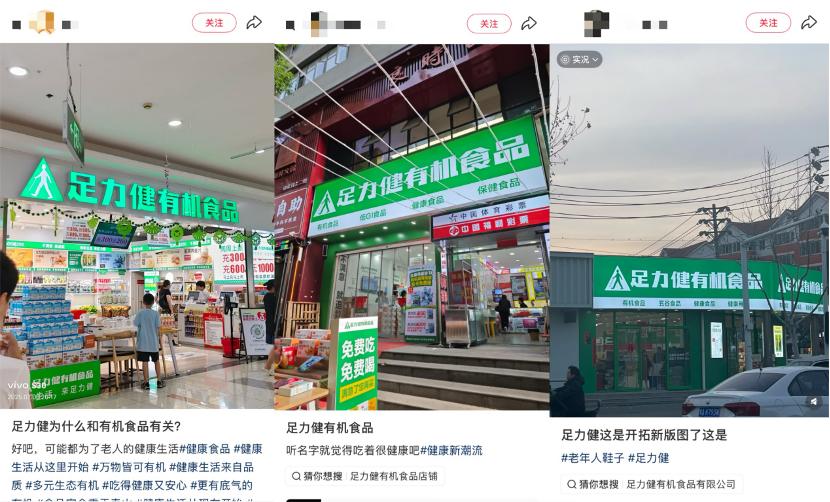
Core Insights - The article discusses the expansion of the elderly consumer market, highlighting how companies are diversifying their product offerings from traditional health supplements to everyday consumables like organic food [1][15] - The case of the brand "足力健" (Zulijian) is examined, showcasing its transition from a specialized elderly shoe brand to entering the organic food sector, raising questions about the motivations behind this shift [1][7] Company Strategy - Zulijian has opened "organic food stores" in various locations, featuring a range of products labeled as "organic" and "healthy," while avoiding the controversial health supplement market [1][3] - The stores employ a mixed strategy for product certification, combining strictly certified organic products with those that only have standard food certifications, potentially confusing consumers about product quality [3][10] - A low-cost membership system is central to Zulijian's business model, where members pay a nominal fee to access significantly discounted prices on products, creating a strong incentive for consumer participation [4][6] Market Response - The initial market response indicates the effectiveness of Zulijian's model, with membership surpassing 80,000 and over 40 stores established in key regions [6][9] - However, the sustainability of this model is questioned due to low profit margins and the challenge of covering operational costs while maintaining competitive pricing [6][9] Financial Challenges - Zulijian's financial struggles are highlighted, with a significant portion of its revenue being used to repay debts, raising concerns about its long-term viability [9][19] - The brand's attempt to pivot into the organic food market is seen as a desperate measure to generate cash flow and address mounting financial pressures [9][19] Industry Trends - The article notes a shift in the elderly consumer market towards daily dietary needs, with organic food emerging as a potential growth area, reflecting broader health concerns among older consumers [15][17] - The organic food market in China has seen rapid growth, with a market size exceeding 100 billion yuan in 2023, positioning it as a significant player in the global organic product consumption landscape [15][17] Competitive Landscape - The competition in the elderly market is intensifying, with various brands now targeting the same demographic, necessitating a deeper exploration of the elderly lifestyle rather than just product offerings [17][19] - Zulijian's strategy of appealing to both elderly and younger consumers reflects a broader trend of brands seeking to capture diverse market segments, though this may dilute their core identity [10][14]