鹏华基金

Search documents
科创100ETF鹏华(588220)V型反弹,科技板块利好不断
Xin Lang Cai Jing· 2026-01-28 07:01
Group 1 - The "14th Five-Year Plan" emphasizes support for strategic emerging industries, with eight departments promoting "AI + manufacturing" and the establishment of a commercial aerospace office, providing strong support for key areas such as AI chips and reusable rockets [1] - The market is experiencing a surge in interest due to breakthroughs in AI large models and expectations for the commercialization of aerospace, leading to a differentiated market performance [1] - A price increase trend is spreading across the storage sector, influenced by supply-demand dynamics and rising raw material costs, with several manufacturers continuing to raise prices [1] Group 2 - By 2026, investment in the Sci-Tech Innovation Board should focus on the theme of technological self-reliance, with specific attention to AI-related infrastructure, hardware, and vertical applications, as well as opportunities in commercial aerospace [1] - The top ten weighted stocks in the Sci-Tech Innovation Board 100 Index as of December 31, 2025, include Huahong Semiconductor, Dongxin Technology, and Yuanjie Technology, collectively accounting for 26.21% of the index [2] - The leading sectors in the Sci-Tech Innovation Board are electronics (37.42%), power equipment (14.02%), and biomedicine (13.79%) [2]
行业主题ETF开年吸金逾2200亿元,已超去年全年流入额三成
Sou Hu Cai Jing· 2026-01-28 05:45
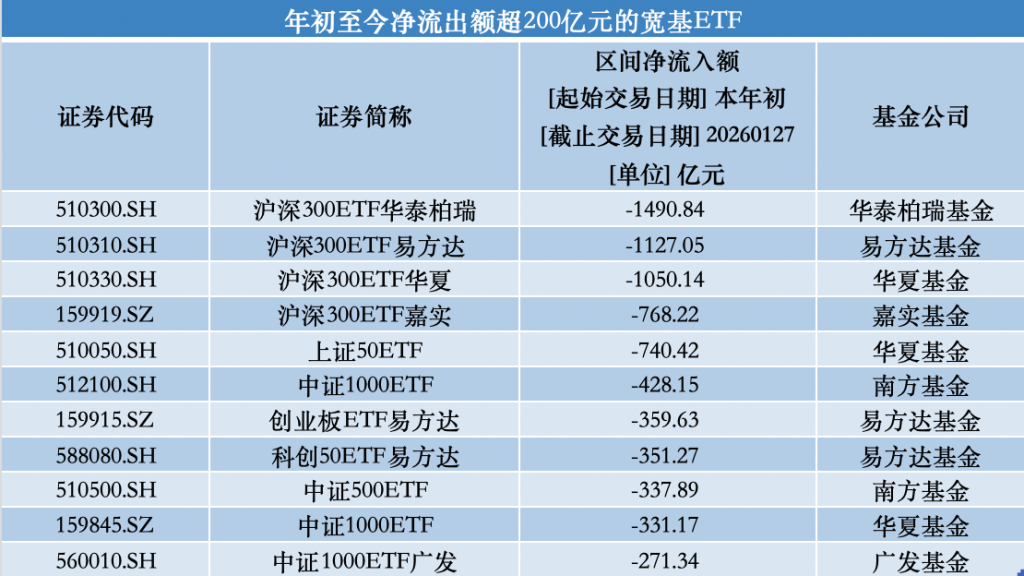
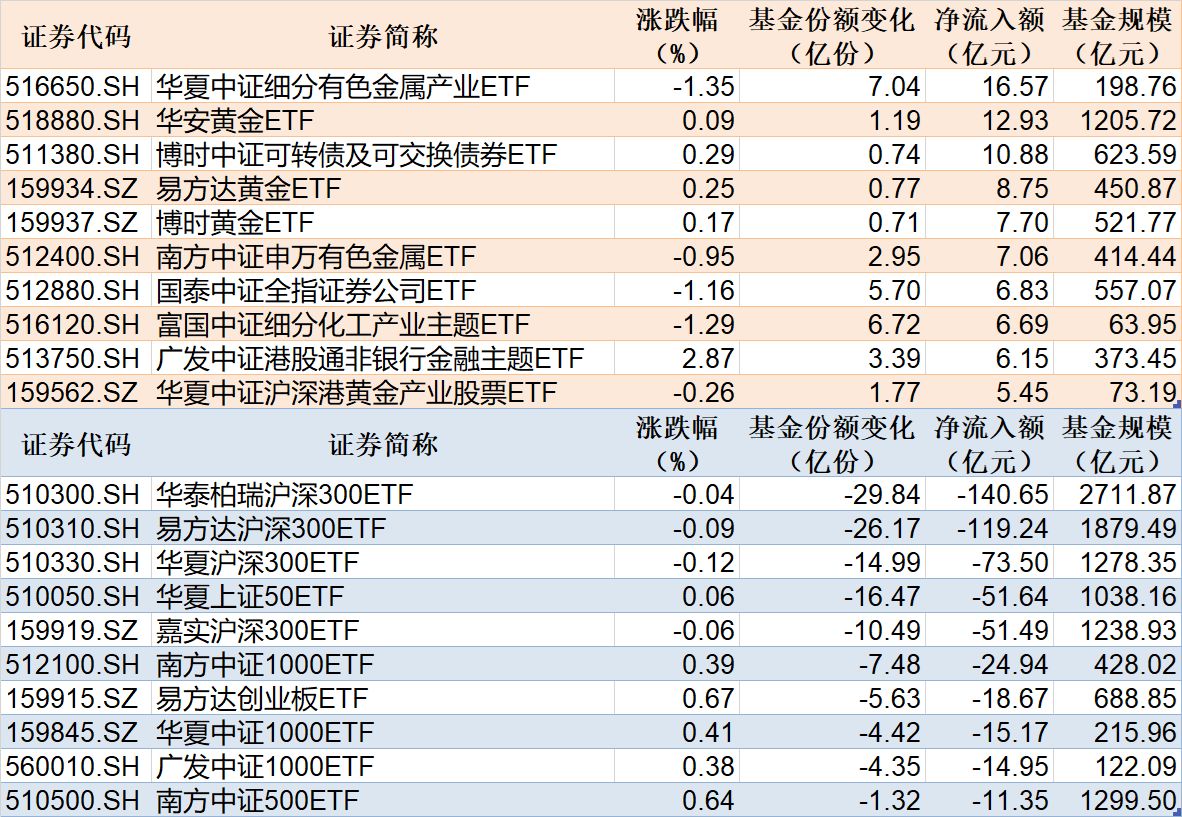
2026年开年以来,A股股票型ETF市场呈现鲜明分化格局。以沪深300ETF为代表的多只核心宽基产品遭遇大幅净流出达7957.56亿元,而有色金 属、电网设备、化工等赛道型行业主题ETF则持续获得资金青睐。 据Wind数据统计,截至1月27日,在年内17个交易日里,全市场771只行业主题ETF(含商品型ETF)累计净流入已达2271.84亿元,接近2025年全 年该类产品净流入总额(7385.40亿元)的三分之一,占比为30.76%。 4只沪深300ETF净流出居前 智通财经记者根据Wind数据统计发现,1月27日,全市场1317只可统计的股票型ETF(含跨境ETF)单日累计净流出为480.25亿元。年初至今,股 票型ETF累计净流出额达5974.45亿元。 从资金的整体流向来看,宽基ETF是"失血"主力。若仅筛选规模指数ETF(含跨境ETF),截至1月27日,其年初至今净流出额已高达7957.56亿 元。 仅1月27日当天,华泰柏瑞沪深300ETF、易方达沪深300ETF的单日净流出额分别为140.65亿元、119.24亿元;华夏沪深300ETF、华夏上证 50ETF、嘉实沪深300ETF的单日净流出额也均 ...

未知机构:鹏华基金陈大烨总观点市场观点近期认为春节前边际-20260128
未知机构· 2026-01-28 02:10
Summary of Conference Call Notes Industry Overview - The discussion primarily revolves around the **AI industry**, **cyclical commodities**, and **commercial aerospace** as key areas of focus leading up to the Chinese New Year [1][2]. Core Insights and Arguments - **AI as a Growth Driver**: By 2026, AI is expected to remain a core driver of global economic growth. The main influencing factors include the direction of U.S. monetary policy and the sustainability of the AI industry. If the Federal Reserve maintains a loose monetary policy to stimulate global demand, combined with the ongoing prosperity of the AI sector, it could lead to a significant revaluation of Chinese assets [1][2]. - **Market Outlook**: The market is anticipated to trend upwards, supported by a potential easing of U.S.-China relations, a shift from external to internal demand, and an influx of foreign capital alongside the appreciation of the Renminbi [1][2]. Investment Strategy (Six Main Rotation Lines) 1. **Inflation Line**: This sector is viewed as the most stable and certain, with positive outlooks for storage, CPUs, semiconductors (high price elasticity, strong sustainability in the first half), non-ferrous metals, chemicals, electronic materials, and petrochemicals [1][2]. 2. **Overseas Computing Power Chain**: Recently affected by fluctuations in U.S. stocks, but long-term prospects remain strong due to new technology elasticity (CPO, power supplies, liquid cooling, PCB) and unexpected entry of Apple [1][2]. 3. **Domestic Computing Power Chain**: Expected to outperform overseas counterparts, benefiting from breakthroughs in advanced processes and self-sufficiency, with recent catalysts intensifying [1][2]. 4. **AI Applications**: This year is likely to see significant marginal changes, transitioning from thematic investments to industrial realization. Key areas of focus include autonomous driving, AI super entry points, AI software, and edge computing, with an emphasis on trading opportunities pending commercial maturity [1][2]. 5. **Real Estate Chain**: There are potential short-term opportunities driven by policy changes [1][2]. 6. **Thematic Line**: As market risk appetite continues to rise, participation in rotations is encouraged [1][2]. Additional Important Information - **Fund Positioning**: The fund is positioned as a technology growth-oriented secondary bond fund, primarily investing in AI directions, with a year-to-date return of 3.11%. The fund is managed by Chen Daye, who has a background in AI and finance, allowing for precise identification of opportunities [1][2]. - **Current Holdings**: The fund's current holdings include semiconductors, domestic computing power, AI applications, overseas computing power, and non-ferrous metals [1][2]. - **Position Management**: The fund is slightly adjusting its positions under a slow bull market, nearing full investment [1][2]. - **Future Adjustments**: Key focus areas for the first quarter include tracking revenue growth from AI-related companies like Google and Microsoft around their earnings reports, to validate commercialization effectiveness. The overall year will hinge on whether the Federal Reserve continues its loose monetary policy [1][2].
石油ETF鹏华(159697)涨近2%,三大因素助推油价走高
Sou Hu Cai Jing· 2026-01-28 02:05
Group 1 - Oil prices increased due to the situation in Iran, adverse weather in the US, and a weakening dollar, with WTI crude oil futures closing at $62.39 per barrel, up 2.9%, and Brent crude oil futures at $67.57 per barrel, up 3.02% [1] - According to the IEA's January 21 report, the global oil demand growth forecast for 2025/2026 was raised to 850,000/930,000 barrels per day, driven by improved macroeconomic and trade outlooks, alongside a decline in oil prices and a weaker dollar [1] - The demand for petrochemical feedstock is recovering, with jet fuel leading the growth in fuel products, while non-OECD countries are expected to contribute to the entire demand increase in 2026 [1] Group 2 - As of December 31, 2025, the top ten weighted stocks in the National Oil and Gas Index (399439) include China National Petroleum, Sinopec, CNOOC, and others, accounting for 67.11% of the total index [2] - The oil ETF Penghua (159697) closely tracks the National Oil and Gas Index, reflecting the price changes of listed companies in the oil and gas sector on the Shanghai and Shenzhen stock exchanges [1][2]



ETF规模速报 | 有色金属ETF基金净流入超16亿元,沪深300ETF华泰柏瑞净流出超140亿元
Xin Lang Cai Jing· 2026-01-28 01:13
Market Overview - The market rebounded yesterday with all three major indices turning positive, driven by strong performance in the chip industry, precious metals, CPO concepts, and space photovoltaic concepts [1] - Conversely, sectors such as coal and batteries experienced significant declines [1] ETF Fund Flows - On January 27, the non-monetary ETF market saw significant inflows, with the following notable changes: - Huaxia CSI Segmented Nonferrous Metals Industry ETF saw an increase of 704 million shares and a net inflow of 1.657 billion yuan - Huaan Gold ETF increased by 119 million shares with a net inflow of 1.293 billion yuan - Bosera CSI Convertible Bonds and Exchangeable Bonds ETF increased by 74 million shares with a net inflow of 1.088 billion yuan [1][2] ETF Performance - The top 20 ETFs by net inflow as of January 27 include: - Southern CSI Shenwan Nonferrous Metals ETF with a net inflow of 14.474 billion yuan - Huaxia CSI Electric Grid Equipment Theme ETF with a net inflow of 12.740 billion yuan - Penghua CSI Segmented Chemical Industry Theme ETF with a net inflow of 11.980 billion yuan [4] Overall Market Data - As of January 27, the total ETF shares in the market reached 32,858.54 billion shares, with a total scale of 56,365.94 billion yuan - The financial sector saw the largest increase in shares, with 26 funds tracking it - The largest increase in thematic shares was in the CSI Segmented Chemical Industry, with 6 funds tracking it - The highest return index was the Sino-Korean Semiconductor, which increased by 3.98% with 1 fund tracking it [4]
10家基金公司跻身“万亿俱乐部”
2 1 Shi Ji Jing Ji Bao Dao· 2026-01-28 00:47
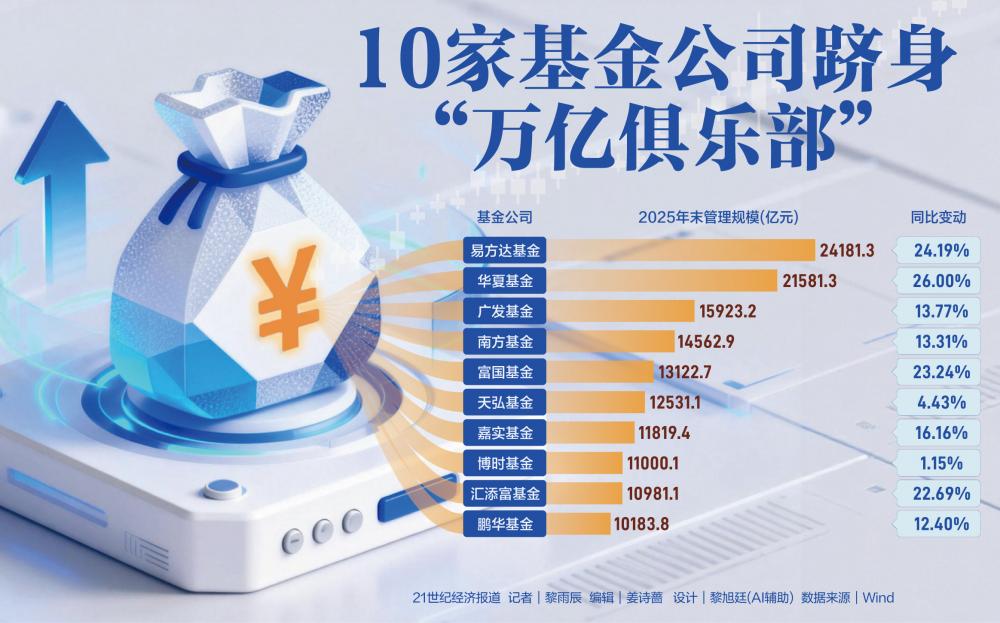
Group 1: Industry Overview - The public fund industry has reached a record management asset scale of 37.64 trillion yuan by the end of 2025, with a quarterly growth exceeding 1.3 trillion yuan [1] - All top 10 public fund managers have entered the "trillion club," indicating a significant shift in the competitive landscape within the industry [1][3] - The dominance of fixed-income funds is changing as the market shifts back to equity styles, with research capabilities and product layout becoming key determinants of scale [1] Group 2: Fund Manager Rankings - The top two fund managers, E Fund and Huaxia Fund, have surpassed 2 trillion yuan in scale, with E Fund at 2.42 trillion yuan and Huaxia Fund at 2.16 trillion yuan, showing quarterly growth rates of 1.16% and 0.54% respectively [3] - The rankings for the top 10 fund managers remained consistent from the third quarter to the end of the year, with notable growth from Guangfa Fund and Southern Fund [3][4] - The number of public funds exceeding 1 trillion yuan has increased from 8 to 10, with Huitianfu and Penghua Fund entering the "trillion club" for the first time [4] Group 3: Non-Monetary Scale Growth - Over 60% of public funds achieved growth in non-monetary scale by the end of 2025, with 100 out of 164 fund companies reporting increases [6] - E Fund's non-monetary scale grew from 1.34 trillion yuan to 1.66 trillion yuan, while Huaxia Fund's increased from 1.16 trillion yuan to 1.44 trillion yuan [6] - The growth in non-monetary scale is closely linked to the performance of actively managed equity and "fixed income plus" products [8] Group 4: Active Management and Product Performance - Four institutions reported over 100 billion yuan in growth for their actively managed products, with significant contributions from "fixed income plus" offerings [8][10] - Jingshun Longcheng Fund led the growth in non-monetary scale with a 43.93% increase, driven by its "fixed income plus" products [8][10] - The shift in product strategy reflects a broader industry trend towards sustainable performance rather than just launching new products [11]
公募基金2025年四季报全景解析
Huafu Securities· 2026-01-27 14:25
- The report does not contain any specific quantitative models or factors for analysis[1][2][3]
2025年公募最大意外背后的生存逻辑
Sou Hu Cai Jing· 2026-01-27 14:08
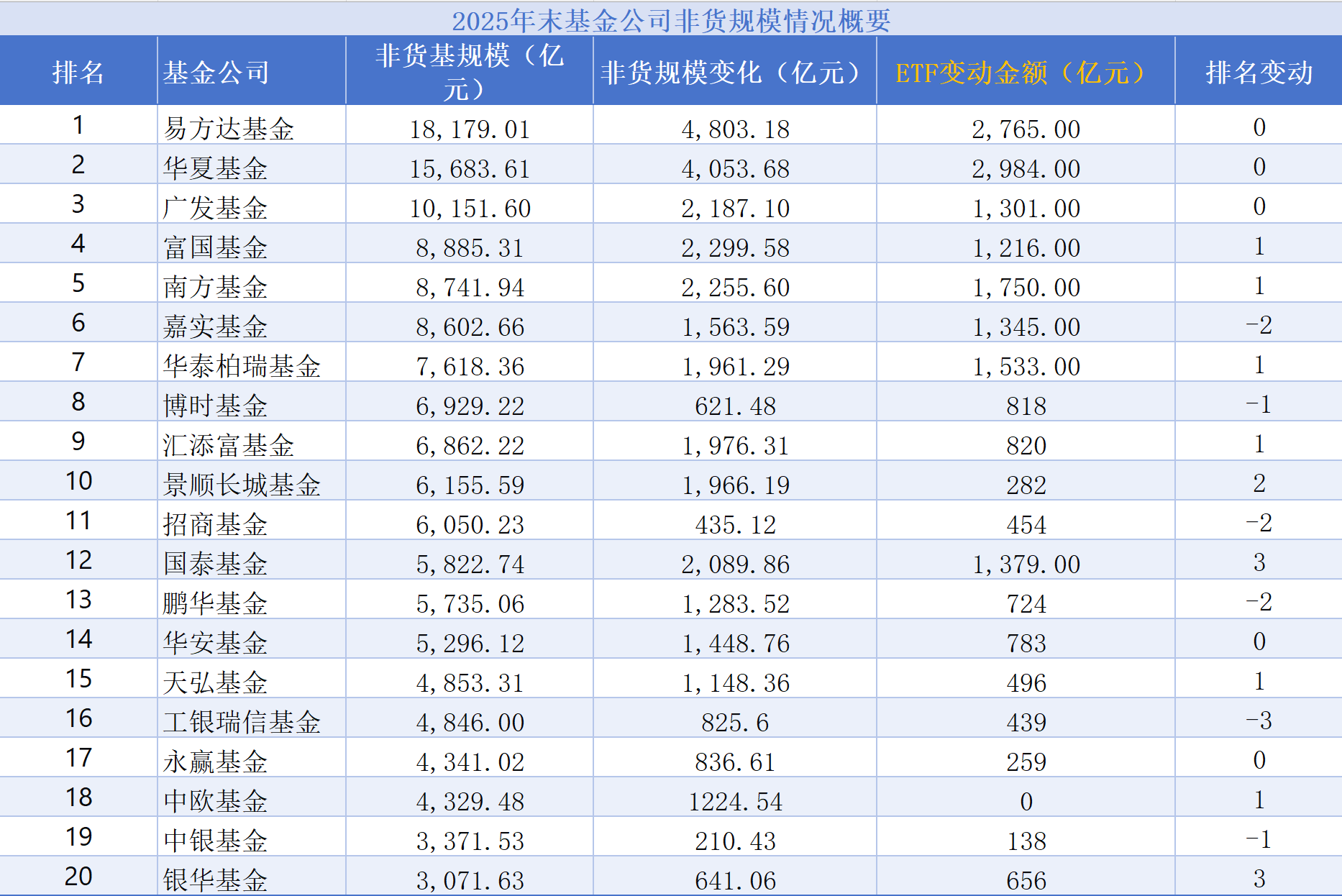
Core Insights - The public fund industry in 2025 experienced significant growth, with total management scale reaching 37.64 trillion yuan, a 16.13% increase from the end of Q4 2024 [1] - The top ten fund managers accounted for 40.48% of the total market scale, indicating a pronounced Matthew effect in the industry [1][2] - Equity funds, particularly ETFs, were the main growth drivers, although active equity funds faced net redemptions despite improved performance [1] Group 1: Fund Management Scale - By the end of 2025, the top ten fund managers had a combined management scale of 15.24 trillion yuan, with 14 companies each adding over 100 billion yuan in non-monetary scale [2][3] - The "ten trillion club" expanded to ten companies, with E Fund leading at 2.42 trillion yuan and Huaxia Fund at 2.16 trillion yuan [4] - E Fund and Huaxia Fund established a "dual leader" position in non-monetary scale, with 1.82 trillion yuan and 1.57 trillion yuan respectively [5] Group 2: ETF Growth and Market Dynamics - ETFs emerged as the brightest growth engine in the public fund industry, with total stock-type ETF scale nearing 3.8 trillion yuan, marking a historical high [6] - The market saw a significant structural change, with some ETFs having over 80% of their holdings concentrated among single institutions, raising concerns about stability [7][10] - A notable outflow of 407.12 billion yuan from stock-type ETFs occurred in January 2026, highlighting the risks associated with concentrated holdings [8][9] Group 3: Competitive Landscape - E Fund and Huaxia Fund are leading players across various sectors, maintaining their positions through strong growth in non-monetary scale [12][13] - Zhongou Fund achieved remarkable growth without ETFs, increasing its non-monetary scale by over 120 billion yuan, showcasing a unique strategy [15][17] - Other notable competitors include GF Fund, which excelled in the FOF sector, and Yongying Fund and Invesco Great Wall, which emerged as dark horses in 2025 [19][20] Group 4: Future Challenges and Industry Trends - The public fund industry is shifting from pure scale expansion to structural optimization and quality enhancement, emphasizing the need for active management capabilities [21][26] - The challenge for leading firms is to maintain flexibility and innovation while managing large scales, avoiding the pitfalls of becoming too rigid [22] - For niche players like Zhongou Fund, the focus will be on balancing specialization with diversification to sustain competitive advantages [23]
股票ETF成交活跃 行业主题产品“吸金”显著
2 1 Shi Ji Jing Ji Bao Dao· 2026-01-27 13:18
Core Viewpoint - The A-share market is experiencing a cooling trend, leading to a significant shift in ETF investments from broad-based ETFs to sector-specific ETFs, with substantial net outflows from major broad-based ETFs and inflows into thematic ETFs [1][2][3] Summary by Sections ETF Market Dynamics - As of January 23, 2026, the total net outflow from the CSI 300 ETF and the CSI 1000 ETF reached 336.9 billion and 78 billion respectively since the beginning of the year, while thematic ETFs, particularly in resources and technology, attracted a total of 158.5 billion in net inflows [1][4] - The week of January 12-16 saw a net outflow of 141.6 billion from stock ETFs, which increased to 333.1 billion in the following week, marking a historically significant outflow [1][2] Performance of Broad-based vs. Thematic ETFs - From January 19-23, the CSI 300 ETF experienced a net outflow of 237.3 billion, while the CSI 1000 ETF and the SSE 50 ETF saw outflows of 71.7 billion and 36.1 billion respectively [2] - The net outflows for the CSI 300 ETF, CSI 1000 ETF, and SSE 50 ETF from January 5-23 were approximately 336.9 billion, 78 billion, and 56.2 billion respectively [2] Institutional Investor Behavior - Institutional investors hold a significant portion of ETFs, with over 1.5 trillion in ETF holdings reported as of the end of Q4 2025, primarily in the CSI 300 ETF [3] - Despite the outflows, the CSI 300 ETF remains a major holding for institutional investors, with an estimated 1 trillion still held in ETFs by these investors [3] Sector-specific ETF Inflows - Thematic ETFs, particularly in sectors like non-ferrous metals and chemicals, have seen strong inflows, with 50 ETFs collectively attracting 158.5 billion from January 5-23 [4][5] - Notably, three ETFs exceeded 10 billion in net inflows, including the Southern Non-ferrous Metals ETF (12.6 billion), Huaxia Power Grid Equipment ETF (11.9 billion), and Penghua Chemical ETF (10.3 billion) [5] Market Outlook - Analysts suggest that the shift in ETF investments indicates a structural rebalancing rather than a complete exit from the market, which may lead to deeper market trends and structural opportunities [7][8] - The current market dynamics suggest a transition from valuation recovery to a phase driven by fundamentals, with a focus on sectors with clear industry trends and performance support [8]
南方基金固收类夺冠,汇添富债基翻车了!
Xin Lang Cai Jing· 2026-01-27 12:30
Core Insights - The performance of fixed-income funds in 2025 significantly declined compared to 2024, with an average return of 2.15% across 3,988 funds, down from 4% in 2024 [2][35] - The total profit from fixed-income funds in 2025 was 372.31 billion yuan, a decrease of 264.15 billion yuan from 636.47 billion yuan in 2024 [2][46] - Despite poor overall performance, the management scale of fixed-income funds increased to 26.12 trillion yuan by the end of 2025, up nearly 2 trillion yuan from the end of 2024 [2][57] Fund Performance - The top-performing fund was Southern Changyuan Convertible Bond A, achieving a return of 48.77%, while the worst performer was Huatai Fuheng Pure Bond A, with a return of -7.7%, resulting in a performance gap of 56.47% [2][39] - Among 3,648 bond funds, the average return was 2.23%, with 3,311 funds generating positive returns and 337 funds reporting losses [5][37] - Convertible bond funds performed exceptionally well, with an average return of 23.34%, while index bond funds lagged with an average return of 0.82% [5][37] Management Scale Changes - By the end of 2025, the management scale of fixed-income funds increased by 1.96 trillion yuan, representing an 8.11% growth [25][57] - 33 fund companies saw their bond fund management scale grow by over 10 billion yuan, while 51 companies experienced similar growth in money market funds [36][61] - However, some companies, such as Bosera Fund, saw significant reductions in their bond fund management scale, with a decrease of 457.91 billion yuan [31][62] Profit Distribution - In 2025, 32 fund companies reported net profits exceeding 3 billion yuan from fixed-income products, with 12 companies surpassing 10 billion yuan [2][51] - The top profit-generating fund was Tianhong Yuerbao, with a profit of 9.256 billion yuan [48][49] - Conversely, 442 fixed-income funds reported negative profits, with 21 funds losing over 1 billion yuan [50][51] Company-Specific Insights - E Fund led the profit rankings among fund companies with a total profit of 19.974 billion yuan from fixed-income products [52][51] - Six companies, including Xinghe Fund and Huachen Future Fund, reported negative profits, primarily from their bond funds [52][53] - The performance of fund managers also varied, with some experiencing significant underperformance compared to benchmarks [43][45]