云铝股份

Search documents
ETF盘中资讯|暴涨4%,有色ETF华宝(159876)续创新高,资金加速抢筹!金价首次突破5000美元关键心理整数关口!
Sou Hu Cai Jing· 2026-01-26 02:08
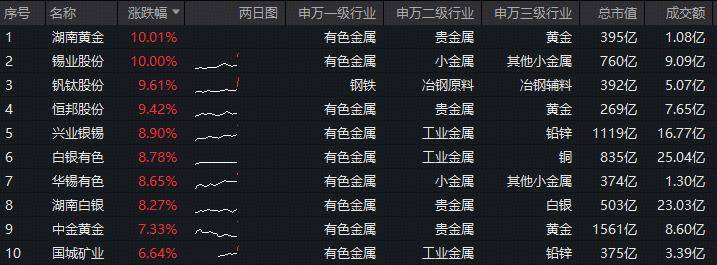
Group 1 - The core viewpoint of the news is that gold prices have surged, breaking the $5000 per ounce psychological barrier, with expectations of further increases due to various economic factors [1] - Historical patterns suggest that gold prices may rise between 10% and 35% by 2026, driven by anticipated Federal Reserve interest rate cuts, instability in the US dollar, midterm elections, and geopolitical uncertainties [1] - Long-term bullish factors for gold include rising US fiscal risks, strong global central bank demand for gold, continuation of the Fed's easing cycle, and increased geopolitical risks due to disruptions in international order [1] Group 2 - On January 26, the non-ferrous metals sector led the market, with significant gains in stocks such as Hunan Gold and Xiyang Co., which hit the daily limit, and others like Vanadium Titanium and Hengbang, which rose over 9% [2] - The non-ferrous ETF Huabao (159876) saw a substantial increase, with a 4.1% jump in intraday trading, reaching a historical high, and attracting significant capital inflow, totaling 569 million yuan over the past 10 days [2][5] - As of January 23, the Huabao non-ferrous ETF reached a record size of 1.892 billion yuan, making it the largest ETF tracking the non-ferrous metal index in the market [5] Group 3 - The Huabao non-ferrous ETF and its linked funds cover a wide range of sectors including copper, aluminum, gold, rare earths, and lithium, allowing investors to capture various market cycles effectively [8] - The ETF's comprehensive index tracking positions it well to benefit from different economic phases, including safe-haven assets, strategic metals, and industrial metals [8]

有色金属:关注供给扰动带来的板块机会
GUOTAI HAITONG SECURITIES· 2026-01-26 01:46
Investment Rating - The report assigns an "Overweight" rating for the industry [5] Core Insights - The report emphasizes the importance of macroeconomic factors such as monetary policy, macro expectations, geopolitical dynamics, and supply disruptions in influencing metal prices [2] - Precious metals are expected to continue their upward trend due to geopolitical events in North America, concerns over the US dollar and treasury bonds, and increased central bank gold purchases [6] - Copper prices are anticipated to remain strong due to supply disruptions in Chile and expectations of a potential interest rate cut by the Federal Reserve [6] - Aluminum prices are expected to maintain a strong performance supported by macroeconomic factors and increased production capacity [6] - Energy metals show strong demand with continuous inventory depletion, particularly lithium, despite seasonal production declines [6] Summary by Sections Supply Disruptions and Opportunities - Gold prices have risen significantly, with SHFE gold increasing by 8.00% to 1,115.64 CNY per gram and COMEX gold by 8.44% to 4,983.10 USD per ounce [9] - Silver prices have also surged, with SHFE silver up 10.62% to 24,965 CNY per kilogram and COMEX silver up 16.63% to 103.26 USD per ounce [10] Industry and Stock Performance - The SW non-ferrous metals index increased by 6.03% last week, outperforming major indices [16] - The report highlights that industrial metal prices have shown mixed performance, with copper and aluminum prices increasing while lead and zinc prices have decreased [25] Metal Prices and Inventory - Copper prices rose to 101,340 CNY per ton on SHFE, reflecting a 0.57% increase, while LME copper increased by 2.44% to 13,115 USD per ton [12] - Aluminum prices on SHFE increased by 1.53% to 24,290 CNY per ton, supported by improved production and demand [11] Macro Data Tracking - The report tracks macroeconomic indicators, including CPI and PPI, which are crucial for understanding the broader economic environment affecting metal prices [29][44] Precious Metals - The report notes that low inventory levels and expectations of liquidity easing are driving precious metal prices higher [50] - Central bank gold purchases and ETF holdings are expected to support gold prices in 2026 [6] Copper Market - Supply disruptions in Chile, including strikes at major copper mines, are expected to support copper prices [12] - The report anticipates that copper prices may experience fluctuations based on macroeconomic developments, particularly related to interest rates [65] Energy Metals - Lithium inventory continues to decline, indicating strong demand, while the market is cautious about production disruptions from key mines [13] - The cobalt sector is facing high prices due to tight raw material supply, with companies extending their operations into downstream sectors [13]
光大证券晨会速递-20260126
EBSCN· 2026-01-26 01:29
2026 年 1 月 26 日 晨会速递 分析师点评 市场数据 总量研究 【策略】A 股牛市当前阶段形态特征六问六答——解密牛市系列之六 本轮牛市或已突破第二震荡段,进入上涨段 3。参考历史结构性牛市规律,本轮牛市 上涨段 3 初期或在 4200-4300 点形成阶段性高点,随后回调企稳于震荡段 2 上沿, 并重新开启新一轮上涨。后续需重点跟踪两点:一是 4200-4300 点区间压力释放与 资金承接情况;二是震荡段 2 上沿的支撑有效性及核心板块企稳信号。 【策略】保持稳健,持股过节——策略周专题(2026 年 1 月第 3 期) 保持稳健,持股过节。参考之前的市场行情,我们认为春节前市场将会保持震荡,难 以保持稳定的趋势,这主要与春节之前投资者交易热度有所下行,以及微观流动性短 期趋紧有关。从历史情况来看,春节前 20 个交易日,主要指数上涨概率不足 50%。 预计春节之后市场将会迎来新一轮上行动力,春节后 20 个交易日主要指数上行概率 与平均涨幅均较高。因此建议投资者近期以稳为主,但仍应持股过节。 【债券】如何看待近期 DR001 的上行?——2026 年 1 月 23 日利率债观察 如果一段时间内 ...
有色金属行业周报:银价率先突破,看好金属牛市延续
GOLDEN SUN SECURITIES· 2026-01-26 01:24
Investment Rating - The report maintains a "Buy" rating for the non-ferrous metals sector, indicating a positive outlook for investment opportunities in this industry [6]. Core Insights - The report highlights a bullish trend in precious metals, particularly silver, which has recently surpassed $100 per ounce, suggesting a continuation of the metal bull market [2]. - The report notes that macroeconomic factors, including geopolitical tensions and supply chain disruptions, are influencing metal prices, with a general upward trend observed across various metals [3][4][5][9]. Summary by Sections Precious Metals - Silver prices have surged, breaking the $100 mark, while gold is approaching $5000 per ounce, driven by increased market risk aversion due to geopolitical tensions [2]. - Key companies to watch include Xinyi Silver, Shengda Resources, and Zijin Mining [2]. Industrial Metals - Copper inventories have increased, with global copper stocks rising by 69,000 tons, indicating a potential supply-demand imbalance [3]. - The report mentions ongoing labor strikes affecting copper production in Chile, which could exacerbate market tensions [3]. - Suggested companies for investment include Zijin Mining and Western Mining [3]. Aluminum - The aluminum market is experiencing short-term price fluctuations due to macroeconomic policies and supply chain issues, with production capacity remaining stable [4]. - Companies to consider include China Hongqiao and Nanshan Aluminum [4]. Nickel - Nickel prices have risen by 4.7% to 148,010 yuan per ton, influenced by supply disruptions in Indonesia and macroeconomic liquidity [5]. - Recommended companies include Huayou Cobalt and Ganfeng Lithium [5][8]. Tin - Tin prices are supported by macroeconomic factors and supply chain bottlenecks, with demand from the electronics sector showing signs of recovery [8]. - Key companies include Hunan Tin and Yunnan Tin [8]. Lithium - Lithium prices continue to rise, with battery-grade lithium carbonate reaching 177,000 yuan per ton, driven by pre-holiday stockpiling and supply disruptions [9]. - Companies to watch include Ganfeng Lithium and Tianqi Lithium [9]. Cobalt - Cobalt prices have decreased by 3.7% to 437,000 yuan per ton, with supply disruptions easing but demand from downstream sectors weakening [10]. - Suggested companies include Huayou Cobalt and Tianqi Lithium [10].
机构观点“多空对决”,会影响有色金属后续的投资逻辑吗?
Sou Hu Cai Jing· 2026-01-26 01:00
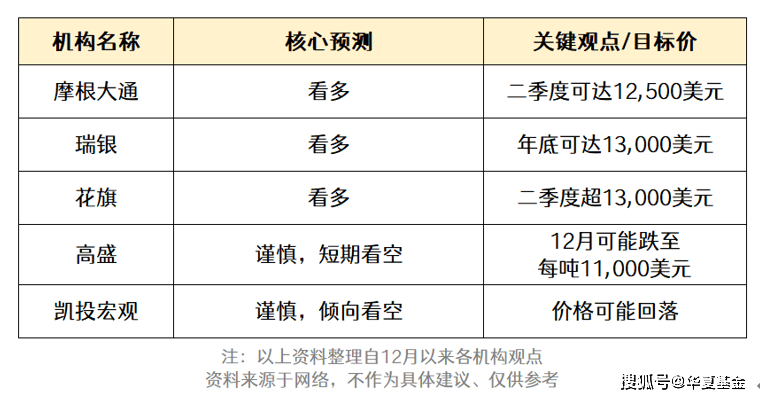
Core Viewpoint - The recent divergence in views among international investment banks regarding copper prices indicates a potential volatility in the non-ferrous metal sector, with some institutions optimistic while others express caution [1][2]. Group 1: Institutional Predictions - Morgan Stanley predicts a bullish outlook for copper, forecasting a price of $12,500 per ton by Q2 [2] - UBS shares a similar optimistic view, projecting a year-end price of $13,000 [2] - Citigroup also maintains a positive stance, expecting prices to exceed $13,000 in Q2 [2] - Conversely, Goldman Sachs advises caution, suggesting a potential drop to $11,000 per ton in December [2] - Capital Economics leans towards a bearish outlook, indicating a possible price decline [2] Group 2: Price Trends and Market Dynamics - Copper prices surged from $11,000 in early December to over $13,300, surpassing some optimistic forecasts [3] - Goldman Sachs warns that the current high prices have attracted speculative investments, which may suppress short-term actual consumption [5] - The speculative enthusiasm for copper is linked to concerns over potential tariffs following the U.S. Section 232 investigation, which led to significant imports of refined copper [6] Group 3: Long-term Demand Drivers - The fundamental narrative supporting copper prices revolves around its role as a "green metal" and "AI metal," driven by global infrastructure upgrades, electric vehicle adoption, and AI data center construction [7] - The ongoing demand for copper is expected to remain strong, as long as the underlying growth story persists [7] - The non-ferrous metal ETF funds track A-share listed companies rather than futures prices, meaning the performance of mining and refining companies will directly benefit from rising copper prices [7][8] Group 4: Investment Considerations - The non-ferrous metal ETF fund tracks a diversified index, with copper comprising 33% of the index, followed by aluminum and gold, indicating a balanced exposure to various metals [8] - Given the current global economic landscape and rising risk aversion, the non-ferrous metal ETF fund is expected to maintain a strong investment rationale throughout the year [8]
有色钢铁行业周观点(2026年第4周):金银比突破50,贵金属有望带领工业金属加速上涨
Orient Securities· 2026-01-26 00:45
Investment Rating - The report maintains a "Positive" outlook on the non-ferrous metals industry [5] Core Viewpoints - The gold-silver ratio has broken through 50, indicating that precious metals are likely to lead industrial metals in accelerating price increases. Recent significant price increases in silver reflect a broader trend of rising physical metal prices as a response to the weakening trust in fiat currency systems [7][12] - The long-term debt cycle is entering its late stage, with rising physical metal prices signaling a loss of confidence in existing fiat currency systems. This trend is expected to continue, with precious metals likely to set new historical price records in 2026 [12] - Zinc is viewed as an overlooked foundational material in the context of de-globalization, with favorable supply-demand dynamics suggesting continued price increases. The report highlights the potential for increased demand from re-industrialization efforts in Asia, Africa, and Latin America [13] - The aluminum sector is expected to benefit from geopolitical concerns, with China's electrolytic aluminum industry poised to enjoy valuation premiums due to its supply chain security and competitive advantages [13] Summary by Sections Precious Metals - The report emphasizes the potential for precious metals to lead industrial metals in price increases, driven by a breakdown in the gold-silver ratio and a late-stage long-term debt cycle [7][12] - Specific investment opportunities include companies like Chifeng Jilong Gold Mining (600988) and others in the precious metals sector [7] Zinc Sector - The report identifies zinc as a critical material in the context of re-industrialization, with supply constraints and increasing demand expected to drive prices higher [13] Aluminum Sector - The report highlights the competitive advantages of China's electrolytic aluminum industry, which is expected to benefit from geopolitical tensions and supply chain security [13] Steel Sector - The steel industry is currently facing weak fundamentals as it approaches the seasonal low period before the Spring Festival, with expectations for policy measures to support the industry [14] - Steel production and consumption metrics indicate a slight increase in iron output but a decrease in rebar demand, reflecting a mixed outlook for the sector [19][26] New Energy Metals - The report notes significant increases in lithium and cobalt prices, with production metrics showing substantial year-on-year growth in lithium carbonate output [37][46] - The demand for new energy vehicles remains strong, with production and sales figures indicating continued growth in the sector [41] Industrial Metals - The report discusses the overall upward trend in industrial metal prices, driven by political policy risks and supply reduction expectations [56] - Specific metrics indicate rising copper production and declining refining fees, suggesting a tightening supply environment [57]





有色钢铁行业周观点(2026年第4周):金银比突破50,贵金属有望带领工业金属加速上涨-20260126
Orient Securities· 2026-01-26 00:15
Investment Rating - The report maintains a "Positive" outlook on the non-ferrous metals industry [5] Core Insights - The gold-silver ratio has broken through 50, indicating that precious metals are likely to lead industrial metals in accelerating price increases. Recent significant price increases in silver reflect a broader trend of rising physical metal prices as a response to the weakening trust in fiat currency systems [7][12] - The long-term debt cycle is entering its late stage, with rising physical metal prices signaling a loss of confidence in existing fiat currency systems. This trend is expected to continue into 2026, with precious metals likely to set new historical price records [12] - Zinc is identified as an overlooked material in the context of de-globalization, with favorable supply-demand dynamics suggesting continued price increases. The report highlights the potential for increased demand from re-industrialization efforts in Asia, Africa, and Latin America [13] - The aluminum sector is expected to benefit from geopolitical concerns, with China's electrolytic aluminum industry poised to enjoy valuation premiums due to its supply chain security and competitive advantages [13] Summary by Sections Precious Metals - The report emphasizes the importance of precious metals in preserving wealth amid a declining trust in fiat currencies, recommending active investment in this sector [12] Zinc Sector - The report suggests that zinc, as a fundamental material for de-globalization, will see increased demand driven by infrastructure needs in emerging markets, despite current market skepticism [13] Aluminum Sector - The electrolytic aluminum industry in China is expected to benefit from enhanced supply chain security and competitive advantages, with a positive outlook for profitability and valuation [13] Steel Industry - The steel sector is currently facing weak fundamentals as it approaches the seasonal low around the Spring Festival, with expectations for policy measures to support the industry [14] - Steel production has seen a slight increase, but demand for rebar is weakening, indicating a mixed outlook for the sector [19] New Energy Metals - Lithium and carbonate prices have shown significant increases, with production levels rising sharply, indicating strong demand in the new energy vehicle sector [37][41] - The report notes a substantial increase in the production of lithium carbonate and hydroxide, reflecting the growing demand for electric vehicles [37] Industrial Metals - The report indicates that political risks and supply constraints are contributing to an overall increase in industrial metal prices, with copper production expected to rise despite declining refining fees [56][57]
可能远超预期!全球商品,迎第三轮“超级周期”
Zheng Quan Shi Bao Wang· 2026-01-25 23:40
当国际金价距离5000美元/盎司仅一步之遥,当伦敦银现仅用两个月时间便实现翻倍,当铜铝铅锌锡上 演起"元素周期表"行情,当硫磺价格一年翻倍、碳酸锂迭创新高……这一系列看似独立的市场脉冲正汇 聚成一股时代洪流,宣告着全球大宗商品市场正迈入新一轮的"超级周期"。 "这轮周期的持续强度、持续时间都可能远超我们想象。"近期,多位基金经理向券商中国记者表达了类 似的观点,在全球货币超发、美元信用危机、技术革命创新需求、地缘冲突引发供应链重构等众多因素 共振下,全球大宗商品可能迎来一场远超市场预期的周期浪潮,而嗅觉敏锐的公募基金正闻风而动,将 投资罗盘的指针拨向现代工业的"血液"与"基石"——有色金属与基础化工,不仅定位着这场全球商品盛 宴的历史坐标,更寻找着浪潮之下具体的产业掘金路径。 全球大宗商品迎来第三轮"超级周期" 其四,长达十年的资本开支收缩期后的供给约束。上述基金经理指出,全球有色金属主要品种的资本开 支在2011年见顶后,步入了漫长的收缩期。勘探投入持续低迷,叠加全球矿山品位的自然下降,导致主 要金属品种的产出缺口日益明显。供给端的约束,是本轮周期最具刚性的一环。 "目前我们处于过往60年以来第三轮全球商品 ...

可能远超预期!全球商品,迎第三轮“超级周期”
券商中国· 2026-01-25 23:25
Core Viewpoint - The global commodity market is entering a new "super cycle," driven by factors such as excessive monetary issuance, a credit crisis in the US dollar, technological innovations, and geopolitical conflicts reshaping supply chains [1][2]. Group 1: Factors Driving the Super Cycle - The current super cycle is rooted in global monetary overissuance, particularly since the 2008 financial crisis and accelerated by the COVID-19 pandemic, leading to significant inflation and asset price increases [2]. - Four key factors are contributing to this cycle: the US debt cycle and the restructuring of dollar credit, structural demand driven by AI and green energy transitions, geopolitical changes affecting supply chain security, and supply constraints following a decade of reduced capital expenditure in the mining sector [3][4][5]. Group 2: Domestic Price Trends and Economic Policies - China's Producer Price Index (PPI) is showing signs of recovery, with a 0.2% month-on-month increase in December 2025, indicating a potential turning point for domestic prices [6]. - Three core factors are expected to drive this price recovery: a strong base effect from previous low commodity prices, the impact of "anti-involution" policies aimed at improving industry profitability, and stabilization in the real estate sector after years of decline [7][8]. Group 3: Strategic Asset Allocation - Fund managers are increasingly reallocating towards cyclical assets, particularly in the non-ferrous metals and chemical sectors, as they anticipate a recovery in commodity prices and domestic economic conditions [9][10]. - Notable investments include significant positions in leading mining companies and a strategic focus on industrial metals and small metals, which are expected to benefit from new demand drivers such as AI infrastructure and energy transitions [11][12].
成形起势提质效
Xin Lang Cai Jing· 2026-01-25 21:22
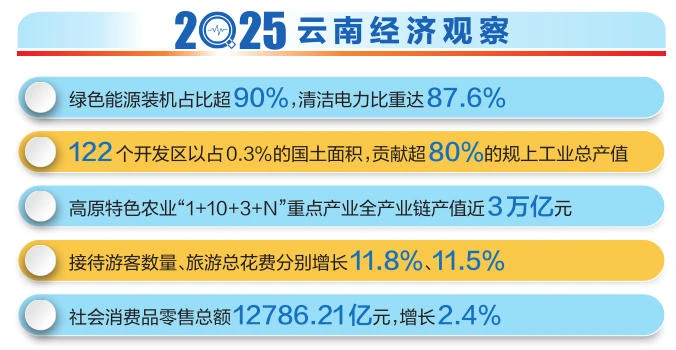
Core Viewpoint - The economic development of Yunnan is projected to achieve a GDP of over 3.27 trillion yuan with a growth rate of 4.1% by 2025, emphasizing structural optimization and quality improvement in development [3]. Investment and Economic Structure - Yunnan's investment strategy has shifted towards precision, focusing on key sectors rather than widespread investment, with over 10,000 major industrial projects initiated and nearly 1 trillion yuan invested [4]. - The proportion of industrial investment in total investment continues to rise, with private investment becoming increasingly active [4]. - The non-ferrous metal mining industry is expected to see a 20.8% increase in investment, with aluminum smelting and processing investments growing by 16.1% and 7.9% respectively [4]. Business Environment and Growth - Yunnan has made significant strides in improving the business environment, resulting in a 1.7% year-on-year increase in the number of operating entities, totaling 6.878 million, with a 3.8% increase in the number of enterprises [5]. - The province has implemented various measures to reduce institutional transaction costs and stimulate internal motivation, enhancing administrative efficiency [5][6]. Economic Pillars and Strategic Layout - Yunnan's economic structure is supported by three main pillars: resource economy, park economy, and port economy, which are crucial for high-quality development [7]. - The province's green energy capacity exceeds 90%, with clean electricity accounting for 87.6%, attracting industries due to its low carbon emissions [7]. - The agricultural sector has developed a comprehensive industry chain with a total output value nearing 3 trillion yuan, focusing on highland specialty products [7]. Tourism and Consumption - Yunnan's tourism sector is experiencing significant growth, with a projected 11.8% increase in tourist numbers and a 11.5% rise in total tourism expenditure by 2025 [9]. - The province's consumption market is also evolving, with a total retail sales of consumer goods reaching 12.786 trillion yuan, reflecting a 2.4% year-on-year growth [10]. - Rural consumption is growing at a rate of 3.1%, outpacing urban growth, indicating a broader release of domestic demand potential [10].